Showing posts with label Lumber Industry. Show all posts

Sunday, August 01, 2021

Rollin B. Hubbard, Pioneer Citizen of Sandusky


Rollin B. Hubbard was a pioneer in the lumber industry in both Ohio and Michigan. He was born in Connecticut in 1817 to John Mills Hubbard, and his wife, the former Mabel Barnard. As a young man, Rollin made his way from Connecticut to Ohio, and he settled in Sandusky. 

In the 1840s, he purchased timber land in what is now Sanilac County, Michigan. He operated saw mills in Michigan. Later he went into business with his cousins Langdon Hubbard and Watson Hubbard. They operated R.B. Hubbard and Company, a large lumber business on the waterfront in Sandusky, Ohio. By 1886, the company had become known as R.B. Hubbard and Son. The 1886 Sanborn Map shows the lumber yard south of Water Street, between Lawrence and Fulton Streets, and the planing mill was located on the north side of Water Street.


R.B. Hubbard once served as president of the Second National Bank, and he served for several years on the Board of Education. Mr. Hubbard was very active in Grace Episcopal Church, where he served as a vestryman. Mr. Hubbard’s first wife was Anne Massey, who died in 1871; he married Dorothea Hoffman in 1881. 

Rollin B. Hubbard died on May 18, 1904, after a lengthy illness. An obituary for R.B. Hubbard, which appeared in the May 19, 1904 issue of the Sandusky Register, read in part, “A man of fine presence and bearing; a gentleman of the old school in all that means in high character and intelligence; wise in counsel, charitable in judgment; closely identified through a long and successful career with the commercial and educational interests of Sandusky, Rollin B. Hubbard has left his impress on this community and it is an impress for good.” You can read much more about the history of the Hubbard family in the book One Thousand Years of Hubbard History, compiled by Edward Warren Day (Harlan Page Hubbard, 1895) available at the Internet Archive.


R.B. Hubbard was buried next to his first wife in the Hubbard family lot at Oakland Cemetery.

Wednesday, December 23, 2020

James D. Lea, Lumber Merchant


James Davis Lea was born on July 21, 1817 in Lycoming County, Pennsylvania. He moved with his family to Ohio when he was a young man. After working for a time as a school teacher and then as a carpenter, he established himself as a lumber merchant. Below is an advertisement from J.D. Lea’s business, from the 1855 Sandusky City Directory.

Through the years, Mr. Lea had several different partners in the lumber business, including Lewis Moss, Frank Sloane, and finally his son in law, Mr. William H. Herbert. In 1897 Mr. Lea retired from the lumber business, and in retirement devoted his time to real estate. The Lea Block, at the southwest corner of Wayne and Market Streets was named for James D. Lea.


His wife was the former Caroline Mackey, and together the Leas had six children, three of whom survived to adulthood. On  January 8, 1901, James D. Lea died at his home on Wayne Street. An article in the Sandusky Star of January 8, 1901 reported that Mr. Lea had been “one of the most prominent and respected citizens of Sandusky.” He was remembered as someone who was honorable and fair, and was missed by a wide circle of friends. Mr. Lea had been a trustee of the Sandusky Water Works, and was a member of the Science Lodge, Sandusky City Council, and the Knights Templar. Funeral services were held at the family’s residence on Wayne Street, under the auspices of the Science Lodge, and burial was at Oakland Cemetery.

Thursday, April 02, 2020

William H. H. Herbert, Businessman and Civic official


William Henry Harrison Herbert was born on April 24, 1839 in Hagerstown, Maryland. As a young man, he moved to Paw Paw, Virginia where he made his home with his sister. When the Civil War broke out, he fought for the Confederacy, enlisting in the 12th Virginia Cavalry. He spent time in a northern prison camp at Camp Chase in Columbus, Ohio. 

After the war ended, Mr. Herbert left his southern home, and moved north to Sandusky.  He married Elizabeth Davis Lea on November 15, 1877, and by the 1880s was engaged in the lumber business with J. D. Lea. In 1893, he was appointed collector of customs at Sandusky. He also served as a city councilman and on the board of the Water Works at Sandusky. 

On March 28, 1906, William H. H. Herbert died at the residence of his brother-in-law, Edward H. Marsh, on East Washington Street.


An article in the April 16, 1906 issue of the Sandusky Register said about Mr. Herbert, “He left his southern home and came north to engage in business and from that time to the day of his death conducted himself as a high-minded and honorable man of business, taking at the same time an active part in politics and also showing himself ready at all times to bear his share of any public burden connected with any enterprise for the good of the community in which he lived.”

Funeral services were held at the Edward H. Marsh home, with Rev. A.N. Slayton of Grace Church officiating. Members of the Elks and the city council and city officials were in attendance. Burial was at Oakland Cemetery. The pallbearers, all associates of Mr. Herbert were: Judge Thomas M. Sloane, C.W. Sadler, Fred Pickering, T. Pitt Cooke, C.T. Wight, Dr. John T. Haynes, W.H. Gilcher, and Alex M. Wagner. 

Saturday, November 25, 2017

G.B. Hodgman Manufacturing Company


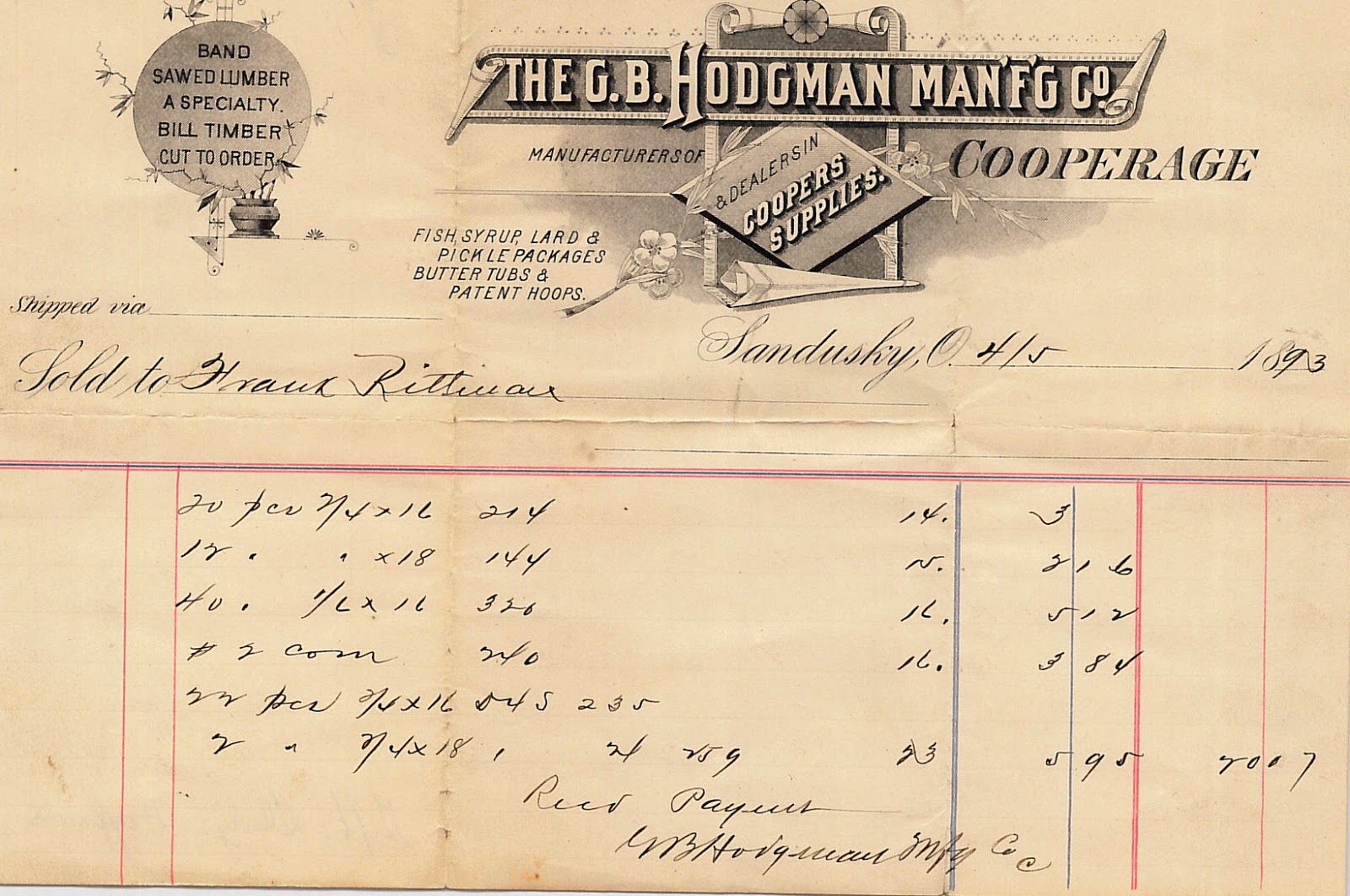
Above is a receipt for goods sold to Frank Rittman from the G.B. Hodgman Manufacturing Company in Sandusky in 1893. The company was located on the very eastern end of First Street along the waterfront. 


The G.B. Hodgman Company started out as a cooperage in the 1870s, and later became a lumber mill; it was founded by George B. Hodgman, who served as president of the organization. O.A. Knight was vice-president, and Henry Knight was the secretary-treasurer.

An article in the Sandusky Register of July 30, 1881 reported that the G.B. Hodgman Manufacturing Company gave constant employment to over one hundred workmen. At that time the factory sat on two acres, and had two docks for shipment of products. There was a branch factory in St. Louis, Missouri. The book History of Erie County, ed. by Lewis Cass Aldrich (D. Mason, 1889) described the company as sitting on twenty acres, which included a warehouse, sawmill, band factory, cooper shop, stables, blacksmith shop and wagon shop. The buildings had incandescent lighting, and the company had its own generator. Products were shipped throughout a large portion of the United States, and the proprietors were known for “business integrity and thoroughness.” The 1890 Sandusky City Directory listed the company as a manufacturer of lumber and cooperage, specializing in fish, syrup, lard and pickle packaging. 

During the Panic of 1893, the G.B. Hodgman Manufacturing Company went into receivership, as did many companies throughout the United States. Mr. and Mrs. Hodgman moved to Chicago, where George worked in wood manufacturing, and later they moved to St. Louis, Missouri. George B. Hodgman died in St. Louis on May 8, 1934. His remains were returned to Sandusky, Ohio for burial in Oakland Cemetery. 

Marian Hodgman, a sister to George, was an early member of the Board of Trustees of the Sandusky Library.
  

Sunday, July 07, 2013

William H. Gilcher, Lumber Dealer


William H. Gilcher was born in Sandusky, Ohio on July 2, 1843 to Peter and Christina (Boos) Gilcher. Peter Gilcher was a native of Germany, and came to Sandusky in the 1830s. He started out as a carpenter, and later embarked on a long and prosperous career in the lumber industry.  As a young man, William H. Gilcher went into the lumber business with his father. In 1868, the Gilchers became partners with R.E. Schuck in the lumber business, and the firm was known as Gilcher & Schuck. The office was on Water Street, in the former depot of the Mad River and Lake Erie Railroad.   You can see stacks of lumber from the Gilcher & Schuck firm along the waterfront in the picture below.


Hewson Peeke wrote in his book entitled A Standard History of Erie County, Ohio: “For more than half a century the name of William H. Gilcher has been synonymous with the lumber industry around the shores of the Great Lakes.”  Since heavy shipments of lumber came down the lake in boats, he aspired to become involved in the shipping industry, eventually becoming one of the founders of the Gilchrist Transportation Company. Unfortunately, the Gilchrist Transportation Company suffered disaster, and the investors and stockholders all lost a great deal of money. Other business ventures with which William H. Gilcher was connected were the White Line Electric Company, later part of the Lake Shore Electric, Cedar Point., and the Third National Exchange Bank.

Mr. Gilcher married Miss Tinnie Rosenbaum in 1868. After Tinnie’s death in 1890, he married Julietta Stimson of Ashtabula in 1902. On March 9, 1922, William H. Gilcher died after a lengthy illness. His obituary, which appears in the 1922 Obituary Notebook, stated that he had been a “pioneer lumber and business man and one of the best known residents of the city.”  Funeral services for Mr. Gilcher were held at the family residence on Columbus Avenue, and burial was in Oakland Cemetery.


Monday, August 22, 2011

George R. Butler, Civil War Veteran and Manufacturer

George R. Butler was born on April 3, 1848 to Samuel W. and Clarissa (Boalt) Butler in Sandusky, Ohio. During the Civil War, he served as a drummer in Company B of the 145th Ohio Volunteer Infantry.

After working for ten years with the passenger department of western railroads, George began working with his brother, Jay Caldwell Butler, in the lumber business. The company, located at the southwest corner of Water and Decatur Streets, manufactured sashes, doors, and blinds. George took over the business after the death of his brother in 1885. The George R. Butler factory can be seen in the picture of downtown Sandusky in the mid 1880’s.

On January 28, 1925, George R. Butler died at Good Samaritan Hospital after a lengthy illness. Rev. N.R.H. Moor officiated at funeral services, and he was buried at Sandusky's Oakland Cemetery. Mr. Butler was survived by his wife, the former Susan Barney, a son, and two daughters.

Wednesday, August 18, 2010

Sandusky Coal Company

In the early 1890’s, the Sandusky Coal Company had its offices at R. B. Hubbard & Son. Mr. Rollin B. Hubbard and his son were wholesale lumber dealers, located at 903 Water Street in downtown Sandusky.

The 1890 Sandusky City Directory lists R. B. Hubbard as president of The Sandusky Coal Company, as well as the proprietor of R. B. Hubbard & Son. Rollin’s son, Shannon B. Hubbard was the treasurer and manager of The Sandusky Coal Company.
An article that appeared in the November 21, 1889 issue of the Sandusky Register reported that Jackson Hill coal was being transported by barge from Sandusky to Port Huron, Michigan, for the Sandusky Coal Company. The “Big Four” railway transported Jackson Hill Coal from southern Ohio to the railway derricks in Sandusky. Jackson Hill Coal was considered one of the best domestic and steam coals mined in the state of Ohio.

At some point in time the Sandusky Coal Company was called the Hubbard Coal Company. The ruler below advertised that Jackson Coal was the "Best Steam Coal Mined."
Besides running the lumber business, Rollin B. Hubbard was also associated with the Second National Bank in Sandusky. His son S.B. Hubbard died at the age of 37, in 1894.

Monday, November 23, 2009

Lumber Industry in Sandusky

Lumberyard employees are pictured below on a sled. While we do not know the name of the Sandusky business which employed them, the men have been identified as: Joe Nubus, John Good, Gus Boeckling, Frank Ritter, Frank Boslough, Bert Cassidy, Julius Biglin, George Baumeister, William Voreck, George Laepply, H. Van Barge, Fred Wresser, Julius Broen, Ed Hall, Karl Obececa, Karl Oberer, George Mischler, Charles Arndt, William Bahnsen, and Peter Bahnsen.

Henry Howe wrote in his 1907 edition of Historical Collections of Ohio that four things come to mind in connection with Sandusky, Ohio: lumber, fish, lime and grapes. As early as 1840, there was a lumber yard in Sandusky. G. G. Nichols’ Sandusky of To-Day, published in 1888, gave the name of Conklin as the first person to run a lumber yard in Sandusky. It was located at the corner of Jackson and Water Streets. Mr. Conklin received his lumber from Port Huron, Michigan by ship. Most of the lumber handled in Sandusky was Michigan pine, which was sent by water from Saginaw, Alpena, Cheboygan and Oscoda. Once in Sandusky, it was processed, and then left by ships in the early years, and later was shipped via the railroad.

The Hubbard family had an interest in lumber in Sandusky for many years. In the early 1840’s, Hubbard & Co. bought out Tucker & Daniels. Later, the business was known as Hubbard & Lester, and by 1888 was known as R. B. Hubbard & Son. The Hubbard planning mill was on the corner of Water and Fulton Streets, and the office was at 903 Water Street. The Hubbard yards covered three acres of ground.

Sandusky of To-Day featured the businesses of R. B. Hubbard & Son, J. T. Johnson & Co., Hawes & Williams’ Lumber Yard, Schoepfle & Sloane, and G. W. Icsman’s Lumber Yard. Mr. Icsman secured oak from Erie, Sandusky, and Ottawa Counties, while obtaining his pine from Black River, Michigan. Gilcher & Schuck was another major lumber business in Sandusky.

A view of the Sandusky’s “Lumber District” is seen on this post card.

Harriet Taylor Upton wrote in her book History of the Western Reserve, that “During the open season of lake navigation Sandusky harbor is crowded with great vessels heavily laden with lumber… From it is made furniture, sashes, doors, blinds and various ornaments for the exterior of buildings. A large number of woodworkers in Sandusky are also engaged in the manufacture of casks, barrels, and other packages required by brewers and wine merchants.”

Sandusky declined as a major city for lumber trade as the number of railroads increased. With more rail travel, lumber could be transported from a variety of locations.


Visit the Archives Research Center to learn more about Sandusky’s businesses, both past and present.