Showing posts with label Johnson. Show all posts

Friday, June 02, 2023

When Johnson’s Island Was Known as Bull’s Island


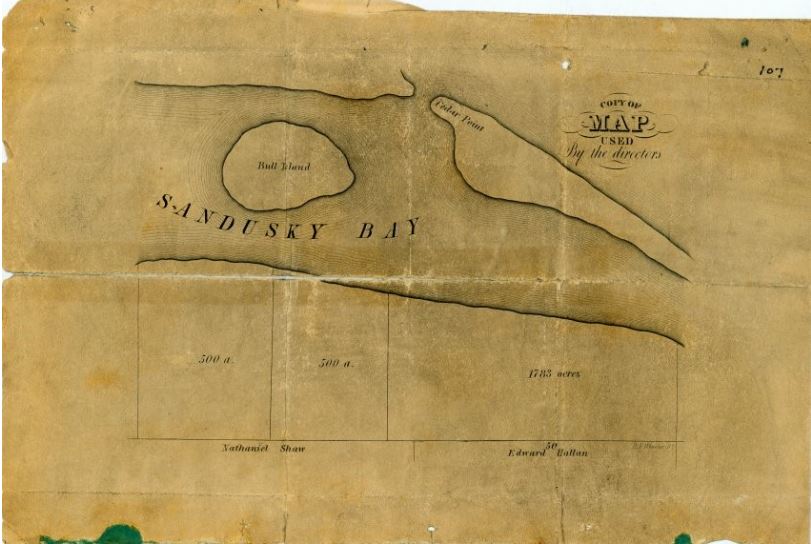
An early map of Sandusky Bay, published by H.F. Wheeler, is in the map collection of the Sandusky Library Archives Research Center. (A copy of this map was used as evidence in a case before the Ohio Supreme Court in 1844, "B. Lockwood and others v. Wildman, Mills, and others.") The island was first owned by Epaphras W. Bull, an early settler of the Firelands region, who died in 1812. In 1852, Leonard B. Johnson, a native of Ireland, purchased the island from the Bull family, and re-named it Johnson’s Island.

Leonard B. Johnson, 1808-1898

The epitaph on Mr. Johnson’s tombstone at Oakland Cemetery mentions Johnson’s Island.

During the Civil War, Johnson’s Island was selected as the site for a prison camp which housed Confederate prisoners of war. Many soldiers died at Johnson’s Island, and a cemetery on the island is the final resting place of 206 (or more) Confederate officers and soldiers. Today the Confederate Stockade Cemetery on Johnson’s Island is operated by the National Park Service. The website of the Johnson’s Island Preservation Society includes a listing of all the soldiers buried at the Confederate Cemetery on Johnson’s Island.

Thursday, March 14, 2019

Fireman’s Ball Held in Sandusky in 1839


On March 6, 1839 a Fireman’s Ball was held at Bradley’s Cotillion Rooms in the city of Sandusky. While we do not have specific details about Bradley’s facility, most likely the ball was held in an upper floor of one of the two story buildings then in downtown Sandusky. 

On the list of managers for the Fireman’s Ball were F.M. Follett, L.B. Johnson, and E.B. Sadler. In 1839 Foster M. Follett was the chief engineer of the Sandusky Fire Department. Mr. Follett would later serve as the Mayor of Sandusky and the Erie County Auditor. Leonard B. Johnson was an early owner of Johnson’s Island, which was the site of a prison camp during the Civil War. E.B. Sadler was a well-respected judge in Erie County.

Ellie Damm noted in her book Treasure by the Bay that the city of Sandusky used horse-drawn equipment for fighting fires until 1919. Several early fire stations were built of limestone, with space for the horses at the ground level, and quarters for the fire fighters and their equipment on the upper level.  Pictured below are fire fighters are standing in front of the old Number Four Fire Station, located on the northeast corner of Central Avenue and Osborne Street in the late 1800s and early 1900s.


Sandusky’s Fire Department has been in operation since the 1830s. The very earliest firemen were equipped with substantial buckets filled with water, known as the “bucket brigade.” As time went by, fire engines were purchased, fire stations were built, and wells were dug throughout the city to supply water for the firemen. To read about the history of Sandusky’s Fire Department, visit the Sandusky Library Archives Research Center. 

Monday, December 31, 2018

"Happy New Year to the Ladies of Sandusky"


In 1877 eight gentlemen from Sandusky wished the “Ladies of Sandusky” a Happy New Year. Possibly this was in conjunction with a party or dance that was held to celebrate the New Year. We do not know details about all the men, but some of the surnames included in the group come from families that were prominent in the early years of Sandusky’s history. In the 1870s  Fred M. Woolsey worked with his father, J.V. Woolsey in a factory that made wagon and carriage wheels. Charles L. Mills and Grayson Mills were both grandsons of Isaac Mills, who was one of the co-founders of the city of Sandusky. Fred Woolsey and C.L. Mills are two of the men in the picture below (at a "leap year party" the previous January); unfortunately we do not know which ones they were.


Edward H. Marsh was involved in the plaster business in this area.  He was a personal friend of President William Howard Taft. You can see Edward H. Marsh in a white jacket in the picture below, when future President Taft was campaigning in Sandusky in 1908.


Tuesday, December 19, 2017

Sandusky High School’s A Capella Choir


This is the Sandusky High School A Capella Choir during the 1957-1958 academic year. The A Capella Choir was organized in 1934 by Miss Eulalie Shaw. In 1947 the Choir was heard over a local radio broadcast for the first time, and the Sandusky Rotary Club presented the choir with thirty-seven handbells in 1960.  

The fiftieth annual Christmas concert was presented by the A Capella Choir of Sandusky High School on December 19 and 20, 1983. Over twenty holiday songs were sung at the concert, with the final number being the Hallelujah Chorus from the “Messiah,” which was dedicated to the memory of former choir director Harold C. Kaufman. A special program was created for the Golden Anniversary concert of the Choir was created by Mr. Charles T. Mayer. It featured drawings of the directors of the A Cappella Choir from 1934 to 1983.


This key to the illustrations appears inside the front cover of the program.

A history of the A Capella Choir is found in the 50th Anniversary program, along with the story of the Sandusky High School choir robe. The first robing ceremony took place in 1953. 


Here is a picture of the first A Capella Choir, from the 1934-1935 school year:


Visit the Sandusky Library Archives Research Center to learn more about the rich history of the Sandusky City Schools. Several archival boxes are devoted to graduation programs, photographs, and many other historical items. Concerts by Sandusky City School students in band, choir, and elementary music classes have been enjoyed by local residents for many years.

Tuesday, February 28, 2017

Civil War Pension Files of Harrison Washington and William H. Johnson, African American Recruits from Sandusky


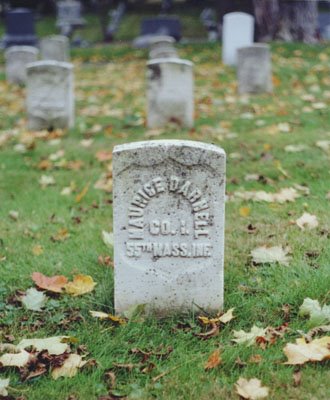
An article in the June 6, 1863 issue of the Sandusky Register reported on several African American recruits from Sandusky who were traveling by train to Readville, Massachusetts to enlist in the Massachusetts 55th Infantry. The group included a large majority of the able bodied men of color in the city of Sandusky ranging from 18 to 40 years of age. The Massachusetts 55th Infantry was a sister regiment to the Massachusetts 54th, the military unit featured in the film Glory. Fourteen men from Sandusky served in Company I of the 55th Massachusetts Infantry. They were led by Captain George T. Garrison, the son of well-known abolitionist William Lloyd Garrison. A previous blog post about these soldiers included pictures of the tombstones of two Civil War Veterans of the Massachusetts 55th who were buried in Sandusky at Oakland Cemetery.

In the pension file for Harrison Washington from the National Archives, we learn that he enlisted in the Massachusetts 55th in June of 1863. At that time, he was 5 feet 6 inches tall and he had been born on May 15, 1833 in Fleming County, Kentucky. Harrison Washington was honorably discharged in Massachusetts in October of 1865. He returned to Ohio for about thirty years, and then moved back to Fleming County, Kentucky.


Another page from Mr. Washington’s pension file provides the name of his wife, Frances Washington, whom Harrison married in 1890, his third wife. One of his previous wives had been the former Cordelia Winfield from Sandusky, Ohio, who died in 1866. The file also includes the names and birth dates of Harrison Washington’s children, who were named Matilda, Charlie, Cordelia, and Mary. In 1898, Harrison Washington was still living in Kentucky.


A note in the pension file of Harrison Washington stated that he was dropped from the pension roll due to his death in September of 1917.


William H. Johnson was another Sandusky resident who served with Co. I of the Massachusetts 55th Infantry. He enlisted when he was 22 years old, and his occupation was listed as carpenter. He died from wounds he received in battle on July 2, 1864 at James Island, South Carolina. On September 3, 1883, Mrs. William H. Johnson, the former Anna McGuire, applied for a widow’s military pension. She stated that she had married Mr. Johnson on December 25, 1861, in Augusta County, Virginia. A Sandusky attorney, John E. Moore, presented the widow’s claim, though at the time she had moved to Cleveland, Ohio.


A recent article in the Charleston Post and Courier reports on the unveiling of a historic marker at Folly River Park which honors the service of the Massachusetts 55th Infantry during the Civil War. In the 129th Ohio General Assembly, the Ohio House of Representatives passed H.R. No. 297, to honor the 511 African American Ohioans who enlisted in the 54th and 55th Regiments of the Massachusetts Volunteer Infantry during the Civil War.

Tuesday, May 12, 2015

Mrs. Alice Jenkins, An Early Trustee of the Sandusky Library Association


Alice J. Johnson was the daughter of Leonard Beatty Johnson, a prominent business man who once owned Johnson’s Island. She was born in 1850 to Mr. Johnson and his wife, the former Permelia Nettleton. In 1868, Alice was a student at the Oberlin College Conservatory of Music. On December 28, 1875, Alice J. Johnson married Charles H. Jenkins. In 1880, U.S. Census records show that Alice and Charles Jenkins lived very close to Alice’s parents, on Columbus Avenue in Sandusky, Ohio. During the years of 1879 and 1880, Alice was a trustee of the Sandusky Library Association. This was before the construction of the Sandusky Library building on West Adams Street. Alice was part of a group of ladies who were interested in raising funds for the building of a public library in in the city. 

On January 24, 1881, Mrs. Alice Jenkins passed away at the age of 31. An obituary for Mrs. Jenkins appeared in the January 25, 1881 issue of the Sandusky Register. A transcription of the obituary reads:

Death of Mrs. Jenkins
It was with painful shock indeed that a large circle of friends yesterday learned of the death of Mrs. Alice J. Jenkins, wife of Mr. Chas. H. Jenkins, and elder daughter of one of the oldest and most respected families of our city. Mrs. Jenkins was seriously ill for several weeks. All that professional skill and the most careful nursing of a devoted family could do was done, but the time for the unseen messenger had come, and a lovely woman, beloved by family in the deepest affection of the human heart, and cherished by friends for an intelligence, grace and nobility of character whose impress was felt in all the broader circles of acquaintance, has been called to the other an better life, free from suffering and death. To a stricken family, the sympathy of many friends is extended.

Mrs. Alice Jenkins was buried in the Johnson family lot at Oakland Cemetery. 

Tuesday, February 17, 2015

Double Stone House on West Market Street


According to the book, At Home in Early Sandusky, by Helen Hansen, this double stone house, which no longer stands, was built at what is now the 400 block of West Market Street by Leonard B. Johnson (of Johnson's Island) in 1846. William A. Simpson bought the property in 1848. In 1866, Rev. J. George Lehrer owned the west half of the house, and Julius Robrahn owned the right side. Until 1960, this property had several different residents. In the 1920 U.S. Census, sisters Mary and Amelia Maul lived in one half of the house, where they both worked as dressmakers. 

In 1960 the double stone house was razed, for use as a parking lot. This link to Google Maps shows what the space looked like in the fall of 2013. See At Home in Early Sandusky to learn more about houses in Sandusky, some still standing. This book is available at the Sandusky Library in the Reference Services area of the Sandusky Library, or you may buy it for $1.00 at the check-out desk at the library. 

Monday, January 07, 2013

Reber Nettleton Johnson, Violin Prodigy


Reber Nettleton Johnson was the son of Leonard Sumner Johnson and Alice Reber Johnson, born in Sandusky on June 7, 1890. Reber’s paternal grandfather, Leonard B. Johnson, once owned Johnson’s Island, in Sandusky Bay. His maternal grandfather, George Reber, was a prominent attorney in Sandusky. Reber Nettleton Johnson became an internationally known violinist while still a child. He is seen with his violin in the picture below when he was only three years and eleven months old.


According to an article in the June 9, 1966 issue of the Sandusky Register, Reber N. Johnson played violin at Carnegie Hall when he was age seven, and he performed in Paris at age eight.


Reber Johnson received a doctorate in music from Brown University in 1914, and shortly thereafter became first violinist with the New York Philharmonic Orchestra. He was concertmaster of the New York Symphony from 1919 to 1923, when he accepted a position of professor of violin at the Oberlin College conservatory of Music. He held that post for more than thirty years.

Reber Nettleton Johnson died after a lengthy illness on May 31, 1966, in Oberlin, Ohio. His wife, the former Esther Andrews, preceded him in death in 1964. The Sandusky Library Archives Research Center was fortunate enough to have been given several portraits of Reber Nettleton Johnson by Glenn Everett.

Friday, January 07, 2011

Erie County Infirmary

 
The historic limestone Erie County building at 2900 South Columbus Avenue served as the Erie County Infirmary from 1886 until 1976, when the residents were transferred to the Erie County Care Facility at 3916 East Perkins Avenue in Huron Township. A history of the Erie County Care Facility and its predecessors is found on the Erie County web site.  The Infirmary housed individuals who were poor, unfortunate, disabled, or who were unable to care for themselves. Sixty acres of land were farmed on the Infirmary grounds. Residents capable of farming the land pursued this occupation as they were able. A hospital was located on the grounds to care for the sick. Over a seven year span, Katharyn Huss Wunderley produced a book which compiles information about residents who died at the Infirmary. She included obituary citations, references to local newspaper articles, and often indicated how long the person had made their home at the Infirmary. The book, entitled Erie County Ohio Infirmary, provides history of the facility, regulations from 1856, and a listing of the directors and superintendents.

The April 17, 1896 issue of the Sandusky Register ran a story about Jean Lafitte Johnson, who was buried at the Infirmary Cemetery, located just north of the Jewish Cemetery, on Columbus Avenue. Jean Johnson was said to have been the adopted son of Dan Rice, who had a traveling show. The “Great Quadruple Exhibition” featured circus acts and trained animals. Jean Johnson was a bareback horse rider who performed “unequaled feats of horsemanship.” Jean Johnson died July 12, 1895. A Mr. J. Killer died at the 1910, and was buried in the Infirmary Cemetery. He was afflicted with tuberculosis, and thought that if he lived in his covered wagon out in the open air, he would recover. He did not recover, and died in the wagon near Castalia. Robert W. Tavener (sometimes spelled Tavenor), known as the “Prince of Story Tellers,” became a resident of the Erie County Infirmary in 1918. He had been a colorful figure in Sandusky for many years. From 1900 – 1902, he operated a large bath parlor at the corner of Washington and Warren Streets. Mr. Tavener’s obituary in the February 21, 1919 Sandusky Register states that R. W. Tavener was a “globe trotter, medicine man, bath house proprietor, and finally porter in downtown cafes…” 

Read Mrs. Wunderley’s book, Erie County Ohio Infirmary, to learn more about the lives and deaths of many of the facility’s residents.

Wednesday, October 01, 2008

The Irish in Erie County

During the first half of the nineteenth century thousands of Irish emigrated to the United States. The potato famine of 1845 left devastating conditions in Ireland. The Irish immigrants had hopes of starting a new life in the United States. Often the only jobs available were among the least desirable. As a result many Irish born workers built the canals and railways of America and worked in dangerous mines. Besides working difficult jobs, the Irish often faced discrimination. They encountered signs that said “HELP WANTED – NO IRISH NEED APPLY.” As a result the Irish found solace in churches and community organizations. Eventually the Irish were assimilated into American culture, along with thousands of other immigrants from many other countries. Today Americans of Irish descent are still known for their humor, love of family, and their sometimes feisty personalities. St. Patrick’s Day has been celebrated in America since 1737.

One of the earliest Irish immigrants in Erie County was John Beatty, who was one of largest land owners of the Firelands. John Beatty led a group of fourteen families from Connecticut to Perkins Township in 1814. He was Mayor of Sandusky from 1833 to 1836. His brother-in-law was Rev. William Gurley, an early Methodist minister was licensed to preach by John Wesley, the “father of Methodism.”

Father R. A. Sidley (below) was born in Ireland in 1828. He was the priest of Sts. Peter and Paul Church in Sandusky from 1863 until 1871. Father Sidley oversaw the building of the church which still stands today at the southeast corner of Columbus Avenue and Jefferson Street. Father Sidley left a bequest of over $13,000 for the building of a new school, which was completed in 1907. The auditorium of the new school was named “Sidley Memorial Hall” in honor of Father Sidley. For many years Sidley Hall was used for concerts, commencements, as well as amateur and professional dramatic productions.

Leonard Johnson, another local Irish immigrant, bought Bull’s Island in 1852. The name of the island was later changed to Johnson’s Island. During the Civil War there was a Prisoner of War Camp located on Johnson’s Island.
Wilson “Slip” McLaughlin, who was Chief of the Sandusky Fire Department for many years, was the grandson of Irish immigrant, Michael McLaughlin. “Slip” is in the center of the group pictured below at the fire station located at the corner of Meigs Street and Sycamore Line. Mr. McLaughlin’s obituary in the November 24, 1984 stated that he was a “champion of the underprivileged and public” and a public servant for fifty years.
Descendants of Irish immigrants to Sandusky and Erie County still live and work in Sandusky today. A walk through St. Joseph’s Cemetery will bring to mind many of those Irish Americans who have gone before us.

Friday, September 26, 2008

Genealogical Research with High School Alumni Publications

High School alumni directories can be very helpful in genealogical research. The page below shows both the maiden names and married names of female graduates. Since the directory was current to 1909, by searching the 1910 United States Census, more details about the graduates can be gleaned, such as place of birth, occupation, and the names of children and spouse. (U.S. Census records are available at the Archives Research Center on microfilm, as well as through the databases Ancestry Library Edition and Heritage Quest. See the Reference Staff for assistance.)
Laura Beattie married the Rev. Charles Dinsmore, and moved to Waterbury, Connecticut. Evelina Ball had become Mrs. George W. Perkins. Charles Henry Arndt had become a minister serving a church in Germantown, Pennsylvania. A. J. Weis was employed by the Keystone Fish Company in Erie, Pennsylvania.

The listings in the directory will provide the names of the classmates of your ancestors. By then searching through the appropriate Sandusky High School “Fram,” you can view photographs of various clubs, teams, and organizations, which give further details about the students of Sandusky High School throughout several decades. Yearbooks from St. Mary’s Central High School and Perkins High School can also be found at the Archives Research Center.

In 1994, the Sandusky High School Alumni Association published an Alumni Directory, which is shelved immediately after the collection of high school yearbooks from Sandusky High School. The Alumni Directory serves as an index to the yearbooks, giving the year of graduation, and providing the maiden name of females. An address that was current in 1994 is also listed. At yearly class reunions, current addresses of living graduates are usually proved in a pamphlet given to attendees.
Alice Reber Johnson is just one of the many persons whose names are listed in the “Complete List of Living Graduates of Sandusky High School from 1855 to 1909.”

Friday, May 23, 2008

Musicians in Sandusky

Music has been an important part of society throughout history. From lullabies, to work songs, to patriotic anthems and funeral hymns, music is associated with major milestones of an individual’s or a family’s life experiences. Before the time of television and radio, families would often enjoy songs together in the evening. Virtually all movies, plays, and television programs utilize some form of music to convey a message.

In Sandusky music has been performed by many community and school bands and orchestras. Musical performances at public events were common. Organized singing groups were very popular with the German immigrants. Additionally, the first known band in Sandusky was the Jaeger Band, comprised mainly of German immigrants (seen here circa 1851). A variety of bands appeared at Cedar Point throughout the years, including that of John Philip Sousa. When local piano teachers had recitals, the newspaper listed the names of the students as well as the pieces each student played.
Aimee Quinn is pictured with her violin in 1897. She later taught music along with her sister Jean in New York City. Aimee’s father was grocer in Sandusky.
Reber Johnson was a child prodigy. He is seen here at the age of 6 with his instructor William F. Peters. Reber Johnson taught music at Oberlin College for thirty years. He was the grandson of Leonard Johnson, who owned Johnson’s Island at one time. Reber Johnson’s aunt, Sallie Reber, was a well-known popular singer.

The Sandusky High School Orchestra of 1904 is pictured below:

Visit the Sandusky Library’s Archives Research Center to learn more about the music and musicians of Erie County.

Thursday, July 06, 2006

Freedom Fighters

It has been only relatively recently that the service of African-American soldiers in the Civil War has been adequately recognized. In the Sandusky area during the war, fifteen African-American men volunteered for service in Company I of the 55th Massachusetts Volunteer Infantry. The men were mustered into service in May and June of 1863 at Camp Meigs in Readville, Massachusetts.

In January 1863, Governor John Andrew of Massachusetts received permission to recruit an African-American regiment to fight for the Union. The 55th was a sister regiment to the 54th Massachusetts Volunteer Infantry, whose heroic service in the war was featured in the movie, Glory. This second unit was formed due to the overwhelming response from men who sought to serve in the 54th. A total of 222 men from Ohio served in the Massachusetts 55th.

Among the Sanduskians who served, William H. Johnson was killed in battle on July 2, 1864 at James Island, South Carolina. Morris Darnell and Elijah J. Brown
returned home to Sandusky after the war, and are buried in Oakland Cemetery; Frank Gardner, Joshua Cole, and Thomas Robinson are buried at the Ohio Veterans Home.


African American soldiers comprised over ten percent of the Union Army, and over 18,000 African-American men served in the Navy. You can read an article about the Sandusky recruits in the June 2, 1863 issue of the Sandusky Daily Commercial Register, available on microfilm in the Sandusky Library Archives Research Center. Military records from the Civil War and other wars may be found on the Ancestry Library Edition research database, which can be accessed from within the library.