Showing posts with label ice industry. Show all posts

Tuesday, September 13, 2022

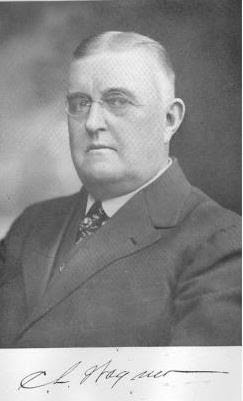
Charles L. Wagner, Pioneer in the Natural Ice Industry


Charles L. Wagner was born in Cleveland, Ohio in 1852, to German-born parents, Mr. and Mrs. Julius Wagner. As a young man, he was a clerk in several different stores in Sandusky, Ohio, and later was associated with the company Wagner, Powers and Brodbeck. In 1885, he founded the Wagner Brothers Wholesale and Retail Ice Company, later known as the Wagner Lake Ice Company, serving as president and general manager. In 1907, the Wagner Lake Ice Company became a part of the Interstate Ice Company.

In 1913 the City Ice & Fuel Company acquired the Interstate Ice Company. C.L. Wagner was the wholesale manager of this business at the time of his death in 1921.

Charles L. Wagner had interests in several businesses during his long career in Sandusky.  At one time he was the manager of the Sloane Hotel. He was listed as one of the incorporators of the Sandusky Portland Cement Company, along with Arthur St. John Newberry, Spencer B. Newberry and F.D. White. This company was later known as the Medusa Cement Company. Wagner Avenue, which leads north from Barrett Road in Bay Bridge, Ohio, next to Clemons Boats, was named for him.

When Mr. Wagner died in 1921, his obituary appeared on the front page of the August 6, 1921 issue of the Sandusky Register.

C.L. Wagner was buried in Sandusky’s Oakland Cemetery in the family plot.


Monday, September 05, 2016

At Work in Sandusky

Celebrated in the U.S. since 1882, Labor Day, the first Monday in September, is dedicated “to the contributions workers have made to the strength, prosperity, and well-being of our country.” The men in the photograph above were employed by Lay Brothers Fisheries in the 1930s. The crew was on a fishing boat, pulling up nets from Sandusky Bay. In the historical photograph collection at the Sandusky Library Archives Research Center are a wide variety of images of local residents pictured in the workplace. 

Several men and women who were employed at Hinde and Dauch can be seen in the 1905 picture below.


The ice industry provided many area residents with jobs in the late eighteenth and early nineteenth centuries.


During World War II, employees at Barr Rubber made life rafts for the war effort.


In the picture below, taken sometime between 1910 and 1915, are members of the Sandusky Chapel of the Typographical Union employed by the Sandusky Register. Maybe their vehicles were decorated for a Labor Day celebration!
 

Visit the Sandusky Library Archives Research Center to see many more vintage pictures of the people who called Sandusky and Erie County home.

Monday, January 18, 2016

Ice Harvesting in Sandusky


Before the advent of electricity and refrigeration, Sandusky’s natural harbor provided ice for local residents and businesses, and was also shipped by rail to other locations. An early document from the United States House of Representatives stated that Sandusky ice was in great demand in the 1880s. It was in good supply, was up to twenty inches thick, and it was clear as plate glass. The shipping of hundreds of tons of ice brought great profit to the railroads that transported it. The cities of Columbus, Cincinnati and Springfield purchased Sandusky ice in the late nineteenth and early twentieth centuries. Snow had to be cleared off the ice by horse drawn equipment in the early years of ice harvesting. Later mechanized equipment was used in ice harvesting.


After the ice was cleaned and scored, employees piked the blocks of ice. Then they were taken across a channel to the ice house.


The blocks of ice were loaded into the ice houses on a conveyor belt, awaiting shipment. Many fisheries in Sandusky harvested their own ice, in order to keep their fish fresh. In the late 1800s, dozens of ice houses were found along the shoreline. To read more about the natural ice industry in Sandusky, see Ron Davidson’s blog post in the January 20, 2014 online issue of the Sandusky Register. The picture below shows several employees who were packing blocks of ice in an ice house in Sandusky in 1929.


Visit the Sandusky Library Archives Research Center to learn more about the harvesting of ice in Sandusky.                     

Saturday, September 12, 2015

E.H. Schlessman, Commercial Photographer


During the first quarter of the twentieth century, Edward H. Schlessman was a commercial photographer in Sandusky. On his World War I Draft Registration card, Mr. Schlessman stated that he was self-employed as both a photographer and a taxi driver.


Though he made his living by taking pictures, no known picture of him is in the historic photographic collections of the Sandusky Library Archives Research Center. 

Mr. Schlessman’s photos and postcards chronicled the everyday life of area residents. Ice workers and friends were captured on Sandusky Bay in this postcard from December, 1909.

     
In 1912  Schlessman took a picture of the Shamrocks, who were the champions of their baseball league that season.


Sandusky newsboys who were promoting the Saturday Evening Post were captured in this 1916 Schlessman postcard, near the stand of Norman Holzaepfel.


A young lady feeding two horses is the subject of this undated photograph.

          
When a tornado struck Sandusky in 1924, Schlessman took a series of photographs that showed how much damage the tornado had caused to the Sandusky area. You can see that many buildings were reduced to rubble.

       
The National Guard can be seen near their supply area in this photo taken on June 28, 1924.


By 1934 Edward H. Schlessman had left Sandusky. A legal notice which appeared in the September 22, 1934 issue of the Sandusky Star Journal stated that his last known address had been in Detroit, Michigan, and his wife, Mrs. Josephine Schlessman, had filed for divorce. Though Edward Schlessman moved away from Sandusky, he left us with a better understanding of local life in our community. Visit the Sandusky Library Archives Research Center to view over one hundred photographs taken by E. H. Schlessman.

Sunday, May 25, 2014

When Sandusky Businesses Made Home Deliveries


Before the advent of automobiles and supermarkets, several businesses in Sandusky delivered their products to the homes of area residents. The E.C. Sprau grocery store had a horse and wagon that made deliveries, seen in the picture above, taken about 1908. A young man and child, with a horse and wagon from the Lewis Neill, Jr. Dairy were parked at the rear of St. Mary’s Church in Sandusky in 1910.

               
Employees of several local bakeries made deliveries to both homes and businesses throughout the years. Mrs. C. Frank’s bakery was first located on Tiffin Avenue, and moved to Columbus Avenue near Neil Street by 1902.

               
Below is the wagon fleet of the H and S Modern Bakery on Hancock Street in 1920.

            
Esmond Dairy started making dairy deliveries by horse drawn vehicles, but eventually the company switched to refrigerated trucks. The Esmond Dairy began in 1907, and ceased operations in the late 1970s or early 1980s.
        
In the 1930s and 1940s, both ice and coal were delivered by the City Ice & Fuel Company.


Before there were electric refrigerators, Sandusky residents ordered ice from the ice man. Customers put a card in their window, indicating how many pounds of ice they needed for the ice box. This ice card from the City Ice & Fuel Company, now in the Industry Room at the Follett House Museum, allowed customers to indicate whether they wanted 25, 50, 75, or 100 pounds of ice.


The popularity of online shopping has actually increased home delivery of consumer goods in recent years, but of course, it is a very different method of sales and delivery. Now, you don't see your sales person, and the money you spent leaves your community. Amazon, Ebay, and many other online retail sites display their products on a computer or mobile device, and with a credit card, ordering is quick and easy. 

Saturday, January 22, 2011

Fred J. Hinkey, Blacksmith and Boiler Maker

Fred J. Hinkey was blacksmith in Sandusky for sixty one years. (Here he is pictured in the uniform of the Knights of the Maccabees or the Knights of Pythias -- if you know which it is, let us know in comments.) He started working as a helper in a blacksmith shop, and later he opened his own shop on Market Street, near Franklin Street. In the 1935 Sandusky City Directory, Mr. Hinkey listed these services at his shop: dealer in sheet and bar steel, general blacksmithing, power forging, ship work, and boiler making and repairing. His ad stated that his work was promptly done to order and at the lowest rates. An article in the January 22, 1921 issue of the Sandusky Star Journal reported that Mr. Hinkey did not have to lay off employees, as his business kept the workers busy at all times of the year. During the spring fishing season his shop turned out thousands of iron grab hooks used by fisheries for their trap nets.  In the summertime, boats and barges needed repairs and new parts for their machinery. Fall fishing season brought in more repair work. The winter ice season brought with it “a myriad of orders” for new ice handling equipment and repairs to the old equipment. Besides providing repairs to machinery, Mr. Hinkey also had six boiler makers who made and repaired boilers in an area of about a sixty mile radius around Sandusky.  He stated that the three things which contributed to his success were courtesy, good workmanship, and promptness.

These ice tongs were made at Fred Hinkey’s shop, and can be seen at the Industry Room of the Follett House Museum.

In the 1920’s and 1930’s, Fred’s son Leroy M. Hinkey provided portable arc welding services to Sandusky area residents. Leroy Hinkey later moved to the Dayton area.

Fred J. Hinkey passed away on June 27, 1939. His funeral was held at his home on West Market Street. The Garfield Company of the Knights of Pythias held graveside services for Mr. Hinkey at Oakland Cemetery. Fred J. Hinkey was survived by three sons and a sister. His wife Dorothy had died in 1932.

Tuesday, July 14, 2009

"Sandusky of To-Day" (when "To-Day" was in 1888)

One of the more fascinating and informative items in the Sandusky Library's collections is the publication, Sandusky of To-Day, published by I.F. Mack & Bro. in 1888. It was designed as a promotional document to encourage people and businesses to settle in Sandusky, but for us today (no hyphen anymore) it is an invaluable historical document that gives an interesting snapshot of local business and commerce during that era. Its full title is Sandusky of To-Day (Historically Reviewed) Its Facilities and Inducements for the Investment of Capital, Comprising Sketches of Its Extensive Fisheries, Its Lumber Interests and Complete Railroad Connections, While Affording All the Advantages of a Lovely Lakeside Residence.

As you can tell from this subtitle, a significant portion of the volume describes local businesses, and gives us a good picture of the dominant industries of the time -- an entire chapter on "our fish interests," for example.


As you can see on the image of page 29, Sandusky was said to be the largest fresh water fish market in the world at that time. It was estimated that 1000-1500 men were employed in the profession, and that 500-600 tons of fish or more per day were harvested.
Other industries and businesses received attention in the book -- "our lumber interests," ice companies, wineries, breweries, tool factories, and many others.

And not surprisingly, much was written about the "Cedar Point Pleasure Resort," "the Coney Island of the West."


Unfortunately, due to its condition, access to the original book is restricted, but for those with a research need, the original document may be used under strict conditions in the Archives Research Center. A digital copy is also available; ask a reference librarian for more information.