Showing posts with label Saloons. Show all posts

Friday, June 23, 2023

Souvenir Flour Sack from the Balcony


Notes with the original item indicate that the flour sack pictured above was given to patrons of the Balcony, a tavern located at 301 Camp Street from 1933 to 1963. The sack advertises Wooden Shoe lager beer, and features illustrations and musical notes that accompany a German song called “The Schnitzelbank Song.” The song has several verses that teach German words to the singers. There are several videos on YouTube that will give you an idea of what “The Schnitzelbank Song” may have sounded like long ago at the Balcony. One video includes singing, while another video by Polkadelphia shows the song leader pointing to each illustration as the song is played. 

Helen Hansen and Virginia Steinemann wrote an article for the Sandusky Register of May 26, 1991 entitled “Balcony Conjures up Smiles.” The article explains that in 1933 Otto Ketterer established the tavern, which served beer and soft drinks. Otto played the piano, as patrons sang along.

The tavern known as the Balcony had previously been a saloon and boarding house operated by Leopold and Charles Wildenthaler. Later Emma Wildenthaler Ketterer and her husband Albert Ketterer continued the business. During Prohibition the business was a pool hall and served soft drinks. Otto Ketterer was the son of Emma and Albert Ketterer. To read the complete article about the Balcony, visit the Sandusky Library, where several decades of microfilm of local newspapers are housed.

Saturday, November 26, 2022

The Phil T. Beer Cafe


A mirror from the Phil T. Beer Café has a saying at the top, “Look at yourself, but think of us.” Phil Beer (a great name for a tavern owner) operated the tavern from about 1910 to 1919, at 301 East Market Street. Grace Episcopal Church now operates a thrift shop at this location. In an advertisement in the Sandusky Register on June 28, 1912, readers were informed that they could “while away an idle hour” or play pool, or eat a meal at Phil’s Café.

At the end of May in 1919, the state of Ohio became a “dry” state, several months before the 18th Amendment became a law on October 28, 1919, prohibiting the manufacture, sale or transportation of intoxicating liquors throughout the United States. 

The article below from the May 24, 1919 issue of the Sandusky Star Journal reported on the mock funeral for “John Barleycorn.”


A group of men were to meet at midnight, and pay their respects to old man “Booze” who died from an “overdose of votes.” There was a procession that was to start at Washington Park, and then go to Water Street, past Dan Nolan’s, Baldwin’s, Ted Lauber’s Mulharen’s, the Pabst and the old West House. Next they would shed a tear at the old Annex Cafe, pass by Werner & Wagner, and play slow music as they passed by Phil Beer’s Cafe. It was expected that there would singing and speeches, concluding with the song “We’ll be dry for a long, long time.”

Later in 1919, Phil Beer ran a cigar shop at the Rieger Hotel. 

Mr. Beer died in September, 1959, and was buried at Oakland Cemetery.


You can read more about the residents of
Sandusky and Erie County at the Sandusky Library Archives Research Center, which houses microfilmed copies of decades of local newspapers. A ClevNet database, Newspaper Archive, provides online access to many historical newspapers as well.

Tuesday, May 31, 2022

Bremer Groceries and Saloon


In the first quarter of the twentieth century, members of the Bremer family operated grocery stores in Sandusky. J.D. Bremer was listed as a saloon keeper in the 1880 U.S. Census. In 1902, he ran both a saloon and a grocery store in the 600 block of McDonough Street, and by 1908 had moved his grocery business to the southwest corner of Vine and Monroe Streets (pictured above). He sold staple and fancy groceries and provisions at his grocery store, as well as flour and feed. 

In the early days of telephone service, there were competing phone companies, whose customers could only call other phones connected to the same services; therefore, many businesses subscribed to both services. This was true at the J.D. Bremer store, with the Bell Telephone Company and the Harrison Telephone Company both having phone lines to the store. 

J.D. Bremer ran his grocery store at this location until the early 1920s. Herman Bremer, most likely a brother, also had a grocery store in Sandusky. In 1908, Herman’s store was at the southeast corner of Monroe and Clinton Street. When Herman Bremer died in 1911, the Sandusky Register reported his death on the front page of the March 13, 1911 issue of the paper.

                                                                                                                                                                                                                                                                                                                                                                                                      
After Herman Bremer’s death, his sons and wife ran the grocery store until about 1916. Before the automobile age, many neighborhoods had their own small grocery store. The 1921-1922 Sandusky City Directory listed ninety separate grocery stores on pages 475 to 477.

Wednesday, March 23, 2022

The Other Kerber Grocery


Many people in Sandusky are familiar with Kerber Marine Grocery located on Tiffin Avenue, but not many people know there was another Kerber grocery business on the east side of town.

Albert Kerber was born in 1861 in Ehrenstten, Baden near the city of Freiburg. His parents were Anton Kerber and Cecelia Bauman. Anton Kerber’s brother Vincent Kerber immigrated to Sandusky in 1849 and ran several well-known businesses. He was a masonry contractor whose projects included the Water Works, Barker School, Standard Wheel Company, and several social halls. Later in life Vincent collaborated with his sons in a number of businesses including Consumer Ice Company and a grain and feed business on Water Street.

Records show Albert immigrated in 1880. He was listed in the 1880 census as living with his uncle Vincent on Ogontz Street. Albert then settled on Middle Bass Island and worked for the Golden Eagle Wine Cellars.


While on Middle Bass he met Augusta Kubach who was born in Sandusky in 1865. Augusta’s father John Kubach was born on the Steamer Albany during the family’s immigration to the United States. Albert and Augusta were married in July 1884.


Albert and Augusta moved to Sandusky in 1887. They built a store and residence at the corner of First and McEwen Streets in the east end, near Alberts’s uncle and cousins. The photo below was taken around 1891 and shows Albert and his brother-in-law Andrew Kubach in front of the store. One sign in the window advertises a steamer trip to Cleveland on Thursday June 25, 1891, for fifty cents. The other sign advertises Arbuckle’s Coffee.


Albert’s brother Lawrence (Lorenz) Kerber was born in 1862. In 1888 he founded Kerber Marine Grocery. Lawrence unfortunately died young at just the age of 30 in 1892.

Sometime around 1900 Albert expanded the grocery store to include a saloon. The picture below taken around 1905 shows the store and saloon. Standing in front of the store are Alberts’s sons, Millard and Carlisle and another brother-in-law, Clyde Kubach.


Like many businesses of the era, the saloon issued tokens. Shown below are the two sides of a 5-cent token.


Albert was active in the community and there were numerous listings in the Sandusky Register about hosting social events, sponsoring visiting musicians and travels to visit friends and relatives. One brief article in the Register noted “A young son of Albert Kerber, the Huron Ave and McEwen Street grocer, was struck by an automobile in Huron Ave, Thursday night but escaped serious injury.” The article implies there was a second grocery on Huron Ave, but no records were available.

Albert died on March 13, 1911. His obituary indicates funeral was conducted by Sandusky Lodge No. 669 International Order of Odd Fellows. Burial was in Oakland Cemetery.

The building at the corner of First and McEwen Streets stands today as shown below.

Thursday, October 14, 2021

"All Aboard For Peters’ Restaurant"


From about 1873 to 1890, George Peters operated a restaurant and billiard parlor in the 600 block of Water Street in downtown Sandusky, Ohio (probably where the empty lot on the 100 block of East Water Street is today). He stated in an advertisement in the 1888 Sandusky City Directory that “meals were served to order at all hours of the day or night.”  Wine and beer were served in the saloon, and there was a private parlor for ladies. Women were allowed to patronize the business, but they weren't allowed to work there! 

The Sandusky city ordinances of the time prohibited women from working in a business that served alcohol unless they were the wife or daughter of the owner.


And if a woman did happen to work in a saloon, young men (under 21) were not allowed to engage in conversation with her, to help preserve "order" in the community. Rules were different in those days.


George Peters was a native of Germany. During the Civil War he served as a private in Company B of the 145th Ohio Volunteer Infantry. In the early part of the twentieth century, he moved to Norwalk, Ohio. After his death in 1909, he was laid to rest in Sandusky’s Oakland Cemetery.

Thursday, May 13, 2021

Jacob Hemminger Saloon Building


The building at 333 West Market Street, where the Now and Then Shoppe was located, was originally the site of Jacob Hemminger’s saloon. The Ohio Historic Places Dictionary states that the building was constructed between 1884 and 1886, and was built in the High Victorian style. Decorative brackets are visible along the top of the structure, and decorative trim adorns the tops of the windows.


When Jacob Hemminger ran his saloon, he rented rooms out on the upper floor. The saloon was popular with Sandusky residents of German descent, and it served wines and beers that were produced locally. 

A typical saloon in the 19th century, this one at an unknown location on Market Street

In the 1910s and 1920s, the Erie Hotel was in this building. Other hotels at this site were the Starbird Hotel and the Paris Hotel. Businesses later in the twentieth century at 333 West Market Street included Brinnon’s Paint store, Bernie’s Paint and Wallpaper, and the Worth-More Furniture store. 

For more information on the historic architecture of Sandusky, see Ellie Damm’s book Treasure by the Bay.

Sunday, July 26, 2020

Michael Osterman’s Naturalization Certificate


Michael Osterman became a naturalized citizen of the United States on February 10, 1860. He was born in Bavaria, in what is now Germany. Rush R. Sloane, Erie County Probate Judge, signed the certificate.

 An article in the October 12, 1905 issue of the Sandusky Register reported that Michael Osterman had resided in Sandusky for fifty years, prior to his death on October 10, 1905. He worked on the Mad River and Lake Erie Railroad, and later was a steam engineer for the Sandusky fire department. He was the organizer first president of the local Prussian Society.

For many years he operated a saloon on Water Street. The 1888 Sandusky City Directory listed Michael Osterman as the proprietor of the Engineers’ and Hunters’ Saloon and Restaurant at 808 and 810 Water Street 300 block W. Water today). In the 1900 Sandusky City Directory, Mr. Osterman’s saloon and residence were both located at 435 Market Street (at the northeast corner of Market and Hancock Streets).

 In the January 29, 1923 Sandusky Star Journal, an article tells of the discovery of an old railway passenger coach from the Mad River and Lake Erie Railroad being found in the back of property on West Water Street that had once been owned by Mr. Osterman. The old railroad car had first been used as part of a kitchen, and later was moved to the back of the property where it was used as part of a shed. Alex Osterman, Michael’s son, was asked to tear down the structure in 1923 because it was considered a fire hazard.

Wednesday, April 29, 2020

Miller's Milwaukee Beer


Fred Zander was the manager of the Sandusky branch of the Fred Miller Brewing Company of Milwaukee, according to the 1906-1907 Sandusky City Directory. The building was located at the southwest corner of Warren and Monroe Streets. By 1912 the business moved to 722 Market Street, and the agents for the company were Fred W. Zander and Edward H. Hanson. Miller’s “Buffet” beer claimed to be the purest tasting bottled beer.


An article in the May 23, 1916 Sandusky Star Journal reported that Mr. and Mrs. Zander had moved to Milwaukee, Wisconsin. From Toledo, Ohio to Chicago, Illinois, they followed the signposts for the Lincoln Highway. They had a pleasant trip except for 75 miles of muddy roads in Ohio.


Wednesday, October 02, 2019

The Century Buffet


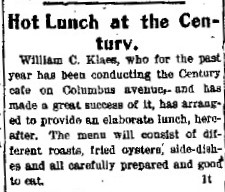
This full page advertisement for the Century Buffet appeared in the book What: Souvenir of Sandusky and the Islands of Lake Erie, published by Hill and Bolly in 1903. According to the Sandusky Evening Star of October 14, 1902, William C. Klaes took possession of the Century saloon and café on Columbus Avenue, taking over the business from Fred Volk. Mr. Klaes is pictured in the center of the page. An advertisement from 1903 indicated that the business was thriving.


One of the favorite beverages on tap at the Century was Atlas Beer. An article in the December 31, 1903 issue of the Sandusky Star Journal reported that Mr. Klaes had been secured to be the manager of the African American boxer Jim Watts. 

By 1907, Charles T. Wolfe was the proprietor of the Century. Mr. Wolfe went out of business in 1909, due to poor business in general, as well as high liquor taxes. Because of its prime location in downtown Sandusky, a variety of businesses have been in operation at the site; Daly’s Pub now occupies the spot on Columbus Avenue that was once home to the Century Buffet.

Friday, July 19, 2019

Sandusky Register Employees in the Early Twentieth Century


In the photograph above, members of the Sandusky Register “Chapel” of the Typographical Union fill up two vintage automobiles in downtown Sandusky. The cars appear to be decorated for a parade. (Possibly the Perry's Victory Centennial Parade?) The picture was taken in front of the Pabst Cafe, between 1910 and 1913, which was located at the northeast corner of Columbus Avenue and Water Street, not far from the Sandusky Register building, which was at 626-630 Water Street, on the south side, between Columbus Avenue and Wayne Street. (The street numbers indicate that the picture was taken before the 1915 change in the street numbering system.)  The proprietors of the Pabst Cafe and Grill Room at that time were Moe Frohman and Frank Elzenheimer. Note that the street is paved with bricks. To see this and many other historical photographs of Sandusky and Erie County, visit the Sandusky Library Archives Research Center.

Monday, June 26, 2017

Frau Miller’s Saloon


Here is a ledger sheet written on letterhead stationery from Frau Rosina Miller’s saloon known as the Deutsches Wirtshaus, which in English is German Inn. Rosina Miller, often listed in city directories as Rosina Mueller, was the widow of Julius Miller, who operated the saloon before Rosina took it over. In the 1886 Sandusky City Directory, she is just one of the many individuals who ran a saloon. There were 172 saloons listed in Sandusky at that time; with Sandusky's population about 18,000 at the time, that comes to roughly one saloon for every 100 persons,  Below is just a portion of the page from the directory listing for saloons.


Rosina Miller/Mueller ran the saloon in the 900 block of Columbus Avenue until about 1906. She died on September 14, 1914, following injuries she received in an automobile accident. Mrs. Miller was survived by a son and two daughters, and six grandchildren. She had made Sandusky her home for fifty years. Rev. J.H. Holdgraf officiated at her funeral services and burial was at Oakland Cemetery.

The building where Frau Miller's saloon operated still stands. You can see it as it appears today on Google Maps.

Saturday, November 14, 2015

The Wagner Palace, at the Junction of Columbus and Hayes Avenues


The road once known as the Columbus and Sandusky Pike, now Route 4, began at the intersection of Columbus and Hayes Avenues in Sandusky, Ohio.  Michael Wagner built a structure at the junction of these two key streets in Sandusky about 1882. He and his family lived on the upper floor, and at the street level was a saloon known as the Wagner Palace. In the book Treasure by the Bay, Ellie Damm describes the architecture of the building, designed in the Second Empire style, with a front tower and arched windows.  

In 1893, Michael Wagner founded the Wagner Quarries, now a part of Lehigh Hanson. This listing for Michael Wagner from the 1902 Sandusky City Directory indicates both of his business ventures.


The Wagner Palace was considered a fine saloon. This picture shows the interior of the business. Note the large fan, ornate ceiling, and mirrored bar.
   
     
This postcard image, which was published in the Sandusky Register on February 23, 1909, shows the downed wires in front of the saloon after a severe sleet storm hit the city on February 14, 1909.


By 1910, Anthony Uhl and John Oswald were the proprietors of the business. From about 1912 to 1919, Mr. Uhl was the sole proprietor. After Prohibition, Mr. Uhl served soft drinks at the former saloon.  In the late 1930s, Edward Brindley operated a sandwich shop at the site. For several decades, the building was home to a beauty salon, first as the Vogue Beauty Salon from 1941 to 1961.  For many years in the 1960s and 1970s, the Marge Marie Beauty Salon operated here. Since the mid 1990s, an insurance company has been in business at this location. 

Through the years, many different businesses have been in operation at this prime site, including a bookstore, thrift shop, meat market, and an appliance store. The historical Sandusky City Directories provide the exact years of operation for these businesses. As you drive down Columbus Avenue or Hayes Avenue in Sandusky,  take a few moments to look at this historic building. Many of the fine architectural details remain from its early days, especially the designs above the arched windows and the tower on the northern most point of the building.


Thursday, March 26, 2015

Seven Mile House


The Seven Mile House was situated in the extreme northeast corner of Groton Township, Erie County, Ohio, along the old Columbus-Sandusky Pike, close to the intersection of Mason Road and Route 4. John Powell built the Seven Mile House about 1831. This early hotel got its name from its location, which was seven miles south of the city of Sandusky. An early stage coach route passed by the building. During the time of the Underground Railroad, fugitive slaves were transported from the old Omar Tavern in Seneca County to the Seven Mile House, on their way to Lake Erie, where they could cross over the lake to freedom in Canada. In his memoirs, detective John Wilson Murray wrote that Charles H. Cole met with fellow conspirators at the Seven Mile House, to make plans for an attempt to free Confederate prisoners from the prison camp at Johnson's Island. In 1870 the house hosted a United States Post Office.

According to an article in the issue of the March 4, 1899 issue of the Sandusky Star, Charles Linder operated a butcher shop and saloon in the building. Three of the Linder children came down with smallpox in March of 1899.


 This advertisement for dancing at the Seven Mile House appeared in the Sandusky Star Journal on December 3, 1920. The Seven Mile House served as a tavern in the same location for a number of years.


 A bookstore has recently occupied the intersection near the site of the old Seven Mile House. When you travel by automobile from Sandusky to Columbus, you will drive by the spot where weary travelers once found rest and food in years gone by.

Thursday, October 23, 2014

Postcards from the Echo Cafe


The Echo Cafe was established about 1901 by Julius Brengartner. It was located at 725 Market Street in its early years. After street numbers changed in Sandusky in 1915, the address became 201 West Market Street. An article in the October 4, 1921 issue of the Sandusky Star Journal stated the bar at the Echo was said to be one of the longest in Northern Ohio.

       
In the October 5, 1921 issue of the Sandusky Register, a brief article was entitled: “Echo Cafe a Thing of the Past After Today.” The article said that the son of Julius Brengartner, Ralph, had taken over the Echo after his father needed to give his full attention to his position with the Ulmer Mortgage Company in Pennsylvania. The Echo Cafe was purchased by Alex M. Wagner. The building where the Echo Cafe once stood is now a parking lot, but it was the site of a hardware store in the 1920s and 1930s, and later was home to B.F. Goodrich and City Loan. This vintage picture shows a portion of the Echo Cafe on West Market Street in the early twentieth century.


Another business called the Echo Tavern later operated on Columbus Avenue in Sandusky from about 1948 until the early 1980s.

Thursday, April 17, 2014

From Sandusky to Camp Vivian


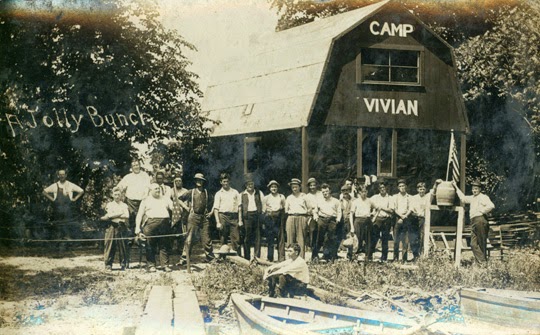
Between 1910 and 1913, Henry Klieger operated a saloon at 445 First Street in Sandusky. He and his wife Jeannette lived above the business. The men above are standing in front of the boat named the “Vivian” outside Mr. Klieger’s saloon. It looks as though one gentleman took his beverage with him onto the boat.

  
Camp Vivian was a camp where amateur boxers trained, possibly on the Cedar Point peninsula.  To date we do not know the exact location of Camp Vivian. If anyone is familiar with Camp Vivian, please leave us a message in the Comments section of this website.   


All the picture postcards featuring the Vivian and Camp Vivian were created by Sandusky photographer E.H. Schlessman.

Monday, April 14, 2014

Joe F. Wieber’s Saloon


From about 1898 until 1910, Joseph F. Wieber operated a saloon at the southwest corner of Monroe and Pearl Streets. In its later years of operation, an ice cream parlor was also in business in conjunction with the saloon. Billiard tournaments were a popular event at Joe Wieber’s saloon in the late 1890s. According to the Sandusky Star of October 7, 1899, the “well known handlers of the cue” in the grand pool tournament included: Joe Siegrist, Andrew Polta, William Bauer, Daniel Damm, Albert Hemmerle, Frank Thompson, Armand Wintersteller, Casper Georgen, Joe Wieber, and a Mr. Baker. Pinochle tournaments were also held at Wieber’s saloon on occasion. 

By 1912 Joe Wieber’s saloon was no longer  listed  in the Sandusky City Directory. Mr. Wieber’s occupation by that time was recorded as inspector, and he was living at 908 Pearl Street. A variety of other individuals and businesses were located at the southwest corner of Monroe and Pearl Streets through the years, including a restaurant run by Clarence Herzog, and the Great Atlantic and Pacific Tea Company, better known to most residents as the A & P store. By the early 1960s, Jimmy’s Bar was in business at the site of the former Wieber saloon. 

Joseph F. Wieber passed away on September 26, 1938, at the age of 54. He was survived by his widow, a son, a daughter, and many other relatives. Funeral services were held at the Frey Funeral Home, and burial was in Calvary Cemetery. 

Monday, September 09, 2013

Conrad Leonhiser Grocery


From 1873 until the late 1890s, Conrad Leonhiser operated a grocery store at the northwest corner of Reese and Hancock Streets. During some of its years in business, a saloon was also connected to the grocery store. You can see the exact location of Mr. Leonhiser’s business in the 1886 Sanborn Fire Insurance Map. The saloon was at 733 Hancock Street, and the grocery was at 735 Hancock Street. (Street numbers changed at least twice during the years of operation of the grocery store.)


Notes on the original picture identified the individuals. From left to right are: Conrad Leonhiser, Mrs. Gundlach, and Mrs. Conrad Leonhiser. On the wagon are Henry Leonhiser (left) and Mr. Heinzerling (right.)


Brooms and produce can be seen in the front of the store, while lamps, bottles and other items line the shelves inside the store. Acme soap was one item sold by Conrad Leonhiser.


 On August 1, 1896, Conrad Leonhiser died at the age of 63. His funeral took place the family residence at 731 Hancock Street. The Odd Fellows and Druids attended the funeral of Conrad Leonhiser. An article in the August 4, 1896 issue of the Sandusky Register reported that Mr. Leonhiser’s funeral was largely attended, and friends and family remembered him with beautiful floral arrangements. He is buried at Oakland Cemetery.

Thursday, October 11, 2012

Hohler’s Place


In the 1890s, Daniel Hohler operated a grocery store and saloon at the northwest corner of Barker and Camp Streets in Sandusky, Ohio. After their father’s death in 1899, Frank J. and Henry L. Hohler took over the business. The nickname of Henry L. Hohler was “Blink.” He can be seen in a long apron on the right side of the picture above. An article in the January 30, 1958 issue of the Sandusky Register stated that Blink Hohler was a big-hearted man, who gave money to charity generously. “He wore a constant smile, and was never known to have said a disparaging word against any man. He was a ‘soft touch’ for those who came to him with hard luck stories.” Henry L. “Blink” Hohler died on December 25, 1912. Funeral services were held at the Hohler residence, which was connected to the family business.

After the death of his brother, Frank J. Hohler continued the grocery store and saloon. When Prohibition went into effect, Hohler’s place became a grocery store. By 1937, the Miller Drug Store was in business at 1031 Camp Street, the former location of Hohler’s Place.

Pictured below is a baseball team in front of Hohler’s Place in the very early twentieth century. “Blink” Hohler is again wearing a long white apron.