Showing posts with label Lake Shore Electric Railway. Show all posts

Saturday, April 08, 2023

Harry L. Cole, Erie County Sheriff


Harry Lewis Cole was born in Huron, Ohio in 1879 to Mr. and Mrs. Angus Cole. For twenty years, he was a conductor on the Lake Shore Electric Railway.

Lake Shore Electric Railway Car No. 41 near Sandusky Car Barns

From 1924 to 1929, Harry L. Cole served as the Erie County Sheriff. As this term was during Prohibition, often he was called on to arrest those who were engaged in consuming or selling intoxicating liquor. An article which appeared in the February 22, 1925 issue of the Sandusky Star Journal reported that Sheriff Cole had started “relentless warfare against the flask, jug or bottle toter.”


On January 1, 1929, the Sandusky Star Journal featured a summary of Sheriff Cole’s accomplishments during his final year as Erie County Sheriff. In 1928, there had been over 300 prisoners at the Erie County Jail.

During Sheriff Cole’s term the County Jail was on West Adams Street

The article also stated that number of automobile accidents had been reduced in Erie County during 1928. After his term as Sheriff ended, he founded the Harry L. Cole Insurance Agency. Mr. Cole died on May 27, 1960. He and his wife M. Viola Cole, who survived her husband until 1977, were buried at the Scott Union Cemetery.

To learn more about the many elected officials of Erie County, Ohio, see the book Elected to Serve Erie County, Ohio, 1838-2003 by Patty Dahm Pascoe. It is housed in the Reference Services area of the Sandusky Library.

Sunday, February 14, 2021

Sandusky’s Valentine was a Sleet Storm in 1909


Between February 14 and 16, 1909 a severe ice and sleet storm coated most of central and northern Ohio. Local weather official E.E. Nimmo reported that the track of the storm was very narrow, heading from east to west along the lake. Sandusky was in the very center of the storm’s fury. Many telephone, telegraph and electric wires were damaged, under the weight of three quarters to an inch of ice. Trains and interurbans were delayed, and the Lake Shore railroad had to resort to using manual signals, due to having no electricity.

John A. Giedeman, from the Sandusky Telephone Company, stated that “It is the worst storm of the kind we have ever had.”   The telephone company sent out ten men to work on the damaged wires. The electric company did not lose its ability to generate electricity, but it could not get that energy out to the local customers due to so many wires being damaged.  Residents and businesses resorted to using old gas lights and candles. The fire alarms in Sandusky were all out of service. Local police officers assisted in removing trees and downed wires that fell across the city’s streets and walks. The picture below shows a portion of Columbus Avenue, at the intersection of Hayes Avenue. 

In the picture postcard below, you can see Old Calvary Church on the left side of the picture, old fire engine house number 3 in the center, and Sycamore School can be seen in the background on the far right. There was severe damage to telephone poles and wires at this location, near the intersection of Sycamore Line and First Street.

Employees of the Lake Shore Electric Railway are seen  clearing the right of way on Camp Street in the postcard below.


An article in the February 16, 1909 issue of the Sandusky Register thanked those who helped the storm edition of the Register get to press. The Register staff had to hand-set the type. The Sandusky Democrat loaned a non-electric motor to the Register, and Ohio Motor Company brought in a 15 horsepower engine to help the press room get the paper out. 25,000 readers of the Sandusky Register got their papers delivered at 2 p.m. on Monday, the day after the big sleet storm first hit. 

To read more about Ohio’s severe sleet storm on 1909, visit the Sandusky Library Archives Research Center, where historical issues of local newspapers are available on microfilm and online.

Tuesday, December 08, 2020

Lake Shore Electric Railway Tracks on Columbus Avenue

These pictures from the Sandusky Library Archives Research Center show work being done on the Lake Shore Electric interurban railway tracks on Columbus Avenue in the 1920s.

Large piles of crushed stone can be seen in the picture below next to the tracks.

Taking a closer look at the images allows us to see what stores were in operation at this time in Sandusky. Area residents were still sending telegrams at the Western Union station in downtown Sandusky.


The J.C. Penney store was relatively new to Sandusky at this time. Matthes Coal had a large advertising sign above the People's Loan and Savings Company at the northwest corner of Columbus Avenue and Market Street. You can see the sign for the State Theater in the first block of Columbus Avenue, towards the waterfront.


The Eugene Close shoe store and Bamberger’s millinery shop, both on the east side of Columbus Avenue, were popular places for local residents to visit in the 1920s.

A large group of people is watching as the crew continues their work on the Lake Shore Electric tracks, near Ritter’s Cigar Store and Holzaepfel Brothers Sporting Goods.

Visit the Sandusky Library Archives Research Center to view these and hundreds of other historic photographs from Sandusky and Erie County.

Thursday, September 26, 2019

A Photographic Postcard from the Perry Centennial


This photographic postcard was taken at the time of the Perry's Victory Centennial which commemorated the one hundredth anniversary of Oliver Hazard Perry’s victory at the Battle of Lake Erie. Sandusky’s celebration took place on September 8 and 9, 1913. Columbus Avenue was decorated with flags, lights, banners, and patriotic bunting. Visitors to the Perry Centennial arrived by the interurban electric railway and automobiles, and then boarded boats to travel Put in Bay on South Bass Island.


On the west side of Columbus Avenue, one of the shops on the street level of the West House hotel hung a banner promoting their services for the developing of Kodak camera prints.


A café and restaurant on the east side of the street were open for business to serve meals to the many visitors to Sandusky and the Lake Erie Islands region.


The Lake Shore Electric Railway Co. transported people to Sandusky from all points on the system, which included Cleveland, Lorain, Elyria, Norwalk, Bellevue, Fremont, Toledo, and many stops in between, while the steamer Arrow made two trips daily to Put in Bay, Lakeside, Kelleys Island, and Middle Bass. 

Taking a closer look at this postcard allows us to see the energy and excitement that was associated with the celebration of this historic event. To learn more about the event, view the Official Souvenir Program of the Perry’s Victory Centennial, available online at the Internet Archive.

Wednesday, August 21, 2019

Marriage of Mr. Albert Brownworth and Miss Theresa Casper


This ornate marriage certificate was issued to Albert Brownworth and Theresa Casper on August 12, 1903. The couple was united in marriage at St. Mary’s Church in Sandusky, Ohio by the Rev. Joseph S. Widmann. Several verses of scripture are found on the certificate, and at the bottom of the certificate is a phrase often used in marriage vows, “What therefor God hath joined together, let no man put asunder.”  

An article in the August 12, 1903 issue of the Sandusky Evening Star reported that Albert Brownworth and Theresa Casper were married at 7:30 in the morning. Theresa was the daughter of Mr. and Mrs. Joseph Casper of 519 McDonough Street. She wore a gown of white mousseline de soie and carried a white prayer book. She was attended by Miss Louise Casper. Mr. Jacob Casper served as best man. A dinner was held in honor of the newlyweds on the evening of August 12, for relatives, close friends, and guests visiting from out of town. 

Albert Brownworth worked in the transportation industry for over fifty years. He was superintendent of equipment for the Lake Shore Electric Railway and the Lake Shore Coach Company. Mr. Brownworth died on June 8, 1962, and he was buried at Calvary Cemetery. Mrs. Theresa Brownworth passed away in October of 1967, at the age of 89. 

While we do not have a wedding picture of the happy couple, below is a picture of Albert Brownworth while he was at work. He is the man in the center of the picture.


Saturday, February 11, 2017

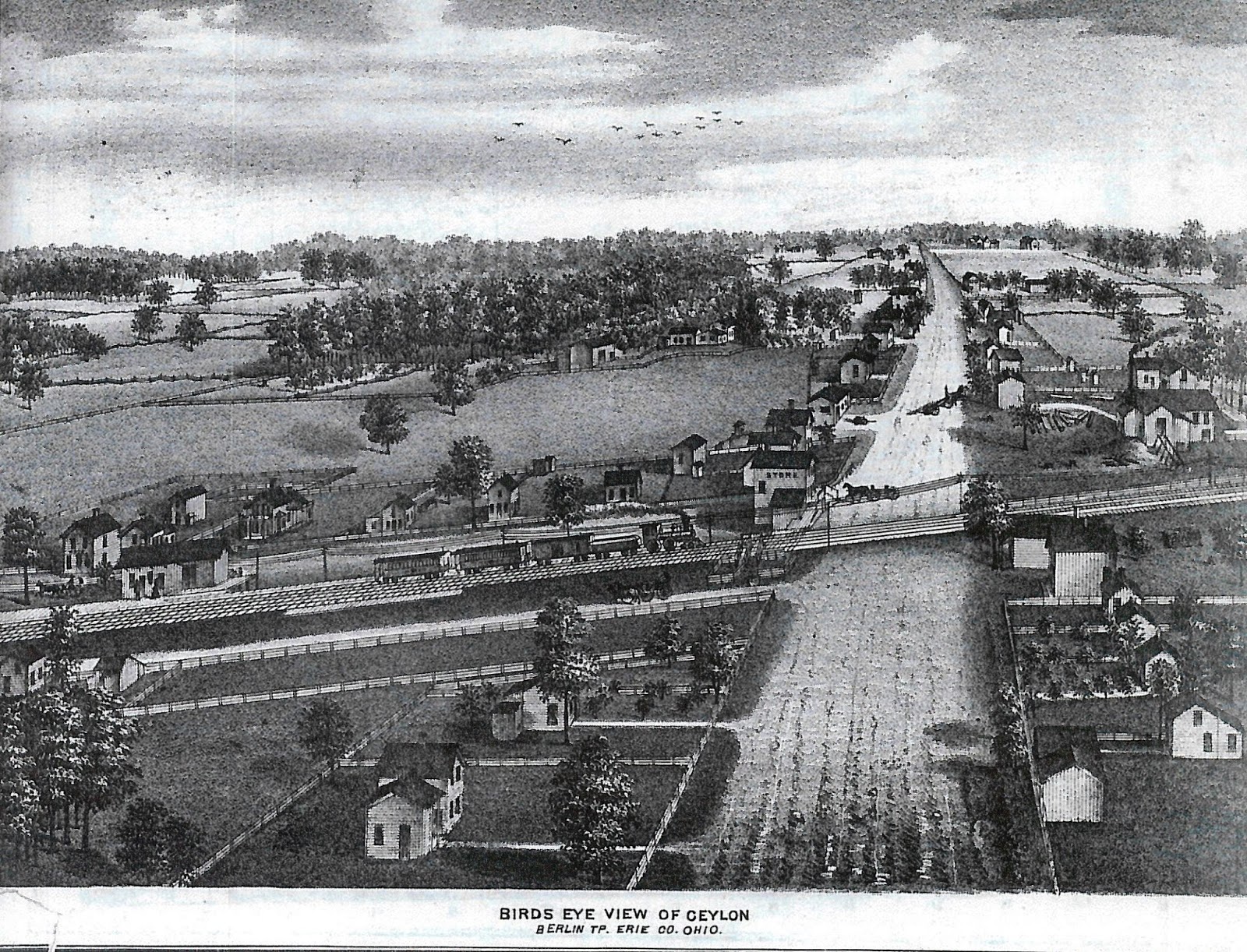
Ceylon, Ohio


Ceylon is a small unincorporated community north of Berlin Heights in Erie County, Ohio, along Route 61 and just east of Old Woman Creek. It was a stop for the Lake Shore and Michigan Southern Railroad, and later was a station on the Lake Shore Electric Railway route. A small refreshment stand served both automobile and interurban customers. Aldrich’s History of Erie County stated that in 1889 Ceylon had “two stores, two saloons, a hotel, a post office and a sawmill.”  The May 6, 1881 Sandusky Daily Register reported that Ceylon was “one of the leading shipping points on the Northern division of the Lake Shore Road.”  In the fall of 1880, twenty five thousand bushels of wheat were shipped out of Ceylon. There was a Post Office in Ceylon until September 14, 1904. (It was established as the Berlin Station Post Office in 1858, and the name was changed to the Ceylon Post Office on Oct. 2, 1871.)   Mail was delivered by stage coach for many years.

The Peake Cemetery is located just east of the intersection of Ceylon Road and Route 2. The cemetery was named after the Peake (sometimes spelled Peak) family which resided in the Ceylon area in the late 1800’s and early 1900’s. An obituary for Oliver Peak, one of Ceylon’s earliest settlers, is found in the July 1878 issue of the Firelands Pioneer.


The final line of Mr. Peak’s obituary says that “The deceased was an industrious farmer for many years, a man of sterling qualities, genial spirits, and went down before the Great Reaper as a shock of corn ripe for the harvest.”

Sunday, September 11, 2016

Postcard View of the Perry's Victory Centennial


This photographic postcard view of Columbus Avenue was taken at the time of the Perry's Victory Centennial which commemorated the one hundredth anniversary of Oliver Hazard Perry’s victory in the Battle of Lake Erie. Sandusky’s celebration took place on September 8 and 9, 1913. Downtown Sandusky was decorated with flags, lights, banners, and patriotic bunting. Visitors to the Perry Centennial arrived by the interurban electric railway and automobiles, and then could board boats to Put in Bay on South Bass Island.


On the west side of Columbus Avenue, one of the shops on the street level of the West House hotel hung a banner promoting their services for the developing of Kodak camera prints.


A café and restaurant on the east side of Columbus Avenue were open for business to serve meals to the many visitors to Sandusky and the Lake Erie Islands region.


The Lake Shore Electric Railway Co. transported people to Sandusky from all points on the system, which included Cleveland, Lorain, Elyria, Norwalk, Bellevue, Fremont, Toledo, and many stops in between, while the steamer Arrow made two trips daily to Put in Bay, Lakeside, Kelleys Island, and Middle Bass Island. Taking a closer look at this postcard allows us to see the energy and excitement that was associated with the celebration of this historic event. The Official Souvenir Program of the Perry’s Victory Centennial is available online at the Internet Archive.

Saturday, July 02, 2016

The Wilke Building in Downtown Sandusky


According to an article from the Sandusky Register of January 30, 1986, the Wilke building at 129 Columbus Avenue was originally part of the West House hotel.


The article said that retail stores were on the street level, while hotel rooms occupied the upper floors. 

In the early 1900s Carl H. Wilke purchased the building, and added a brick facade. (You can still see the surname Wilke at the top of the building.) The building has had a number of tenants through the years. In the mid-1910s, Carl F. and John M. Holzaepfel sold sporting goods and photography supplies at their store at 129 Columbus Avenue.  An article in the April 2, 1920 issue of the Star Journal reported that the Lake Shore Electric would soon occupy the Wilke building. The headline stated that the new home for the Lake Shore Electric would be the “finest on system,” as the stations in Cleveland and Toledo were not nearly as grand as Sandusky’s new station.


After the Lake Shore Electric interurban ceased operations in the late 1930s, 129 Columbus Avenue became the bus station for the Lake Shore Coach Lines and, for a time, the Greyhound Bus Lines. During World War II, a U.S.O. Service Center opened in the rear portion of the Lake Shore Coach station. Having started in 1941, the primary mission of the United Service Organization was giving social support to America’s troops. In contrast to the regimentation of military life, the U.S.O. strived to create a warm homelike atmosphere.


Many different businesses have been in operation in the Wilke building. In October of 1954, the Byer Brothers opened a new store at 129 Columbus Avenue. The new location was triple the floor space of its precious location which had  also been located on Columbus Avenue.


Eventually Marv Byer became the sold proprietor of the business, which became known as Marv Byer Clothiers; he and his wife purchased the property in 1967. In 1986 he was honored for his work in restoring the downtown building. By 2000, the By Design store was located at the site. The  Fabulous Female Boutique currently occupies 129 Columbus Avenue.

Thursday, June 02, 2016

Early Transportation in Sandusky had Horse Power


In the 1820s  mail was delivered to Sandusky by the mail stage. Passengers, as well as the U.S. mail, were transported from Sandusky to Norwalk, Mansfield, Mount Vernon and on to Columbus and then back again. Of course, since Ohio was known as the Gateway State, many families traveled by horse and covered wagons through Ohio as they made their way to the west. People who traveled to Sandusky could board a steamer to several different port cities along the Great Lakes. 

Pioneer Sandusky residents recognized the importance of railroad transportation, and showed interest in railway lines being developed in Sandusky as early as 1826. Ground was broken for the Mad River and Lake Erie Railroad in 1835; it began running from Sandusky to Bellevue in 1838, with trains pulled by the Sandusky Locomotive, the first locomotive with a steam whistle. Rail transportation made it easier for people to travel longer distances, and enabled the shipping of products, which in turn boosted local economies. 


In 1882 the first intra-city transportation route was begun by Charles and William H. Gilcher. It was known as the "herdic lines." Horse drawn passenger vehicles took people along three different local routes. The first route operated from the West House downtown to the Lake Shore and Michigan Southern Railway depot on the south side of town. The second route traveled from the West House to Oakland Cemetery. The third route was an east-west route from the city’s waterworks to Tiffin and Mills Streets. The Sandusky Railway was  the first street railway in Sandusky. It was begun in 1883 by L.D. Alcott, and featured fourteen-passenger side-seat cars that were pulled by two-horse teams. The route was double tracked, and went from the West House to the depot on North Depot Street, and back to the West House. You can see several people gathered around Sandusky’s first streetcar in the picture below, taken in 1883 by W.A. Bishop.


J.O. Moss purchased the Sandusky Railway in 1885, and organized more lines across the city.  An article in the November 27, 1947 Twin Anniversary Edition of the Sandusky Register Star News,  reported that the first electric streetcar operated in Sandusky in 1889 from Scott Street to the Soldiers’ Home, and linked with a spur track from Hayes Avenue. The Peoples Electric Railway Line was built in 1890, with financial support mainly from Sandusky residents. The charter of the Sandusky, Milan and Huron Electric Railway, later the Sandusky, Milan and Norwalk Electric Railway, was applied for in 1892. The line began operating in May of 1893 and connected with the local Sandusky lines.


Eventually all the local streetcar lines were absorbed by the Lake Shore Electric Railway, which was replaced by bus service in the late 1930s. 

As automobiles became more popular, more area residents began to drive their own vehicles instead of relying on public transportation.


However, public transportation is once again available to Sandusky residents as well as visitors to the area aboard the Sandusky Transit System, which operates three lines in the immediate Sandusky area. Sandusky’s Amtrak station operates out of the depot originally built for the Lake Shore and Michigan Southern Railroad. Several area boat lines also provide service to Cedar Point and the Lake Erie Islands. You can read more about the history of transportation in Sandusky, Ohio in the book Sandusky’s Yesterdays, by Charles E. Frohman.

Monday, September 01, 2014

At Work in Sandusky and Erie County


The warm weather in the summer months in northern Ohio allows for workers in a variety of occupations to get work done that is not easily accomplished in the cold months of the winter season. Sandusky photographer W.A. Bishop took the photograph above on July 25, 1908. Employees of the Erie County Courthouse can be seen looking out at Case equipment used to improve roads in Erie County. About 1920, Joe Staffler, Henry Scheid, and Fred Staffler were working on an outside project with a wheelbarrow and shovels.

In the picture below, taken in the early part of the twentieth century, a group of six men are working on a handcart along the Lake Shore Electric Railway in Milan, Ohio.


In this undated postcard, several men can be seen alongside an engine of the New York Central Railroad.


Visit the Sandusky Library Archives Research Center to view these and thousands of other historic photographs from Sandusky and Erie County, Ohio.

Thursday, May 22, 2014

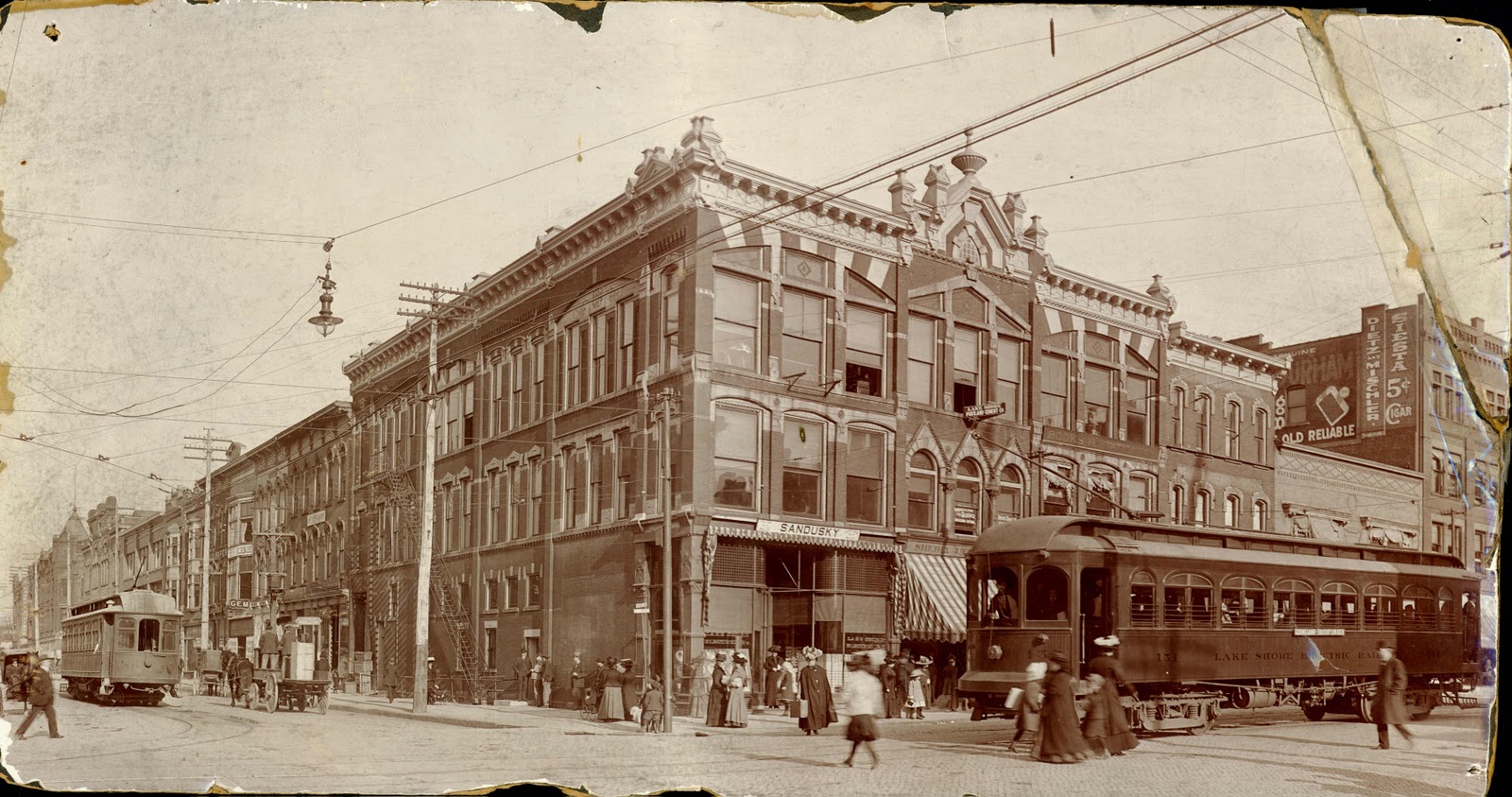
Early Twentieth Century Views of Stone’s Block


According to the Ohio Historic Inventory for Erie County, Stone’s Block was built around 1870 in the High Victorian style. The building features ornate cornices and ornamentation on the centered gable, and the windows have cut stone lintels. The building is located on the southeast corner of Columbus Avenue and Market Street. From the 1880s until 1908, the M. and A. Lebensburger men’s clothing store was in business at the street level of Stone’s block. From about 1910 to 1919, the Lake Shore Electric Railway had offices at the Stone Block. The postcard below refers to the Interurban Station in the building.


Here is a view of Stone’s Block and Market Street on a cold day about 1905.


From 1921 to 1964, the S.S. Kresge store was in business in the Stone’s Block, and the Jupiter store was there from about 1965 to 1985. Later businesses at Stone’s Block were Bourbon Street and Cabana Jack’s. A new business venture, the Small City Taphouse, is about to open in the building at 202 Columbus Avenue. The Stone’s Block has been a vital part of downtown Sandusky for over a century.

Monday, January 02, 2012

Holiday Dinner for Lake Shore Electric Railway Employees

The trainmen of the Lake Shore Electric Railway had a holiday dinner in a car barn in Fremont, Ohio on January 2, 1917. The only person identified is Joe Brownworth, the first person on the left. Elmer A. Whitney was the photographer. The Lake Shore Electric Railway was an interurban railway that ran between Cleveland and Toledo. It operated between 1901 and 1938, and was often called the streetcar.

For many years the Sandusky ticket office for the Lake Shore Electric Railway was in the Stone block at the southeast corner of Market Street and Columbus Avenue.

The Sandusky Library carries several books about the Lake Shore Electric Railway, including two authored by Harry Christiansen, and one by Herbert H. Harwood, Jr. and Robert S. Korach.

Tuesday, June 22, 2010

The Sandusky, Milan & Norwalk Electric Railway

Pictured below is Car No. 9 of the Sandusky, Milan & Norwalk Electric Railway, near the northwest corner of Monroe and Hancock Streets in Sandusky. William Brehm’s dry goods store is visible at the left. Notes with the original picture indicate that Walter Rieger is one of the boys in the photograph.


The Sandusky, Milan & Norwalk Electric Railway was in operation from Sandusky to Milan beginning in July of 1893. The line from Milan to Norwalk began running in September, 1893. The track connected with the Peoples Electric Railway in Sandusky. The electric railway car below is in Norwalk, Ohio.

In 1901 the Sandusky, Milan & Norwalk Electric Railway became part of the Lake Shore Electric Railway. The Lake Shore Electric Railway was closed out in 1938, with the Lake Shore Coach Co., a bus transportation facility taking its place. The Lake Shore Coach Co. was sold to Greyhound in 1949.

An earlier streetcar line in Sandusky, the Sandusky Street Railway Company, was drawn along the tracks by horse. Chapter XVII of Charles E. Frohman’s book Sandusky's Yesterdays, entitled “Trolley Days,” provides historical information about early transportation in Sandusky. A sixteen page illustrated booklet by R. G. Morrison, The Sandusky, Milan and Norwalk Electric Railway, is housed in the Transportation Collection of the Sandusky Library Archives Research Center. To view this item, inquire at the Reference Services Desk in the lower level of the Sandusky Library.