Showing posts with label Moss. Show all posts

Monday, December 18, 2023

A Photo of Family and Friends, and the Birth of Plum Brook Country Club.


In this photographic postcard Elizabeth Marsh and Florence Steinemann are gazing at Edward H. Marsh. Also looking at Mr. Marsh are George C. Steinemann and Lea Marsh. Edward H. Marsh worked with his father in the plaster business. He was a personal friend of William Howard Taft, with whom he attended school. Edward H. Marsh lost his wife Carrie at a young age, and he was left with two very young children to raise.

Lea Marsh was the son of Edward H. Marsh; he married Elizabeth D.G. Moss, the daughter of banker Charles H. Moss. Lea’s good friend was George C. Steinemann, a prominent Sandusky attorney. George was married to Florence Cable, who was the granddaughter of Sandusky businessman Frank Cable.

According to an article in the March 30, 2014 issue of the Sandusky Register, in 1913 Lea Marsh and George C. Steinemann, along with Watson H. Butler, sent out a letter, looking for people to invest in a golf course, to be located on Hayes Avenue and Strub Road, on property owned by August Pfaff. The “Sandusky Golf Club,” sometimes known as the “Auto County Club” was incorporated in 1914. By 1915, land was purchased off Galloway Road, and eventually became the golf course for the Plum Brook Country Club.

By 1930, Lea and Elizabeth Moss had moved to Old Lyme, Connecticut. When George C. Steinemann passed away in 1932, Mr. and Mrs. Lea Marsh traveled back to Ohio for his funeral, where Lea Marsh served as a pallbearer.

Wednesday, November 09, 2022

Ira C. Krupp, Veteran of the First World War


The image above of Captain Ira Charles Krupp appears in the Honor Roll of Ohio, 1917-1918, Erie County Edition. He served as a Captain in the Fourth Corps Artillery Park during World War I.

Ira C. Krupp was the son of funeral director Charles J. Krupp and the former Ida May Palmerton. At the turn of the twentieth century, the Krupp family resided at 404 Wayne Street, the former home of Oran Follett, which is now known as the Follett House Museum.

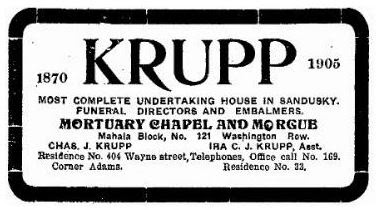
In 1901, Ira Krupp graduated from the Renouard training school for embalmers in New York City. By 1905, he was an assistant at the Krupp Mortuary Chapel. The Sandusky Star Journal of February 27, 1905 reported that he was seriously ill with blood poisoning that he had contracted through a small cut on his skin while embalming someone who had died from the same ailment. For a time, doctors thought they may have to amputate young Krupp’s arm. Fortunately, he recovered.


In 1906, he took a job as a sales representative with a large chemical manufacturing company, working in Boston, and traveling throughout New England. He married Emeline Moss in 1907; she was the daughter of Sandusky banker Charles H. Moss and the granddaughter of Judge William Griswold Lane.

The December 5, 1908 issue of the Sandusky Register featured an article that stated Mr. Krupp was now the proprietor of “Ye Oak Meadow” stock farm and dairy, on South Hayes Avenue. He had recently been at a large farm and dairy exhibit in Chicago, where he purchased a Guernsey bull, Messmate of Ingleside. He said about the animal, “It is one of the finest specimens I have ever seen in all of my experience and is bound to attract the attention of stockmen near and far.”

In 1917 and 1918, Ira C. Krupp achieved the rank of Captain with the Fourth Corps Artillery Park. While in military service in Germany during the war, Ira was the editor of the first American newspaper printed in Germany. The paper was called the “Fourth Corps Flare,” and was considered the official organ of the Fourth Corps Artillery Park. An article in the March 25, 1919 issue of the Sandusky Register featured an article about the publication.


After returning home from military service, Mr. and Mrs. Ira Krupp sold their land in Perkins Township, and moved to Black Hall, Connecticut, where they lived for several years. Ira Krupp died in 1935. His remains were returned to Sandusky. The final resting place of both Mrs. and Mrs. Ira Krupp is in the Lane family lot at Oakland Cemetery in Sandusky, Ohio.

Mrs. Ira Krupp, the former Emeline Moss, was once on the Board of Trustees of the Sandusky Library Association. Mrs. Krupp died in 1957 in Connecticut.


Though Ira and Emeline Krupp lived their final years in Connecticut, they had strong family ties to Sandusky and Erie County, Ohio. Visit the Sandusky Library Archives Research Center if you would like to research your own ancestors from Erie County, Ohio.

Friday, September 02, 2022

Mrs. Caroline Curtis Moss Wilcox


Caroline Curtis was born in Massachusetts in 1871 to Myron B. Curtis and the former Georgette Ainsworth. After her father died in 1880, Caroline moved to Sandusky, Ohio, and married Augustus L. Moss, of a family of bankers, in 1891. According to Hewson Peeke’s book, A Standard History of Erie County, Ohio (Lewis Publishing, 1916), Mr. Moss “had the advantages of being reared in a home of culture and wealth." A.L. and Caroline Moss had one child, Wolcott Griswold Moss; sadly, Wolcott died in an auto accident in 1915 at the age of 22. Mr. A.L. Moss died in 1917, and some believe that the loss of his only son contributed to his early death.

In 1921, Caroline Curtis Moss married Clinton B. Wilcox, a Sandusky businessman and veteran of the Ohio National Guard, who had become a widower in 1909. A newspaper article in the September 13, 1933 issue of the Sandusky Register reported that Mr. and Mrs. C.B. Wilcox had just returned to their home on Wayne Street, after spending the summer at their home on the Cedar Point Chausee.


Caroline became a widow again, when Clinton B. Wilcox died in 1933.

Caroline Curtis Moss Wilcox suffered a great deal of loss in her life, but she kept busy with community organizations. She was an early member of the Board of Trustees of the Sandusky Library Association, as well as the Daughters of the American Revolution, and the Nineteenth Century Club. 

Caroline Wilcox died on March 15, 1944. She was buried in Sandusky’s Oakland Cemetery.

You may recall from previous posts that in 1899, Caroline’s mother in law, Mrs. J.O. Moss, was successful in securing funds from Andrew Carnegie to go towards the building of a public library in Sandusky, Ohio.

Saturday, August 20, 2022

Mr. and Mrs. James Ellis Marshall


James Ellis Marshall was born in 1808 in Bradford, England. He came to the United States in 1855, having interests in the textile and iron industries in Berkshire County, Massachusetts. In about 1860 he settled in Sandusky, Ohio, where he became one of the incorporators of the Sandusky Tool Company, founded in 1869..

Mr. Marshall and his wife, the former Clara Robinson, were the parents of four children: Joseph Marshall, who moved west; Mary Elizabeth Marshall, the wife of Lewis Moss; Hannah Sophia Marshall, who married Rush Sloane, and sadly died in 1872; and Benjamin Marshall, whose death was believed to have been hastened by his experience in the 1900 flood in Galveston, Texas. Clara Robinson Marshall served on the Board of the Sandusky Library Association from 1870 to 1873.

Clara Robinson Marshall

Known as Deacon Marshall, James E. Marshall was very active in the Congregational Church in Sandusky. The Marshall family lived in this lovely Wayne Street home, built in the 1870s, now on the National Register of Historic Places.

According to the Ohio Historic Places Dictionary (State History Publications, 2008), the Marshall home was the first residence in Sandusky to be connected to the city’s new water and sewer lines. 

James E. Marshall died at the age of 98 on March 20, 1907. He and his wife were both interred at Troy, New York in the family vault at Oakwood Cemetery. Though Mr. and Mrs. Marshall were not born in Sandusky, and were not buried here, they definitely contributed greatly to the community in which they lived for over forty years.

Saturday, November 16, 2019

Augustus H. Moss, Pioneer Banker


Augustus Hitchcock Moss was born in the state of New York in 1810. He married his second cousin, Mary Esther Moss, in 1837, and the couple moved to Sandusky, Ohio.  Mr. Moss ran a general store at the western portion of Water Street in Sandusky beginning in 1837.  Later he sold part of his store to his brother Samuel, and kept part of the business as a hardware store until about 1850. 

At that time he became partners with his brothers in law, Truman and Horace Moss, in a banking business known as the Moss Brothers Bank. After the bank was nationalized in 1863, it was known as the First National Bank of Sandusky. By 1883 the bank was known as the Moss National Bank, with Augustus H. Moss serving as its president. In about 1903, the Moss Bank merged with the Second National Bank, to become the Commercial Banking Company. This bank failed in the 1930s during the Great Depression.

In 1842, Mr. Moss bought property from Oran Follett, at the northeast corner of Wayne and Jefferson Streets in Sandusky.


The Ohio Historic Places Dictionary states that the Follett-Moss-Moss residences in the 400 block of the eastern side of Wayne Street “provide a capsule history of the 19th-century styles in stone architecture in the city.” The A.H. Moss home was built in the Gothic Revival style. The home of Oran Follett, a personal friend of Augustus Moss, was located at the southeast corner of Wayne and Adams Street, at what is now 404 Wayne Street. The son of Mr. and Mrs. Augustus Moss, J.O. Moss, and his family lived next door at what is now 414 Wayne Street.

Augustus H. Moss died on December 6, 1888, after a brief illness. He had been known and respected among bankers throughout the United States. Mr. Moss was on the vestry of Grace Episcopal Church for over forty years. He was a trustee of Kenyon College for several years, serving on the Finance Committee. A lengthy obituary for Mr. Moss appeared in the December 7, 1888 issue of the Sandusky Register. It read in part, “A gentleman of quiet, dignified bearings, yet courteous, genial and frank, his familiar form and face will be greatly missed from our business circles, from the street, from the church and the social circle in which they have so long been seen.” Funeral services for Augustus H. Moss were held at the family residence on December 8, 1888. Many local business men attended the funeral, and all the banks in Sandusky were closed from 10:00 a.m. to 1:00 p.m. in memory of Mr. Moss. Rev. R.L. Howell, rector of Grace Episcopal Church officiated at the funeral services. Pallbearers included Rice Harper, Oran Follett, R.B. Hubbard, W.P. Chapman, Homer Goodwin, John M. Boalt, Clark Rude, and J.A. Graham. Private burial services were held at Oakland Cemetery.

Saturday, March 10, 2018

The Donahue Building


The building at 126 Columbus Avenue, now home to a resale shop operated by Stein Hospice, began as a bank building. The Moss Brothers Bank, founded by Augustus H. and Horace Moss, was at this location in the early 1850s.


In 1914, C. Faber and Frank Donahue moved their hardware store from Water Street to what is now 126 Columbus Avenue. Ellie Damm wrote in her book Treaure by the Bay (Western Reserve Historical Society, 1989), that the Donahues added the brick façade to the building as well as the stone carved name “Donahue” under the cornice. You can see the original limestone on  the south side of the Donahue building. Interestingly, Ellie Damm, who was well known for her efforts in local preservation, was a descendant of the founders of Donahue Hardware. In 1920, Lew and Ira Wiles purchased this property, and they ran the Dixie Cafeteria here. If you look closely, you can see the sign for the cafeteria in the picture below.
   

Many area residents will recall that the Sherwin-Williams store was in business at 126 Columbus Avenue from 1952 into the 1990s.


Thursday, June 02, 2016

Early Transportation in Sandusky had Horse Power


In the 1820s  mail was delivered to Sandusky by the mail stage. Passengers, as well as the U.S. mail, were transported from Sandusky to Norwalk, Mansfield, Mount Vernon and on to Columbus and then back again. Of course, since Ohio was known as the Gateway State, many families traveled by horse and covered wagons through Ohio as they made their way to the west. People who traveled to Sandusky could board a steamer to several different port cities along the Great Lakes. 

Pioneer Sandusky residents recognized the importance of railroad transportation, and showed interest in railway lines being developed in Sandusky as early as 1826. Ground was broken for the Mad River and Lake Erie Railroad in 1835; it began running from Sandusky to Bellevue in 1838, with trains pulled by the Sandusky Locomotive, the first locomotive with a steam whistle. Rail transportation made it easier for people to travel longer distances, and enabled the shipping of products, which in turn boosted local economies. 


In 1882 the first intra-city transportation route was begun by Charles and William H. Gilcher. It was known as the "herdic lines." Horse drawn passenger vehicles took people along three different local routes. The first route operated from the West House downtown to the Lake Shore and Michigan Southern Railway depot on the south side of town. The second route traveled from the West House to Oakland Cemetery. The third route was an east-west route from the city’s waterworks to Tiffin and Mills Streets. The Sandusky Railway was  the first street railway in Sandusky. It was begun in 1883 by L.D. Alcott, and featured fourteen-passenger side-seat cars that were pulled by two-horse teams. The route was double tracked, and went from the West House to the depot on North Depot Street, and back to the West House. You can see several people gathered around Sandusky’s first streetcar in the picture below, taken in 1883 by W.A. Bishop.


J.O. Moss purchased the Sandusky Railway in 1885, and organized more lines across the city.  An article in the November 27, 1947 Twin Anniversary Edition of the Sandusky Register Star News,  reported that the first electric streetcar operated in Sandusky in 1889 from Scott Street to the Soldiers’ Home, and linked with a spur track from Hayes Avenue. The Peoples Electric Railway Line was built in 1890, with financial support mainly from Sandusky residents. The charter of the Sandusky, Milan and Huron Electric Railway, later the Sandusky, Milan and Norwalk Electric Railway, was applied for in 1892. The line began operating in May of 1893 and connected with the local Sandusky lines.


Eventually all the local streetcar lines were absorbed by the Lake Shore Electric Railway, which was replaced by bus service in the late 1930s. 

As automobiles became more popular, more area residents began to drive their own vehicles instead of relying on public transportation.


However, public transportation is once again available to Sandusky residents as well as visitors to the area aboard the Sandusky Transit System, which operates three lines in the immediate Sandusky area. Sandusky’s Amtrak station operates out of the depot originally built for the Lake Shore and Michigan Southern Railroad. Several area boat lines also provide service to Cedar Point and the Lake Erie Islands. You can read more about the history of transportation in Sandusky, Ohio in the book Sandusky’s Yesterdays, by Charles E. Frohman.

Sunday, November 29, 2015

The Boalt Family of Sandusky and Norwalk


Pictured above is the former home of John M. Boalt, who was president of the Sandusky Wheel Company in the 1860s. John M. Boalt was the son of Captain John Boalt and Ruth Lockwood Boalt. His first wife was Sarah Follett, daughter of Oran Follett; she died at age 20 in 1844. (He later married Fanny Griswold.)


The Boalt family settled first in Norwalk, but moved to Sandusky around 1823, where Captain Boalt was the proprietor of the Steamboat Hotel. John and Ruth Boalt had a large family. Their daughter Amanda Boalt was the first wife of prominent Sandusky attorney George Reber. Daughter Clara Boalt married Samuel W. Butler, who had a large commission business in the early days of Sandusky. Susan Boalt married Samuel B. Caldwell, an early Mayor of Sandusky. Portraits of both Samuel B. Caldwell and Susan Boalt Caldwell are housed in the Sandusky Library Archives Research Center.


Another child of Captain John Boalt was Charles L. Boalt, who was a well known attorney in Norwalk, Ohio. He was also associated with the Toledo, Norwalk, and Cleveland Railroad. Charles L. Boalt’s daughter, Fanny, became Mrs. Jay O. Moss. Mrs. Moss was the driving force behind securing funds from Andrew Carnegie for the purpose of building a public library in Sandusky.  


Charles L. Boalt’s son was John Henry Boalt, who was a prominent lawyer in California. There is a Boalt Street in Sandusky as well as in San Francisco.


The Boalt family members were deeply involved in civic and business affairs in both Huron and Erie Counties and beyond. Several books in the Sandusky Library chronicle our area’s rich local history. Among the titles are: The Centennial History of Erie County, by Hewson L. Peeke; History of Erie County, edited by Lewis Cass Aldrich; and History of the Firelands, by W. W. Williams.

Wednesday, November 11, 2015

Sandusky Chapter of the American Red Cross was very Active during the Great War

Prior to the entry of the United States into World War I, and throughout the war years, hundreds of volunteers in Sandusky and Erie County worked tirelessly for the local chapters of the American Red Cross. Here are some of the volunteers of the Sandusky Chapter:


In 1916 a sewing room on the third floor of the Parish House of Grace Episcopal Church was used by local volunteers to sew night shirts for the office of the American Fund for French Wounded. Later work done at this location was for the American Red Cross. During World War I, the Sandusky Chapter of the American Red Cross made 59,043 surgical dressings; 13,775 knitted articles; and over 20,000 other articles. The members participated in five parades and raised money for Red Cross Nurses. Red Cross members participated in collecting items for the Tin and Lead Foil Drive and provided financial support to the emergency hospital for victims of influenza in Erie County. Mrs. Elizabeth D.G. Moss Marsh served as chairman of the surgical dressing committee of the Red Cross during the Great War years.


This 1917 American Red Cross display helped to promote the services of the local chapters of the American Red Cross during the War. It depicts a Red Cross nurse giving medical aid to a wounded soldier.


The participation of members of Sandusky and other Erie County chapters of the American Red Cross have been chronicled in detail in the Honor Roll, Erie County Edition, from pages 179 to 213. Many pictures are included on these pages, as well as the names of key individuals and their length of service with the Red Cross. Inquire at the Reference Services Desk to view this valuable local history resource. Military records of servicemen, including family details and brief service records are provided for hundreds of local men who served their country during World War I. Also included are details about the hundreds of local residents who lent aid to the war effort on the home front.


Tuesday, February 26, 2013

Martha Pitkin and the Sandusky Chapter, D.A.R.

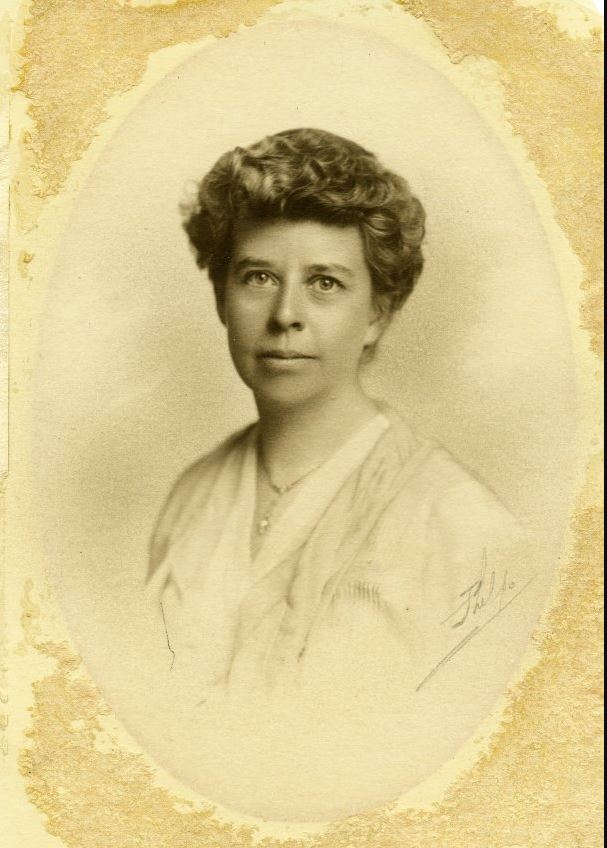
Mrs. E. Lea Marsh, nee Elizabeth Diodate Griswold Marsh, is pictured below. She is one of the many descendants of Martha Pitkin, whose name is associated with the Sandusky chapter of the Daughters of the American Revolution.

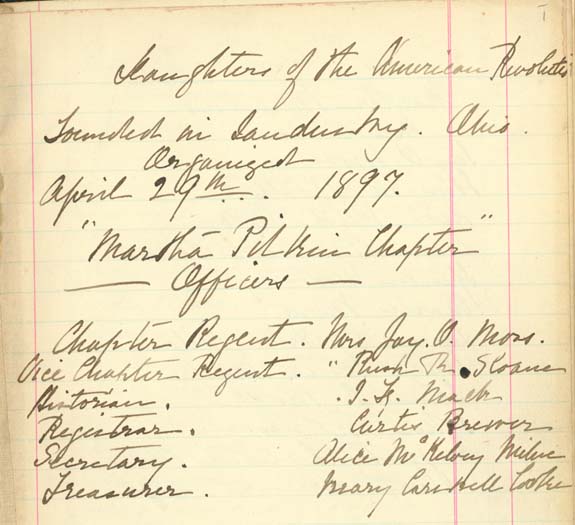
The founder, organizer, and first regent of the Martha Pitkin Chapter of the D.A.R. was Mrs. Jay Osborne Moss, who was born Frances Griswold Boalt. The local chapter was organized on April 27, 1897, with fourteen charter members. Mrs. Moss was a direct descendant of Martha Pitkin. Judges Ebenezer Lane and William G. Lane were also directly descended from Martha Pitkin and her husband Simon Wolcott.

A history of the Martha Pitkin chapter of the D.A.R. was reported in the May 1, 1927 Sandusky Register, on the thirtieth anniversary of the organization’s founding. Mrs. Curtis Schaufelberger, historian, wrote about Martha Pitkin: “Martha, a young woman of religious character, was possessed of a natural brilliancy of intellect, which was later on developed by an education in London. In addition to these attributes she was endowed with great beauty.” Charles Knowles Bolton wrote a “versified narrative” which describes the courtship of Martha Pitkin and Simon Wolcott. The title is On the Wooing of Martha Pitkin. Martha Pitkin was born in England. She came to the United States in 1661. Her first husband was Simon Wolcott. Among their descendants were five Connecticut governors. Martha’s grandson Governor Oliver Wolcott was a member of the Continental Congress and a signer of the Declaration of Independence. After the death of Simon Wolcott, Martha married Daniel Clark. Martha Pitkin Wolcott Clark died in 1719, and is buried in East Windsor, Connecticut.

The records of the Martha Pitkin Chapter of the Daughters of the American Revolution are located in the Archives Research Center of the Sandusky Library. Included in the collection are financial records, historian’s records, and several scrapbooks.

Reminder: Those interested in learning more about genealogy and the D.A.R. are invited to the Genealogy workshop sponsored by the Martha Pitkin Chapter, at the Sandusky Library, beginning at 10:30AM Saturday, March 2.

Friday, August 19, 2011

Jay Moss Home, 414 Wayne Street

The building at 414 Wayne Street was originally built as the home of Mr. and Mrs. Jay O. Moss in 1872.


A portion of the lot was a gift to the couple from Jay’s father, banker A.H. Moss. The remainder of the property was purchased from Oran Follett, who lived nearby at the southeast corner of Wayne and Adams Streets. The Martha Pitkin Chapter of the Daughters of the American Revolution was organized at the Moss home in 1897. In 1899 Mrs. Jay O. (Frances) Moss, who was acquainted with Andrew Carnegie, helped to secure a generous donation from Mr. Carnegie towards the building of the Sandusky Library.

In 1917, the home was purchased by Herbert Farrell, Sr., president of the Farrell-Cheek Foundry. The Sandusky Business Women’s club became the owner of this property in 1926, with financial assistance from the Women’s Building and Restroom Association. Meetings and social gatherings were held here, and apartments in the building were rented, to help pay for the upkeep of the building. For a few years in the 1970’s, the Harlequins owned the property at 414 Wayne Street, but they soon sold the main home to Mr. and Mrs. George Gilbert, who converted the building for use as apartments. The Harlequins retained ownership of the former carriage house for use in the group’s theatrical productions. Since 1984 the former Moss home at 414 Wayne Street has housed offices for several Sandusky attorneys.

Tuesday, May 04, 2010

Edward Lea Marsh and Elizabeth D.G. Moss

When Edward Lea Marsh married Elizabeth D. G. Moss, the society page of the Sandusky Daily Star reported that the bride and groom represented two of Sandusky’s largest and best known families.

Edward Lea Marsh was the son of Edward H. Marsh and Caroline Mackey Lea. Edward’s grandfather, Edward Lockwood Marsh, was a pioneer manufacturer of plaster of Paris in Ohio.

Edward Lea Marsh’s father, Edward H. Marsh, also in the plaster business, was a personal friend of President William Howard Taft. Elizabeth D. G. Moss was the daughter of banker Charles H. Moss and his wife, the former Elizabeth Griswold Lane. Elizabeth D. G. Moss’s grandfather William Griswold Lane and her great-grandfather Ebenezer Lane were both well respected judges in Erie County, Ohio.

The couple was married at the home of Mr. and Mrs. Charles H .Moss on Wayne Street in Sandusky. The Moss drawing room was decorated with palms and ferns. The two ministers who officiated at the wedding were Rev. Winfield Baer, rector of Grace Episcopal Church, and Rev. Dr. Gilbert of Southport, an uncle of the bride. The bridal party was made up of the best man, Vaughn McFall; ushers, Mr. Goodwin, Mr. Perkins, Mr. McKinley, and Mr. Hargrave; maid of honor, Miss Emeline Moss; and bridesmaids, Miss Ethel Mack, Miss Adah Kunz, Miss Knapp, and Miss Carrie Marsh.

While not all the individuals in the wedding party have been identified, the bridal party is pictured below, in a photograph taken by W.A. Bishop. Edward Lea Marsh is the young man seated in front. His bride, Elizabeth D. G. Moss Marsh, is the third person in the second row.

Emeline Moss (later Mrs. Ira Krupp) is the second person in the third row. Caroline Lea Marsh, sister of the groom, is the fourth person in the third row.
The wedding guests were served dinner in the Moss dining room, and each guest received a box of wedding cake, decorated with the monogram M M. After the wedding dinner, the couple left for their cottage at Plaster Bed in Ottawa County. Later they were to take a wedding trip to Black Hall, Connecticut. Pictured below are the newly married Mr. and Mrs. Edward Lea Marsh in Plaster Bed in Portage Township of Ottawa County.
When future President William Howard Taft visited Sandusky on September 8, 1908, Edward Lea Marsh was standing next to Mr. Taft in a photograph taken that day. (to Mr. Taft’s left.)
Edward Lea and Elizabeth Marsh had two daughters. One of them is pictured with her first grade class in Sandusky about 1910. Elizabeth Griswold Marsh is third individual from the right in the second row.
Helen Hanson wrote in At Home in Early Sandusky that Edward Lea and Elizabeth Marsh moved to Lyme, Connecticut in the 1920’s. Edward Lea Marsh died on November 21, 1937 in Old Lyme, Connecticut. An obituary for Mr. Marsh appeared in the November 22, 1937 issue of the Sandusky Daily News. He was survived by his wife , son, and two daughters, and a sister. Edward Lea Marsh had just been to Sandusky earlier that month, while on a business trip with the United States Gypsum Company. He had visited with many of his old friends at that time, and appeared to be in excellent health. Mrs. Marsh died in Connecticut in 1960. While many members of the Moss, Marsh, and Lane families are buried at Oakland Cemetery in Sandusky, Mr. and Mrs. Edward Lea Marsh were buried in Old Lyme, Connecticut.

Edward Lea Marsh, Jr., who died in 1996, was an attorney in Connecticut for sixty years, and was elected as State Representative from Old Lyme in 1937. He was Speaker of the House of the Connecticut General Assembly from 1945 to 1946. Edward Lea Marsh, Jr. lived on a pioneer farm in Old Lyme, and one of his cows was “Elsie the Borden Cow,” who was once exhibited at the New York World’s Fair.

Thursday, July 02, 2009

Wolcott Griswold Moss

The above photograph was taken at the residence of Thomas M. Sloane about 1915. The home, now located at 1415 Columbus Avenue, was first built in the 1840’s, as the residence of Sandusky’s first lawyer, Eleutheros Cooke. The house was dismantled in the 1870’s, and rebuilt a mile down the road. The Cooke House is now a museum, available for tours.

Seated in the Ford Roadster are Rush Richard Sloane, son of Judge Thomas M. and Sarah Cooke Sloane and Wolcott Griswold Moss, son of Augustus L. and Caroline Curtis Moss. Young Rush Richard Sloane was a descendant of one of Sandusky’s Mayors, Rush Sloane and also of Pitt Cooke, brother of Jay Cooke, Civil War financier. Wolcott Griswold Moss’s grandmother, Mrs. J. O. Moss was the person who successfully persuaded Andrew Carnegie to provide funds towards the building of the Sandusky Library.

Sadly, on August 3, 1915, Wolcott Griswold Moss was killed in an automobile accident in Lyme, Connecticut. He was buried in Sandusky’s Oakland Cemetery. The funeral for Wolcott Griswold Moss took place at the residence of Thomas M. Sloane.

Saturday, March 07, 2009

Mrs. G. Hunter Brown

Mrs. G. Hunter Brown, nee Cornelia Moss, was the daughter of Mr. and Mrs. Jay O. Moss. Mrs. Moss is known for her success in securing the sum of $50,000 from Andrew Carnegie for the purpose of the building of a public library building in Sandusky in 1900.

The family of Mr. and Mrs. Jay O. Moss lived for many years at 414 Wayne Street in Sandusky. The home was built in 1872, when Cornelia and her brother Augustus (known as “Gus”) were small children. A photograph of the J. O. Moss house is found on page 10 of Helen Hansen’s book AT HOME IN EARLY SANDUSKY.

In 1890, Cornelia Moss was married to George Hunter Brown. In 1900, the Brown family was living in Fishkill County New York, with infant Ursula. Mr. Brown’s occupation was listed in the U.S. Census as Vice President of a railroad. The family had a total of four servants living with them. By 1920 Mr. and Mrs. G. Hunter Brown were living in Manhattan, where at that time Mr. Brown was a wholesaler of sugar.

On December 31, 1909 the New York Times carried an article in the Society section of the paper when Mrs. George Hunter Brown gave a large dance at Sherry’s in honor of her daughter Miss Ursula Brown. Over 400 guests were received at the dance. The article gives details about the dresses of Mrs. Brown and her daughter. Mrs. Brown wore a gown of delft blue satin, while Ursula wore a white moiré dress with blue chiffon and glad and silver lace. Three orchestras played at the dance, which occupied two ballrooms at Sherry’s.

Though Mr. and Mrs. G. Hunter Brown lived most of their adult life in New York, they are both buried in the family plot of Oakland Cemetery, near the graves of Mr. and Mrs. J. O. Moss. Mrs. Brown died at the age of 84 in March, 1950. Mr. Brown died on January 1, 1963, in his 96th year.

The photograph of Mrs. G. Hunter Brown was scanned from a glass plate negative. Three boxes glass plates were generously donated to the Archives Research Center of the Sandusky Library.

Monday, February 25, 2008

The Grand Cosmorama of 1891

Before Mrs. Jay O. Moss was successful in her appeal to Andrew Carnegie for a donation of $50,000 for the purpose of the building a public library in Sandusky, Ohio, she belonged to a group known as the “Library Building Fund Association,” or L.B.F.A.

The Library Building Fund Association was organized in 1886 with the purpose of raising money to purchase or build a library in Sandusky. They worked diligently to secure funds by sponsoring plays, lectures, and musicals.

Pictured below is the program from the “Grand Cosmorama” held at the Opera House in Sandusky on April 3, 1891, under the auspices of the Ladies Building Fund Association.
The evening’s event opened and closed with selections from the Ladies Banjo Club. Several “living pictures” were acted out. The “Light Infantry” featured six children singing and acting. The “Wheel of Fate” number involved eight ladies in party costumes doing a drill with fans. The “Old Maids of Lee” was an amusing act in which the participants frantically tried to catch a man. Fifty Sandusky residents took part in the festivities.

Susie Selkirk (shown here in her Sandusky High School graduation photo, class of 1888) was one of the ladies who participated in the Grand Cosmorama.

See the Sandusky Daily Register of April 3, 1891 to read an account of the 1891 Grand Cosmorama, available on microfilm in the Archives Research Center of the Sandusky Library.

Mrs. Jay O. Moss addressed the Firelands Historical Society in 1900 and spoke about the history of the “Free Library” in Sandusky. (You can read her address in the 1900 “Firelands Pioneer.”) One of Mrs. Moss’s comments was especially poignant: “The dimensions of our building almost stagger us, for our income will be small and our size great, but if our object of bringing people and library together, in unity, acting in sympathy and sentiment, each with the other, can only be accomplished, our halcyon days are indeed upon us.”

The Sandusky Library website has a brief history of the library.

If you're in Ohio, remember to vote on March 4!