Showing posts sorted by relevance for query jay moss. Sort by date Show all posts

Friday, August 19, 2011

Jay Moss Home, 414 Wayne Street

The building at 414 Wayne Street was originally built as the home of Mr. and Mrs. Jay O. Moss in 1872.


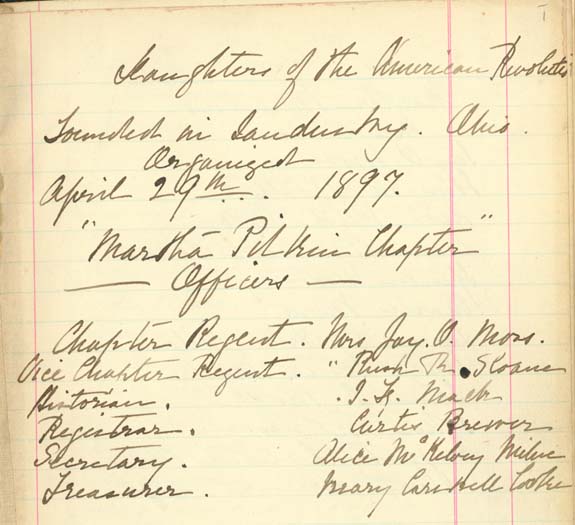
A portion of the lot was a gift to the couple from Jay’s father, banker A.H. Moss. The remainder of the property was purchased from Oran Follett, who lived nearby at the southeast corner of Wayne and Adams Streets. The Martha Pitkin Chapter of the Daughters of the American Revolution was organized at the Moss home in 1897. In 1899 Mrs. Jay O. (Frances) Moss, who was acquainted with Andrew Carnegie, helped to secure a generous donation from Mr. Carnegie towards the building of the Sandusky Library.

In 1917, the home was purchased by Herbert Farrell, Sr., president of the Farrell-Cheek Foundry. The Sandusky Business Women’s club became the owner of this property in 1926, with financial assistance from the Women’s Building and Restroom Association. Meetings and social gatherings were held here, and apartments in the building were rented, to help pay for the upkeep of the building. For a few years in the 1970’s, the Harlequins owned the property at 414 Wayne Street, but they soon sold the main home to Mr. and Mrs. George Gilbert, who converted the building for use as apartments. The Harlequins retained ownership of the former carriage house for use in the group’s theatrical productions. Since 1984 the former Moss home at 414 Wayne Street has housed offices for several Sandusky attorneys.

Saturday, March 07, 2009

Mrs. G. Hunter Brown

Mrs. G. Hunter Brown, nee Cornelia Moss, was the daughter of Mr. and Mrs. Jay O. Moss. Mrs. Moss is known for her success in securing the sum of $50,000 from Andrew Carnegie for the purpose of the building of a public library building in Sandusky in 1900.

The family of Mr. and Mrs. Jay O. Moss lived for many years at 414 Wayne Street in Sandusky. The home was built in 1872, when Cornelia and her brother Augustus (known as “Gus”) were small children. A photograph of the J. O. Moss house is found on page 10 of Helen Hansen’s book AT HOME IN EARLY SANDUSKY.

In 1890, Cornelia Moss was married to George Hunter Brown. In 1900, the Brown family was living in Fishkill County New York, with infant Ursula. Mr. Brown’s occupation was listed in the U.S. Census as Vice President of a railroad. The family had a total of four servants living with them. By 1920 Mr. and Mrs. G. Hunter Brown were living in Manhattan, where at that time Mr. Brown was a wholesaler of sugar.

On December 31, 1909 the New York Times carried an article in the Society section of the paper when Mrs. George Hunter Brown gave a large dance at Sherry’s in honor of her daughter Miss Ursula Brown. Over 400 guests were received at the dance. The article gives details about the dresses of Mrs. Brown and her daughter. Mrs. Brown wore a gown of delft blue satin, while Ursula wore a white moirĂ© dress with blue chiffon and glad and silver lace. Three orchestras played at the dance, which occupied two ballrooms at Sherry’s.

Though Mr. and Mrs. G. Hunter Brown lived most of their adult life in New York, they are both buried in the family plot of Oakland Cemetery, near the graves of Mr. and Mrs. J. O. Moss. Mrs. Brown died at the age of 84 in March, 1950. Mr. Brown died on January 1, 1963, in his 96th year.

The photograph of Mrs. G. Hunter Brown was scanned from a glass plate negative. Three boxes glass plates were generously donated to the Archives Research Center of the Sandusky Library.

Thursday, July 02, 2009

Wolcott Griswold Moss

The above photograph was taken at the residence of Thomas M. Sloane about 1915. The home, now located at 1415 Columbus Avenue, was first built in the 1840’s, as the residence of Sandusky’s first lawyer, Eleutheros Cooke. The house was dismantled in the 1870’s, and rebuilt a mile down the road. The Cooke House is now a museum, available for tours.

Seated in the Ford Roadster are Rush Richard Sloane, son of Judge Thomas M. and Sarah Cooke Sloane and Wolcott Griswold Moss, son of Augustus L. and Caroline Curtis Moss. Young Rush Richard Sloane was a descendant of one of Sandusky’s Mayors, Rush Sloane and also of Pitt Cooke, brother of Jay Cooke, Civil War financier. Wolcott Griswold Moss’s grandmother, Mrs. J. O. Moss was the person who successfully persuaded Andrew Carnegie to provide funds towards the building of the Sandusky Library.

Sadly, on August 3, 1915, Wolcott Griswold Moss was killed in an automobile accident in Lyme, Connecticut. He was buried in Sandusky’s Oakland Cemetery. The funeral for Wolcott Griswold Moss took place at the residence of Thomas M. Sloane.

Monday, February 25, 2008

The Grand Cosmorama of 1891

Before Mrs. Jay O. Moss was successful in her appeal to Andrew Carnegie for a donation of $50,000 for the purpose of the building a public library in Sandusky, Ohio, she belonged to a group known as the “Library Building Fund Association,” or L.B.F.A.

The Library Building Fund Association was organized in 1886 with the purpose of raising money to purchase or build a library in Sandusky. They worked diligently to secure funds by sponsoring plays, lectures, and musicals.

Pictured below is the program from the “Grand Cosmorama” held at the Opera House in Sandusky on April 3, 1891, under the auspices of the Ladies Building Fund Association.
The evening’s event opened and closed with selections from the Ladies Banjo Club. Several “living pictures” were acted out. The “Light Infantry” featured six children singing and acting. The “Wheel of Fate” number involved eight ladies in party costumes doing a drill with fans. The “Old Maids of Lee” was an amusing act in which the participants frantically tried to catch a man. Fifty Sandusky residents took part in the festivities.

Susie Selkirk (shown here in her Sandusky High School graduation photo, class of 1888) was one of the ladies who participated in the Grand Cosmorama.

See the Sandusky Daily Register of April 3, 1891 to read an account of the 1891 Grand Cosmorama, available on microfilm in the Archives Research Center of the Sandusky Library.

Mrs. Jay O. Moss addressed the Firelands Historical Society in 1900 and spoke about the history of the “Free Library” in Sandusky. (You can read her address in the 1900 “Firelands Pioneer.”) One of Mrs. Moss’s comments was especially poignant: “The dimensions of our building almost stagger us, for our income will be small and our size great, but if our object of bringing people and library together, in unity, acting in sympathy and sentiment, each with the other, can only be accomplished, our halcyon days are indeed upon us.”

The Sandusky Library website has a brief history of the library.

If you're in Ohio, remember to vote on March 4!

Tuesday, February 26, 2013

Martha Pitkin and the Sandusky Chapter, D.A.R.

Mrs. E. Lea Marsh, nee Elizabeth Diodate Griswold Marsh, is pictured below. She is one of the many descendants of Martha Pitkin, whose name is associated with the Sandusky chapter of the Daughters of the American Revolution.

The founder, organizer, and first regent of the Martha Pitkin Chapter of the D.A.R. was Mrs. Jay Osborne Moss, who was born Frances Griswold Boalt. The local chapter was organized on April 27, 1897, with fourteen charter members. Mrs. Moss was a direct descendant of Martha Pitkin. Judges Ebenezer Lane and William G. Lane were also directly descended from Martha Pitkin and her husband Simon Wolcott.

A history of the Martha Pitkin chapter of the D.A.R. was reported in the May 1, 1927 Sandusky Register, on the thirtieth anniversary of the organization’s founding. Mrs. Curtis Schaufelberger, historian, wrote about Martha Pitkin: “Martha, a young woman of religious character, was possessed of a natural brilliancy of intellect, which was later on developed by an education in London. In addition to these attributes she was endowed with great beauty.” Charles Knowles Bolton wrote a “versified narrative” which describes the courtship of Martha Pitkin and Simon Wolcott. The title is On the Wooing of Martha Pitkin. Martha Pitkin was born in England. She came to the United States in 1661. Her first husband was Simon Wolcott. Among their descendants were five Connecticut governors. Martha’s grandson Governor Oliver Wolcott was a member of the Continental Congress and a signer of the Declaration of Independence. After the death of Simon Wolcott, Martha married Daniel Clark. Martha Pitkin Wolcott Clark died in 1719, and is buried in East Windsor, Connecticut.

The records of the Martha Pitkin Chapter of the Daughters of the American Revolution are located in the Archives Research Center of the Sandusky Library. Included in the collection are financial records, historian’s records, and several scrapbooks.

Reminder: Those interested in learning more about genealogy and the D.A.R. are invited to the Genealogy workshop sponsored by the Martha Pitkin Chapter, at the Sandusky Library, beginning at 10:30AM Saturday, March 2.

Tuesday, July 23, 2013

Pitt Cooke


Pitt Cooke was the son of Sandusky’s first lawyer, Eleutheros Cooke, and his wife, the former Martha Carswell. He was born on July 23, 1819 in Bloomingville, Ohio, in a building that had formerly served as the Bank of Sandusky Bay.  (The bank was never chartered.)


Pitt Cooke was educated at the Norwalk Academy, and he attended college at Kenyon College, where he studied law. After passing the bar, he practiced law in Sandusky, Ohio with Lucas Beecher. Later he was in the forwarding and commission business with William Townsend, until 1849 when Mr. Townsend died in the cholera epidemic. After the Civil War began, he moved east to assist his brother Jay Cooke a banker was a significant financier of the financier of the Union military effort during the Civil War. Pitt continued to work at the banking house of Jay Cooke and Company in New York until 1873, when he moved back to Sandusky, Ohio. An article in volume 17 of the Firelands Pioneer stated about Pitt Cooke, “Few men were more competent or active in business than Mr. Cooke, and as a companion and friend he was always genial and pleasant. He was a man of large heart and warm, generous impulses, and ever ready to assist to the extent of his ability those who were in need.”    After the death of both Mr. and Mrs. William Townsend in 1849, Mr. and Mrs. Pitt Cooke took in their orphaned children, who were the younger siblings of Mrs. Cooke, the former Mary Townsend.

On December 13, 1879, Pitt Cooke died at his residence on West Washington Street in Sandusky. He left behind his wife and six children. Funeral services for Pitt Cooke were held at the family residence with several members of the Episcopal clergy present, including Rev. L. S. Osborn and Rev. A. Nicholas of Sandusky; Dr. S.A. Bronson of Mansfield; and Rev. Samuel Marks of Huron. Pallbearers were: Judge E.B. Sadler, Judge Rush Sloane, R.B. Hubbard, A.H. Moss, C.C. Keech, W.T. West, W.A. Simpson, and S.S. Hosmer. He was buried in the family lot at Sandusky’s Oakland Cemetery. 

Sunday, November 29, 2015

The Boalt Family of Sandusky and Norwalk


Pictured above is the former home of John M. Boalt, who was president of the Sandusky Wheel Company in the 1860s. John M. Boalt was the son of Captain John Boalt and Ruth Lockwood Boalt. His first wife was Sarah Follett, daughter of Oran Follett; she died at age 20 in 1844. (He later married Fanny Griswold.)


The Boalt family settled first in Norwalk, but moved to Sandusky around 1823, where Captain Boalt was the proprietor of the Steamboat Hotel. John and Ruth Boalt had a large family. Their daughter Amanda Boalt was the first wife of prominent Sandusky attorney George Reber. Daughter Clara Boalt married Samuel W. Butler, who had a large commission business in the early days of Sandusky. Susan Boalt married Samuel B. Caldwell, an early Mayor of Sandusky. Portraits of both Samuel B. Caldwell and Susan Boalt Caldwell are housed in the Sandusky Library Archives Research Center.


Another child of Captain John Boalt was Charles L. Boalt, who was a well known attorney in Norwalk, Ohio. He was also associated with the Toledo, Norwalk, and Cleveland Railroad. Charles L. Boalt’s daughter, Fanny, became Mrs. Jay O. Moss. Mrs. Moss was the driving force behind securing funds from Andrew Carnegie for the purpose of building a public library in Sandusky.  


Charles L. Boalt’s son was John Henry Boalt, who was a prominent lawyer in California. There is a Boalt Street in Sandusky as well as in San Francisco.


The Boalt family members were deeply involved in civic and business affairs in both Huron and Erie Counties and beyond. Several books in the Sandusky Library chronicle our area’s rich local history. Among the titles are: The Centennial History of Erie County, by Hewson L. Peeke; History of Erie County, edited by Lewis Cass Aldrich; and History of the Firelands, by W. W. Williams.

Tuesday, December 06, 2011

Captain George A. Brown

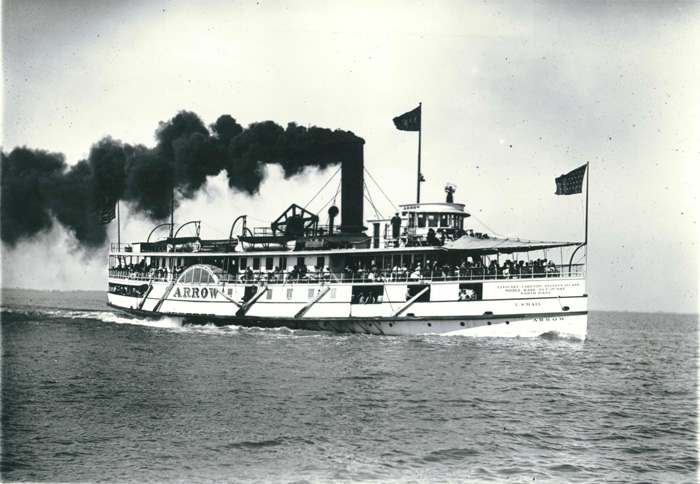
George Arthur Brown was born in Canada on December 6, 1841 to Joseph and Ann (Arbor) Brown. He began his long career with Great Lakes vessels as a deck hand when he was age sixteen. At age twenty one, he was made mate on a ship that operated out of Detroit. In the early 1860’s, Mr. Brown was appointed captain of the J.O. Moss, a ship owned and operated by the Gilcher & Shuck Lumber Company. Captain Brown was connected with several ships throughout his lengthy career. For a time he owned and operated the Champion, a ship that carried lumber. For thirty two years, Captain Brown was on the route between Sandusky and the Lake Erie Islands. He was captain of the steamers Jay Cooke, the City of Sandusky, and the Arrow.


An article in the December 22, 1910 issue of the Sandusky Register stated that Captain Brown “was known by practically every islander and many people from different parts of the United States, who acquaintance he made during the summer seasons…He was a personal friend of Grover Cleveland and many other notables. During all his experience as a lake captain he never met with a serious mishap.” After a lengthy illness, Capt. George A. Brown passed away at Providence Hospital, on December 21, 1910. He was survived by his wife, a son, daughter, and several siblings. The funeral for Captain George A. Brown was held on the day after Christmas in 1910 at the Masonic Temple. Burial was at Oakland Cemetery. Captain Brown was involved in many aspects of life on the Great Lakes. He transported mail, goods, as well as hundreds of individuals to a variety of locations in the Lake Erie Islands.

Tuesday, April 06, 2021

Historic Photos from the Sandusky Library

In commemoration of National Library Week, we are sharing some historical photos from the Sandusky Library.


Cora Rehfus looks up from her duties in the adult department of the Sandusky Library in the 1940s. Note the portrait of Andrew Carnegie above the book shelves. Through the efforts of Sanduskian Mrs. Jay O. Moss, in 1899 Andrew Carnegie, wealthy philanthropist, offered to give $50,000 for a public library in our city. 

In the picture below, Miss Mary McCann, longtime Head Librarian at Sandusky Library, checks out books in the Bookmobile, which operated in the 1950s and 1960s throughout Erie County. 


Long before Netflix and Hoopla, Mrs. Louise Kuemmel inspected and cleaned 16mm films from the Sandusky Library’s circulating collection of films. The film department of the library was in the basement, where the Sandusky Library Archives Research Collection is currently located. 


In August of 1980, Sandusky Library staff was delighted to have completed its inventory project.