Showing posts with label Pharmacies. Show all posts

Thursday, November 30, 2023

Doctors Aloysius and Louis Szendery


As seen in the advertisement above, Dr. Aloys (sometimes spelled Aloysius) Szendery and his son Dr. Louis S. Szendery shared an office at 622 Adams Street in Sandusky, Ohio, which is now in the 100 block of East Adams Street, after the street numbering changed in Sandusky in 1915. The ad appeared in the April 10, 1885 issue of the Sandusky Register. 

According to the Alumni Directory for New York University, Dr. Aloysius Szendery was born in Hungary in 1817. By 1860, Dr. Szendery and his wife Anna were residing in Bellevue, Ohio, where he worked as a doctor. They were the parents of four children. The oldest child, Louis S. Szendery, followed his father into the medical field. sadly, by the early 1890s, the younger Dr. Szendery faced serious health issues. He moved to Texas in hopes of his health improving, but he died there in 1896, leaving behind his wife, the former Elizabeth Westerhold, and a young son, Louis E. Szendery. Dr. Louis S. Szendery was only aged 36 at the time of his death.

Dr. Aloysius Szendery passed away at the age of 81 years and 11 months on August 31, 1898. An obituary from the September 1, 1898 issue of the Sandusky Register reported that Dr. Szendery was one of Sandusky’s oldest and well respected citizens. He was widely known, especially among the German residents of the community. During the last ten years of his life, the elder Dr. Szendery was totally blind. His funeral was held at Sts. Peter and Paul Church, and burial was at St. Joseph’s Cemetery in the family lot. A modest tombstone for the elder Dr. Szendery reads simply “Father.”

Anna Szendery, a daughter of Dr. and Mrs. Szendery, lived in Buffalo at the time of her father’s death. She died there in 1942, following a teaching career that spanned over fifty years at the Nardin Academy, which is affiliated with the Daughters of the Heart of Mary.

Louis Eugene Szendery, a grandson of Dr. Aloysius Szendery, and son of Dr. Louis S. Szendery, was trained as a pharmacist. For a time he was in the pharmacy business with Jay Meek. You can barely read the words “Meek & Szendery” in this sign on a building on Decatur Street. (The building no longer stands.) The partnership of Meek & Szendery was in business in Sandusky from 1916 to 1921. Louis E. Szendery eventually left his pharmacist position and became a salesman for a pharmaceutical company.


Louis E. Szendery died in 1974, and is buried at Calvary Cemetery next to his wife Verna (Ringel) Szendery. The name Szendery was familiar in Sandusky for several decades. If you would like to learn more about your own ancestors in Sandusky and Erie County, visit the Sandusky Library Research Center, where many sources related to family history and local history are housed.

Monday, January 01, 2018

Happy New Year!


In 1917 the first day of January occurred on a Monday, as it does in 2018. This calendar was a promotional item given away by Conrad Ebert, Jr.’s Avenue Pharmacy during the holiday season in December, 1916 and January, 1917. Mr. Ebert’s pharmacy extended from Columbus Avenue through to Hayes Avenue. Below is an interior view of the drugstore.


Wishing you a Happy New Year from the Sandusky Library Archives Research Center and Follett House Museum!

Wednesday, February 22, 2017

Historical Items from Sandusky Pharmacies

                       
This cabinet file once used for storing medicine labels is now housed in the attic level of the Follett House Museum. It had been used at the Sloane House Pharmacy, which was on the street level of the Sloane House hotel in Sandusky, beginning about 1890. Several different pharmacists worked in the Sloane House over the years, including H.K. Henkelman, Henkelman & Bechberger; Bechberger & Brown; Bechberger & Kubach, and Kubach and Buderer. Some of remedies on the labels are for Epsom salts, cod liver oil, boric acid and liniment. The label below from a container of pine tar capsules was purchased when Bechberger & Brown were partners in the Sloane House Pharmacy.


This apothecary bottle came from the pharmacy of Charles A. Lehrer, who had his business at the corner of Central Avenue and Decatur Street for several years in the first quarter of the twentieth century. He was the son of former Zion Lutheran Church pastor Rev. J. George Lehrer.
  
    
The compound of licorice powder is from the pharmacy of J.H. Emrich, an early Sandusky pharmacist.

    
This bottle of medicinal oil came from the E. J. Windisch Quality Pharmacy, which was in business in the 800 block of Hayes Avenue from about 1908 to 1925.

  
From 1898 until about 1930 Daniel Schaffer manufactured liniment. Advertisements claimed it to be the “greatest pain killer on earth.”  This advertisement for Schaffer’s Wonderful Liniment appeared in the Sandusky Star Journal on November 17, 1920:


Mihalovitch’s Hungarian Blackberry Juice was manufactured by a liquor dealer in Cincinnati, but was sold locally by nine different pharmacies in Sandusky in 1887. The juice was said to be a remedy for diarrhea, dysentery, cholera morbus (gastroenteritis), and all disorders of the bowels.


Sunday, October 04, 2015

Drug Stores at Hancock and East Monroe Street


From about 1880 until shortly before his death in 1933, Lewis A. Biehl operated a drugstore at the northwest corner of Hancock and East Monroe Streets. In the 1920s, an ice cream parlor was in the drugstore, making it convenient for customers to have a soda while they waited for their prescriptions to be filled. The early customers of Mr. Biehl arrived on foot, or by horse and buggy. From the 1890s to the 1930s, they could visit his drug store via the streetcar. By 1920 a Pennzoil service station was located kitty-corner to the Biehl store, at the southeast corner of Hancock and East Monroe Streets.


The Biehl drugstore was included in the listing of Sandusky neighborhood drugstores in this advertisement from the September 23, 1928 issue of the Sandusky Register.


Just as in the case of grocery stores, there were drugstores in most Sandusky neighborhoods in the late 1800s and early 1900s, before it was the norm for most families to own an automobile. The ad from 1928 suggested that if a person had a cold, a quick visit to the neighborhood druggist could help prevent pneumonia. The Sandusky Star Journal of July 28, 1939 reported that Harry J. Fisher would soon be having the grand opening of his drugstore at the building formerly occupied by the Lewis A. Biehl drugstore. Mr. Fisher had  remodeled the building, and moved the entrance to the Hancock Street side of the building. (The Fisher drugstore had previously been on West Washington Street.) All vistors to the newly remodeled Fisher Drug store received a souvenir. Below is a picture of the Fisher Drug store in 1955.


By 1957, Earl McGookey was the proprietor of the Fisher Drug Store. Eventually the drugstore became known as the Fisher-Buderer Drug Company. Today, the company is the Buderer Drug Company, a compounding pharmacy with locations in Sandusky, Avon and Perryburg. At GoogleMaps, you can see a recent picture of the intersection of Hancock and East Monroe Street.

Thursday, February 20, 2014

"It's Kleenex Time in America" -- Including Sandusky


In 1938 the window of the Bechberger and Kubach drugstore in the Sloane House in downtown Sandusky featured a display entitled “It’s Kleenex Time in America.” The display showed the Seven Dwarfs explaining why they liked Kleenex. Snow White and the Seven Dwarfs, an animated movie produced by Walt Disney in 1937, was still very popular in the U.S. at that time. In the display Doc said “Don’t  put a cold in your purse – use Kleenex.” Happy was happy about the price of Kleenex, which in 1938 was 13 cents for a package of 200, or 28 cents for a package of 500. Dopey said “I’m dopey because I was the last one to get the Kleenex habit.” The sign by Grumpy read, “Grumpy is so pleased with Kleenex  that he intends to smile soon.”


John H. Bechberger retired in 1945, after sixty years in the pharmacy business. Rol Kubach had joined the business in 1921. Prior to Bechberger & Kubach’s partership, John H. Bechberger had been in business with Henry Henkelman, and later with Nicholas Brown. Below is a picture from 1909 of the pharmacy at the Sloane House when it was operated by Mr. Henkelman & Mr. Bechberger. 

Monday, February 17, 2014

Advertising Card from Henry Eichler and Company


The 1882 Sandusky City Directory lists Henry Eichler and Charles A. Lehrer as manufacturers and dealers of German roots and herb bitters. (Unfortunately, we do not know which man is Mr. Eichler and which is Mr. Lehrer.) Their business, Henry Eichler and Co.,  was located at 420 Decatur Street in Sandusky, Ohio. Sandusky photographer C.A. Cross created this advertising card, now housed in the Sandusky Library Archives Research Center.


German root and herb bitters were a digestive aid, and it was felt that they helped “impurities of the blood” and many other health problems. Both Henry Eichler and Charles A. Lehrer were of German descent. Mr. Eichler eventually moved to Cleveland, Ohio, where he was a dealer in patent medicines. Both Charles A. Lehrer and his brother George Lehrer operated drugstores in Sandusky for several years. In his later years, Charles A. Lehrer moved to North Carolina, where he was engaged in vineyard culture.

Sunday, September 15, 2013

Walther’s Peptonized Port Sold in Sandusky

In August of 1903 the Sandusky Register featured several advertisements for Walther’s Peptonized Port.  


The ad above stated that Peptonized Port was helpful for “people who are nervous, cannot stand noise, start at the least unusual sound” and “get that fly-to-pieces feeling often.” The ad below informed consumers that the remedy was a combination of port wine and pepsin, with no added drugs or chemicals.


The remedy was considered a good tonic for dyspepsia, indigestion, and recommended for nursing mothers, invalids, and older people. Two sizes were sold in 1903, one for fifty cents, and a larger size for one dollar. Two drugstores that sold Walther’s Peptonized Port in Sandusky were Henkelman & Bechberger and L.A. Biehl. Henkelman & Bechberger operated their drugstore on the street level of the Sloane House hotel in downtown Sandusky.


L. A. Biehl’s drugstore was located at the corner of Hancock and East Monroe Streets.


Saturday, April 13, 2013

Carl L. Osberg’s Drug Store


In the early part of the twentieth century, for over twenty years Carl L. Osberg operated a drug store on the street level of the Odd Fellows building on Washington Row in downtown Sandusky. You can see row after row of bottles lined up behind the counter in the pharmacy.


 The soda fountain was a popular feature at Osberg’s.


After selling his business, Carl L. Osberg worked for a time in real estate in Detroit. In 1931 Mr. Osberg started the Estmont Company, a manufacturing chemists business which specialized in cosmetics. The Estmont Company was started in Detroit, but moved to Vermilion in 1932, where Carl L .Osberg ran the company with his sons Carl and Leonard Osberg. On April 21, 1947, Carl Osberg died in a nursing home in Lorain. He was buried in the family lot at Sandusky’s Oakland Cemetery. The Sandusky Library Archives Research Center is fortunate to have been given several vintage pictures of the former Osberg Drug Store. The interior views of the store remind us of a time gone by.

Monday, October 24, 2011

Conrad Ebert, Jr., Druggist

From about 1889 until his death in 1934, Conrad Ebert, Jr. was the proprietor of a drugstore located at 901 Columbus Avenue. The store extended from Columbus Avenue to Hayes Avenue. (The early house number was 807 Columbus Avenue.) Conrad Ebert, Jr. was born in Sandusky, Ohio 1860 to Conrad and Margaret Ebert, who were both natives of Germany. Mr. Ebert’s store had the words Deutsch Apotheke on one side of the store, which means German Pharmacy in English. The words Drugs and Medicines appear on the right side of the door to the business. Advertisements for Sen-Sen, Borden’s Malted Milk, and Ox-Hart chocolates can be seen in the windows.

An interior view of the drug store shows shelves lined with bottles and tins. Some of the products Mr. Ebert sold were Prof. Fields worm powder, Hostetter's Stomach Bitters, Mentholatum, Candy Cathartic Cascarets, and Colgate’s Tooth Powder. Gum and cigars were also carried at Mr. Ebert’s store.

Conrad Ebert, Jr. died on September 22, 1934, at the age of 73. He was among the oldest druggists in Sandusky at the time of his death, and he had been highly respected in the community. He was survived by his widow, the former Miss Emma Dornbirer, and a daughter Helen. Conrad’s son Paul died as a young man in 1922. Conrad Ebert, Jr. was buried in the family lot at Oakland Cemetery.

Tuesday, August 04, 2009

Lewis H. Ohly, Prescription Druggist

In the early part of the twentieth century, Lewis H. Ohly operated a drugstore at the southeast corner of Columbus Avenue and Adams Street, just opposite Emmanuel United Church of Christ. Lewis, his wife Lena, and sons Nelson and Stuart are pictured above about 1910. An advertisement from a 1910-1911 local mail directory stated the Lewis H. Ohly, Druggist, was the headquarters for goldfish and aquarium supplies. The drugstore also sold candy, cigars, and toilet articles.

Lewis H. Ohly died at his residence above the drugstore on April 18, 1918. The April 19, 1918 issue of the Sandusky Register reported that Mr. Ohly suffered from rheumatic trouble. Mr. Ohly had been a druggist for twenty five years, and had run his own business for the past eighteen years. Before opening his own drugstore, Lewis Ohly worked for W. A. Graham and Charles Lehrer in Sandusky.

Eventually Lewis Ohly’s son Nelson Ohly would own the Ohly Drugstore in Sandusky at 402 Columbus Avenue, the same location as his father’s drugstore. The building next to it, at 106-108 East Adams Street is on the National Register of Historic Places. Today the Lawyers Title building is on the site of the Ohly building.

(Edited to correct errors in description.)

Wednesday, April 01, 2009

Victorian Trade Cards from Graham Drug Store

Reaching a peak of popularity in the late nineteenth century, Trade Cards were used to advertise products and services. Often the cards were distributed by the manufacturer, and the name of the local merchant selling their product was stamped on the card.
A trade card advertising Dr. D. Jayne’s Expectorant and Vermifuge features a little girl and a dog, with the message on the back assuring customers that the remedies of Dr. D. Jayne were safe to use.
The card which pictures two hunters let area residents know that W. A. Graham was happy to supply medicines to both English and German speaking customers.
Lydia E. Pinkham’s Vegetable Compound was one of the best selling patent medicines in American history. Graham Drug Store carried this popular remedy.The Graham family operated a drug store in Sandusky from 1845 until 1926. An article in the Sandusky Register of March 15, 1915 reported that W. A. Graham “was one of the best known and best prepared druggists in this part of the state.” W. A. Graham had taken over his father’s drugstore in Sandusky. The Graham Drug Store building is featured in the newly published Downtown Architectural Walking Tour of Sandusky, Ohio, which lists 1868 as the date the building was constructed. (Daly’s Pub now occupies the building at 102 Columbus Avenue.)

To learn more about Victorian Trade Cards, here are three excellent online exhibits:

Victorian Trade Card Exhibit, from Miami University Libraries

The 19th Century American Trade Card, from Harvard’s Baker Library

Emergence of Advertising in America, 1850-1920, from Duke University’s Digital Collections

Monday, August 13, 2007

Lloyd-George Studios


In the 1927 City Directory the “Lloyd-George Studios” advertised studio props and scenery as well as production of pageants, plays, minstrels and reviews with amateurs. The proprietors of the business were Sandusky High School graduates Lloyd F. Weninger and George J. Lehrer. The Lloyd-George Studios continued in business until the late 1930’s, though it was managed by Mr. Lehrer alone for many years.


Lloyd F. Weninger (pictured above) was an artist and musician. He wrote a song entitled “Victory” for Sandusky High School in 1914, and he illustrated the booklet “Our City Sandusky” for the centennial celebration of the city of Sandusky. He went on to graduate from Carnegie Tech, where he taught for 31 years.

George J. Lehrer was a nationally known actor and director. He performed in Broadway, Vaudeville, and Hollywood productions but is best known for his one man show in which he portrayed Abraham Lincoln. The front page of the February 11, 1961 Sandusky Register has a feature article about George Lehrer’s Lincoln performances.

The Lehrer family has a long history of community involvement in Sandusky and Erie County. George J. Lehrer’s grandfather, Rev. J. G. Lehrer was an early pastor of Zion Lutheran Church, and his father, George T. Lehrer ran a local drugstore and was elected mayor of Sandusky in 1910, later serving as city manager.

Here is a view of the Lehrer Drug Store in 1904, at 1211 Washington Street.

Visit the Archives Research Center of the Sandusky Library to learn more about the early residents and businesses of Sandusky and Erie County.

Tuesday, June 27, 2006

Featured Site


Our featured site in history is the Emrich Brothers Apothecaries, later known as the Emrich Drug Store. It was located at 118 Columbus Ave., on the west side, between Market and Water Streets, and operated from the 1850s until the first decade of the twentieth century. Born in Bavaria, James Emrich opened his store in Sandusky probably around 1853; his brother Phillip came to Sandusky and joined him in the business in 1863. However, Phillip died in 1876, of "hemorrhage of the lungs," at the age of only 38.
Here is a portrait of James Emrich, taken probably when he was in his sixties or early seventies (in the 1890s):


(Photo taken from the W.A. Bishop Portrait Photograph Collection.)

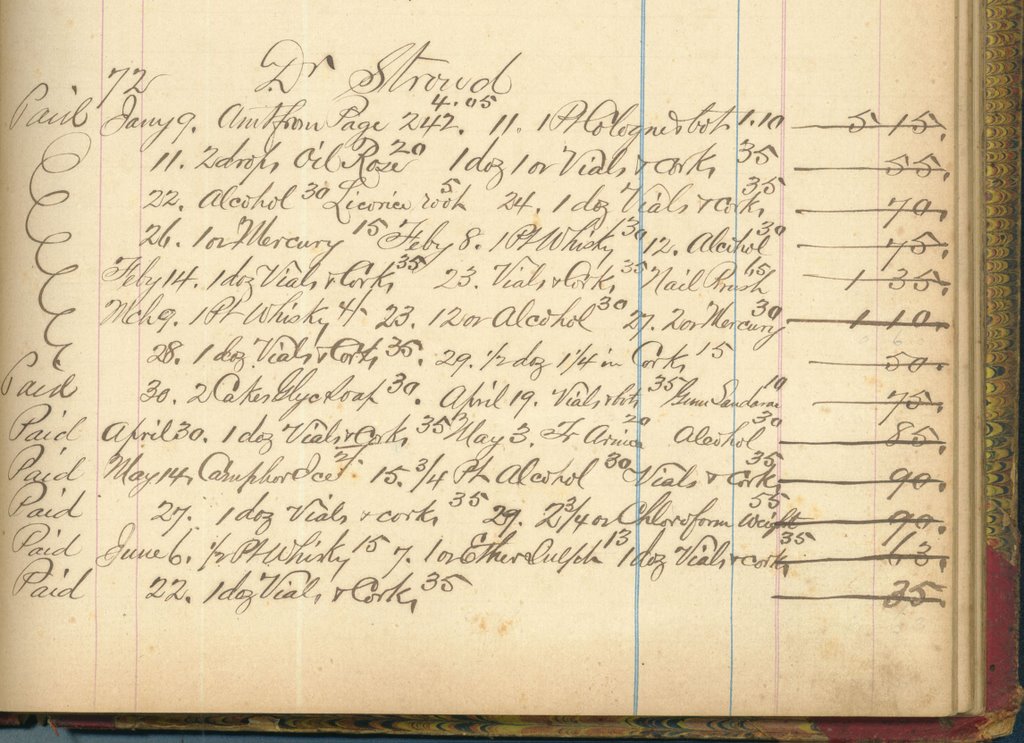
James Emrich ran his pharmacy for over fifty years, closing down the store only a few weeks before his death at age 80 in 1909. The Sandusky Library Archives Research Center possesses documents from the business, including ledgers from the 1860s and 1870s, and a folio book containing handwritten formulas for medicines and other products. Here is a sample of a page from one of the ledgers (notice the orders for whiskey for medicinal purposes):


You can find other life stories in the historical collections at the library.