Showing posts with label Shoe Stores. Show all posts

Tuesday, October 18, 2022

Advertisements from the W.O. Stubig Shoe Store


William O. Stubig began working in his father’s shoe store on Water Street in the 1890s. Christian Stubig, a German immigrant and Civil War veteran, founded the shoe store in 1866. After the elder Mr. Stubig’s death in 1904, William took over the shoe store. Frequently identified as W.O. Stubig, he believed in the power of advertising, often running ads in the Sandusky Register and the Sandusky Star Journal. In this ad from the October 5, 1906 issue of the Register, W.O. Stubig let customers know that he carried several popular brands of shoe wear, including the B. & P. “Korrect Shape” shoe.


The Star Journal of December 30, 1911, carried an ad which implied that shoes were an important feature of a woman wanting to appear attractive. Stubig was adept at fitting shoes for Sandusky ladies (and men.)


A "price wrecking" sale, with “the most stupendous shoe sacrifice ever known” began on December 9, 1919 at Stubig’s shoe store.


In a clever advertisement in the January 20, 1909 issue of the Sandusky Register, W.O. Stubig stated he would give a free pair of shoes to the first person to solve this rebus:


The lucky winner of the contest was Fred L. Werner. The solution to the puzzle is in the article below, from the Sandusky Register of January 24, 1909.


The W.O. Stubig shoe store closed shortly after the death of Mr. Stubig in 1956. 

Here is a picture of the Stubig shoe store while still under the management of the founder, Christian Stubig:

Prior to 1915, the store was at 754 Water Street. After street numbers changed in 1915, that address became 228 West Water Street. The building which once housed the well known shoe store was razed in 1965. A parking lot is now located at the spot where Stubig’s store once stood, near the southeast corner of Jackson and Water Streets.

Tuesday, August 30, 2022

Maus Shoes


After working as a salesman for W.O. Stubig’s shoe store, John N. Maus opened his own business on Market Street in Sandusky. The advertisement above, from the Sandusky Star Journal of July 6, 1916,  stated that the store's temporary quarters were above the Manhattan store. The German surname Maus translates to “mouse” in English, so a mouse was often seen in ads for Maus Shoes. By January, 1917, John Maus moved his shoe store to the upper level of the Schade Theatre building.


In May of 1920, the movie, A Regular Girl was playing at the Schade Theatre on West Market Street in Sandusky.

You can see signs for the Maus shoe store on the second floor of the building. The shoe store was next to the office of Dr. McCormick, the eye doctor.

In this 1935 advertisement, John Maus declared that he sold shoes that fit well, so that ladies could have proper shoes “for cooking and doing housework.”  By this time the theater on West Market had become the Ohio Theatre.


A notice in the November 18, 1968 issue of the Sandusky Register informed customers that Maus Shoes had moved from Market Street to 145 Columbus Avenue. This “back to school” ad appeared in the August 26, 1969 issue of the Register.


After the death of John N. Maus in 1977, his son Glenn Maus took over the business. After over sixty years of doing business in Sandusky, Maus Shoes had a large going out of business sale in May of 1984. Your parents or grandparents probably purchased shoes at this popular local shoe store!

A shoe horn from Maus Shoes is now in the collections of the Follett House Museum.


Tuesday, August 31, 2021

Starr & Dewitt, Dealer in Boots and Shoes

The owners and staff of Starr and Dewitt, dealers in boots and shoes are pictured in front of their business at 130 Columbus Avenue in downtown Sandusky about 1882. The proprietors of the business were Merrill L. Starr and Edward W. Dewitt. Mr. Dewitt later was active as a real estate agent in Sandusky.

Before entering into the shoe and business, Merrill L. Starr served as Erie County Sheriff from 1876 until 1880. He was also a veteran of the Civil War, having been with Company E of the 8th Ohio Infantry. In the 1884 Sandusky City Directory, M.L. Starr was in business with Howard C. Frederick at 130 Columbus Avenue. At this time the listing stated that Starr & Frederick manufactured and sold boots and shoes.

See our previous blogpost to learn more about Columbus Avenue, which has been home to a variety of businesses in Sandusky throughout its entire history.

Tuesday, June 23, 2020

Leo A. Sacksteder Sold “Shoes that are Different”


Mrs. Norman Steinert donated the buttonhook pictured above to the historical collections of the Sandusky Library Archives Research Center. The buttonhook came from Leo A. Sacksteder’s shoe store. It was an instrument used for pulling buttons through the button holes of shoes and gloves.

From about 1915 through the 1920s, Leo A. Sacksteder sold shoes in downtown Sandusky. He had several locations through the years, including on East Market Street, West Market Street, and two different locations on Columbus Avenue. Mr. Sacksteder came from a large Catholic family who had settled in Dayton, Ohio. His mother, Mrs. Helen Burkhardt Sacksteder, was originally from Baden, and his father, Nicholas Sacksteder, was a native of Alsace Lorraine.

In 1915 and 1916, advertisements for Leo A. Sacksteder’s shoe store were featured in the Fram, the yearbook of Sandusky High School. An ad which appeared in the January 1916 Fram states that “Shoes for graduation must have Character and Style and what Sacksteder says is so.”


This advertisement, from the November 1915 Fram, hints that if you buy shoes from Leo A. Sacksteder, your team will win the big football game.


Mr. Leo A. Sacksteder passed away on March 12, 1956. In his later years, he was a salesman for the Goodman Beverage Company of Lorain. Mr. Sacksteder was survived by his wife Antoinette, four daughters, two brothers, and three sisters. He was buried at Calvary Cemetery in Sandusky.

Thursday, November 07, 2019

C.F. Schumacher Shoe Store


From 1898 until about 1927, Charles F. Schumacher sold boots and shoes in Sandusky. In the 1900 U.S. Census for Erie County, Ohio, Mr. Schumacher stated that he was a shoe merchant. He listed his birthplace as Ohio, and stated that both his parents had been born in Germany. Until 1915, the C.F. Schumacher store was in business on the 100 block of Monroe Street; around 1916 the numbering of addresses changed, putting his business on the 600 block of East Monroe Street. 

When you look at the words on the outside of the stairway on the exterior of the Schumacher store, the name of the store has an image of a shoe replacing the first syllable of the owner’s last name, creating a clever logo for the business.


In 1911, the C.F. Schumacher store sold Ball Band rubber footwear, which were a popular item at the time.

In 1922, the Schumacher store sold Educator shoes.

In the Erie County Commissioners’ Report which appeared in the Sandusky Register of December 31, 1919, C.F. Schumacher’s name appeared in the list of expenses because he had done shoe repairs for residents of the Children’s Home. 

On October 27, 1927, Charles F. Schumacher died at the age of 56. He was survived by his widow, a son, daughter, two brothers and a sister. Mr. Schumacher had been an active member of the First Reformed Church. Funeral services were held at the family residence, with the Rev. V.J. Tingler officiating, and burial was at Sandusky’s Oakland Cemetery.

Wednesday, April 10, 2019

Early Sandusky Shoe Stores


Before John L. Rieger built the Rieger Hotel, he was in the shoe business. He began working as a shoemaker in 1876, and continued until 1917. Mr. Rieger’s advertisement read in part, “Protect your feet from the wet and cold, and thereby save your health. You can do this for the least money by buying your boots, shoes, rubbers and overshoes at Jno. L. Rieger’s.” His shoe store was at the corner of Hancock and Madison Streets. Many people will remember this location as the site of the former Wholf Hardware Store.


Another pioneer in the shoe and boot business in Sandusky was Leopold Federer. His ad from the late 1800s was printed in both English and German. In this particular advertisement, Mr. Federer offered boots and shoes that were “somewhat damaged” by fire and water at a reduced cost.


Long before online shopping became popular, people purchased their clothing, shoes, and other necessities of life at local stores that were close to their homes.

Unidentified Shoe Store

Monday, November 04, 2013

Isaac Grasgreen Boots and Shoes


From 1882 through 1890, Isaac Grasgreen operated a business that sold boots and shoes at 115 Columbus Avenue in downtown Sandusky. An advertisement for Isaac Grasgreen’s store, which appeared in the October 16, 1889 issue of the Sandusky Register, stated that Mr. Grasgreen could save customers from twenty-five cents to forty cents on each pair of school shoes purchased. The shoes ranged in prices from $1.00 to $1.75.


A listing by Mr. Grasgreen in the 1886 Sandusky City Directory stated that “fine custom work” was a specialty at the Isaac Grasgreen boot and shoe store. This promotional booklet was given to customers of the Grasgreen boot and shoe store.


By 1891 the Isaac Grasgreen family had moved to Toledo, Ohio, where he operated a saloon. 

Monday, October 28, 2013

Merrill L. Starr, Erie County Sheriff, 1876 to 1880


Merrill Leroy Starr was born in the state of New York in 1842 to Daniel and Bathsheba (Chadwick) Starr. The Starr family moved to Perkins Township, Erie County, Ohio in the 1850s. During the Civil War, Merrill L. Starr enlisted in Company E, Ohio 8th Infantry Regiment. Military records indicate that he was honorably discharged in 1863, after he was wounded at Antietam. According to Erie County Probate Court records, he married Kate Cooper on December 5, 1867. From 1876 to 1880, he served as Erie County Sheriff. Mr. Starr also was Superintendent of the Erie County infirmary in 1870 and in 1884-1885. In the 1880s, he was a partner in a shoe and boot business with E. W. Dewitt.


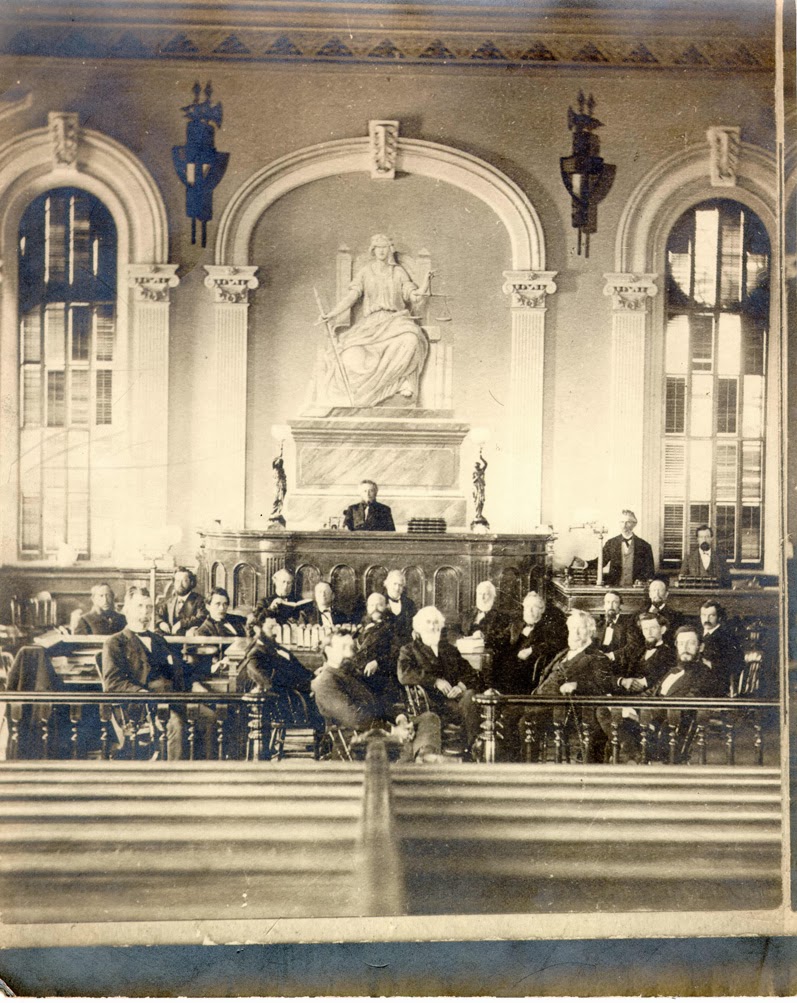
Merrill L. Starr died January 6, 1914 at the home of his daughter, Mrs. Alfred Huntley on Adams Street.  Mr. Starr was survived by his widow, four daughters, a son, a brother and a sister. He was buried in the Sand Hill Cemetery. Mr. Starr is sitting in front of the bench in the courtroom at the Erie County Courthouse in this picture taken in 1875.


To learn more about Merrill L. Starr and many other former Erie County officials, see Elected to Serve, by Patty Pascoe, in the Sandusky Library genealogy collection.

Saturday, November 24, 2012

Pietschman’s Shoes


Two youngsters are pictured above with a banner advertising an anniversary sale for Frank W. Pietschman, who was known as the “west side shoe-man.” Pietschman’s Shoe Store was located for several decades at the same location in Sandusky, at 417 Tiffin Avenue. The Twin Anniversary Edition of the Sandusky Register and Star News, from November 24, 1947 featured a full page advertisement for Pietschman’s Shoes.


The article stated that Frank Pietschman, a Civil War veteran, had first established a small shoe shop at 417 Tiffin Avenue in 1865. The original shop was a two story building with two rooms on the first floor and an apartment on the second level. Boots and shoes were custom made by six cobblers who were skilled in the art of shoe making. Frank Pietschman’s son William took over the shoe business in 1896. Though by this time, most people purchased ready-made shoes, one cobbler remained on staff for custom shoe orders. At the end of World War I, William’s son, who was named Frank William Pietschman, took over the family business. Young Frank W. Pietschman had served as an apprentice under his grandfather, and he had learned how to make shoes for individuals with deformed feet. In the year 1947, Frank W. Pietschman had been fitting people with corrective shoes for forty five years. Frank W. Pietschman passed away in October of 1979. Pietschman’s Shoes continued in operation, with the next generation of Pietschmans at the helm, for several years. Pietschman’s Shoes went out of business in the mid 1990s, but for decades it was known as one of the oldest and most outstanding shoe stores in northern Ohio.

Thursday, November 15, 2012

Stubig’s Shoes


According to History of Erie County, Ohio, edited by Lewis Cass Aldrich, Christian Stubig began manufacturing and selling shoes and boots in Sandusky, Ohio in 1866. Born in Nassau, Germany, Christian Stubig came to the United States in 1861. During the Civil War, Christian Stubig served with the Hoffman Battalion, where he guarded prisoners at Johnson’s Island. Stubig’s shoe store was located at 228 West Washington Street in downtown Sandusky.


In the 1890s Christian’s son, William O. Stubig, began working with his father at the Stubig’s shoe store, and William took over the business after his father’s death in 1904. Several employees of Stubig’s shoes can be seen in the 1910 picture below.

William O. Stubig died on November 15, 1956. An obituary for Mr. Stubig, which appeared in the November 17, 1956 issue of the Sandusky Register Star News stated that William O. Stubig had been one of Sandusky’s oldest and best known businessmen. Visit the Sandusky Library Archives Research Center to see more documents, photographs, and other primary resources related to the Stubig family.

Wednesday, June 02, 2010

Businesses in the 600 Block of Hancock Street in 1888

In 1888, three different businesses were in operation at the southeast corner of Hancock and Madison Street in Sandusky. The proprietors of the businesses, along with family members and employees are seen standing in front of their stores.

August M. Koegele had a dry goods store at 600 Hancock Street. “Gents Night Shirts” sold for fifty cents, and yards of percale fabric sold for under $1.00:
John L. Rieger, who also built the Rieger Hotel in 1912, sold boots and shoes at 602 Hancock Street:
Claussen Bros. Grocery was located at 604 Hancock Street. Canned goods can be seen in the window, and brooms and baskets were for sale outside the store. An advertisement on the door read “Drink Grain-O.” Grain-O was a cereal based coffee substitute, popular in the late nineteenth century.
A variety of businesses were in operation at this location throughout the years. Wholf Hardware was in business at the 600 block of Hancock Street from 1952 through the mid-1990’s. This property is now privately owned.

Thursday, August 20, 2009

Mystery Photos: Shoe Stores in Sandusky (or Elsewhere?)

Some of the most interesting photos in the library's collections are the ones we know little or nothing about. Here are three photographs of shoe stores that fit that description. We assume that these are scenes from Sandusky, but we don't know for sure. Do they look familiar to you? We can try to guess some things about the images by looking closely at the details in the picture. It is probably safe to say that the picture above was taken in the late 19th or early 20th century, judging from the design of the store and the clothes of the men. The original image is not sharp enough for us to read the signs in the background, but sometimes reading the signs might help you identify an unidentified image.
The next image is certainly from a later period than the first, judging from the more "modern" appearance of the store and the salesman. We can read some of the signs (the one in the center says: "Our terms are cash. These prices positively do not warrant any extension of credit."), but they don't really help us to locate this store. But as for the date, do you think, around 1920?

This is probably the most recent of the images, but perhaps not too far in time from the previous one. 1930s, perhaps? Clothing and shoe styles help to date this photo. (Look at the really short tie of the man on the right, for example.) Again, we don't have much else in the photo to help us determine the location of the store. We do see the prices for the shoes, which makes the scene even more interesting, and might be helpful for any shoe historians who view the image.

If you have any observations of your own -- especially if you recognize any of these stores or people -- feel free to add your comments.

Wednesday, July 16, 2008

"Die Gartenlaube"

Though the entire issue is not found, the cover of Die Gartenlaube (The Arbor, in English) is located in the Stubig Family Collection of the Archives Research Center of the Sandusky Library. The issue is dated January 1, 1870, and features a cartoon by X. A. W. Aarland. Die Gartenlaube was the most widely read magazine in Germany in the late 1800’s. It was first published in Leipzig in 1853, and later moved to Berlin, continuing publication until 1944. The weekly magazine featured many illustrations, serialized novels, and travel narratives.

The New York Times carried an article about Kurt Aram’s visit to the United States. The editors of Die Gartenlaube pondered how German immigrants could manage to live in the United States of America without knowing the language and having very little money. They decided to fund a project in which Kurt Aram, a German writer, would go to America with only twenty five dollars, and then report to the editors about his experiences in the new land. Mr. Aram told how he found food and lodging, obtained employment, and even managed to find a German restaurant that served authentic German beer and sauerbraten. For a book which gives a thorough look at Die Gartenlaube from 1853 – 1900, read Kirsten Belgum’s Popularizing the Nation, available for loan through ClevNet.
Christian Stubig was born in Nassau, Germany in 1835, and came to the U.S. in 1861, settling in Sandusky. (He is probably the man standing at the back of the group of men in this photo; the photo was taken in Nauheim, Germany, at a reunion of schoolmates in 1900.) He had a shoe business which was later carried on by his son William. Another son, Carl Stubig, had a local newspaper in Sandusky from 1914 through 1918, and was active in local politics. Christian Stubig served as a guard at Johnson’s Island during the Civil War and later re-enlisted in the 5th Regiment, U.S. Veteran Volunteer Infantry. An obituary honoring Christian Stubig in the Sandusky Register, July 20, 1904 stated that “Sandusky loses a prominent citizen.” Christian Stubig became fully involved in every aspect of American life, but he also remained in touch with his family members who remained in Germany. The Stubig Family Collection contains several letters to the Stubig family, as well as financial documents, postcards, and business and legal papers.

Here is a photograph of the Stubig Shoe Store located at 754 Water Street around 1904.