Showing posts with label Curtis. Show all posts

Friday, September 02, 2022

Mrs. Caroline Curtis Moss Wilcox


Caroline Curtis was born in Massachusetts in 1871 to Myron B. Curtis and the former Georgette Ainsworth. After her father died in 1880, Caroline moved to Sandusky, Ohio, and married Augustus L. Moss, of a family of bankers, in 1891. According to Hewson Peeke’s book, A Standard History of Erie County, Ohio (Lewis Publishing, 1916), Mr. Moss “had the advantages of being reared in a home of culture and wealth." A.L. and Caroline Moss had one child, Wolcott Griswold Moss; sadly, Wolcott died in an auto accident in 1915 at the age of 22. Mr. A.L. Moss died in 1917, and some believe that the loss of his only son contributed to his early death.

In 1921, Caroline Curtis Moss married Clinton B. Wilcox, a Sandusky businessman and veteran of the Ohio National Guard, who had become a widower in 1909. A newspaper article in the September 13, 1933 issue of the Sandusky Register reported that Mr. and Mrs. C.B. Wilcox had just returned to their home on Wayne Street, after spending the summer at their home on the Cedar Point Chausee.


Caroline became a widow again, when Clinton B. Wilcox died in 1933.

Caroline Curtis Moss Wilcox suffered a great deal of loss in her life, but she kept busy with community organizations. She was an early member of the Board of Trustees of the Sandusky Library Association, as well as the Daughters of the American Revolution, and the Nineteenth Century Club. 

Caroline Wilcox died on March 15, 1944. She was buried in Sandusky’s Oakland Cemetery.

You may recall from previous posts that in 1899, Caroline’s mother in law, Mrs. J.O. Moss, was successful in securing funds from Andrew Carnegie to go towards the building of a public library in Sandusky, Ohio.

Tuesday, June 29, 2021

The All American: Newsletters from the American Crayon Company


Seventeen issues of The All American newsletters from the American Crayon Company are housed in the business collections of the Sandusky Library Archives Research Center. The newsletters covered company news, information about the managers and employees of the company, photographs, poems, and travel articles. This item from the June 1922 issue paid tribute to the company president, L.L. Curtis, on the occasion of his seventieth birthday.

George Koch described the Art Department of the Kroma division of the American Crayon Company in the July 1925 issue. He stated that the view from his office, which faced Sandusky Bay, often gave him inspiration for his work. The employees in the Art Department created cover designs for the various styles and sizes of products.

In this article by C.W. Hord, who was with the American Crayon’s sales department for many years, he describes the process by which “Old Faithful” was chosen as a trademark for the company.

Though the American Crayon company is no longer in operation, for decades the company provided jobs locally and in other states for hundreds of individuals. To view the historic newsletters, which range in date from 1921 through 1925, visit the Sandusky Library Archives Research Center.

Sunday, July 28, 2019

"Bathing Beauties" in Sandusky


In the 1940s Vera Jean Curtis, Elizabeth Hitchcock, Grace Pietschman, and Mary Brohl posed on the S. S. Goodtime, bound for Cedar Point.


Beryl Starr, a young man, and the pilot pose on a "flying boat" airplane in Sandusky Bay in the 1920s.


Cedar Point’s sandy beach has been attracting swimmers for more than a century.


Saturday, October 28, 2017

A Wading Party at Bay Point


On October 1, 1916, a group of Sandusky residents had a picnic on the Sand Beach at Bay Point, in Ottawa County, Ohio. Below is a key which identifies the people in the picture.


Willard A. Bishop was a longtime Sandusky photographer. Phil Beery was a broker in Sandusky for over twenty years. Among the group were four sisters: Martha Anthony Brewer, Ida Anthony Woolsey, Jessie E. Anthony, and Minnie Sawyer, all daughters of pioneer Sandusky residents Mr. and Mrs. Lorenzo Dow Anthony. At the time of this gathering the Sandusky Bay Bridge had not yet been built, so it is likely that the group traveled from Sandusky to Bay Point aboard a steamer. Ferries traveled back and forth between Sandusky and Bay Point, where a rail connection to Toledo was available.

Sunday, October 15, 2017

Ione Klenk Wiechel’s Book Plate Collection

Bookplates (aka Ex Libris) have been a popular method throughout history for book owners to create a personalized method of showing ownership of their books. The creative quality and informational value of many bookplates has inspired collectors and artists. 


Mrs. Ione Klenk Wiechel, a longtime member of the American Society of Bookplate Collectors and Designers, shared her hobby of collecting bookplates, calligraphy, and miniature books with the community through an exhibit at the Sandusky Area Cultural Center from November through December of 1979.


After her death Mrs. Wiechel’s bookplate collection was donated to the Sandusky Library. The collection features bookplates owned by individuals and businesses of Sandusky and Erie County. 

This bookplate once belonged to Judge Ebenezer Lane, former Common Pleas Judge and Judge of Supreme Court of Ohio:


Esther Sloane Curtis was the granddaughter of abolitionist and former Sandusky Mayor Rush Sloane:


Author and local historian, Charles E. Frohman, was a past president of the Ohio Historical Society. His bookplate reflects his many interests, including nautical history, the theater, and the history of Sandusky industry. Mr. Frohman’s bookplate was designed by Norman Lonz and Harold Zeitsheim.


Daisy A. Kugel was graduated from Sandusky High School in 1896. She earned a Bachelor of Arts from the University of Michigan in 1900, and graduated from Columbia University in 1909. From 1911 to 1927, Miss Kugel served as Director of Household Arts at University of Wisconsin-Stout.


There are several more bookplates in the holdings of the Sandusky Library Archives Research Center. Ask for assistance at the Reference Services desk if you are interested in viewing Ione Klenk Wiechel’s bookplate collection.

Friday, October 11, 2013

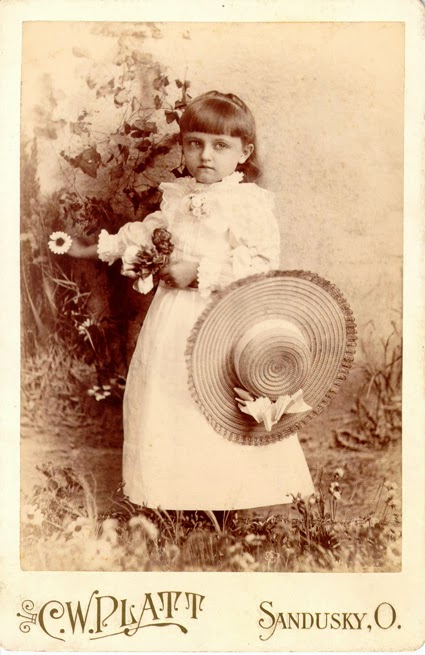
Portrait Photo of Louise Rinkleff


Louise Rinkleff is pictured on a cabinet card created by Sandusky photographer C.W. Platt about 1890. Louise was born in 1887 to George and Louisa (Taubert) Rinkleff. When Louise Rinkleff was just a small child, her mother died. An article in the June 19, 1923 issue of the Sandusky Star Journal stated that Louise spent many happy hours at her maternal grandparents’ home when she was a youngster. In the 1910 U.S. Census, Louise Rinkleff was aged 23, and she still resided with her maternal grandmother, Kate Taubert, in Sandusky. In the 1910 Sandusky City Directory, Louise Rinkleff’s occupation was listed as music teacher. Several newspaper articles through the years reported Louise Rinkleff as providing musical entertainment for church services, dances, and other community events. Her future husband, Frank Curtis, was also a popular local musician. In June of 1923, Louise Rinkleff married Frank Curtis. Both Mr. and Mrs. Curtis provided musical entertainment at the graduation ceremony of the Providencde Hospital School of Nursing in June of 1928. Mrs. Louise Rinkleff Curtis passed away on March 3, 1962 at the age of 75. She was survived by a half brother, and several nieces and nephews.

By looking at vital records, census records, and newspaper accounts about Louise, we were able to glean a few more details about the little girl in this lovely cabinet card.

Wednesday, March 21, 2012

The C.F. Denzer Company

An article in volume 85 of the American Stationer magazine reported that in 1919 Carl F. Denzer bought out the business of the George F. Windisch & Co. in Sandusky, Ohio. Mr. Denzer had been connected with Mr. Windisch for twenty-three years, and he had been a business partner since 1909. The C.F. Denzer Co. was located at 210-212 Columbus Avenue in the Stone Block. In the picture above, signs in the windows advertised safes, cabinets, filing supplies, and office furniture. Mr. Denzer also sold books, stationery, and sporting goods. Signs in the windows on the uppermost level of the building still featured the name of the previous owner George F. Windisch. A shoe store operated by George Ueberle and H. George Brengartner was just north of the C.F. Denzer Company. Right above the shoe store was the Christian Science Reading Room.

In a special “Ladies Night” sponsored by the Rotary Club in January, 1920, Carl F. Denzer was presented with a big barrel labeled Port Wine. Mr. Denzer pretended to open the wine and share with it with his friends, as the audience sang “How Dry I Am.” Since this event took place during Prohibition, there was most likely not any wine in the barrel.

During the Christmas season of 1921, the C.F. Denzer Co. advertised a wide variety of books, cards, games, and holiday decorations for Sandusky area residents. A title at the top of the list of books was A Web of Thought, by Marjorie Anderson, a native of Sandusky.

In September of 1926, Carl F. Denzer married Miss Corrinne Curtis, the sister of Worth Curtis. On August 23, 1940, members of the Ohio Stationers Club met at the new location of the C.F. Denzer Company on East Market Street. Mr. Denzer had sold the old C.F. Denzer building to the S.S. Kresge Company in March of 1940.

Carl F. Denzer passed away in California at the age of 59 on February 6, 1943. Though he had been in failing health, his death was unexpected. Carl F. Denzer was survived by his widow, two sisters and two brothers. Burial was at Oakland Cemetery.

Here is a postcard with a view of the Stone Block on Columbus Avenue, from the first quarter of the twentieth century:

Monday, April 20, 2009

The American Crayon Company


The American Crayon Company, steeped in Sandusky’s colorful history as one of the premier and foremost manufacturers of school art supplies and other industrial products in the nation during its time, originally grew out of the need for a high quality chalk. It soon branched out of a humble kitchen into a national company primarily operated and concentrated in the city of Sandusky. It expanded over time by merging with and absorbing other companies and redirecting its product line focus, and also established itself as a lifetime employer of countless Sanduskians. With the acquisition of Prang’s Educational Company around 1915, the American Crayon Company adopted and incorporated Prang Educational Company’s mission to make art accessible to the common American household and child by way of the public classroom, thus cementing its historical impact on a local and national scale.

In 1835, Dr. Francis F. Field, a dentist in Waltham, Massachusetts experimented with chalk, which was later developed into a commercial product by Parmenter, Powell & Powers Company to become known as Waltham Crayons. Similarly, Marcellus F. Cowdery, the first superintendent of Sandusky’s Public Schools, frustrated by existing chalks constantly scratching slate boards, encouraged his brother-in-law, William D. Curtis, to formulate an improved chalk. In the 1860s Curtis began conducting experiments in the kitchen of his small home, located on Hayes Avenue near Polk Street and was able to create a few sticks of pure white, processed chalk. Plentiful gypsum and limestone deposits, used in the production of this chalk, were conveniently located nearby, alongside Sandusky Bay. Initially, the business remained small and was operated out of Curtis’s kitchen, as he peddled the product from house to house. The invitation of John S. Cowdery, Marcellus’s brother into this new business venture, sparked company growth, as by 1869, John Cowdery’s cellar on Columbus Avenue became the center of operations for chalk production for the Mississippi and Ohio River Valley markets. By the late 1860s, the American Crayon Company had made the first tailor’s chalk, the first carpenter’s chalk, and in 1878 created the first railroad chalk. Originally labeled as the J.S. Cowdery Manufacturers the company quickly renamed itself Western School Supply in 1884 after expanding production facilities in 1881 near Hayes Avenue and Polk Street to meet the growing demands for school related products.

In 1890, the Sandusky based Western School Supply Company merged with Tiffin Crayon Company and the Parmenter Crayon Company in Waltham, Massachusetts to officially form and establish the American Crayon Company. On October 4, 1901, a fire destroyed the company’s original Sandusky plant, and a larger one on Hayes Avenue south of the New York Central Railroad tracks was opened in September 1902. The revitalized company began purchasing additional art supply companies in New England and the Midwest.
World War I interrupted commercial trade between many nations including the United States and Germany. Prang’s heavy reliance on German chemicals and products to manufacture its own items was impeded by decreased availability before and during World War I. These circumstances pushed Prang Educational Company and American Crayon Company into a merger in 1913. The combined companies organized their own small independent watercolor factory in Sandusky called Kroma Color Company. American Crayon Company’s complete take- over of the Prang Educational Company around 1915 gave them the rights to use the unmistakable “Prang” trademark of the “Old Faithful” geyser at Yellowstone National Park as their advertising logo symbolizing quality, value, and tradition. The American Crayon Company manufactured a long line of crayons, chalks, blackboards, erasers, watercolors, pencils, paste, cleaners, and other more industrial items, such as chalk for tailors, carpenters, textile mills, and railroad stockyards. The growing success and popularity of the American Crayon Company led to its prosperous operation at the original Sandusky plant through the 1920s to the 1950s.

In January 1957, the American Crayon Company became an affiliate of Joseph Dixon Crucible Company, based in Jersey City, New Jersey. The news was followed by high hopes and promises to continue labor operations in Sandusky and deter little from the existing set up. The unpredictable nature of business and changing economy led to the Bryn Mawr Corporation’s 1984 purchase of American Crayon’s parent company, Joseph Dixon Crucible. Dixon Ticonderoga, established much earlier than American Crayon Company, produced similar products but tended to focus more on industrial supplies. Although predictions and negotiations continued and were meant to reassure the ongoing operation of the Sandusky plant following its acquisition, gradually labor and plant operations along with a host of selected employees were outsourced to Canada and Mexico. Eventually, all the operations were progressively moved out of the original Sandusky plant, and it closed its doors in 2002 after 167 years of service in Sandusky, Ohio as a loyal and long-term employer in the community. American Crayon Company opened a new world of art to young children and provided a major source of employment for the local community, earning itself an important place in Sandusky’s history of development and business.