Showing posts with label Lea. Show all posts

Saturday, March 11, 2023

The John Rice Miner House

A daguerreotype image taken around 1876

The home at the southeast corner of Fulton and Washington Streets in Sandusky, Ohio, was built in 1868 in the Italianate style. In the 1870s and 1880s, the family of John Rice Miner resided here. Mr. Miner was a vice president of the Sandusky Wheel Company. The address of this home prior to 1915 was 934 Washington Street. By the late 1890s, Mr. and Mrs. Miner had moved to Fresno County, California.

Through the years, the house was sometimes a private residence, with an apartment upstairs, but often it was home to a variety of businesses. In the early 1900s, the Gilbert Harris family lived in the house. When Mr. Gilbert died in 1905, the Sandusky Register featured an obituary of the prominent businessman.


In 1937 Dr. James D. Lea had his “optical parlors” at what by then was 618 West Washington Street.


From about 1942 through 1973, Brownworth’s Furniture was in business on the site. In this advertisement from the May 7, 1953 issue of the Sandusky Register Star News, it appears that Philco radios were a popular item at the business.


The Darr Chiropractic office was in the house for much of the decade of the 1990s. In more recent years, a legal office has been in operation at 618 West Washington Street. Here is a recent view of the former home of John Rice Miner:

From Google Maps

Visit the Sandusky Library to learn more about the residents of Sandusky and Erie County, Ohio.

Monday, June 20, 2022

Edward H. Marsh, Friend of William Howard Taft


Edward H. Marsh was born in Cincinnati in 1851, and came to Sandusky with his father in 1872. Edward Lockwood Marsh, the father, was a pioneer in the gypsum business. Both Marsh men were involved with a plaster business in Sandusky, and later developed a larger gypsum business in Ottawa County. Edward H. Marsh eventually became the sole owner of the gypsum business.

In 1879, he married Caroline Mackey Lea, the daughter of James Davis Lea, a Sandusky businessman. She was known as “Carrie.” The couple was married by Rev. Josiah Strong at the Congregational Church. A reception was held at the home of Mr. and Mrs. Lea on Wayne Street, where the Great Western Orchestra provided musical entertainment. The couple left on the evening train for a trip touring the Southern United States. Upon their return, the newlyweds lived at a lovely home at the corner of Washington and Franklin Streets.

Sadly, on June 10. 1885, Carrie Lea Marsh died, leaving her husband a widower with two very young children, Edward Lea and Caroline Marsh. Mr. Marsh would never remarry. An article from the Grace Episcopal Church tells of Carrie Lea Marsh having been a Sunday School teacher at the St. Luke’s Chapel of Grace Episcopal Church for many years. The chapel did not have a bell, so after Mrs. Marsh’s death, a fund was designated for the purchase of a bell. This bell is now located just outside the side door of Grace Episcopal Church, in memory of Carrie Lea Marsh. The Marsh family also gave a processional cross and a window to Grace Episcopal Church.

After the death of Mrs. Marsh, Edward H. Marsh continued to live at 334 E. Washington Street. It was at this home that William Howard Taft visited Edward H. Marsh in 1908. The two were classmates in Cincinnati. Pictured below is William Howard Taft with Edward Lea Marsh in the front seat of an automobile. J. Warren Kiefer is sitting beside Edward H. Marsh in the back seat.


Edward H. Marsh died on December 17, 1921. On the day of his funeral, which was held at Grace Episcopal Church, the entire U.S. Gypsum Co. closed down, in respect of Mr. Marsh.

To read more about the Marsh and Lea families, see Helen Hansen’s book At Home in Early Sandusky at the Sandusky Library. This title is also available for purchase at the circulation desk at the library.

Wednesday, December 23, 2020

James D. Lea, Lumber Merchant


James Davis Lea was born on July 21, 1817 in Lycoming County, Pennsylvania. He moved with his family to Ohio when he was a young man. After working for a time as a school teacher and then as a carpenter, he established himself as a lumber merchant. Below is an advertisement from J.D. Lea’s business, from the 1855 Sandusky City Directory.

Through the years, Mr. Lea had several different partners in the lumber business, including Lewis Moss, Frank Sloane, and finally his son in law, Mr. William H. Herbert. In 1897 Mr. Lea retired from the lumber business, and in retirement devoted his time to real estate. The Lea Block, at the southwest corner of Wayne and Market Streets was named for James D. Lea.


His wife was the former Caroline Mackey, and together the Leas had six children, three of whom survived to adulthood. On  January 8, 1901, James D. Lea died at his home on Wayne Street. An article in the Sandusky Star of January 8, 1901 reported that Mr. Lea had been “one of the most prominent and respected citizens of Sandusky.” He was remembered as someone who was honorable and fair, and was missed by a wide circle of friends. Mr. Lea had been a trustee of the Sandusky Water Works, and was a member of the Science Lodge, Sandusky City Council, and the Knights Templar. Funeral services were held at the family’s residence on Wayne Street, under the auspices of the Science Lodge, and burial was at Oakland Cemetery.

Thursday, April 02, 2020

William H. H. Herbert, Businessman and Civic official


William Henry Harrison Herbert was born on April 24, 1839 in Hagerstown, Maryland. As a young man, he moved to Paw Paw, Virginia where he made his home with his sister. When the Civil War broke out, he fought for the Confederacy, enlisting in the 12th Virginia Cavalry. He spent time in a northern prison camp at Camp Chase in Columbus, Ohio. 

After the war ended, Mr. Herbert left his southern home, and moved north to Sandusky.  He married Elizabeth Davis Lea on November 15, 1877, and by the 1880s was engaged in the lumber business with J. D. Lea. In 1893, he was appointed collector of customs at Sandusky. He also served as a city councilman and on the board of the Water Works at Sandusky. 

On March 28, 1906, William H. H. Herbert died at the residence of his brother-in-law, Edward H. Marsh, on East Washington Street.


An article in the April 16, 1906 issue of the Sandusky Register said about Mr. Herbert, “He left his southern home and came north to engage in business and from that time to the day of his death conducted himself as a high-minded and honorable man of business, taking at the same time an active part in politics and also showing himself ready at all times to bear his share of any public burden connected with any enterprise for the good of the community in which he lived.”

Funeral services were held at the Edward H. Marsh home, with Rev. A.N. Slayton of Grace Church officiating. Members of the Elks and the city council and city officials were in attendance. Burial was at Oakland Cemetery. The pallbearers, all associates of Mr. Herbert were: Judge Thomas M. Sloane, C.W. Sadler, Fred Pickering, T. Pitt Cooke, C.T. Wight, Dr. John T. Haynes, W.H. Gilcher, and Alex M. Wagner. 

Sunday, October 19, 2014

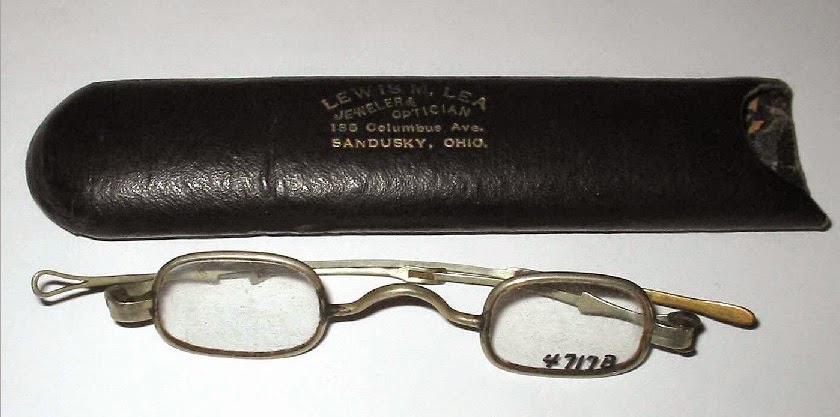
Lewis M. Lea, Jeweler and Optician


Lewis M. Lea was born in Sandusky in 1843 to James D. and Caroline (Mackey) Lea. James D. Lea was successfully engaged in the lumber yard business in Sandusky for many years. When Lewis M. Lea was twenty years of age, he enlisted in Co. B of the 145th Ohio Volunteer Infantry. After the end of the Civil War, he began a long career in the jewelry business, working as a jeweler and watchmaker in Sandusky in 1866.  He was first in partnership with other jewelers, including Joseph Bixby, Henry Dehnel, and a Mr. Greenfelder. In the 1888 Sandusky City Directory, Lewis M. Lea was listed as the sole proprietor of a jewelry business at 135 Columbus Avenue. He stayed at this location until 1917, when he moved the jewelry business to the Lea building at the southwest corner of East Market and Wayne Streets. 

Besides selling watches, clocks, jewelry and silverware, Lewis M. Lea was also an optician. An advertisement in the May 1, 1891 issue of the Sandusky Register stated that residents could secure their spectacles from Lea, the “graduate optician.”


An article in the December 9, 1911 issue of the Sandusky Register stated that Lewis M. Lea’s life was “like an open book.”  Mr. Lea was said to have large and well-selected stock, featuring “novelties of every selection” and a complete line of optical goods. 

On August 18, 1918, Lewis M. Lea passed away after an illness of six months. His obituary, found in the 1918 Obituary Notebook, stated that Lewis M. Lea had been one of Sandusky’s best known business men. Funeral services were held at the Masonic Temple. Several Ohio leaders in the Masonic order attended Mr. Lea’s funeral, which was solemn and impressive, according to an article in the August 22, 1918 issue of the Sandusky Register. At the funeral, Grand Commander Barton Smith presented Lewis M. Lea’s 33rd degree Masonic ring to his son, Jay D. Lea.  Lewis M. Lea was survived by his wife, one son, seven grandchildren, and a sister and brother. A son, Lewis W. Lea, had predeceased him. Lewis M. Lea was buried in the family lot at Oakland Cemetery. At the Follett House Museum you can view eyeglasses and silverware which were purchased from Lewis M. Lea’s jewelry store.

Friday, January 28, 2011

The Weekly Fly

 
The Weekly Fly was a small eight page newspaper published in the mid-1880’s. Harry Van Stack wrote in his column in the November 8, 1952 issue of the Sandusky Register Star News that the two young men who published this small weekly newspaper were Lucas J. Beecher and Lewis W. Lea, who were teenagers at the time they produced The Weekly Fly.
The paper featured news about local churches, clubs, sports, as well as editorials and advertisements from area businesses. It was printed at the Lea residence, at 1059 Columbus Avenue. (This address no longer exists.)
Lewis W. Lea was the son of Sandusky jeweler Lewis M. Lea. Sadly. Lewis W. Lea died in 1907, while he was not yet forty years old. Lucas J. Beecher went on to a successful career as a journalist, serving as a member of the editorial staff of The Toledo Blade from 1901 until his retirement in 1946. Lucas J. Beecher was named for his paternal grandfather, Lucas Beecher, a pioneer lawyer and abolitionist who was well known in Sandusky.