Showing posts with label Cemeteries. Show all posts

Wednesday, July 05, 2023

Leicester and Juliet Walker, Pioneer Residents of the Firelands


Pictured above is the home of Leicester and Juliet Walker, in Perkins Township, Erie County, Ohio. The home was at what is now the intersection of Milan road and Hull Road, on the west side of Milan Road.

 The Firelands Pioneer of September, 1876 states that Leicester Walker was born in Herkimer County, New York in 1796, and he was orphaned as a child. He settled in Sandusky in 1818, and assisted in building the first frame homes in the Sandusky area. He married Juliet Andrews of Richland County, Ohio in 1825. It is said that both Leicester and Juliet Walker often attended to the needy and sick. Leicester was an abolitionist who was “an active supporter of the government in its efforts to crush the slaveholder’s rebellion.” (Three of the Walker sons served in the Union Army during Civil War.) In 1832, Leicester and Juliet Walker moved to Perkins Township, and they raised a large family of seven sons and two daughters.

On March 31, 1875, the Walkers celebrated their Golden Anniversary. Unfortunately, not long after, on May 6, 1875, Leicester Walker died at his home in Perkins Township. Mrs. Walker died at the home of her daughter in Michigan on September 13, 1875. The Walkers were interred at Oakland Cemetery in Sandusky, Ohio.

The pioneer settlers of the Firelands area worked the land, established churches and businesses, and formed governmental units to oversee the region where they lived. To learn more about the earliest residents of Erie and Huron Counties, see the Firelands Pioneer a multi-volume set of books housed in the Reference Services section of the Sandusky Library.

Friday, June 02, 2023

When Johnson’s Island Was Known as Bull’s Island


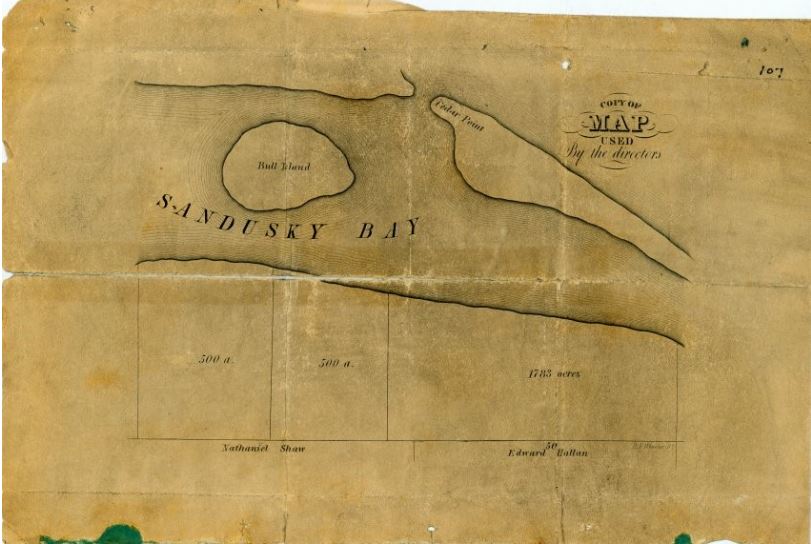
An early map of Sandusky Bay, published by H.F. Wheeler, is in the map collection of the Sandusky Library Archives Research Center. (A copy of this map was used as evidence in a case before the Ohio Supreme Court in 1844, "B. Lockwood and others v. Wildman, Mills, and others.") The island was first owned by Epaphras W. Bull, an early settler of the Firelands region, who died in 1812. In 1852, Leonard B. Johnson, a native of Ireland, purchased the island from the Bull family, and re-named it Johnson’s Island.

Leonard B. Johnson, 1808-1898

The epitaph on Mr. Johnson’s tombstone at Oakland Cemetery mentions Johnson’s Island.

During the Civil War, Johnson’s Island was selected as the site for a prison camp which housed Confederate prisoners of war. Many soldiers died at Johnson’s Island, and a cemetery on the island is the final resting place of 206 (or more) Confederate officers and soldiers. Today the Confederate Stockade Cemetery on Johnson’s Island is operated by the National Park Service. The website of the Johnson’s Island Preservation Society includes a listing of all the soldiers buried at the Confederate Cemetery on Johnson’s Island.

Wednesday, May 10, 2023

Thankful Cooke, Pioneer Resident


Thankful Parker Cooke (sometimes listed as Cook) was born in 1792 to Asaph Cook and his wife Thankful Parker, who were residents of Wallingford, New Haven County, in Connecticut. Asaph Cook served in the Revolutionary War. (The first name “Thankful” is an example of the early American practice of naming daughters with reference to terms of comfort and consolation, while males were often named after men from the Bible.) In 1818, the Asaph Cook family moved to an area known as “Four Corners” in Huron County, Ohio, close to what is now the intersection of Route 99 and Route 113, in North Monroeville. Today, this area is at the boundary between Erie and Huron Counties.

Thankful P. Cooke died in 1858 at the age of 66, and she was buried in the family lot in North Monroeville Cemetery. Her sister Sarah was the first wife of Moors Farwell, the first Mayor of Sandusky. Her brother, Eleutheros Cooke, was Sandusky’s first lawyer. Her nephew Jay Cooke was a major financier of the Civil War.

You can read genealogical details about the Cook/Cooke family in the book The History of Wallingford, Connecticut, written by Charles Stanley Henry Davis in 1870. A portion of page 684 can be viewed below.


To learn more about the early residents of Erie and Huron Counties, visit the Sandusky Library, where several local history books are housed.

Tuesday, October 11, 2022

Visiting Cemeteries


When you visit a cemetery, you can learn a lot about your family history. You may find tombstones of infants that you never knew existed, until you found their grave marker. By looking around a family lot, you may find the surnames of married females in a family. If you take along younger relatives, a visit to the cemetery can be a springboard for you to tell them stories about their grandparents and great grandparents.

These are the grandchildren of General John Beatty at his grave in Sandusky’s Oakland Cemetery.

The great grandfather of these youngsters, also named John Beatty (an ardent abolitionist), was once the Mayor of Sandusky!

If you do want to learn more about the people whose final resting place is in Erie County, Ohio, visit the Sandusky Library where you will find dozens of resources, both in print and online, which can provide more details about your ancestors. Several times a year, the library offers walking tours of the city and cemeteries in Sandusky. On Wednesday, October 12 at 6pm There will a tour of Sand Hill Cemetery on Mason Road.

Remember that every tombstone has a story! Visiting a cemetery can be a terrific learning adventure.

Saturday, November 13, 2021

Confederate P.O.W.’s: Soldiers & Sailors Who Died in Federal Prisons and Military Hospitals in the North


In 1984 Frances Ingmire and Carolyn Ericson compiled into a book the names, rank, regiment, death dates, and burial location of Confederate soldiers and sailors who died in federal prisons and military hospitals in the North, during the Civil War. The records were compiled from the Office of the Commissioner for Marker Graves of Confederate Dead. The main text is compiled by the names of each prison, but an index of servicemen is found in the back of this volume, listing the former Confederate sailors and soldiers alphabetically by surname.

Soldiers and sailors who died at Camp Chase, near Columbus, Ohio are listed on pages 50 through 93. The names of four soldiers who died while prisoners of war in Gallipolis, Ohio are found on page 175. Of particular interest is the section of the book with the names of several soldiers and Confederate officers who died during the Civil War at Johnson’s Island. Their names are provided on pages 178 through 182. You can view this book at the Sandusky Library, where it is shelved with the genealogical and local history books in the library’s lower level.

Many items relating to the Civil War can be found at the Sandusky Library Archives Research Center and the Follett House Museum. The original wooden tombstone of D.L. Scott, 2nd Lieutenant, Co. I, of the Third Missouri Cavalry, is on display at the Follett House. In the late 1880s, a group of Georgia businessmen raised funds to provide marble tombstones for those soldiers and officers interred at Johnson’s Island.


Over one thousand people witnessed the unveiling of the Confederate Cemetery Monument at Johnson’s Island on June 8, 1910, an event sponsored by the United Daughters of the Confederacy.

Friday, April 07, 2017

Miss America of 1922 Had Ties to Sandusky


One hundred years after David Campbell founded the Sandusky Clarion, his great great granddaughter Mary Katherine Campbell was named Miss America in Atlantic City. A former “Miss Columbus,” she won the title in both 1922 and 1923. The clipping above appeared in the Sandusky Register on August 24, 1924. Miss Campbell had been invited to Sandusky’s Centennial Celebration. (It is unknown if she actually attended the celebration in Sandusky.) Mary Katherine was the daughter of H.R. Campbell, who worked for several years in Ohio governmental offices, including the State Auditor and the Ohio Bureau of Inspection. The grandfather of Mary Katherine Campbell was Frank Little Campbell, former owner of the Blue Limestone Company. Mary Katherine’s great grandfather was George W. Campbell.


Before moving to Delaware, Ohio, George W. Campbell worked for several years with his father in the newspaper publishing business in Sandusky. His father, and great great grandfather of Mary Katherine Campbell was David Campbell, who died in Sandusky in 1861. An inscription on Mr. Campbell’s tombstone in Sandusky's Oakland Cemetery reads: “An Honest Man.”


Thursday, October 01, 2015

Research Using Erie County Cemetery Interment Cards


A valuable source of genealogical information is housed at the Sandusky Library Archives Research Center. In the 1980s, in preparation for the book Erie County,Ohio Cemetery Census Before 1909, volunteers from all townships of Erie County created note cards with interment information about the individuals buried in Erie County cemeteries. While the book features inscriptions about graves up to the year 1908, the index cards provide information about burials up to the decade of the 1980s. These hundreds of index cards were microfilmed, and are now found in the second drawer of the third section of the microfilm cabinet in the Archives Research Center.


When you load the microfilm onto the microfilm reader/scanner, remember to set the size to 16mm, as these films are a smaller size than the standard 35mm size microfilm.
Below is a copy of Anne Hubbard Butler’s interment card. The inscription that is on her tombstone is provided, as well as her birth and death years, and also noted is the fact that she was from Pennsylvania. Anne, who died when she was only eight years old, is buried in Block 61, Lot 14 at Oakland Cemetery. The inscription on her stone reads: Adored daughter of Watson Hubbard Butler and Susan Quay Butler. A little child shall lead them.


David Campbell, 1816 – 1855, was most likely a close relative of the David Campbell who founded Sandusky’s first newspaper, which eventually became the Register. This particular David Campbell was born in Homer, New York in 1816 and died in Delaware, Ohio in 1855. Though he was not born in Sandusky, Ohio, and he did not die in Sandusky, he was laid to rest in Sandusky, Ohio to be in the family lot at Oakland Cemetery.


By viewing the microfilmed interment cards, you can glean details about your ancestors beyond what appears on their tombstone, such as family relationships, military service, and place of residence. Visit the Sandusky Library Archives Research Center to dig into your own family history. 

Saturday, March 29, 2014

C. Keim’s Excelsior Monumental Works


Conrad Keim was the proprietor of C. Keim’s Monumental Works in Sandusky, Ohio from 1902 until his death in 1927. The monument business was located at the southeast corner of Market and McDonough Streets. Prior to moving to Sandusky, Mr. Keim had also been a marble sculptor in Johnston, Pennsylvania. One of the first tombstones he made was the monument he created for Jacob Horner, who was the founder of the Sandyvale Cemetery in Johnstown, Pennsylvania. Mr. Keim was a survivor of the Johnstown Flood of 1889. Conrad Keim opened his home to house and feed other survivors of the flood, even though he himself lost most of his possessions in the disaster. 

Tombstones made by Conrad Keim can be seen throughout Erie County. The head of an angel adorns the tombstone which Mr. Keim made for Constance A. Fleming who died in 1914. This monument can be seen at Sandusky’s Oakland Cemetery.


Mr. Keim signed his stones C. KEIM  in block letters.


The Singler monument at St. Mary’s Catholic Cemetery features an exquisitely sculpted angel.


Christ on the cross is the focal point of the Bauman monument at the Kelleys Island Cemetery.


 Mr. Keim was apparently quite confident in his workmanship. In an ad which appeared in the January 8, 1911 issue of the Sandusky Register, he stated, “Monuments and tombstones free of charge if they can be equaled in design, beauty or workmanship manufactured by C. Keim.” Conrad Keim passed away on January 12, 1927, at the age of 66. He had been in failing health for three years. Mr. Keim was survived by his wife Elsie, and a daughter, Mrs. Walter Erly, of Cleveland, Ohio. Mr. Keim was buried in section G of Oakland Cemetery.  A lovely angel adorns the top of the Keim monument.


Tuesday, July 30, 2013

Cholera Victims of 1849: in Sandusky, Erie County, Ohio


In the fall of 1986, Mrs. Katharyn L. Wunderley completed a project which resulted in a compilation of information about hundreds of individuals who lost their lives in Sandusky’s cholera epidemic of 1849. Mrs. Wunderley used these ten sources in her research.


Names are listed alphabetically, with the sources used indicated for each name.


Some entries provide very brief details, while others are lengthy, such as this listing for William Townsend:


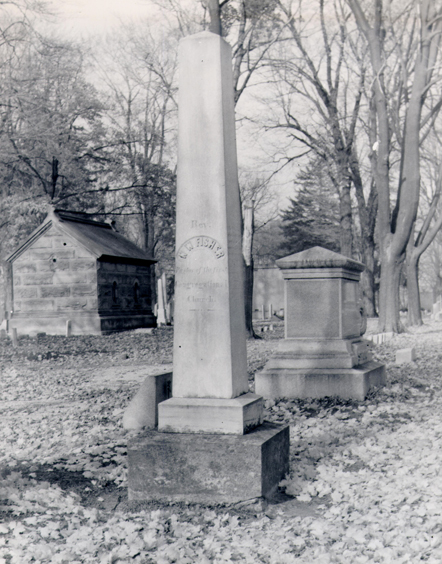
About two hundred fifty victims of cholera were buried in the Harrison Street Cemetery, now known as the Cholera Cemetery.  A single column honors the memory of those who died. About one hundred twenty persons were buried in the St. Joseph Catholic Cemetery. After Oakland Cemetery was opened in 1850, at least thirty tombstones were put in place in memory of cholera victims who lost their lives in 1849.  Three ministers who died of cholera are buried side by side at Oakland Cemetery.


A marble monument bears the name of Rev. N.W. Fisher, former pastor of the Congregational Church; Rev. H.P. Ward, a Methodist minister; and Rev. T.C. Cooper of the Bethel Church. To learn more about the many individuals who died of cholera in Sandusky in 1849, see Katharyn Wunderley’s book Cholera Victims of 1849: in Sandusky, Erie County, Ohio, shelved with the genealogy and local history books in the Lower Level of the Sandusky Library. This resource is invaluable, as it covers a time in history prior to the publication of Sandusky City Directories. 

Sunday, June 23, 2013

Convention of the Association of Ohio Cemetery Superintendents Held in Sandusky


On June 23 and June 24, 1909, the eighth annual convention of the Association of Ohio Cemetery Superintendents was held in Sandusky, Ohio. The first session of the convention was held on June 23 at the Sloane House hotel. After the opening address, roll call, and the annual report, the group went by trolley to Oakland Cemetery, where another brief meeting was held at the chapel.


 The group toured Oakland Cemetery after the meeting ended.


Evening sessions of the convention continued at the Sloane House. Frederick Green of Cleveland presented a paper on “Digging Graves,” illustrated with lantern slides. A paper by John Perrin of Toledo was entitled “The Seven Rs – Refractory Relatives Require Resolute Reasonable Restraining Rules.” Meetings on Thursday were held at Cedar Point. Topics covered included “Underground Drainage in Cemeteries” and “ Revenues of Cemeteries.” Twenty years after the 1909 Convention of the Ohio Cemetery Superintendents Association, the Sandusky Register stated in its “Twenty Years Ago” column that a good time was being had by all, in reference to the convention attendees.

Saturday, September 10, 2011

Dedication of Historical Marker at the Cholera Cemetery


On September 10, 1966, the Ohio Historical Society’s marker at the Cholera Cemetery was dedicated. Charles E. Frohman composed the wording on the text of the marker. The arch, which had been designed by Artist Frank W. Smith, was donated by the grandchildren of John Lay, Sr. Serving as Master of Ceremonies at the marked dedication was Charles E. Frohman. Dr. C. F. Lavender, President of the Erie County Medical Society spoke, along with Daniel R. Porter, executive director of the Ohio Historical Society. Music was provided by the Sandusky High School Band. The invocation was given by Rev. Msgr. William Armitage, and Dr. Theodore Stellhorn, Jr. gave the benediction. Also participating in the day’s events were the Boy Scouts, Girl Scouts, and Camp Fire Girls.


Over 300 persons lost their lives in the Cholera Epidemic of 1849, which took place between July 1, 1849 and September 7, 1849. Cholera struck Sandusky again in 1852 and in 1854, but not as severely as the 1849 epidemic.

Two sources which include historical details about the cholera epidemics in Sandusky are chapter XIV of Hewson Peeke’s A Standard History of Erie County, Ohio, published in 1916, and chapter 9 of Sandusky Then and Now.

Another outstanding resource relating to the cholera epidemic of 1849 is Cholera Victims of 1849 in Sandusky, Erie County, Ohio, by Katharyn L. (Huss) Wunderley. Mrs. Wunderley, who was an avid genealogist, spent hundreds of hours researching the names of the individuals who perished from cholera in 1849. She consulted the above two books, along with History of Erie County, Ohio, edited by Lewis Cass Aldrich, local newspapers, church records, and cemetery records. Two other resources used in Mrs. Wunderley’s research were the Cholera Hospital Register and the Cholera of 1849 and the Opinions of Medical and Other Professional Gentlemen in Regard to Its Origin and Proper Treatment, both accessible at the Ohio Memory Online Scrapbook.

Sunday, April 19, 2009

The Reverend Philip Ried, of Castalia

Rev. Philip Ried (sometimes spelled Reid) was the first pastor of Grace Lutheran Church in Castalia. Rev. Theodore Stellhorn had taught catechism to some of the young people in Margaretta Township in the early 1900’s, but in the summer of 1901, Rev. Ried was called to minister to three different parishes, those in Mustcash (an area of Western Erie County near Crystal Rock), Groton Township, and Castalia. Rev. Ried traveled between the congregations on horseback and taught catechism classes in his home.

A building fund was started in 1905, and the cornerstone for the Lutheran Church in Castalia was laid on October 2, 1910. Dedication of the new church building was held on August 27, 1911. In February of 1912, only five months after the church’s dedication, Rev. Philip Ried died. He had been attending a session of Luther League in Toledo, when he was suddenly was taken ill. Rev. Ried had been well respected in the community. His obituary, from the front page of the February 6, 1912 Sandusky Daily Register reported that Rev. Reid was “a faithful worker and an excellent preacher as well as a man whose advice and counsel was sought in affairs of citizenship as well as religion, the Rev. Mr. Reid had none but friends. There were many manifestations of sorrow when the announcement of his death was received at Castalia.”

Rev. Philip Ried’s parents outlived him by many years. At the Castalia Cemetery, there is a striking monument on the Ried family plot. The cross is inscribed with the words “Simply to thy cross I cling.”
At the base of the Ried monument is the Ried surname, formed in the shape of tree branches.
A booklet marking the 75th anniversary of the founding of Grace Lutheran Church provides a history of the church. It is found, along with many other church histories from Erie County, at the Archives Research Center of the Sandusky Library.

Friday, June 06, 2008

The Unveiling of the Confederate Cemetery Monument at Johnson’s Island

On June 8, 1910 over one thousand people witnessed the unveiling of the Confederate Cemetery Monument at Johnson’s Island. Several prominent former officers of the Confederacy attended the ceremonies. The dedicatory address was delivered by General George W. Gordon of Memphis, commander of the Army of Tennessee United Confederate Veterans. The monument was created by Moses Jacob Ezekiel, a Jewish sculptor who had attended the Virginia Military Institute and fought for the Confederacy. The Robert Patton Chapter of the United Daughters of the Confederacy had commissioned the monument, which was funded by donations from members of the Masons across the nation as well as by members of military organizations. Fund raising efforts were led by Mrs. Mary Patton Hudson, whose brother Oliver A. Patton had been a prisoner at Johnson’s Island during the Civil War. According to a report in the June 9, 1910 issue of the Newark Advocate, “The veterans of both armies without exception were moved to tears and some fairly shook with emotion when the strings drawn by Mrs. Mary Patton Hudson, of Cincinnati, the big American flag that screened it from the public gaze was lowered and the statue designed and executed by Sir Moses Ezekiel was revealed.” After the unveiling ceremony, several former Confederate officers were escorted to dinner at the Ohio Soldiers and Sailors Home where they inspected the grounds and were entertained at dinner. John T. Mack of Sandusky was the marshal of the parade, in which soldiers from both the Union and Confederate armies participated.

Tuesday, December 04, 2007

The Oheb Shalom Cemetery

The Oheb Shalom Cemetery is located south of the Erie County Fairgrounds, at the intersection of Columbus and Dewitt Avenues, in Perkins Township (near the Ohio Veterans Home). The land for this cemetery was purchased in 1854, according to an article in the Sandusky Daily Commercial Register, October 4, 1854.The first burial at this Jewish cemetery was Max Teshner, a Civil War veteran who died December 9, 1864. Although his name is given as Max Teshner in the cemetery records, he is probably the person recorded in the Ancestry Library Edition database (a Clevnet database) as Michael Tashner, who enlisted December 4, 1861 as a private at age 18. He eventually was promoted to Full Principal Musician of Company G, 72nd Ohio Volunteer Infantry. On December 9, 1864, he died from wounds suffered in a battle at Nashville, Tennessee. He is buried in the cemetery with several other members of the Teshner family (sometimes spelled Teschner).

David and Rachael Frohman, along with some of their children, are also buried in the Oheb Shalom Cemetery. David was an uncle to the theatrical Frohmans, Charles and Daniel.

Moses Lebensberger, a native of Bavaria, Germany, migrated to Sandusky in 1857. He was involved in the clothing business in Sandusky for many years, first with a Mr. Minott, then with his son. The business, on Columbus Avenue in downtown Sandusky, is shown in the image below (from 1908). He is buried in the Oheb Shalom Cemetery with members of his family.
A booklet entitled The 100th Year History of Reform Judaism in Sandusky, Ohio is part of the Churches Collections in the Archives Research Center of the Sandusky Library. The interment records for the burials at the Oheb Shalom Cemetery are available on microfilm in the Archives Research Center.

Thursday, July 12, 2007

Family History Clues from Cemeteries

A trip to the cemetery can prove very productive when you are looking for information about the people in your Family Tree. Tombstones provide dates of birth and death, and may include evidence of an individual’s military service, or fraternal affiliations.

The tall monument below is at Oakland Cemetery, a memorial to three local pastors who died in the Cholera Epidemic in Sandusky.

The Archives Research Center of the Sandusky Library has a variety of sources about local cemeteries. The ERIE COUNTY, OHIO CEMETERY CENSUS BEFORE 1909, edited by Katharyn Huss Wunderly and Patty Dahm Pascoe, lists cemetery inscriptions from over sixty cemeteries located in Erie County. You will also find cemetery records from Ottawa County, Huron County, and other counties in the Archives Research Center. Housed with the microfilm cabinet are several rolls of film which contain cemetery records of Erie County. The cemetery microfilming project took place in 1989, and are arranged by location.

There are many web sites on the Internet which contain cemetery records. Two well known sites are: http://www.findagrave.com/ and http://www.interment.net/.

Also found in the Archives Research Center is a limited number of photographs from area cemeteries. Pictured below is a photograph of the tombstones of four members of the Cooke family, buried in North Monroeville. These individuals were related to Eleutheros Cooke, Sandusky’s first lawyer.
A Confederate Civil War Cemetery is located on Johnson’s Island. This photograph was taken about 1910.


Visit the Sandusky Library for more information about local cemetery records.