Showing posts with label Erie County Courthouse. Show all posts

Friday, June 17, 2022

Sandusky Souvenir Letter Tablet


Around the turn of the twentieth century, the Alexander Manufacturing Company published a "Souvenir Letter Tablet," which featured scenes from Sandusky and the surrounding area. Since the Lake Erie Islands was such a popular vacation destination, it is likely that tourists bought the tablets to write letters home to their family and friends while they were on vacation. The cover of the tablet (above) had a picture of the Sandusky Yacht Club building (then between Wayne Street and Columbus Avenue) and nautical decorations. 

Another page showed the boat landing at the foot of Columbus Avenue:


This page shows the Erie County Courthouse prior to its renovation in the 1930s:


The Congregational Church was featured on this page of the Sandusky souvenir letter tablet:


In addition to the souvenir tablet, the Alexander Manufacturing Company published souvenir postcards of Sandusky, several of which are in the collections of the Sandusky Library Archives Research Center.

Saturday, February 27, 2021

Harry Dane, Chief Clerk at Erie County Probate Court


Harry Dane was born in Sandusky, Ohio in 1871 to George W. Dane and his wife, the former Maria Robinson Blanchard. 

In August of 1900 an article in the Sandusky Star told of Harry Dane’s bravery in rescuing a young lady who had fallen in the waters of Sandusky Bay after slipping between the dock at Cedar Point and the Andrew Wehrle steamer. The article stated that the Harry Dane and Mabel Marks may have drowned, had it not been for the combination of “rare good fortune, heroism and skill.”

During World War I, Harry Dane served as clerk of the Erie County Draft Board. After the war, from 1919 until 1940, he was the chief deputy clerk of Erie County Probate Court, working under Judge John Ray, Judge John Tanney, and Judge John Baxter. During his years as clerk of the Court, Mr. Dane issued hundreds of marriage licenses. June was often busy for Erie County Probate Court with June brides; in 1931, he issued four marriage licenses on the first day of June. An article in the August 2, 1938 issue of the Sandusky Star Journal reported that at one point during the renovation of the Erie County Courthouse, Harry Dane was the only employee of Probate Court to be still working. The headline read “Harry Dane Does Duty for Cupid,” since he was available to issue marriage licenses in spite of the construction and renovation work being done at that time. 

What the Erie County Courthouse looked like when Harry Dane began working at Probate Court

 
The Courthouse as it looked at the end of his career

In spite of the fact that Harry Dane never owned a boat, he was a longtime member of the Sandusky Yacht Club, and served on its Board of Trustees. After his sudden death on May 20, 1940, the members of the Yacht Club paid tribute to Mr. Dane. An article in the June 11, 1940 issue of the Sandusky Star Journal read in part, 

“Harry B. Dane was undoubtedly the oldest member of the Sandusky Yacht Club, from the standpoint of years of continuous affiliation. Not even the oldest records still in existence go back to the time when he first became a member…Always modest and unassuming, Harry never aspired to wear a commodore’s stars, but no man gave more years of work and efficient service to yachting in general and the Sandusky Yacht Club in particular than he. For years he served as its secretary and treasurer, and did much to keep aglow the very feeble spark of life which alone remained of the club following the tornado of June 28, 1924. He was a member of the Board of Trustees for so many years that the memory of man runneth not to the contrary, and his counsel and advice were always sincere, and usually right. That he was able to live to see the present strong and virile club spring phoenix-like from the ashes of old was, we know, a source of great happiness and satisfaction to him. And so his surviving shipmates, fellow members and friends of the Sandusky Yacht Club, pause for a moment in silent mediation, while eight bells are sounding slowly on the night air, and give thanks that they have been privileged to know such a true yachtsman and sportsman as Harry Dane. While the burgee of the Sandusky Yacht Club flies, he will not be forgotten.”

On May 21, 1940, the flag at the Courthouse was flown at half-staff in memory of Harry Dane. Funeral services for Mr. Dane were held at the Keller Funeral Home, and burial was at Oakland Cemetery. Officers of the Sandusky Yacht Club served as pallbearers at the funeral service.

Monday, August 10, 2020

Cyrus B. Winters, Ohio Legislator


According to an early twentieth century issue of Ohio Legislative History, Cyrus B. Winters was one of the oldest members in 80th General Assembly of Ohio (convened 1913). He was elected four times to represent Erie County in the Ohio House of Representatives as a Democrat. 

Cyrus Bertrand Winters was born in Townsend Township, Sandusky County, Ohio, and he lived on the family farm for several years. He attended the Milan Normal School, and after reaching adulthood he became a deputy clerk in the Clerk of Courts office. He studied law, and was admitted to the bar in 1874. From 1882 to 1888, Mr. Winters served as the Erie County Prosecutor. The listing for C.B. Winters in the 1884-1885 Sandusky City Directory stated that C.B. Winters was an attorney at law, and Erie County Prosecuting Attorney, with his office in the Erie County Courthouse. He also served for a time on the Sandusky Board of Education.

While in the General Assembly of Ohio, Mr. Winters served as chairman of the Committee of Cities, Ways and Means. He was considered an authority of matters pertaining to legal affairs, and is well known as the author of the Public Utility Law. 

In 1874, Cyrus B. Winters married Helen E. Clason, a native of Logan County, Ohio, and had six children. On June 9, 1916, he died in Castalia, at the home of his daughter, Mrs. Howard Brown, at the age of 68. Funeral services for Mr. Winter were held at the Brown residence in Castalia, with the Reverends Ross W. Sanderson and J. W. Overmyer officiating. Burial was in the Castalia Cemetery. Mr. Winters was survived by his wife, two sons, three daughters, a sister and a brother. To read more about this former Ohio legislator, see Elected to Serve, by Patty Pascoe (Sandusky, Ohio, 2003) and A Standard History of Erie County, Ohio, by Hewson L. Peeke (Lewis Publishing Company, 1916.)

Friday, February 14, 2020

A Victorian-Era Valentine


This ornate card is housed in the historical collections of the Sandusky Library Archives Research Center. It is decorated with flowers and lace, which is typical of the Victorian era. Inside the card is a verse that reads:

Return My Love
Love is dangerous, they say;
But what am I to do-
When you and I met the other day,
I fell in love with you.

But if you will return my love,
I don’t mind what they say;
Our vows will be registered above-
So name the happy day.

The card was sent to Miss Capitola E. Rockwell of Prout’s Station, Erie County, Ohio. The small envelope is embossed with a floral design. The one-cent Benjamin Franklin stamp was first issued in 1870.


By searching the name of Capitola Rockwell in the FamilySearch database, we learn that she married Charles O. Merry in Erie County, Ohio, on April 3, 1879.  Their marriage license was filed at Probate Court of the Erie County Courthouse.
            

Charles and Capitola Merry were married for sixty-five years. They had four children, and several grandchildren and great grandchildren. You can read much more about both Charles and Capitola Merry on pages 1051-1053 of Hewson Peeke’s book A Standard History of Erie County, Ohio (Lewis Publishing Company, 1916.)  The lovely card which was sent to Capitola before she wed was not signed, so we do not know if it was sent by her future husband or by another suitor.

Monday, October 01, 2018

Clocks Around Sandusky


The charming clock pictured above was outside the store of “Henry Dehnel, The Leading Jeweler” on Sandusky’s Columbus Avenue. The scene is a parade which took place in downtown Sandusky about 1905, and the view was facing north towards Sandusky Bay. 

In the late 1890s, Jacob Kronthal gave away a small clock that was set inside a figurine. The store was in a variety of different locations, but at the time this promotional item was given away, Jacob Kronthal’s men’s clothing store was at 705 Water Street:


When Citizens Bank was located in the Feick Building, this clock was in front of the Bank on Market Street:
                                       

In 1992, the clock was moved to the corner of Water and Wayne Streets, opposite Civista Bank.


Always a popular spot for taking pictures, this snapshot of Sandusky’s floral clock was taken on June 18, 1988.


If you are in Washington Parks in downtown Sandusky, you can always just look up at the Courthouse to see yet another clock.


Friday, August 24, 2018

The City of Sandusky Has Beautiful Parks


In a 1907 article for the Ohio Magazine, the Honorable Charles S. Reed wrote, “It can fairly be said that there are few cities in the country that can boast of such beautiful and well kept parks as Sandusky. They are the admiration and envy of the thousands and thousands of people who visit the city annually…”   The Sandusky Library Archives Research Center has several historical images of Sandusky’s City Parks in the Parks Collection of photographs. 

Here an employee from the City of Sandusky’s Park Department admires a floral mound labelled “Flora.” This picture was taken before the Erie County Courthouse was renovated in the 1930s:

   
In 1950, a worker mows the grass on a mound that features the Masonic emblem:

              
In 1955, Chris Goelz, then supervisor with the Sandusky Parks and Greenhouse can be seen working on a mound that reads “Drive Slow - Save Lives.” In the 1950s, Mr. Goelz often traveled to parks throughout the United States and Canada to get new landscaping ideas.

    
In the picture below, four city workers are hard at work getting the floral lighthouse ready for the summer season at Washington Park.

                                          
This picture of the city of Sandusky’s Greenhouse employees was taken about 1980. Three of the four people are identified: Ernest Erdman is standing at the back of the group; next to him is Mary Bloker; one of the other men is Fred Bloker.
  

Tuesday, March 06, 2018

Group Photos on the Erie County Courthouse Steps


Though we do not know the names of the people in this group, we do know that this photograph was taken by commercial photographer E.H. Schlessman in the first quarter of the twentieth century. The men, and one lady, are posed on the steps of the Erie County Courthouse, prior to the 1930s Art Deco renovation. Most of the men are in jackets and ties, and several are holding their hats. Many of the gentlemen are wearing a small pin on their lapel, which may indicate membership in a local fraternal organization.  This picture was taken in the same location as the ladies of the first jury of women in Erie County on August 26, 1920.


Sunday, January 07, 2018

Henry C. Millott, Architect


Henry C. Millott was born in Erie County, Ohio in 1878 to Martin and Julia (Tracy) Millott, who were both of Irish descent. Mr. Millott worked as an architect in Sandusky for over fifty years, in partnership with Harold Parker for much of that time. He was the architect for St. Mary’s Catholic School, which was dedicated in 1909.


In 1915 Mr. Millott designed an addition to the Hotel Rieger. He was also the architect for the Sandusky Star-Journal building built between 1920 and 1921 at the southeast corner of Market and Jackson Streets, now home to the Sandusky Register.


Two financial buildings were constructed in Sandusky in 1923. Mr. Millott was the architect of the Third National Exchange Bank on Market Street, which was built in the Neoclassic style.


Both Henry C. Millott and Harold Parker were listed as architects of the Commercial Banking and Trust Company, built at the corner of Columbus Avenue and East Washington Row. Ellie Damm wrote in her book Treasure by the Bay that the Commercial Banking and Trust Company is the only Beaux-Arts style building in the city of Sandusky.


Note the carved cornucopias above the front door of the former Commercial Banking and Trust Company, which is a symbol of abundance.


In 1938, Mr. Millott designed the Erie County Children’s Home, which was a federal Public Works Administration project. The August 10, 1939 issue of the Sandusky Star Journal reported that Henry Millott had been the “brain child” of renovation of the Erie County Courthouse project which took place in the 1930s.  The courthouse renovation was completed without interrupting the normal activities of the courts.


When Mr. Millott filled out his World War II registration card in 1942, he stated that his employer was the Trojan Powder company, for whom he worked as an architect. In 1946, the Bellevue Housing Company announced that he was the architect for twelve new homes to be constructed for U.S. veterans on lots purchased on Ellis Avenue, Sheffield, Walnut and Kern Streets in that city. 

Henry C. Millott died on June 20, 1957. He was survived by his wife, the former Eleanor Hinde, two daughters, three sons, and several grandchildren. Through his architectural designs, Mr. Millott quite literally left his mark on Sandusky and Erie County.


Friday, July 21, 2017

Interior Views of the Erie County Courthouse


In the picture above, taken in 1938, George P. Lydens, Deputy Clerk for Erie County Clerk of Courts, is seen in the Clerk of Courts office. Below is a view of the Common Pleas Courtroom at the Erie County Courthouse from the summer of 1952.
     

Here is how a Common Pleas courtroom looked shortly after the courthouse was built in 1874:


Have you ever heard that there is a tunnel that leads from the Erie County Courthouse to the old Erie County Jail? You can see the close proximity of the two buildings in this picture, taken sometime before the renovation of the Erie County Courthouse in the 1930s.


According to an article which appeared in the Sandusky Register of February 11, 1992, there is indeed a tunnel that connects the Erie County Courthouse to the old jail building. However, Erie County employee Bill Higgins told the Register reporter that the tunnel contains the service water main. The tunnel is inspected by maintenance crews every year, and the height of the tunnel is only four feet by four feet. Most likely, prisoners were never transported through the tunnel because of the very small space it occupies.

Thursday, May 25, 2017

Erie County Courthouse, Built in the 1870s


Pictured above is the Erie County Courthouse about 1888, with the Congregational Church and Zion Lutheran Church on either side of it. Before the courthouse was at its current location, it was on the east side of Columbus Avenue, near the present location of Emmanuel Church. This building had originally been built for use as a school, and was often called the Academy.


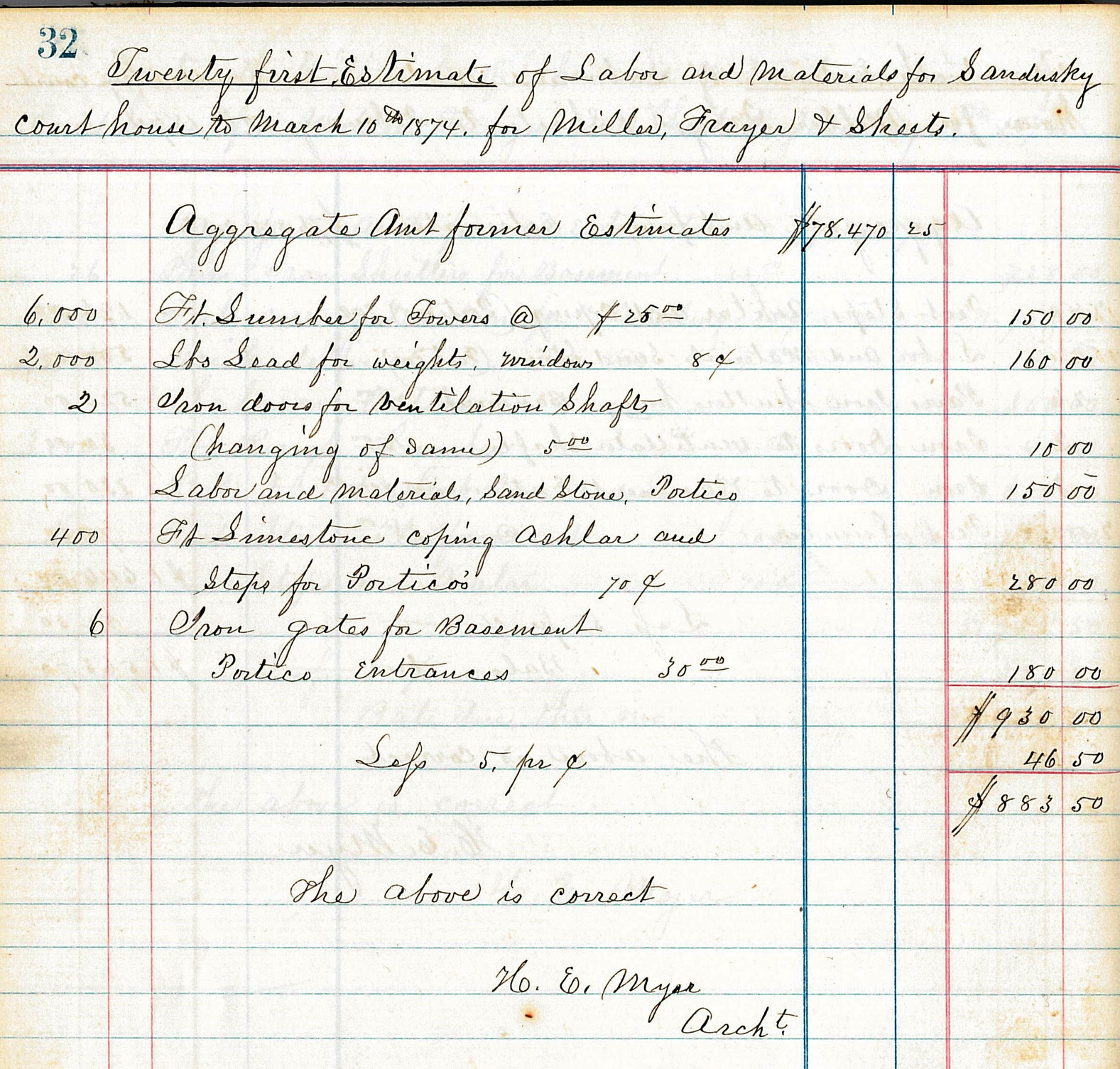
In 1871 Erie County officials began planning for a new county courthouse to be built. According to History of Erie County, Ohio, edited by Lewis Cass Aldrich (D.Mason and Co., 1889), a plan was adopted by Myer and Holmes, architects from Cleveland. In light of the recent disastrous fire at Chicago, it was suggested that the new courthouse be as fire-proof as possible. Several bids from contractors were received early in 1872, and the winning bid was Miller, Frayer and Sheets, from Mansfield, Ohio. The Sandusky Library Archives Research Center has in its historical collections a ledger book from Miller, Frayer and Sheets, which contains several estimates of labor and materials. Each page was signed by architect H.E. Myer.


The courthouse was built in the Second Empire style. There were marble mantels in some of the offices of the courthouse, and the corridors were floored in marble tiles of black and white. Oran Follett gave an address when the new courthouse was dedicated in 1875. The courthouse was appreciated by the community, as evidenced by this paragraph from History of Erie County, Ohio, edited by Lewis Cass Aldrich:
“This new Erie County Court-house is a model of beauty and modern architecture, and does honor not only to those engaged it its construction but to the county. Its location, on the west block of the public square, was exceedingly well chosen, as from all sides a full view of its grand proportions is obtained. The effort at elaborate ornamentation was completely successful, and here does not appear at any point, evidences of needless display.”
Below is a picture of the Ohio National Guard in front of the courthouse in the late 1880s.

       
In the 1930s the Erie County Courthouse was remodeled through a WPA project. The remodeling was done in the popular Art Deco style, and much of the limestone exterior of the courthouse was replaced with a flat concrete surface. Henry Millott was the local architect for the remodeling project. This brass medal commemorated the project.


Below is a view of the Erie County Courthouse taken by Thomas Root on July 9, 1975.

         
You can read more about the history of the Erie County Courthouse in Article 20 of From the Widow’s Walk by Helen Hansen and Virginia Steinemann as well as in a Sandusky Register article by Ron Davidson.

Saturday, August 13, 2016

Three Early School Buildings in Sandusky


According to Hewson Peeke’s A Standard History of Erie County, Ohio, (Lewis Publishing, 1916), in 1843 a committee of three was appointed to “prepare and present a plan for the erection of one or more school houses in the town of Sandusky.” The committee members included Moors Farwell, Alexander M. Porter, and Zenas W. Barker. The earliest school buildings were the East Market School, pictured above, the West Market School and the Academy building. The East and West Market Schools, both constructed of limestone, were built in 1845. You can still see the East Market School building, behind Variety Village. This school served students in Sandusky throughout the late 1800s. The East Market School was built on Franklin Street near East Market Street. For a time the Waldricher Pump Works was in business at the former East Market School. 

Below is a picture of the former West Market School building, on Fulton Street, taken in 1990.


Another early Sandusky school building was known as the Academy building. Though this structure was built as a school, it also served as the Erie County Courthouse before the present Courthouse was constructed in 1874.

    
The Academy building sat just north of the Emmanuel Church, as seen on page 19 of the 1886 Sanborn Map, which shows the “new” High School, which opened in 1869, as well as the old Academy building:


A previous blog entry reports on an antislavery meeting  that was held at the Academy building in March of 1844. 

To read more about the early public schools of Sandusky, read articles 48 and 49 in From the Widow’s Walk, by Helen Hansen and Virginia Steinemann (Follett House Museum, 1991.)