Showing posts with label Great Western Band. Show all posts

Wednesday, April 27, 2022

Memorial to President Ulysses S. Grant

While we cannot be certain that any Sandusky residents attended the dedication of the Memorial to President Ulysses S. Grant in Washington D.C., Mrs. John T. Mack bequeathed the program from the dedication exercises to the Sandusky Library Archives Research Center. 

Civil War veterans in both blue and gray attended the ceremonies, which took place on the 100th anniversary of the birthday of President Grant, one hundred years ago, on April 27, 1922. Princess Cantacuzene, born Julia Dent Grant, the granddaughter of former President Grant, and her daughter Princess Ida Cantacuzene unveiled the Memorial. A parade made up of soldiers, sailors, and Marines participated in the ceremonies, which included a 21 gun salute and “doves of peace” being released.

According to the April 28, 1922 issue of the Sandusky Register, President Harding addressed a crowd of 15,000 people in President Grant's birthplace, Point Pleasant, Ohio on the former President's 100th birthday, April 27, 1922. President Harding praised Grant as a great hero and military leader.

After President Grant died on July 23, 1885, the city of Sandusky conducted a memorial to the late President on  August 8, the same day as his funeral in New York city. Businesses and private homes in Sandusky were draped with black cloths to pay respects to former President Grant. Flags were at half-mast on boats in the port of Sandusky as well as at government buildings in the city. A parade took place from Market Street to Biemiller’s Opera House; hundreds of mourners were turned away from Sandusky’s memorial service because the Opera House was filled to capacity. I.F. Mack presided at the service, and music was provided by the Great Western Band.

Isaac Foster Mack, 1837-1912
 

Rev. David J. Meese, of the First Presbyterian Church, spoke about General Grant’s boyhood days. Rev. George H. Peeke, of the First Congregational Church, spoke of Grant as an ideal hero. Rev. F. K. Brooke, of Grace Church, spoke about the peace in the United States as evidenced by those who mourned Grant from both the northern and southern states of the United States. Other speakers of the day included Rev. A. B. Nicholas, A.H. Moss, Homer Goodwin, and F. W. Alvord. When the Honorable Oran Follett spoke, he alluded to Shakespeare as he said in part, “We have met today to praise, not to bury, the man who had the courage and ability to lead us to a great victory.” 


Oran Follett, 1798-1894

The Great Western Band played a final song, and the audience dispersed after the McMeens Post of G.A.R. left in a group.

Great Western Band

Visit the Sandusky Library Archives Research Center to learn more about the history of the former residents and businesses of Sandusky and Erie County, Ohio.


Friday, July 23, 2021

Erie County Farmers' Picnic

Here is a schedule of events at the Erie County Farmers’ Picnic held at Cedar Point on Saturday, July 23, 1892.

An account of the picnic in the July 25, 1892 Sandusky Register reported that the event was a “success in every way,” except for attendance.  Many farmers could not attend because of the late harvest, which kept many farmers at home working in the fields.  The article stated, “The programme heretofore published was fully carried out and nothing was left undone by the Cedar Point management that would add to the pleasures and comfort of those who were there to enjoy the day.” 


Musical entertainment was provided by the Great Western Band (above) and vocalist Ida Reynolds.


Charles Steen, pictured above with his wife Sarah, was the Vice-President of the Erie County Agricultural Society in 1892. Mr. Steen introduced the speakers of the day: I.F. Mack, Department Commander of the Ohio G.A.R. and General William H. Gibson, from Tiffin, Ohio.


Mr. Mack gave an address which focused on pensions for the Union Veterans of the Civil War. He indicated that the pensions for former U.S. soldiers compared favorably with the pensions given to the veteran soldiers of other countries.

When Vice President C. F. Steen introduced General William H. Gibson, of Tiffin, the crowd gave an enthusiastic ovation. General Gibson, considered an outstanding orator, was known as the “Grand Old Man of Ohio.” The Register carried a large portion of General Gibson’s speech, in which he praised the farmers of the United States. He spoke of the American wheat, corn, and cotton crops, and how wheat from the U.S. was sent to famine victims in Russia. He continued “This is a great farm and we don’t want any drones on it. I have worked ever since I was born and this is the best world I ever struck.” He encouraged the young men in the crowd to “get forty acres of land in any part of the state of Ohio” and “hang on to it.”  General Gibson concluded with patriotic remarks, stating that America was the most popular nation in Christendom, with bounteous wealth and infinite resources. 

To read the full article about the Erie County Farmers’ Picnic in 1892, visit the Archives Research Center of the Sandusky Library, which houses decades of historical local newspapers on microfilm, or find the article on Newspaper Archive, a subscription service available free to Sandusky Library cardholders via our local history resource page.

 Pictured below is a picnic at Cedar Point in 1906, several years after the Erie County Farmers’ Picnic.


Friday, January 08, 2021

The Reminiscences of Herman and Hedwig Zistel


In Archival Box G-14, folder 14 at the Sandusky Library Archives Research Center  is a wonderful piece of local history. The complete title reads: The Reminiscences of Herman Zistel: Memories of a German-American family in Nineteenth-Century Sandusky, Ohio to which are appended The Childhood Memories of Hedwig Zistel, edited by David P. Harris (2006, 2009.) The first part includes remembrances of Herman Zistel, who was born to Louis and Anna (Rosenkranz) Zistel in 1867. Herman’s parents were both natives of Germany.  Herman’s reminiscences were put on paper because his daughter, Era Zistel Posselt, wanted to hear memories of the older generations of her family. David P. Harris was a great nephew of Herman Zistel, and he edited the memories from a typewritten transcript of the original family letters. Herman tells about losing his mother at a young age, and having a new stepmother whom the children called “Grandma.” He described living in Sandusky, Ohio in the 1860s and 1870s, close to the waterfront and spending time at his father’s business known as the Atlantic Gardens. Herman survived an attack by the bear that lived in a cage at the Atlantic Gardens.

An interior scene at the Atlantic Pleasure Gardens in the 1870s

When he was old enough, Herman took one of his father’s boats out on Sandusky Bay for fishing parties. Then in the 1880s he left home on the train and headed west where he worked on a cattle ranch. Eventually he moved back to Ohio and married Mary Rodecker. They had two daughters, and resided in Cuyahoga County, where Herman worked in the shoe business. 

In the portion of the notebook which includes memories of Hedwig Zistel are Hedwig’s recollections of life in Sandusky in the 1800s. She recalled that the Great Western Band used to have a concert every Wednesday night at the Atlantic Gardens.

Stereographic Image of Great Western Band circa 1880

Her job was to clean the chimneys. Hedwig, also known as Hettie or Hattie, told about her father inventing a rustic cash register, and an ice elevator. She also recalled her brother Oscar’s inventions, especially the live fish car. Hettie became an apprentice seamstress, after leaving school at a young age. In 1891, she married Charles Schippel. Hettie lived to the age of 91, passing away in January of 1962. This notebook of recollections of Herman and Hedwig Zistel is fascinating to read. It takes one back to a day before television and automobiles, and gives details about what everyday life was like in Sandusky, Ohio from a long gone era.

Tuesday, December 30, 2014

The Wedding of Cora H. Arndt and George F. Hagenman


 On Thursday afternoon, December 29, 1881, Rev. L.S. Osborne officiated at the marriage of Cora H. Arndt and George F. Hagenman at the bride’s home on 410 Adams Street in Sandusky, Ohio. A listing of the gifts that were presented to the bride was printed for the friends and family of the newlyweds.


 Cora H. Arndt was the only daughter of David M. Arndt, superintendent of the Sandusky Water Works, and her groom, George F. Hagenman, was a young lawyer from Reading, Pennsylvania. An article which appeared in the December 30, 1881 issue of the Sandusky Register gave a lengthy description of the wedding.  Cora wore a brocade cream dress with satin shirrings, and a magnificent set of diamond earrings, which had been a gift of her bridegroom. William Dilger, proprietor of the Hayes Avenue Conservatories, decorated the Arndt home with flowers and vines. A floral archway took the place of the traditional wedding bell. Music was provided by the Great Western Orchestra, who played an arrangement of Lohengrin’s Wedding March that had been rendered by Eugene Baetz especially for the wedding. Wedding gifts included several items of silver and crystal.


Sadly, the marriage did not last. Erie County Probate Court records indicate that on February 17, 1885, Cora married lawyer George Henry White. The couple moved to Chicago, and had two children. Cora Arndt White died on January 26, 1914, following a lengthy illness. Her obituary, which was in the January 29, 1914 issue of the Sandusky Register, stated that Cora had been one of “Sandusky’s charming young ladies.” She had been an active member of the community, especially in the parish work of Grace Church. Cora Arndt White was buried in the White family lot in a cemetery in Harvard, Illinois. George F. Hagenman died in 1907 when he was in a tragic railway accident during a Shriner’s trip to California.

Saturday, March 01, 2014

Alex H. Osterman’s History of Bands in Sandusky


In the Arts Collection of the Sandusky Library Archives Research Center is a binder with typewritten pages, in which Alex H. Osterman presented a history of bands and orchestras in Sandusky, from 1851 to 1934. The binder was given to the Sandusky Library from the library of Dr. Norbert A. Lange. Local musicians Ed Senne and Fred W. Bauer assisted Mr. Osterman in gathering information, as many of the musicians in the early bands were deceased by 1934. The first known band in Sandusky was the Jaeger Band, which was organized in 1851.


Mr. Osterman related how Charles Baetz’s stern discipline helped the Great Western Band to build up an enviable reputation. The band performed from 1867 to the early 1890s, and had several different directors. The Great Western Band is pictured below in the 1870s.


While Mr. Osterman’s history provides us with details about relatively well known bands, such as Ackley’s Band, the Cedar Point Orchestra, and Scouton’s Concert Band, he also covered little known bands, such as the Sandusky Light Guard Band, the Big Five Band, and the Curtiss Orchestra. Below is a list of members of the Harlemetts Orchestra, an orchestra made up of African Americans from Sandusky.


In the back portion of Mr. Osterman’s history binder are letters and anecdotes from local musicians, as well as notes from Dr. Norbert A. Lange with further details about Sandusky’s rich musical history.

Alex H. Osterman died on November 10, 1945, at the age of 69. He had been a restaurant operator in Sandusky from 1896 to 1901, and he served as the street superintendent of Sandusky from 1928 to 1933. In his later years, he was employed at the Erie China Company on Cleveland Road. Mr. Osterman’s little black binder helps us know more about music in a time gone by in Sandusky. An article in the Sandusky Star Journal of April 7, 1934, Alex H. Osterman stated that his history of bands in Sandusky was written “to perpetuate the memory of those men who were always ready and willing to give their time so that their music might be means of bringing joy and pleasure to tired bodies and saddened hearts.” 

Saturday, October 19, 2013

German celebration in Sandusky, 1883


On Sunday, October 7, 1883, Sandusky residents celebrated the bicentennial anniversary of the first permanent German settlement in the United States. Accounts of the gala event were featured in the October 8, 1883 issue of the Sandusky Register and the October 8, 1883 issue of the Sandusky Demokrat.


Adam Bauer was the president of the day, while Constantine Zipfel served as the Marshall. They were assisted by M. Osterman, William Koch, John Weideman and Alex Motry. Over one thousand people took part in the procession, which started at West Market Street, and ended at the Erie County Fairgrounds. The Great Western Band provided music for the parade.


All the German societies of Sandusky were represented, including the Active Turn Verein, pioneer German citizens, the Harmonie and Frohsinn Societies, Workingmen’s Association, German Knights of Labor, Cigar Makers’ Union, the Platte Deutsch Verein, Union Benevolent Society, Odd Fellows, Druids, along with delegations from local factories and fire departments. A large delegation of German Americans from Kelleys Island, Middle Bass Island, and Put in Bay also participated in the procession. Gottlieb Epple led a cavalry troop of one hundred men. Thousands of area residents lined the streets along the parade route. After arriving at the Erie County Fair Grounds, the Great Western Band played an overture, and Dr. Von Schulenburg spoke about the mission of the German element in America. Herman Ruess gave an elegant address. Gymnastic exercises were performed by both the Active and Social Turnverein. According to the Sandusky Demokrat, the German celebration was “the most imposing demonstration ever witnessed in Erie County.”

Tuesday, October 15, 2013

Music and Musicians at Cedar Point

(Reposted) The premiere of the video presentation, Under the Baton: Music at Old Cedar Point, will be at the Sandusky Library on Friday, November 1, at 7PM; a lecture on the subject by Dr. Steven Plank, Oberlin College, with a question & answer session, will follow. 

Since the late nineteenth century, a variety of bands, orchestras, and singers have been associated with Cedar Point.  Highlighted in this post are just a few of the individuals and groups associated with the resort's long, rich musical history. Charles Baetz an early general manager at Cedar Point, founded the Great Western Band in 1867. Baetz was born in Renghausen, Germany in 1836, where he learned the violin and cornet as a young man.  In 1854 he immigrated to the United States. He was the principal musician for Company A of the 128th Ohio Volunteer Infantry during the Civil War.  He participated in seven battles, and then returned home where he directed the military band at the federal prison on Johnson's Island, which was just across the bay from Sandusky.


The Great Western Band performed at Cedar Point for concerts and dances until about 1892.


The Ackley Band, founded by E.B. Ackley, was the successor to the Great Western Band.


E.B. Ackley came to Sandusky in 1893. He was the instructor of the Sandusky Band and Orchestra, and he also worked as the director of music at Cedar Point. Several members of Ackley's Band appear in the picture below, taken at Cedar Point.


In 1902, E.B. Ackley published the Cedar Point Two-Step. The music was arranged for Band, Orchestra, Mandolin and Guitar, and was dedicated to the Cedar Point Pleasure Resort Company.


Other compositions of sheet music dedicated to Cedar Point include Cedar Point March, by Francesco P. Russo (1910), the Cedar Point March composed by T. J. Martin (no date listed),  and Cedar Point That’s the Place, composed in honor of G.A. Boeckling by J. Otto Martin in 1922.

Charles Bauman was a member of both the Great Western Band and Ackley's Band.


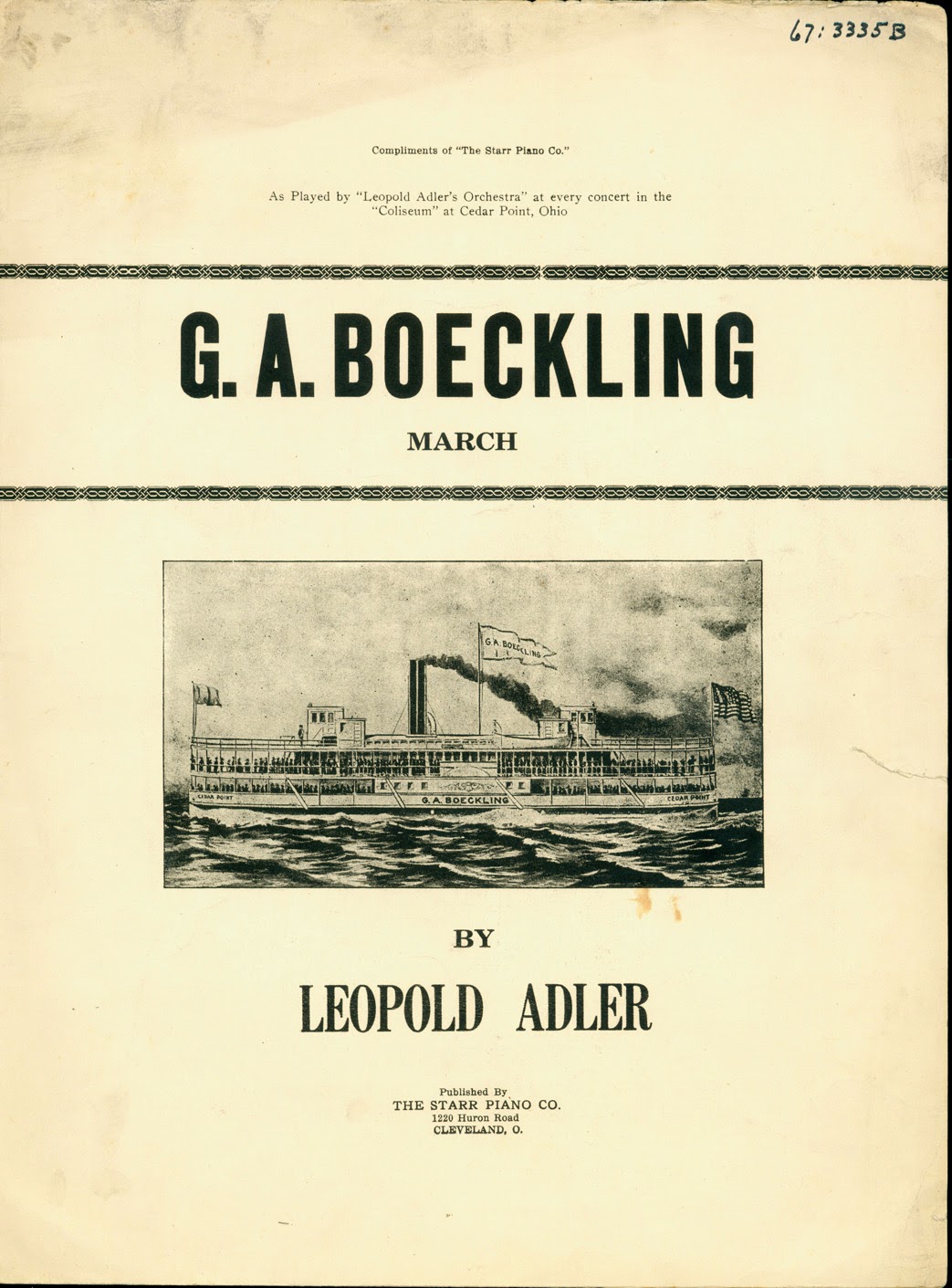
From 1914 to 1919, Leopold Adler was the popular director of the orchestra at Cedar Point. He conducted hundreds of concerts in the Coliseum.


 Leopold Adler composed the G.A. Boeckling March in 1916. The G.A. Boeckling March was played in the Coliseum at every concert directed by Leopold Adler.


During the Great Depression and World War Two, big bands performed in the Coliseum's Grand Ballroom. Bands included: Woody Herman, Blue Barron, Guy Lombardo, Benny Goodman, and Ozzie Nelson’s band.


Today several venues at Cedar Point offer live musical performances throughout the park's season. To read more about the history of Cedar Point, see the book Cedar Point: The Queen of American Watering Places, by David W. and Francis (Amusement Park Books, 1995), available at the Sandusky Library.

Thursday, December 27, 2012

Sandusky Turn-Gemeinde Christmas Festival


On December 25, 1892, the Sandusky Turn-Gemeinde held their annual festival at the Turner Hall, which had formerly been known as Norman Hall. Tickets were twenty-five cents and the music was provided by the Great Western Orchestra.

The Turn-Gemeinde was an association made up primarily of German-American individuals, and whose primary objective was to promote physical fitness. It was formed by a merger of the Active Turnverien and the Social Turnverein clubs around 1888.

The last party of the Social Turn-Verein, before merger with the Active Turn-Verien

The December 26, 1892 issue of the Sandusky Register reported that the Turn-Gemeinde Christmas festivities were largely attended. Otto Baumeister had created a piece of floral art that was quite attractive. The article went to say that “The music of the Great Western Orchestra was exceptionally fine, fully maintaining the reputation of that well known organization of musical artists.” The Great Western Band and Orchestra entertained Sandusky residents for many years. To read more about the history of German-American citizens of Sandusky, see Sandusky Then and Now, by Dr. Ernst von Schulenburg.

Sunday, September 09, 2012

Ohio State Firemen’s Tournament, September 1868

The Ohio State Firemen’s Tournament was held in Sandusky, Ohio on September 10, 1868. Firemen who traveled to Sandusky by railroad were issued half fare tickets, and their engines and other equipment were transported at no cost, according to the Committee of Arrangements. Bells rang at 6 a.m. for the gathering of the firemen. Twenty three fire companies from all over Ohio attended the Tournament, with an estimated total of eighteen hundred firemen in all. A reception for visiting firemen was held between 7 and 9 a.m., and the parade began at 9 o’clock. Chief Marshal was John H. Williams.

The Great Western Band, along with the Sandusky Fire Department, Chief Marshal, Sandusky Mayor and other elected officials met at East Washington Street, near Columbus Avenue to form the First Division of the Parade. Representatives from Rochester, Buffalo, Detroit, Pittsburgh, and Naugatuck, Connecticut were also with the First Division. The Second Division, which met on West Market Street, included Assistant Marshals, the Sandusky City Band, and representatives from Fire Departments from Elyria, Norwalk, Oberlin, Delaware, Fredricktown, Mansfield, Newark, and Zanesville. The Fremont Band, and firemen from Fremont, Dayton, Kenton, Urbana, Tiffin, Toledo and Clyde made up the Third Division. Prizes were given for several classes of steam fire engines, hand engines, hose companies and hook and ladder teams. A moonlight excursion to the Lake Erie Islands was held in the afternoon aboard the Evening Star. In the evening a Firemen’s Ball was hosted by the Hecker Hook and Ladder Company at Norman Hall. The Sandusky Daily Register of September 11, 1868 reported that the event was “the finest Firemen’s Tournament ever held in Ohio….The shining machines decked with flowers and evergreens, the gay uniforms and clanging bells, the numerous bands, stirring music, waving banners, martial step, and crowds of cheering spectators altogether formed a pageant at once imposing and attractive.”

In August of 1871, the Sandusky Fire Department was awarded this silver speaking trumpet as a prize at the Firemen’s Tournament held in Norwalk, Ohio. The trumpet is now in the collections of the Follett House Museum.

Company 3 of the Sandusky Fire Department won a trophy on June 22, 1910. (For what exactly the trophy was given is unknown.)

Sunday, March 18, 2012

William Hauser, Musician

William Hauser was born in 1858 to John and Margaret (Schmidt) Hauser. When he was age 15, he became a member of the Great Western Band in Sandusky. When the Great Western Band disbanded, he became associated with Ackley’s Band. William Hauser can be seen on the far right in the back row, in the picture of Ackley’s Band below.


Mr. Hauser was among the musicians who took part in the dedication of the first Water Works in Sandusky in 1876.

When the 1924 tornado struck in Sandusky, William Hauser was inside his residence at 622 East Market Street in Sandusky. Though the house was destroyed, he survived the tornado with just a few minor injuries.
William Hauser continued as a musician throughout his life. When the Sandusky Musical Union put on a performance of Max Bruch’s oratorio Odysseus, he played the viola in the orchestra.

On November 13, 1928 William Hauser died after suffering a heart attack, at the home of his sister Mrs. Emma Wirth. He was survived by two sisters and a brother. He was laid to rest in the family lot at Sandusky’s Oakland Cemetery. A nephew who survived him was Dr. Norbert A. Lange, a chemistry professor at Western Reserve University, who is known for writing the classic text Handbook of Chemistry. Dr. Lange and his wife were the benefactors for The Norbert A. and Marion Cleaveland Lange Trust of Sandusky Library, which has provided cultural and educational programs for Erie County residents for over twenty five years. Dr. Norbert Lange and Marion Cleaveland Lange translated into English the book Sandusky "Einst und Jetzt" which was originally written in the German language by Rev. Ernst Von Schulenburg. Members of both the Hauser and Lange families contributed greatly to the rich cultural heritage of Sandusky and Erie County.

Saturday, February 25, 2012

Great Western Band Events in the Nineteenth Century

The Great Western Band Carnival was held at the Social Turner’s Hall on February 26, 1889. The February 27, 1889 issue of the Sandusky Register reported that 1,000 people attended the event, which was a Masquerade. Spectators lined the walls and gallery, and several local merchants were also at the big event. Dancers wore brilliantly colored costumes which represented hundred of various characters. Nineteen prizes were given out in a drawing.


Before the Carnival the prizes were on display at J. Krupp & Son’s Furniture Store on Market Street. The Sandusky Register printed the names of all the prize winners. The article began, “If there is one thing more than another that Sandusky prides herself on, it is the Great Western Band, a musical organization that has no peer in Northern Ohio and on the occasion of the band’s annual carnival, citizens attest their appreciation by turning out en masse.”

Ten years earlier, on February 25, 1879, the Great Western Band had sponsored its thirteenth annual Masquerade at Fisher’s Hall.
The program included twenty four numbers that were played, including waltzes, the Virginia Reel, polkas, the Mazurka, and Schottisches. The final number was the Fire Fly Galop.

While no sound recordings exist from the Great Western Band events in 1879 and 1889, by visiting the National Jukebox of the Library of Congress, you can hear examples of the Fire Fly Galop, the Virginia Reel, and several polkas and mazurkas.

Saturday, January 21, 2012

Masquerade Party Given by the Knights of the Scissors

On January 21, 1890, the second annual masquerade party given by the Knights of the Scissors was held at Fisher’s Hall. Music was provided by the Great Western Orchestra. Admission was fifty cents for men and twenty five cents for ladies.


Dances included waltzes, polkas, the schottische, and many more. An article in the January 22, 1890 issue of the Sandusky Register reported that two hundred people were at the party, with about half of the guests in masquerade. To date we do not know if the Knights of the Scissors were a labor group, perhaps made up of tailors, or if the group was an informal club.

Saturday, August 06, 2011

Annual Excursion of the Great Western Band

Sandusky area residents were invited to the annual excursion of The Great Western Silver Cornet Band on Thursday, August 6, 1868. The Great Western Band was formed in 1867 and was led for many years by Charles Baetz.

The steamer Evening Star was chartered for the excursion, which left at 10 a.m. from Fitzhugh’s Dock. The Evening Star carried passengers on the Great Lakes from the 1860’s through the 1890’s.