Showing posts with label Federation of Women's Clubs. Show all posts

Sunday, November 19, 2017

The “All Nation’s Pageant” in 1932


Several ladies from the Sandusky and Erie County Federation of Women’s Clubs participated in the Cleveland Plain Dealer’s “All Nation’s Pageant”, held at Cleveland’s Public Hall. This event was part of the International Exposition presented in Cleveland from November 19 to 28, 1932. While thirty-eight women participated, only sixteen were present for the photograph above. 

Pictured are: Back Row: Ada Parker, Leona Love, Carrie Beatty, Nettie Beatty, Ms. Drummond, Emma Phillips, Dorothy Drummond, Adeline Rosekelly, Florence Wright. Front Row: Mary Louise Blanckey, Annette Lockwood, Lois Miller, Attie Hawley, Harriet Ruggles, Virginia Caswell, and Marie Harris. 

Several scrapbooks, membership lists, secretary’s record book and photographs from both the Erie County and Sandusky Federation of Women’s Clubs are housed in the Sandusky Library Archives Research Center.

Thursday, April 20, 2017

“You Never Can Tell” in Sandusky, 1922


On April 20, 1922  the play You Never Can Tell, by George Bernard Shaw, was presented by Sandusky Federation of Women’s Clubs at the Sandusky Theater.


Charlotte Atwater DeVine directed the performance, which was put on for the benefit of a free dental clinic for school age children in Sandusky. The play was about a dentist falling in love. A subplot in the play was about three children who accidentally meet their father for the first time. Mrs. Lilly Johnson wrote a review of the local production in the April 21, 1922 issue of the Sandusky Register, declaring that a large and distinctive audience saw the play, which featured many professional touches. Two actors who played their roles very well were George Lehrer as the semi-villainous father, and Charles Selkirk, who portrayed the suave attorney. The article concluded, “In this group of people Sandusky possesses dramatic talent of a high order and it is to be hoped that lovers of the drama have an opportunity of seeing them at frequent intervals. A total of $300 was raised for the future dental clinic.”

Along the edges of the play’s program were advertisements for local businesses, which were written in rhyme. These two ads are from Gassen and Werner’s and  W.A. Bishop, photographer.


Tuesday, April 21, 2015

“You Never Can Tell” Performance in 1922


On April 20, 1922, the play “You Never Can Tell” was presented by the Sandusky Federation of Women’s Clubs at the Sandusky Theater on Jackson and Water Streets.


Charlotte Atwater DeVine directed the play, which was put on for the benefit of a free dental clinic for school age children in Sandusky. George Bernard Shaw wrote the play, which was about a dentist falling in love. A subplot in the play was about three children who accidentally meet their father for the first time. Below is the list of characters, and the local actors who portrayed them.


Mrs. Lilly Johnson wrote a review of the local production in the April 21, 1922 issue of the Sandusky Register. Mrs. Johnson stated that a large and distinctive audience saw the play, which featured many professional touches. Two actors who played their roles very well were George Lehrer as the semi-villainous father, and Charles Selkirk, who portrayed the suave attorney. The article concluded:

In this group of people Sandusky possesses dramatic talent of a high order and it is to be hoped that lovers of the drama have an opportunity of seeing them at frequent intervals. A total of $300 was raised for the future dental clinic.


Along the edges of the play’s program were advertisements for local businesses, which were written in rhyme. These two ads are from W.A. Bishop, photographer, and Denzer’s office supply store.


Wednesday, August 23, 2006

Clubs and Organizations in Erie County

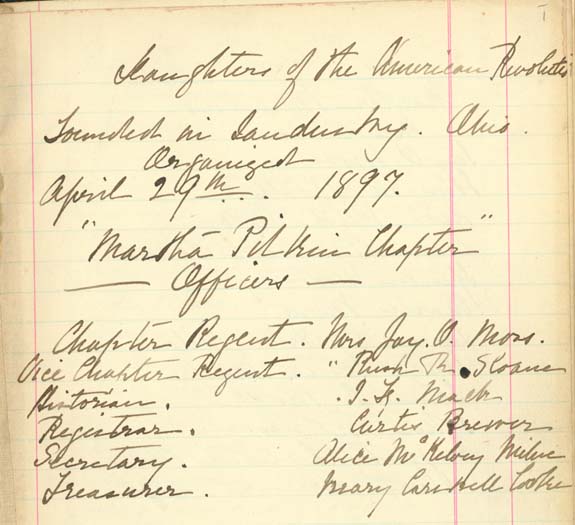
For better or worse, social clubs and community organizations are not as popular as they once were. With the advent of movies, television, the Internet, the automobile, and many other developments in technology and culture, clubs and organizations play a smaller role in the community than they did, say, in 1897, when the Daughters of the American Revolution, Martha Pitkin Chapter, was founded in Sandusky. (An excerpt from the D.A.R. secretary's book is shown above.) In the nineteenth century and well into the twentieth century, the role of clubs and organizations in the community was dominant. For an analysis of this development in society, you might want to read Robert Putnam's book Bowling Alone (in our library collection at 306.0973 PU) -- but don't take my world for it, since I haven't read the book yet.
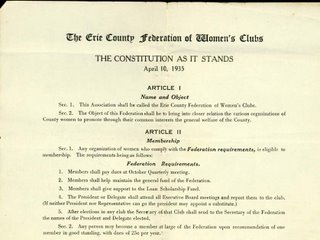

It does seem clear, however, that studying the history of local clubs and organizations will help you understand the culture and society from which they come (or at least that portion of society represented by the members of that particular club). The Sandusky Library Archives Research Center holds records and documents from several local clubs and service organizations, including: the Daughters of the American Revolution, Martha Pitkin Chapter; the Erie County Federation of Women's Clubs, and the Sandusky Federation of Women's Clubs; the Art Study Club; the Men's Literary Club; the Sunyendeand Club; the Nineteenth Century Club; the Sandusky Concert Association; and others. Thanks to the help of our summer archives intern, we have new and updated finding aids describing many of these documents and collections, for those interested in researching this aspect of our history.

For those of you involved in a local organization or who owns the records of local clubs from the past, we encourage you to consider depositing those records with the Archives Research Center, to preserve these documents for future generations. We will be glad to explain how we will store and record your donation in the library as a record of our community. For more information, call (419-625-3834) or email the Archives Librarian.
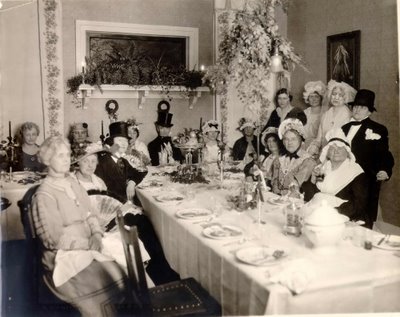

The photo above is of a costume party given by the Art Study Club (probably circa 1920), where guests came dressed as famous literary characters. (From the Library's historic photo collection -- CLUB-047.)