Showing posts with label Jewett. Show all posts

Monday, January 23, 2023

Getting to Know Rev. Edward R. Jewitt


Rev. Edward Rogers Jewitt (sometimes spelled Jewett) was born in Connecticut in 1811. He married Elizabeth Camp in 1834. In 1835 the young couple settled in Elyria, Ohio. By 1840 E.R. Jewitt was admitted to the North Ohio Conference of the Methodist Episcopal Church. Rev. Jewitt ministered in the Methodist Episcopal Church for over twenty years. Rev. Jewitt addressed the crowd that gathered on July 4th in Milan, Ohio for a Celebration and “PicNic.” He was the pastor of the Sandusky Methodist Episcopal Church from 1845 to 1847. In the 1850s, he was the minister of the Bethel Church, which was an outreach of the Methodist Episcopal Church to improve the moral and religious condition of seamen in waters west of New York State.

Rev. Jewitt preached a sermon on July 4, 1852 at Put in Bay, when five companies of the Volunteer Militia of Ohio met at Put in Bay to celebrate Independence Day, as well as to discuss the erection of a monument to commemorate Perry’s victory at the Battle of Lake Erie.

In 1860 and 1861, Rev. Jewitt was the Presiding Elder of the Methodist Episcopal Society of Sandusky. On January 13, 1860, under his leadership, the following anti-slavery resolution was passed at the Quarterly Meeting of the Methodist Episcopal Church of Sandusky:


 According to the obituary of Mrs. Elizabeth Jewitt, in 1863 Rev. Jewitt was injured and had to retire from active ministry. However, Rev. Jewitt remained involved in the community and in Methodist religious circles in Erie County, Ohio.

This advertisement from the Sandusky Register of May 11, 1864, states that Rev. Jewitt had opened a bookstore on Columbus Avenue. He sold Bibles and hymn books, as well as stationery, toys, and writing supplies.

When the Convention of the Erie County Sunday School Union met on May 11, 1872, the president of the organization was absent, so Rev. E.R. Jewitt stepped in to run the convention. Several in attendance felt that there was a significant correlation between children who attended Sunday School and secular school. There was a feeling that learning at Sunday School could reinforce the skills of school children who also attended public school. 

Rev. Jewitt attended the 42nd Annual Session of the North Ohio Conference of the Methodist Episcopal Church held in Ashland in September of 1888, and reported on the events which took place.

By 1880, Rev. and Mrs. Jewitt retired to a farm in Margaretta Township. Rev. Jewitt died on August 22, 1892, and he was buried at Oakland Cemetery. Mrs. Jewitt survived until 1904.

This obituary appeared in the Sandusky Register of August 23, 1892:

Wednesday, January 03, 2007

One of the Oldest Items in Our Collections

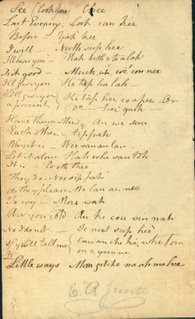
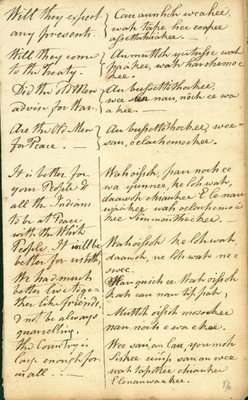
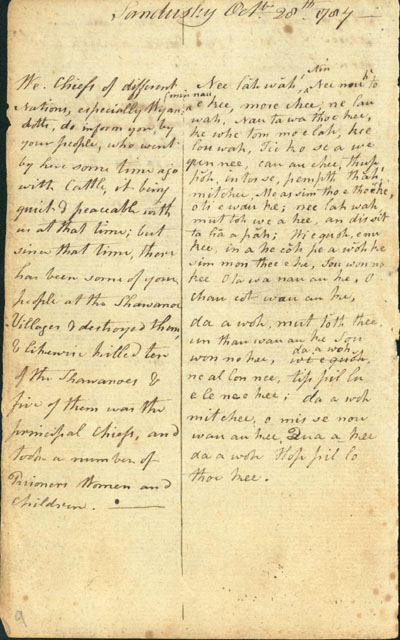
In the vault of the Sandusky Library Archives Research Center is a manuscript copy, dated 1787, of a phrase book, containing translations of words, phrases, and speeches, from English to a local Native American language, possibly the Wyandot/Huron language. This item was donated to the library in 1943, by Dr. Marjorie Anderson (1892-1954) -- a professor at Hunter College in New York, a poet, author, former employee at the Sandusky Library, and native Sanduskian. (She was the great-granddaughter of Dr. George Anderson, Sandusky's first physician -- he died in the cholera outbreak of 1834, after treating infected patients.)

The manuscript is attributed to E.R. Jewett, but the accuracy of this claim is far from certain -- the only signatures with the Jewett name are written in pencil along the margin of a page, and don't seem to match the rest of the handwriting. Who E.R. Jewett was is also unclear -- there was a businessman in Buffalo named Elam R. Jewett, who owned a publishing company and engraving business; this E.R. Jewett, however, appears to have been born around 1811, much later than the date of this manuscript. Could there have been an earlier E.R. Jewett, who travelled around the Sandusky Bay in 1787? Or was this phrase book written by someone else (whose name we do not know), but later owned by E.R. Jewett of Buffalo? Or is there another explanation? (Anybody out there looking for a research project?)

Also, some of you might be wondering, "How could this manuscript be marked 'Sandusky, 1787' when we know that the city of Sandusky was not founded until 1818?" In fact, in that era most of the region around Sandusky Bay and along the Sandusky River was identified simply as "Sandusky." It is possible (or even likely) that this phrase book was written in or around what is now known as the city of Fremont, which was called Lower Sandusky until 1849, and was the site of a Wyandot village in the 18th century. (The city named Upper Sandusky -- farther up the Sandusky River -- still exists, of course.) For those who study Native American languages and cultures, and the early interactions between those peoples and the European settlers, this document may prove an invaluable resource. Although access to the original item is restricted due to its age and fragility, the entire document (21 leaves on 32 digital images) is available in digital format at the library.


Update: Oops. . . . I forgot about the Reverend Edward R. Jewett, who was a founder of the Bethel Church on Water Street (between Decatur and Jackson) in Sandusky in 1852. The image below shows Reverend Jewett some thirty years later. So we might be able to assume that the phrase book was in the Reverend Jewett's possession at some point, but we still do not know the complete provenance of this document.
Update 2: Here is an enlarged view of a portion of a page from the phrase book: