Showing posts with label Harrison. Show all posts

Wednesday, May 10, 2017

Stone Houses Owned by Eleutheros Cooke

Between 1827 and 1835 several structures in the 400 block of Columbus Avenue were built by Eleutheros Cooke, Sandusky’s first lawyer.  You can see the properties on the 1893 Sanborn Fire Insurance Map.


You can still see the brackets along the top of the home, under which are geometric designs.


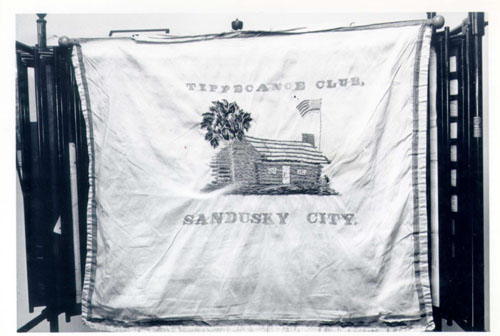
On the porch of the home that is now 410 Columbus Avenue, General William Henry Harrison was presented with a flag made by the ladies of Sandusky. That flag is now in the historical collections of the Follett House Museum.


This home is considered to be Sandusky’s oldest standing house, according to the Ohio Historic Places Dictionary. It was built in the Greek Revival style of architecture in 1821. In the 1890s, Dr. C.T. Stroud and his son had their dental offices at this location. An advertisement which appeared in the Sandusky Register Star News of April 4, 1945 indicates that a beauty shop and “normalizing salon” was in business here.


Through the years, several different medical practices were in business at his location. 

Just to the south of 410 Columbus Avenue is a double stone house, built from limestone, now with the address of 412-414 Columbus Avenue. William Robertson purchased this property in 1865 from the Cooke estate. For many years this structure has been used as apartments. There are doors on either side, at the street level and lower level.


The third stone building, now 416 Columbus Avenue, was razed in 1918 to make way for a Bell Telephone Company office building. The United Way now has its offices at this location. 

To learn much more about the many historic homes and businesses in Sandusky, see At Home in Early Sandusky by Helen Hansen, and Treasure by the Bay, by Ellie Damm, both available at the Sandusky Library. 


Saturday, April 23, 2011

Services Held in Honor of President William Henry Harrison

Grace Episcopal Church held a special service in honor of recently-deceased President William Henry Harrison on Friday, April 23, 1841. The Order of Exercises included two Odes by the choir, as well as a choral anthem. Prayers were led by the Rev. I.A. Hart and Rev. A.W. Curtis, and the eulogy for President Harrison was give by the Rev. B.H. Hickox. William Henry Harrison was the ninth United States President, serving from March 4, 1841 to April 4, 1841, the shortest term of any American president. He died after he caught a cold that developed into pneumonia.

Before he became President, William Henry Harrison was a frontier leader who fought in several battles during the early Indian wars. He was known his victory over Shawnee chief Tecumseh at the Battle of Tippecanoe on November 7, 1811. During the War of 1812, he commanded the Army of the Northwest as Brigadier General. He became a national hero after the defeat of the combined British and Indian forces at the Battle of the Thames.

In September of 1835, Harrison was in Sandusky to officiate at the groundbreaking of the Mad River and Lake Erie Railroad.

During his presidential campaign in 1840, William Henry Harrison visited Sandusky. The ladies of Sandusky presented him with this embroidered banner in honor of the campaign.
The banner is still on display at the Follett House Museum. The story behind this banner is related on page 13 of the October 1896 issue of the Firelands Pioneer, available in the Genealogy section of the Sandusky Library.

Today few would agree with William Henry Harrison’s views on slavery and Native Americans, but in his day he was heralded as a military hero by the residents of Sandusky, Ohio.

Monday, October 23, 2006

Political Campaigns in Sandusky

As election day is approaching, it's a good time to talk about political campaigns that passed through Sandusky. I know it's not a presidential election year, but let's talk about some candidates for President of the United States who made campaign visits to Sandusky.


Possibly the earliest campaign visit to Sandusky by a presidential candidate was in 1840, when William Henry Harrison, the Whig Party candidate, came to town. To commemorate his visit, several women of Sandusky (including Mrs. Eleutheros Cooke) created an embroidered banner in honor of the campaign (shown above in a b&w photo). The banner, showing a log cabin on one side and an eagle on the other, is on display at the Follett House Museum. This story behind this banner is related on page 13 of the October 1896 issue of the Firelands Pioneer, available in the Genealogy section of the Sandusky Library.

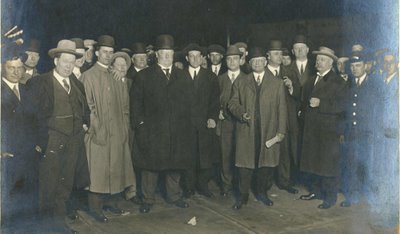
During his successful 1908 presidential campaign, William Howard Taft spoke at the Ohio Soldiers' and Sailors' Home (now the Ohio Veterans Home). The photo below shows the soon-to-be President-Elect with a group of local dignitaries outside of the Soldiers Home. Taft was a close friend of Sandusky resident Edward Marsh, and apparently visited the area several times for social occasions.


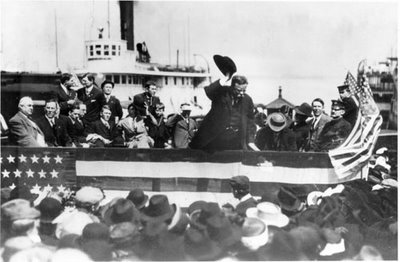
Taft's former political ally, Theodore Roosevelt, became his political opponent during the 1912 presidential campaign. Believing that Taft betrayed the progressive principles that formed the core of Roosevelt's beliefs, "TR" ran for president that year as the candidate of the Progressive Party (often called the "Bull Moose" party, in honor of a popular nickname for Roosevelt). In May of that year, Roosevelt gave a whistle-stop speech at the foot of Columbus Avenue to a large crowd of Sanduskians. Here is one of several images of that event from the library's photo collections:

In the 1916 election, Charles Evans Hughes was the Republican candidate for president, seeking to unseat President Woodrow Wilson from his position. In September 1916, Hughes gave a speech in front of the American Crayon factory on Hayes Avenue. (Unfortunately, that photo will not post properly on Blogger.)

Another interesting local story of presidential campaigns can be found in the November 11, 1940 issue of Life magazine. In an article titled "The People's Choice," the publishers used Erie County, Ohio as a microcosm for the nation, with images of local residents and descriptions of why they chose to vote the way they did. You can read the article, and see photographs of local residents of the time (as well as a picture of candidate Wendell Willkie in Sandusky), in the Sandusky Library. Ask a reference librarian for that issue of Life magazine from closed storage.