Showing posts with label Calvary Episcopal Church. Show all posts

Sunday, February 14, 2021

Sandusky’s Valentine was a Sleet Storm in 1909


Between February 14 and 16, 1909 a severe ice and sleet storm coated most of central and northern Ohio. Local weather official E.E. Nimmo reported that the track of the storm was very narrow, heading from east to west along the lake. Sandusky was in the very center of the storm’s fury. Many telephone, telegraph and electric wires were damaged, under the weight of three quarters to an inch of ice. Trains and interurbans were delayed, and the Lake Shore railroad had to resort to using manual signals, due to having no electricity.

John A. Giedeman, from the Sandusky Telephone Company, stated that “It is the worst storm of the kind we have ever had.”   The telephone company sent out ten men to work on the damaged wires. The electric company did not lose its ability to generate electricity, but it could not get that energy out to the local customers due to so many wires being damaged.  Residents and businesses resorted to using old gas lights and candles. The fire alarms in Sandusky were all out of service. Local police officers assisted in removing trees and downed wires that fell across the city’s streets and walks. The picture below shows a portion of Columbus Avenue, at the intersection of Hayes Avenue. 

In the picture postcard below, you can see Old Calvary Church on the left side of the picture, old fire engine house number 3 in the center, and Sycamore School can be seen in the background on the far right. There was severe damage to telephone poles and wires at this location, near the intersection of Sycamore Line and First Street.

Employees of the Lake Shore Electric Railway are seen  clearing the right of way on Camp Street in the postcard below.


An article in the February 16, 1909 issue of the Sandusky Register thanked those who helped the storm edition of the Register get to press. The Register staff had to hand-set the type. The Sandusky Democrat loaned a non-electric motor to the Register, and Ohio Motor Company brought in a 15 horsepower engine to help the press room get the paper out. 25,000 readers of the Sandusky Register got their papers delivered at 2 p.m. on Monday, the day after the big sleet storm first hit. 

To read more about Ohio’s severe sleet storm on 1909, visit the Sandusky Library Archives Research Center, where historical issues of local newspapers are available on microfilm and online.

Saturday, March 14, 2015

Camptown


A neighborhood on the eastern part of Sandusky was once known as Camptown. It is located east of Sycamore Line and south of Scott Street, including First, Second, Third, Fourth and Fifth Street. Camptown was named after John G. Camp, John G. Camp, Jr. and Jacob A. Camp, who added this section of the city to the original plat of Sandusky in 1852.  In the 1800s, St. Ann’s Chapel was built in Camptown as an outreach of Grace Episcopal Church. This chapel later became Calvary Episcopal Church, which is now in use as a wedding venue. Around the turn of the twentieth century, Philip Schmidt ran the Camp Town grocery store at the corner of Monroe and Meigs Streets, on the edge of the neighborhood. In the 1870s, artist Samuel Tebbutt lived on Second Street. The neighborhood has always been primarily residential. Though no signs of the name Camptown remain today, thousands of tourists drive through the section of Sandusky formerly known as Camptown, on their way to Cedar Point each summer.

Thursday, December 04, 2014

St. John’s Chapel of Grace Episcopal Church


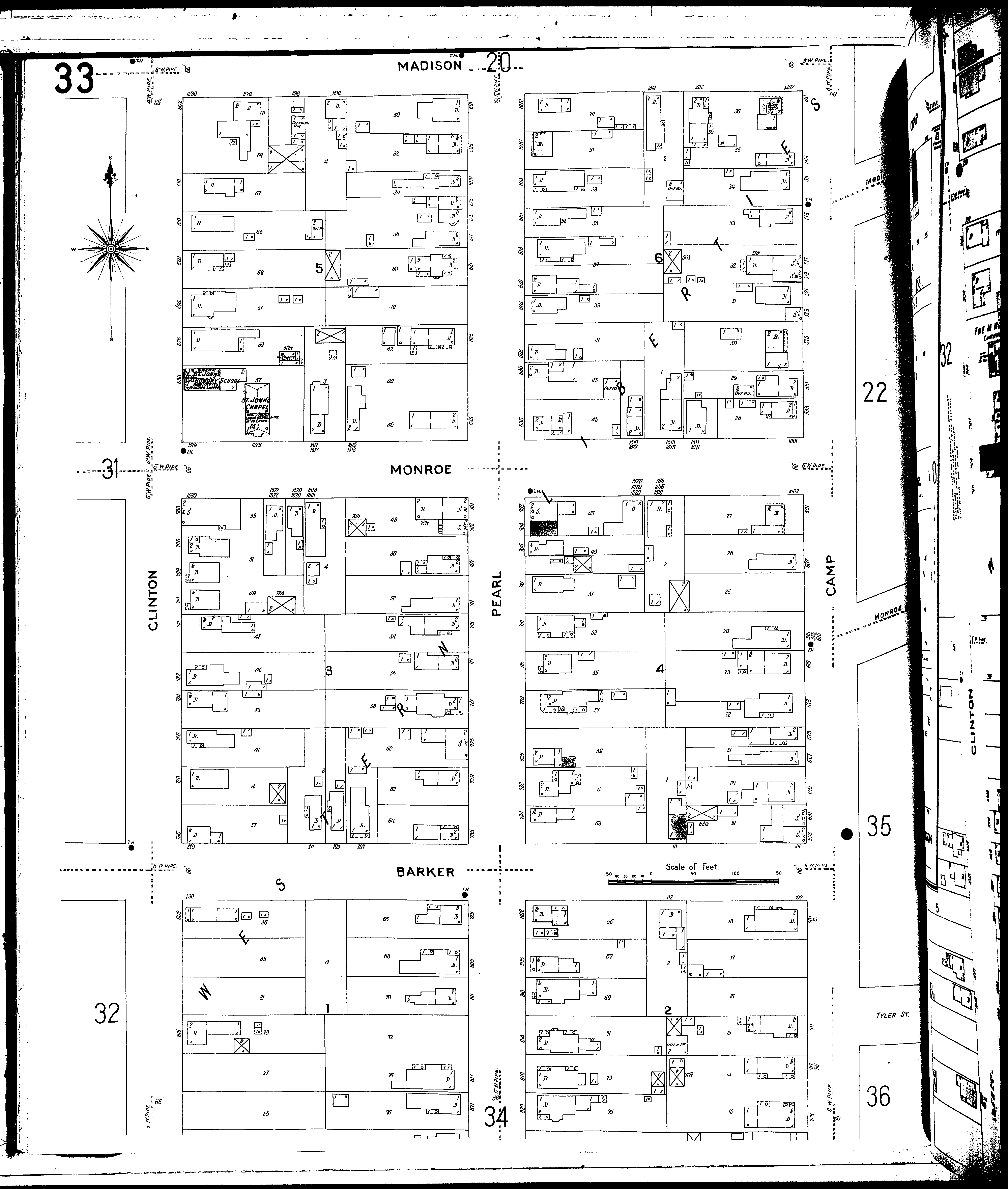
Pictured above is a Sunday School group at St. John’s Chapel, an outreach site of Grace Episcopal Church. The photograph was taken between 1900 and 1910. All the children are dressed in their Sunday best, and the pastor and several other adults are standing behind the Sunday School students. The 1905 Sanborn Map actually shows two buildings associated with the St. John’s Chapel. One was located on Clinton Street, and designated as the St. John’s Sunday School, while the St. John’s Chapel itself was located on West Monroe Street.


Grace Episcopal Church’s original church building was begun in 1835. This post card shows the church before the towers were altered.


At the back of a history of Grace Church by Gordon Wendt, is a list of several outreach programs undertaken by Grace Episcopal Church. Under the leadership of Rev. S.A. Bronson, St. Ann’s Chapel was built in the area known as Camptown, on the east side of Sandusky. St. Mary’s Chapel was built in the 1850s on the west side of Sandusky and later became the Sunday School building for St. John’s Chapel. St. John’s Chapel was built in 1876 on West Monroe Street, and was in operation through the 1920s. St. Luke’s Chapel was built in 1881 on Hayes Avenue, between Tyler and Polk Street. It was sold in 1915 to the First Christian Church, and was home to that church for many years. Mr. Wendt wrote that Calvary Episcopal Church started out as a chapel, built in 1870-71 at First Street and Erie Street. In 1899-1900, Calvary’s building at Meigs and First Street was constructed.  Old Calvary Church now serves as a wedding venue. Visit the Sandusky Library to read more about the history of Grace Episcopal Church, and many other local churches. The Sandusky Library Archives Research Center holds many reels of microfilmed church records.