Showing posts with label Pennsylvania Railroad. Show all posts

Monday, November 21, 2022

Short Line Docks at Foot of Decatur Street


The Sandusky and Columbus Short Line Railway opened in 1893, and it became part of the Pennsylvania Railroad system in 1902. In 1964 the Norfolk and Western Railway acquired the line. The former Norfolk and Western is now part of Norfolk Southern. 

Ships met the railroad at this dock, which was a slip at the foot of Decatur Street. A horse drawn wagon can be seen transporting lumber in the picture above.

Another view of the Short Line Docks appeared in the 1894 publication, Art Work of Huron and Erie Counties:

Coal continued to be shipped from this location until the 1930s and 1940s. In the 1960s, the former Decatur Street slip was filled in as a joint project of Scott Paper and the Westvaco Corporation. Today the Sandusky Boat Basin and Paper District Marina are in the location of the former Decatur Street slip.

Saturday, December 15, 2018

A History of the Coal Docks


Two centuries ago, Sandusky’s founders assumed that Sandusky’s protected harbor destined the city to become the leading port on Lake Erie. Unfortunately, this was not to be the case. The problem was simply that the entrance to the bay was blocked by shifting sand bars, and the bay itself was shallow and difficult to dredge because of the underlying limestone. The original channel into the bay followed the convoluted course of the Sandusky River bed in the direction of Johnson’s Island and then turned south to the city’s waterfront. The channel and the waterfront docks were shallow and poorly marked. Ships often ran aground or hit submerged rocks, and Sandusky soon earned a reputation as a port to be avoided. Cleveland, Lorain and Toledo thrived. Sandusky languished.


Recognizing the situation, improvements were continually made during the course of the 19th and early 20th Centuries. In 1889, the “Straight” channel 17 ft. deep was dug from the foot of Warren St. to the tip of Cedar Point and the channel was marked, but the “Dock Channel” along the waterfront remained unmarked and quite shallow. In 1895, construction was begun on a Jetty at the tip of Cedar Point in an ongoing effort to prevent sand from blocking the entrance to the bay. 

Iron ore, lumber, coal, and grain were shipped in large quantities from the B & O docks at the foot of Warren St. but as ships got bigger and bigger, these improvements proved to be  too little and too late. The mouths of the Maumee, Black and Cuyahoga Rivers were easy to dredge. Sandusky Bay was not. Sandusky prospered, but it was unable to attract heavy industries such as steel manufacturing that depended on deep water ports. One by one companies began to close their shipping operations in Sandusky in the early years of the 20th Century with one notable exception – the Coal Docks.


In 1891, the Sandusky & Columbus Short Line Railroad Company opened a straight track from Sandusky to Columbus and constructed the original Coal Dock later known as Pier #1 at the foot of King St. The City of Sandusky helped fund construction of the pier and the cost of dredging to allow lake freighters access to the pier. The small freighters of the day were initially loaded by hand using wheelbarrows, but in 1893, Pier #1 was equipped with a steam driven loading apparatus known as the “Whirly.” Workmen loaded coal in buckets that were then whirled over the side of the freighter where they were dumped and then whirled back in a continuous circle. In 1898, the “Whirly” was replaced by a new ship loader that could lift a coal car to a level above a ship’s deck from where its contents could be dumped into the cargo hold. It could unload fifteen coal cars per hour which meant that a four and a half ton cargo could be loaded in just under six hours.

In 1902, the Sandusky & Columbus Short Line Railroad was purchased by the Pennsylvania Railroad and the coal dumper on Pier #1 was replaced with one that could handle up to 25 cars per hour. Coal demand was high, and in 1914, a second dumper was installed on Pier #2 located just to the west of Pier #1. The coal shipped from the docks was originally destined primarily for power production, but the docks were beginning to supply more and more coal for steel production.  In 1937, with Piers #1 and #2 operating around the clock and larger and larger freighters being constructed, the Pennsylvania Railroad announced a mammoth project that was destined to transform the Sandusky harbor and finally resolve the issues associated with the harbor’s channels.


A new Pier, designated #3, was to be constructed west of Pier #2 that would be almost a mile long and 600 ft. wide. A new dock channel with a wider turning basin, and a “Bay Channel” that would permit ships to return to the lake to the north of the “Dock Channel” were part of the project.   Eleven million tons of steel sheeting and pilings and the 2.5 million cubic yards of silt and debris that were dredged from the bay were used in the construction of the pier. The crowning achievement was the construction of a giant new Coal Dumper which Sanduskians have enjoyed watching operate to this day as it lifts coal cars high in the air and dumps their contents into the holds of today’s huge lake freighters. The new dumper stands 172’ above water level and could dump 30-35 50 ton rail cars per hour.  In 1944 when the demand for coal peaked, a record 14.3 million tons of coal were shipped from Piers #1, #2 and #3.

People enjoy watching freighters enter and leave the bay and sometimes wonder why we don’t see as many freighters these days. The answer is simple. In 1955 Sandusky loaded 1123 lake freighters with 8.1 million tons of coal. It would only take 270 of today’s much larger freighters to haul the same amount.  Piers #1 and #2 could not accommodate the larger freighters which resulted in Pier #2 being closed in 1957, and Pier #1 being closed in 1969.


When the docks were sold to the Norfolk and Western Railway Company in 1964, plans were soon underway to add a coal stockpiling and reclaiming facility to Pier #3. It was designed to provide space for one million tons of stockpiled coal and incorporated nearly 2.56 miles of interconnected conveyer belts. Three silos were installed 40 ft. in diameter and 194 ft. tall each with a capacity of 3,500 tons. Two large pieces of equipment were constructed to move stockpiled coal of different grades to the silos or directly to a waiting freighter. The “Bucket Reclaimer” which stands 45 ft. tall and weighs over 320 tons can move 3,000 tons of coal per hour. The “Bandwagon” which stands over 90 ft. tall and weighs 310 tons can stack coal into storage piles and work in conjunction with the “Reclaimer” to transport coal from storage piles directly to vessels. These two pieces of equipment increased vessel loading capacity from 3000 to 7,000 tons per hour and on September 3, 1988, Pier #3 loaded a 989’ long freighter with 59,058 tons of coal, a record for the Great Lakes.

Now owned and serviced by Norfolk Southern and operated by Sandusky Dock Corporation, the Pier #3 coal dumper has been in operation for 79 years. Remarkably, it is able to efficiently handle today’s 100 ton rail cars that are 50 tons heavier than those of the 1930’s.  Today 95% of the coal shipped from Sandusky is used in the manufacture of steel.

Sandusky, like most cities in along the Great Lakes has lost much of its industry during the past forty years, but the Sandusky Dock Corporation continues to evolve and prosper utilizing ever more advanced equipment and technology. Orders for different grades of coal can be filled promptly and efficiently thanks in large part to the foresight of the men who designed Pier #3 many years ago. The Sandusky Docks are a tremendous asset for our community. The Pier #3 coal dumper ranks with the Top Thrill Dragster as one of Sandusky’s premier attractions.  Sandusky would not be the same without it.


Sunday, July 22, 2018

Excursion of Kilbourne and Jacobs Employees to Cedar Point


Each summer between 1903 and 1911, the employees of the Kilbourne and Jacobs Manufacturing Company in Worthington, Ohio were treated to a day at Cedar Point. A banner bearing the company’s  name was placed on a Pennsylvania Railroad car. 


An article from the July 22, 1905 issue of the Sandusky Star Journal provides with details about the festive event.


James Russell Kilbourne provided each employee with two tickets to Cedar Point. Four separate trains from the Pennsylvania Railroad brought the visitors from Columbus to Sandusky. Once in downtown Sandusky, the employees then boarded steamers to travel to Cedar Point.


Mr. Kilbourne and his party traveled in a private train car. When he arrived in town, he ran into a former military buddy from the Ohio Soldiers’ and Sailors’ Home. The retired soldier wanted to chat, but Mr. Kilbourne said, “I’m too busy to think or talk politics. I want to see that all my people have a good time here.” Besides visiting the beach and other attractions at Cedar Point, the group took part in several contests, including a smoking contest and another one in which they had to guess the number of seeds in a watermelon. On the day of the visit of the three thousand employees of Kilbourne and Jacobs to Cedar Point, the Knights of Columbus brought in a group of one thousand visitors to the Point.

Of course the surname Kilbourne is very familiar to Sandusky residents. The great grandfather of James Russell Kilbourne, was an early surveyor of the lands in Ohio. James Kilbourne (1770-1850) was instrumental in the founding of Sandusky and Worthington. Hector Kilbourne, son of the elder James Kilbourne, was responsible for laying out the plat of Sandusky in the shape of the Masonic emblem.


Thursday, February 02, 2017

Lower Lake Dock Company Dinner at the Hotel Rieger in 1928


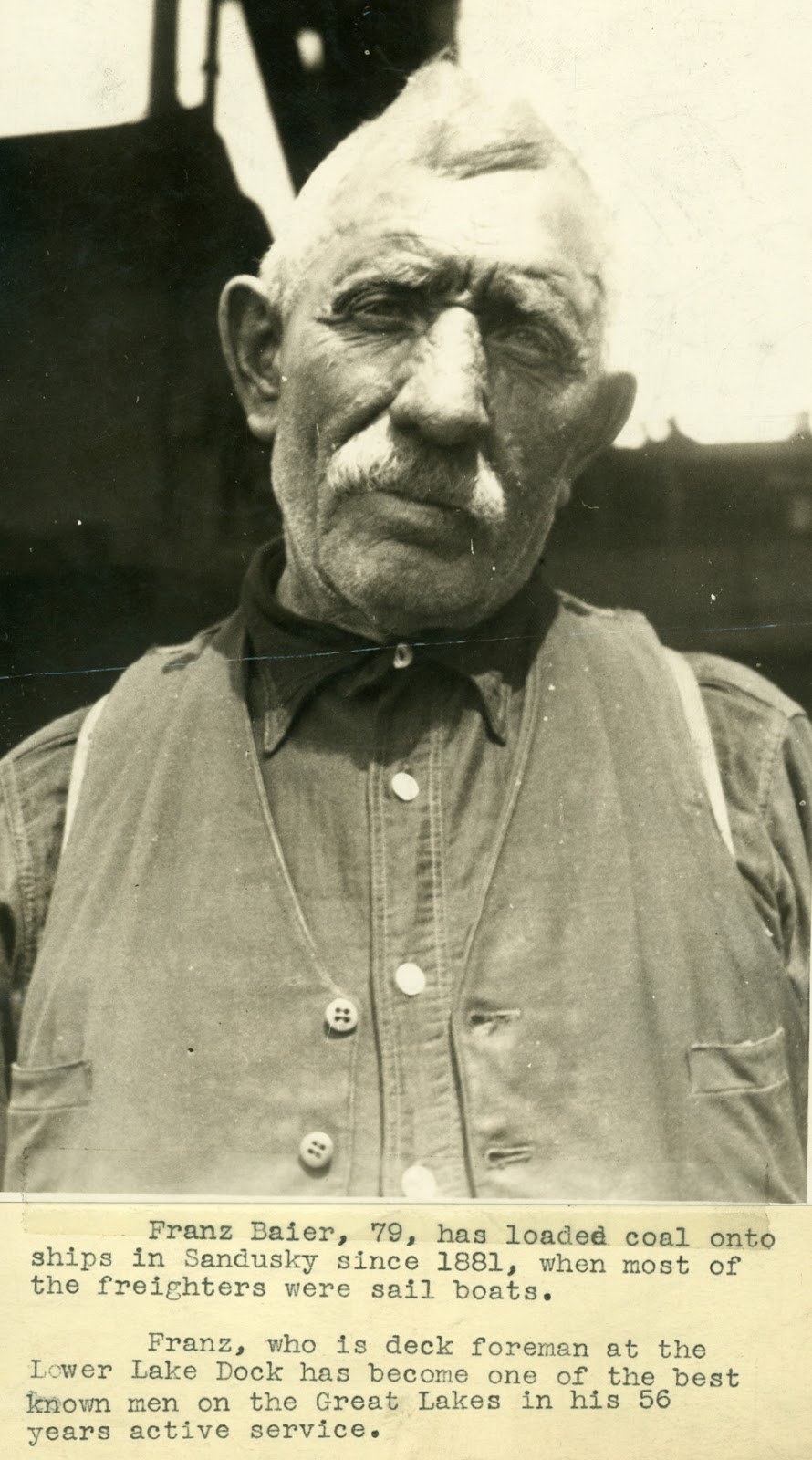
On February 11, 1928, several members of management and staff of the Lower Lock Dock Company met for a dinner at the Hotel Rieger in Sandusky. The celebratory dinner was held in honor of the crews who staffed Heyl and Patterson dumpers at the Lower Lake Docks in Sandusky. 

On May 6 and 7, 1927, 1254 coal cars of the Pennsylvania Railroad were unloaded, resulting in 73,987 tons of coal being dumped. This feat broke all previous unloading records at the dock.

The invited guests were treated to a dinner of steak and baked potatoes with all the trimmings. 

At that time, C.H. Hampe was the superintendent of the company. He would go on to have a career that spanned over fifty years of dock service, having worked in Ashtabula and Sandusky. In 1950, officials of the Lower Lake Dock Company and the Pennsylvania Railroad honored Mr. Hampe with a celebration of his fifty years of service by hosting a party in his honor at the Odd Fellows Hall. 

Now the company formerly known as the Lower Lake Dock Company is owned by Norfolk Southern and is operated by the Sandusky Dock Corporation. This firm still uses equipment made by Heyl and Patterson. To see more pictures of the coal docks, see a previous post at Sandusky History’s website.


Wednesday, July 29, 2015

Carp Were Shipped Live From Sandusky to Philadelphia in 1911


An article in the May 18, 1911 issue of the Sandusky Star Journal reported that 4000 pounds of live carp from Oscar Zistel’s wholesale fish company, on Meigs Street in Sandusky, were recently shipped to Philadelphia. Mr. Zistel, the Adams Express Company, and government officials all worked together on the venture. At one time the fish, which were introduced in the U.S. from other countries, were despised,  known as “the hog of the waters,” but by the 1910s carp were considered a delicacy in some markets in the eastern U.S.

To ship the carp, first the fish were penned in floats on Sandusky Bay; then the floats were transported to the Pennsylvania freight house. The live fish were loaded onto a car on the Pennsylvania Railroad, which was refrigerated and had circulating water, to ensure the well being of the carp. The carp were taken out of the floats, placed into baskets, weighed, and put into the freshwater tanks on the railway car, where they traveled from Mansfield to Pittsburgh, and then on to Philadelphia.The trip to Philadelphia was over 500 miles, and an expert aboard the railroad monitored the refrigeration and air tanks in the fish tanks. The Star Journal article stated that the Jewish residents of Philadelphia were so eager to purchase the fresh fish that they bought it straight from the train car, where the fresh carp sold for eighteen to twenty cents per pound. 

In 1913 and 1914, Oscar Zistel received patents for fish transporting devices. Patent number 1,109,193 was for the improvement of an aerating device which could be useful in the transporting of live fish. Patent number 1,227,732, issued in 1917, was for an automobile which could be used to transport live fish.


Sadly, Oscar Zistel died in 1918, before his vehicle could be fully developed. Several patents issued between 1951 and 2011 cited technology that Zistel had patented. The Zistel family was quite entrepreneurial. Oscar’s father Louis Zistel carried passengers to Cedar Point in the 1870s, and was the proprietor of the Atlantic Pleasure Gardens, a saloon and entertainment center on Meigs Street.

Saturday, April 10, 2010

"Reading" a Photograph -- West Monroe Street about 1933

Pictured above is a scene which shows West Monroe Street at the crossing of the Pennsylvania Railroad, near the entrance to the coal docks. In front of the buildings on the north side of Monroe a railroad employee can be seen. Whenever a train passed by, he would have to manually hold up the stop sign, to warn automobile drivers of the train. We can see that more clearly in this close-up cropped from the original image.
In another cropped view, we can see where Elmer B. Otto manufactured ice cream, at 2434 West Monroe Street (in the building on the right side of the street).
To the north of the railroad crossing, a factory can be seen through the trees. Not enough of the letters of the building and water tower are legible enough to be deciphered. If anyone can identify this business, please leave a message in Comments.