Showing posts with label Catholic Church. Show all posts

Saturday, November 14, 2020

Sister Mary Aloysius Molloy, President of the College of Saint Teresa

Image of Sister Mary Aloysius Molloy courtesy College of Saint Teresa Archives, Winona, Minnesota

Mary Molloy was born in Sandusky in 1880 to Mr. and Mrs. Patrick Molloy, who were both Irish immigrants. She graduated from Sandusky High School in 1899, and during her senior year won a silver medal from the Ohio Society of the Sons of the American Revolution for her essay on “The Causes of the American Revolution.” Mary attended the Ohio State University, earning a degree in Philosophy in 1903. She earned a Master’s Degree in English Philology from Ohio State in 1905. In 1907, Mary Molloy got her PhD from Cornell University. Her doctoral thesis was entitled “The Vocabulary of the Old English Bede.” After leaving Cornell, Mary began teaching freshmen courses at the Winona Seminary. Soon she began teaching higher level courses, and eventually became the dean of the college in 1911, which by then had become the College of St. Teresa. A brief article about Mary Molloy appeared in the August 1, 1920 issue of the Sandusky Register, which reported on several local residents whose names had been listed in the book Who’s Who in America.


In 1922 Mary Molloy entered the novitiate of the Sisters of the Third Order Regular of Saint Francis of the Congregation of Our Lady of Lourdes, in Rochester, Minnesota, and she became a Franciscan Sister in 1923. After a fire had done serious damage to Sister Mary Aloysius Molloy’s home parish of Saints Peter and Paul Church in Sandusky, Ohio, she contributed $5000.00 to the renovation.

The generous gift was designated for two new side altars and a communion railing made from Italian marble. These gifts were given in memory of her parents. 

Sister Mary Aloysius Molloy was devoted to excellence in parochial education. In 1928, she was named president of the College of St. Teresa. She wrote several books, including: Give Us Teachers, The Parochial Schools, Catholic Colleges for Women, and The Lay Apostate. Sister Mary Aloysius was the first woman to be appointed to the executive committee of the college department of the National Catholic Educational Association. She retired from the college in July, 1946. 

On September 27, 1954, Sister Mary Aloysius Molloy died in Rochester, Minnesota at the age of 74. She was selected as an honoree of the National Women’s History Project in 2006, for her contributions to education. A biographical essay about Sister Mary Aloysius Molloy is found in the book Women of Minnesota. You can read more about Sister Mary Aloysius Molloy in a book published when Saints Peter and Paul Church celebrated its 125th Anniversary, available in the local history section in the Lower Level of the Sandusky Library. Though the College of St. Teresa is no longer in existence, Sister Mary Aloysius Molloy will long be remembered for her leadership and her contributions to parochial higher education.

Tuesday, March 08, 2016

The Cassidy Home: Site of Early Catholic Church Services in Sandusky


A room in the home of the Cassidy family at 221 Hancock Street (no longer standing) was used for Catholic Mass in Sandusky, Ohio, before Catholic churches were built in the city. 

Edward and Robert Cassidy were immigrants to the United States, having been born in Ireland. The Ohio Historic Places Dictionary states that Robert Cassidy built Holy Angels Church in Sandusky between 1841 and 1845. In the 1855 Sandusky City Directory, both Cassidy men listed their occupation as mason. Edward Cassidy and his wife Bridget had a total of twelve children. An early plat map from the Erie County Auditor shows the exact location of the Edward Cassidy home, though by the time of this map’s publication, it may have been Edward Cassidy, the son of Edward and Bridget Cassidy who resided here. The house sat on the west side on Hancock Street between Market Street and Washington Street, in Sandusky’s Second Ward.


It is believed that this is the room in which the early Catholic church services were held when they met at the Cassidy home.
                                        

Ernst Niebergall this picture of a dresser in the Cassidy home in the 1920s, though its use as an altar for church services took place in the 1840s.


When Edward Cassidy died in 1893, a front page article of the Sandusky Register stated that he had been a “city father.” Edward and Robert Cassidy built many of the stone buildings in early Sandusky, including the first jail, the U.S. Customs House, and the shops of the Mad River Railroad and the Sandusky, Mansfield & Newark Railroad. Over fifty individuals with the surname Cassidy are buried in the St. Joseph Cemetery in Sandusky. 


Wednesday, February 24, 2016

Father William F. Murphy


Father William F. Murphy was appointed Pastor of Sts. Peter and Paul Church on September 5, 1905, the second priest to serve this parish. He succeeded Father R.A. Sidley. Father Murphy oversaw the building of a school for the parish, partially funded by a bequest from Father Sidley. The new school and Sidley Memorial Hall was dedicated in 1907. Following two fires which damaged Sts. Peter and Paul Church, Father Murphy led the parish in seeing that the church was repaired and restored. With the help of a generous gift from Sandusky native Sister Mary Aloysius, the church installed a communion railing made from Italian marble, and two new side altars.


During his thirty-eight years at Sts. Peter and Paul, Father Murphy officiated at hundreds of weddings, baptisms, funerals, and sacred holiday masses. On July 14, 1915, Father Murphy officiated at the wedding of Notre Dame legendary coach Knute Rockne to Bonnie Skiles. The pair had met while they were employed at Cedar Point.


On the occasion of Rev. William F. Murphy’s Golden Jubilee, in which he celebrated fifty years in the priesthood, the whole community gathered to honor him. A mass was held at Sts. Peter and Paul Church on July 4, 1934, with the Most Reverend Kal J. Alter, D.D. presiding.


Catholic leaders all across Ohio attended the Golden Jubilee celebration. On July 5, 1934, a civic reception for Father Murphy was held at Jackson Junior High, and was open to the public. Speakers included Judge Edmond Savord, Mr. J. J. Carroll, president of the G & C Foundry, Congressman W. L. Fiesinger, Attorney John F. McCrystal, Sr., Mr. F. J. Prout, Superintendent of Sandusky Schools, Major C.B. Wilcox, President of the Sandusky Chamber of Commerce, as well as Rev. William Zierolf from St. Mary’s Church and Rev. Thomas Hughes from Trinity Methodist Church. Father Murphy was respected as a community leader by residents of all walks of life and religious denominations. 

On February 24, 1942, Father William F. Murphy died at the age of 84. Sandusky City Manager A.J. Lauber  stated  in an article in the February 24, 1942 issue of the Sandusky Register Star News that, “The death of Monsignor William F. Murphy is a severe loss to our community. He was always eager to give his time and energy to those things which make for a better city in which to live and work. His kindly spirit, his wise counsel and his marvelous personality has endeared him to every person in Sandusky.” Father Murphy’s funeral was widely attended, and he was buried at St. John’s Cemetery in Cleveland, Ohio. 

Father William F. Murphy saw his congregation through the Great Depression, World War I, and the early years of World War II. His leadership, integrity and compassion were appreciated by  his church members and the entire community.

Friday, November 30, 2012

Three Churches at the Intersection of Columbus Avenue and Jefferson Street

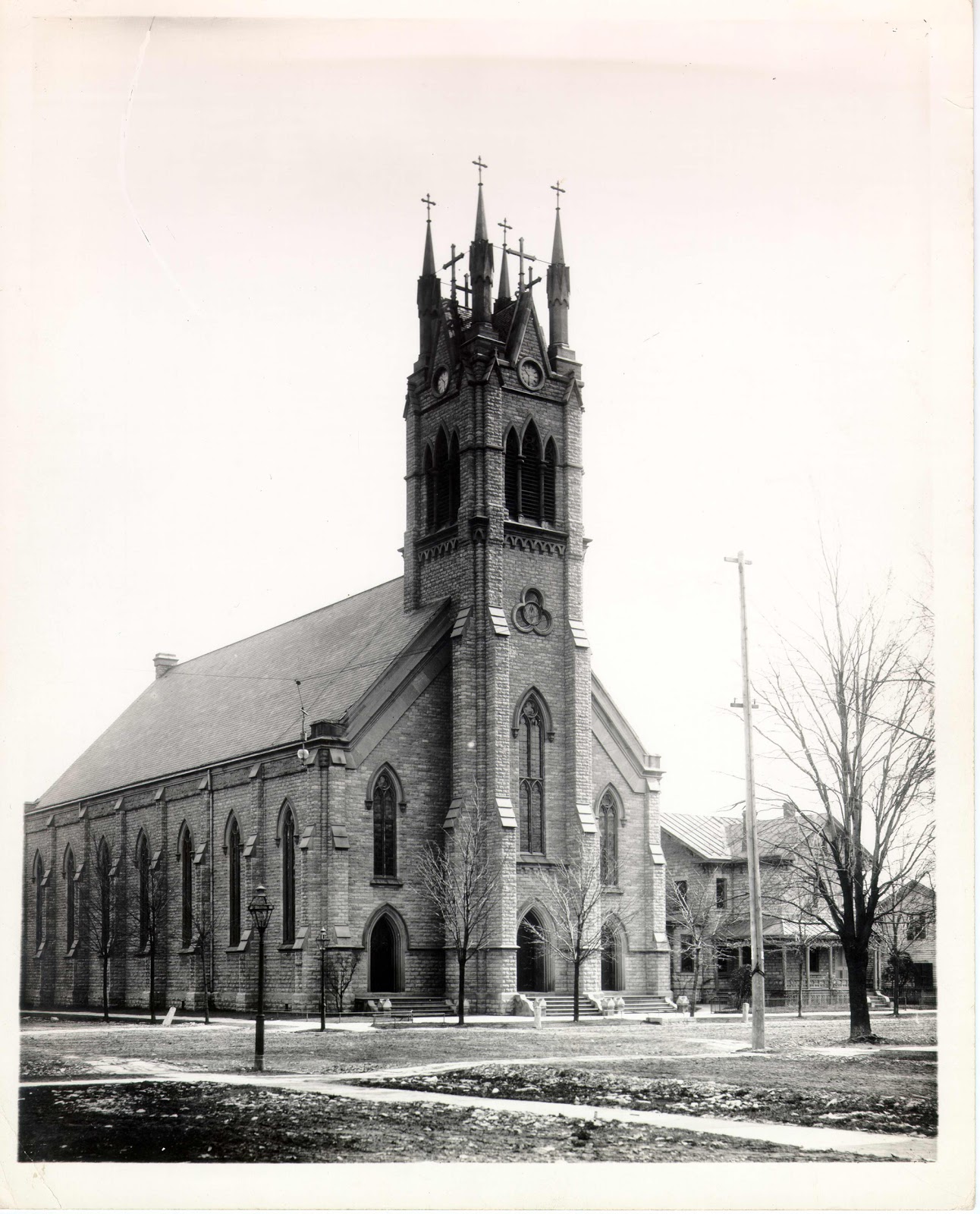
In this aerial view of Columbus Avenue, taken around 1920, one can see the three churches located at the intersection of Columbus Avenue and Jefferson Street. (The church steeple in the right foreground of the picture is Emmanuel Church.) The oldest of the three churches at this intersection is Saints Peter and Paul Church, located at the southeast corner of Columbus Avenue and Jefferson Street. According to the Dictionary of Ohio Historic Places, Saints Peter and Paul Church (below) was built of limestone in 1865 by Patrick Charles Keely in the Victorian Gothic style. The triple windows in the tower and the three front doors are reflective of the Trinitarian theme often used by Keely.


The First Congregational Church was built in 1895 by George Philip Feick in the Romanesque Revival style of architecture. Tiffany glass is featured in this two story church, located at 431 Columbus Avenue.

George Feick was also the builder of Zion Lutheran Church, built in 1898-1899 at the southwest corner of Columbus Avenue and Jefferson Street. The church was built from limestone in the Victorian Romanesque style. Many early German immigrants worshipped at this church, whose congregation formed in 1847. Well into the twentieth century, there was a German language service held here every Sunday. Zion Lutheran Church served as a mother church for several other Lutheran churches in the area.

Visit the Sandusky Library Archives Research Center to learn more about these and several other area churches. In the Church Collections of the Archives Research Center are many vintage photographs, church histories, and church records on microfilm.

Saturday, August 22, 2009

Father Joseph P. Machebeuf, Pioneer Priest

Joseph Projectus Machebeuf was born in France on August 11, 1812. A history of the Holy Angels Church, published in 1976, states that Father Machebeuf was ordained by the Bishop of Clermont, France in December of 1836. After hearing an address by Bishop J. B. Purcell, Father Machebeuf and Father J. P. Lamy followed the call to serve in the Catholic churches of the United States. Father Machebeuf served as a missionary to Catholics in the Northern Ohio area. He began his duties in Sandusky on January 1, 1840, and he is considered the founder of Sandusky’s Holy Angels Church. Mathilda Cassidy, born October 28, 1840, was the first infant baptized by Father Machebeuf. During the first half of 1841, Father Machebeuf had participated in three First Communions, three marriages, twenty confirmations and he had one hundred ten communicants on Easter Sunday. The cornerstone for Holy Angels Church was laid on October 13, 1841, and the church was completed in 1845.
Hewson Peeke wrote in his 1916 edition of A Standard History of Erie County, Ohio, that during the Cholera epidemic of 1840, Father Machebeuf secured a home to be used as a children’s home for the children left orphans during the epidemic. Catherine Bissonette, from La Prairie, Sandusky County was the matron of this home. The 1850 Census for Erie County, Ohio lists a “Projectus Maschbuff,” along with a female named Mary, an adult male, and four children named John Sheibley, Fanny Mahoney, and Barney and James McCormick residing on the west side of Sandusky. An article on the February 22, 1883 Sandusky Register gives an account of Father Machebeuf’s strong teachings on temperance. When Father Machebeuf would hear of one of his parishioners “getting on a spree and neglecting to support his family, he used to arm himself with a rawhide and finding the chap in a saloon, he could then and there draw forth the rawhide and give him a sound flogging. It is said he was never resisted and that the priest’s unique temperance lecture was in more than one case effectual.”

In 1850 Father Machebeuf left Sandusky for the western United States. He worked as a missionary priest in New Mexico and Colorado, and he was appointed Bishop of Denver on August 16, 1868. Willa Cather based the character of Father Joseph Vaillant in her 1927 book Death Comes to the Archbishop on the life of Father Joseph P. Machebeuf. Mount Machebeuf was named after Father Machebeuf, and Bishop Machebeuf School is considered a top school in Denver, Colorado.

Two biographies of Father Joseph Machebeuf are found in the genealogy collections of the Sandusky Library: Life of the Right Reverend Joseph P. Machebeuf, by Rev. W. J. Howlett, and Death's Deceiver, by Lynn Bridgers. Father Joseph P. Machebeuf died on July 10, 1889, and he is buried in Mount Olivet Cemetery in Jefferson County, Colorado.

Wednesday, October 01, 2008

The Irish in Erie County

During the first half of the nineteenth century thousands of Irish emigrated to the United States. The potato famine of 1845 left devastating conditions in Ireland. The Irish immigrants had hopes of starting a new life in the United States. Often the only jobs available were among the least desirable. As a result many Irish born workers built the canals and railways of America and worked in dangerous mines. Besides working difficult jobs, the Irish often faced discrimination. They encountered signs that said “HELP WANTED – NO IRISH NEED APPLY.” As a result the Irish found solace in churches and community organizations. Eventually the Irish were assimilated into American culture, along with thousands of other immigrants from many other countries. Today Americans of Irish descent are still known for their humor, love of family, and their sometimes feisty personalities. St. Patrick’s Day has been celebrated in America since 1737.

One of the earliest Irish immigrants in Erie County was John Beatty, who was one of largest land owners of the Firelands. John Beatty led a group of fourteen families from Connecticut to Perkins Township in 1814. He was Mayor of Sandusky from 1833 to 1836. His brother-in-law was Rev. William Gurley, an early Methodist minister was licensed to preach by John Wesley, the “father of Methodism.”

Father R. A. Sidley (below) was born in Ireland in 1828. He was the priest of Sts. Peter and Paul Church in Sandusky from 1863 until 1871. Father Sidley oversaw the building of the church which still stands today at the southeast corner of Columbus Avenue and Jefferson Street. Father Sidley left a bequest of over $13,000 for the building of a new school, which was completed in 1907. The auditorium of the new school was named “Sidley Memorial Hall” in honor of Father Sidley. For many years Sidley Hall was used for concerts, commencements, as well as amateur and professional dramatic productions.

Leonard Johnson, another local Irish immigrant, bought Bull’s Island in 1852. The name of the island was later changed to Johnson’s Island. During the Civil War there was a Prisoner of War Camp located on Johnson’s Island.
Wilson “Slip” McLaughlin, who was Chief of the Sandusky Fire Department for many years, was the grandson of Irish immigrant, Michael McLaughlin. “Slip” is in the center of the group pictured below at the fire station located at the corner of Meigs Street and Sycamore Line. Mr. McLaughlin’s obituary in the November 24, 1984 stated that he was a “champion of the underprivileged and public” and a public servant for fifty years.
Descendants of Irish immigrants to Sandusky and Erie County still live and work in Sandusky today. A walk through St. Joseph’s Cemetery will bring to mind many of those Irish Americans who have gone before us.