Showing posts with label Native Americans. Show all posts

Saturday, September 28, 2024

The Dorastus Snow Family and a Wartime Raid in Margaretta Township


 According to the September 1860 Firelands Pioneer, Dorastus P. Snow was the first white settler in Margaretta Township. He built a log house and also constructed a grist mill on Cold Creek. In 1813, there were three families living in the area of Cold Creek, those of Dorastus P. Snow, and the families of Mr. Butler and Mr. Putnam.

A copy of the map of Dorastus Snow's property along Cold Creek in 1823

In June of 1813, while the men were in the fields, the women and children of the families were attacked by sixteen Odawa (Ottawa) men allied with the British who controlled Fort Detroit during the War of 1812. The women were told they would be taken to Detroit. Mrs. Hannah Snow, however, was physically unable to travel due to an illness (or pregnancy), so she and three of the children were killed, while the rest of the group was taken to Detroit and given over to the British agent named Ironside. All the survivors were eventually returned to safety by the Fall of the same year, when United States forces established contact with the British in Detroit.

After life returned to normal at the end of the war, Dorastus Snow married Anna Faulk in 1818, and they had a son named Charles Snow. (After Mr. Snow’s death in 1824, Anna married Philip Cowell, and they had several children.) The Firelands Pioneer lists the children of Dorastus Snow from his first marriage as: Henry, Alanson, Willard, Electa, and Laura. 

Charles and Willard Snow are both buried in the Castalia Cemetery of Margaretta Township.  The inscription on Willard Snow's tombstone (pictured below) is in memory of his mother and brother who were murdered in 1813. (Though the stone reads 1812, all other sources indicate that the killings took place in 1813.) Willard Snow died on January 22, 1875. He was a Veteran of the Civil War, having served in the 40th Illinois Volunteer Infantry.


There are several accounts of the Snow Massacre. You can read about it in Lewis Cass Aldrich’s A Standard History of Erie County, Ohio, as well as The History of the Firelands, by W. W. Williams, both available at the Archives Research Center of the Sandusky Library.

Wednesday, January 03, 2007

One of the Oldest Items in Our Collections

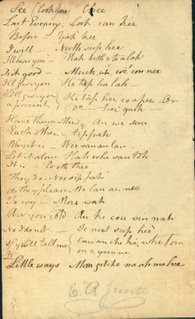
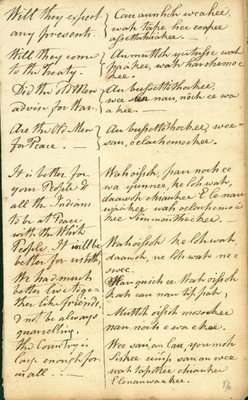
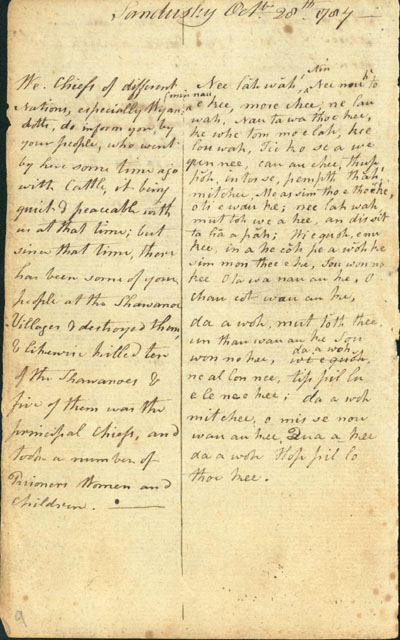
In the vault of the Sandusky Library Archives Research Center is a manuscript copy, dated 1787, of a phrase book, containing translations of words, phrases, and speeches, from English to a local Native American language, possibly the Wyandot/Huron language. This item was donated to the library in 1943, by Dr. Marjorie Anderson (1892-1954) -- a professor at Hunter College in New York, a poet, author, former employee at the Sandusky Library, and native Sanduskian. (She was the great-granddaughter of Dr. George Anderson, Sandusky's first physician -- he died in the cholera outbreak of 1834, after treating infected patients.)

The manuscript is attributed to E.R. Jewett, but the accuracy of this claim is far from certain -- the only signatures with the Jewett name are written in pencil along the margin of a page, and don't seem to match the rest of the handwriting. Who E.R. Jewett was is also unclear -- there was a businessman in Buffalo named Elam R. Jewett, who owned a publishing company and engraving business; this E.R. Jewett, however, appears to have been born around 1811, much later than the date of this manuscript. Could there have been an earlier E.R. Jewett, who travelled around the Sandusky Bay in 1787? Or was this phrase book written by someone else (whose name we do not know), but later owned by E.R. Jewett of Buffalo? Or is there another explanation? (Anybody out there looking for a research project?)

Also, some of you might be wondering, "How could this manuscript be marked 'Sandusky, 1787' when we know that the city of Sandusky was not founded until 1818?" In fact, in that era most of the region around Sandusky Bay and along the Sandusky River was identified simply as "Sandusky." It is possible (or even likely) that this phrase book was written in or around what is now known as the city of Fremont, which was called Lower Sandusky until 1849, and was the site of a Wyandot village in the 18th century. (The city named Upper Sandusky -- farther up the Sandusky River -- still exists, of course.) For those who study Native American languages and cultures, and the early interactions between those peoples and the European settlers, this document may prove an invaluable resource. Although access to the original item is restricted due to its age and fragility, the entire document (21 leaves on 32 digital images) is available in digital format at the library.


Update: Oops. . . . I forgot about the Reverend Edward R. Jewett, who was a founder of the Bethel Church on Water Street (between Decatur and Jackson) in Sandusky in 1852. The image below shows Reverend Jewett some thirty years later. So we might be able to assume that the phrase book was in the Reverend Jewett's possession at some point, but we still do not know the complete provenance of this document.
Update 2: Here is an enlarged view of a portion of a page from the phrase book: