Showing posts with label judge. Show all posts

Saturday, January 13, 2024

Judge Edmond H. Savord


Judge Edmond H. Savord was born in 1889 in Sandusky, Ohio, to Alexander J. Savord and his wife, the former Jennie Kelley. He attended both parochial and public schools in Sandusky, and graduated from Sandusky High School in 1908. In 1912, he was awarded a law degree from the University of Notre Dame and was admitted to the bar in the same year.

Judge Savord had a long career in Sandusky. He was appointed Sandusky City Safety Director in 1914. He served as Sandusky City Solicitor for six months in 1915, and then again from 1922 to 1931. On March 31, 1931, he was named Judge of Erie County Common Pleas Court, a position he held for twenty years. Later he served on the Sixth District Appellate Court, and in March, 1954, he was named Chief of the State Division of Securities by Ohio State Commerce Director H. Harper Annat.

Judge Savord died at the age of 68 in Tiffin, Ohio. Funeral services were held at Saints Peter and Paul Church, with Rev. Gerald Stein officiating. Honorary pallbearers were members of the Erie County Bar Association. Active pallbearers included Judge James M. McCrystal, B.G.Zeiher, George A. Beis, Dr. T.M. Quilter, Frank Weingates, and Joseph Ginnane. Burial was at St. Joseph’s Cemetery in Sandusky, Ohio. Judge Savord was survived by two sons and a daughter. His wife predeceased him in 1951.

A lengthy biographical sketch of Judge Edmond H. Savord, including information about his ancestors is found in Hewson Peeke’s Standard History of Erie County Ohio (Lewis Pub. Co., 1916.)

Tuesday, June 06, 2023

John Emmett Tanney, Erie County Probate Judge


John Emmett Tanney was born in Sandusky in 1892 to John G. Tanney and the former Caroline Weingates. As a young teen, John worked at the Cedar Point Bathhouse. He is number 1 in the picture below.

John E. Tanney was a graduate of Sandusky High School, and studied law at the Ohio State University. He was admitted to the Bar in 1917, and in that same year he entered into military service. 

A biographical sketch of Judge Tanney, which appeared in The Centennial History of Erie County (1925), by Hewson L. Peeke, gives an account of Tanney’s service during World War I:

On the 7th of November, 1917, he enlisted in the Seventeenth Field Artillery of the United States Regular Army, and was at first stationed at Camp Robinson, Wisconsin. On the 14th of December, 1917, he sailed with his command from the port of New York City for the stage of conflict, and he landed in Brest, France, on the last day of that month. That he was at the forefront in connection with the operations of the American Expeditionary Forces needs no further voucher than the statement that he was with his battery in the Verdun sector, in the battling at Chateau Thierry, and the engagements at Soisson, Toul, St. Mihiel and Champagne, besides having been in service with the allied Army of Occupation in Germany after the armistice brought active hostilities to a close. He finally embarked for the home voyage, and on the 20th of August, 1919, he received his honorable discharge. He returned to Sandusky, and here he has since been engaged in the practice of his profession, as a member of the law firm of Tanney & Webster.

John E. Tanney served three terms as Erie County Probate Judge. An article in the December 13, 1926 issue of the Sandusky Star Journal gave an account of an interesting experience for a young couple wishing to be married. The couple appeared before Judge Tanney, but one of the young people needed to have the permission of both parents. The mother had given her permission, but the father was traveling on a train. Judge Tanney drove his car to the train depot, got permission to have the train halted, and promptly got the necessary signature so the wedding could take place. The couple went on to Monroe, Michigan, where there the judge waived the five days requirement usually required from the time of the marriage application until the wedding date, and the couple was married.

Judge Tanney was a popular speaker at civic and school organizations, and he often gave patriotic addresses at Memorial Day and Armistice Day celebrations. He was twice married. His first wife, Olive Turpin Tanney, died in 1917. John and Olive had an infant son who died in 1916. His second wife was Kathryn Richter. Miss Richter was a stenographer in the Erie County Probate Court.

Sadly, Judge John E. Tanney died of a cerebral hemorrhage at the age of 45. Funeral services were held at the Charles J. Andres’ Sons Funeral Home and St. Mary’s Church on July 4, 1938. Military services were held at the burial at St. Joseph’s Cemetery.

Saturday, March 26, 2022

Alonzo W. and Jane Hendry


According to the book History of Erie County, Ohio, edited by Lewis Cass Aldrich (Mason & Co., 1889), Alonzo W. Hendry was born in Erie County, New York. He moved to Lorain County, Ohio in 1834, and he was admitted to the bar in 1842. Mr. Hendry moved to Sandusky in 1843. He married Jane Penfield in Lorain County on August 4, 1848. Jane Penfield had been born in Penfield Township of Lorain County. The township was named for her father’s family, who had been early settlers there. She was a graduate of the Ladies Course of the Oberlin Collegiate Institute in 1847. 

Alonzo Hendry was vehemently opposed to slavery. In an article in the abolitionist newspaper, the Michigan Liberty Press, on April 21, 1848, Alonzo W. Hendry was on a committee that prepared several proclamations relating to keeping “free soil.”  The second resolution read in part:

“As free sons of a free soil and a free Government, we make the cause our own, and in the majesty and strength of justice, of truth, and right, proclaim to the world our unalterable opposition to extending the blighting curse of slavery over one foot of soil now free.”

In 1878, Mr. Hendry published an article in the Firelands Pioneer about the settlement of "Africa," on the edge of Sandusky, where free African Americans resided in the 1830s and 1840s (before the advent of the Fugitive Slave Act). 

A.W. Hendry’s name appeared in the listings of attorneys in Sandusky in the Daily Sanduskian of October 27, 1849. His office was in the upper level of the West block in downtown Sandusky.

The first child born to Mr. and Mrs. Hendry was a daughter, Maria, who was born on July 11, 1849, while Sandusky was in the midst of a deadly cholera epidemic. They had a total of seven children, including a set of twins. 

Alonzo’s recollections of Sandusky during the cholera epidemic of 1849 appeared in Hewson Peeke’s History of Erie County, Ohio (Lewis, 1916), in the chapter, “The Three Cholera Years.”  His description of Sandusky at that time read:

 "The railroad connection between Sandusky and Cincinnati had just been completed and the large amount of travel and traffic over its line was unprecedented in the West.  Large shops, docks and warehouses at Sandusky became a necessity, laborers with their families were crowded into small buildings with insufficient accommodations and it often happened that several families would occupy a small building hardly sufficient in size for one.  Temporary cabins and boarding houses were hastily erected and soon crowded to overflowing.  When the visitation of cholera came the city was wholly unprepared.  There were no hospital accommodations and the force of local physicians was wholly insufficient for the emergency.  Hospitals had to be improvised and physicians like the good Samaritan of old came in from the neighboring cities.  The first death from the cholera was Mrs. Allen, July second.  Three prominent ministers of the gospel passed away - Rev. N. W. Fisher, pastor of the Congregational Church; Rev. H. P. Ward, of the Methodist Church and Rev. T. C. Cooper in charge of the Bethel Church.  They are buried side by side in Oakland Cemetery near the city.  A single marble shaft bearing the names of each was erected by kind friends as a monument to mark their last resting place.  The cholera again visited Sandusky in 1852 and 1854 but in a mild form compared with 1849."

From 1848 to 1852, Mr. Hendry served as the Erie County Prosecuting Attorney. He served as Erie County Probate Judge from 1863 to 1869. After the death of his wife in 1881, he moved to Shawnee, Oklahoma. 

Alonzo W. Hendry died in Oklahoma on April 15, 1901. His remains were returned to Sandusky, for burial in Sandusky’s Oakland Cemetery. An obituary for Mr. Hendry, which appeared in the April 19, 1901 issue of the Sandusky Star reported that he had been a “prominent and highly respected resident of Sandusky.”  To read more about former Judge Hendry and many other of Erie County’s elected officials, see the book, Elected to Serve, by Patty Pascoe.

Friday, December 17, 2021

Judge John Phelps and Sandusky Descendants


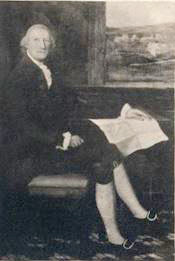
According to volume 3 of the book, New England Families, Genealogical and Memorial: A Record of the Achievements of Her People in the Making of Commonwealths and the Founding of a Nation, Judge John Phelps (born in Suffolk, Connecticut in 1736, died circa 1808) served as a Justice of the Peace and was a Representative to the Connecticut Legislature for several terms. Judge Phelps was associated with the manufacturing of iron, including the production of cannon balls and other war implements purchased by the United States Government. 

John Phelps married Mary Richardson, daughter of William and Lady Abigail Richardson, of Edinburgh, Scotland. One of their daughters was Abigail Phelps, who married Judge Isaac L. Mills, one of the co-founders of the city of Sandusky. William H. Mills, a well known Sandusky wine maker, was the grandson of the judge. 

Another descendant was Allen Phelps Mills, pictured with his mother in the daguerreotype below. Sadly, he died of diphtheria on November 7, 1869 at the age of nine. He was buried in the family lot at Oakland Cemetery.

Though Judge John Phelps lived and died in Connecticut, his descendants left a lasting impression on Sandusky. Mills School, Mills Street, and Mills Golf Course were all named after members of his daughter's family.

Saturday, April 11, 2020

Judge George Morton and Dr. George Morton

In the 1800s, there were two well-known gentlemen, both named George Morton, who called Sandusky home. This excerpt from a page from the 1855 Sandusky City Directory lists both George Mortons along with their address and occupation.


George Morton, the civil engineer, resided at 49 Franklin Street. George R. Morton, the physician, resided at 14 Adams Street. Below is a portrait of Judge George Morton, the former civil engineer in Sandusky, from the Bishop Collection of photographs.


Judge George Morton was born in 1803 in Pennsylvania. He and his wife, the former Ruth Fifield, had a large family of six children. Mr. Morton worked as a civil engineer in Sandusky for many years. From November 1861 to November 1863, he served as Judge of the Erie County Probate Court. After serving as Judge, Mr. Morton went on to work as the Sandusky City Engineer. On June 4, 1888, Judge Morton passed away in Conneaut, Ohio. The Sandusky Register printed a copy of the telegram that had been sent to I.F. Mack & Brother, publishers of the Sandusky Register:


I.F. Mack & Bro:

George Morton died today in the 85th years of his age. Burial at Conneaut, Wednesday.

E. Chapin


We do not own a photograph of Dr. George R. Morton, but we do know that he is buried in Sandusky’s Oakland Cemetery, where he has two grave markers. The tall monument provides his dates of birth and death. Dr. Morton was born in Philadelphia, Pennsylvania on July 13, 1806. He died on April 9, 1875 in Columbus, Ohio, while visiting his daughter’s family.


A flat stone is adjacent to the tall monument that honors the doctor's memory. (While one stone lists Dr. Morton’s birth year as 1805, the other states he was born in 1806.)


Dr. George R. Morton first practiced medicine in Coshocton, and then he moved to Sandusky. His later years were spent residing on North Bass Island, where he was involved in the growing of grapes.

Tip for researchers: When you find yourself researching two names that are the same, and the individuals lived in the same county in the same time period, gather all the census and vital records that you can find, and compare the occupations and the names of other family members. Make two separate files with the information you have found, and eventually you will most likely end up with solving the case of the two individuals with the same name.

Wednesday, January 09, 2019

Law Partnership of F.D. Parish and E.B. Sadler


Two of Sandusky's most prominent early lawyers, F.D. Parish and E.B. Sadler were partners in a legal office in Sandusky, Ohio. Hewson Peeke wrote in A Standard History of Erie County, Ohio (Lewis Publishing Company, 1916), that F.D. Parish was the second lawyer in Erie County, following Eleutheros Cooke. In 1836 F.D. Parish went into a legal partnership with E.B. Sadler. Their office was on Public Square in Sandusky, near the old Courthouse, often known as the Academy because it once served as a school.


It appears that F.D. Parish was the senior partner, because his name always appeared first in the listing.


The partnership continued until 1847, when Mr. Sadler left to take the position of presiding judge of the Court of Common Pleas of the 13th Judicial Circuit, which then included the counties of Erie, Huron, Sandusky, Ottawa, Lucas, Wood and Henry. On February 15, 1847, the partnership between F.D. Parish and E.B. Sadler was dissolved.


A copy of the dissolution notice is found in the historical files of the Sandusky Library Archives Research Center. Though the partnership ended, it appears that E.B. Sadler was trying to tie up loose ends. In the letter below from Mr. Sadler to a “Brother Norman,” E.B. Sadler requested that fees owed in some recent legal matters were to be paid.


F.D. Parish went to become well known as an abolitionist who took an active part in the Underground Railroad. E.B. Sadler served as Mayor of Sandusky from 1844 to 1845.

Friday, December 07, 2018

Judge Elisha M. Colver


In Judge Colver’s obituary in the Sandusky Register of September 25, 1895, the headline read “Death of a Patriot, Soldier, Jurist and Orator.”  Elisha M. Colver was born in Hudson, New York in 1832, but received his early education in Monroeville, Ohio. He graduated from the Cincinnati Law School in 1859, with the highest honors of his class. After leaving college, he moved to Perrysburg, Ohio. While in Perrysburg, he enlisted in the Third Ohio Cavalry, first serving as first lieutenant of Company B; later he was promoted to Captain. 

In 1864, Elisha M. Colver came to Sandusky, Ohio to aid in the recruiting of a cavalry regiment. Having concluded his military service, he opened up a law office in Sandusky. He was elected as Sandusky’s City Solicitor in 1868, and served as Probate Judge of Erie County from 1869 through 1878. Judge Colver's first wife was Clara Prout. After her death, he married Miss Caroline T. Wood. 

Judge Colver was a charter member of the McMeens Post of the Grand Army of the Republic, and was very active in local Masonic organizations as well. He was known to be an excellent speaker, with his speaking services in great demand, and “his energy would put to shame many a younger man. He was in every sense of the word an American citizen and his enthusiasm in the support of American institutions was unbounded.”  Judge Colver had delivered the eulogy for John Brown, Jr. at Put in Bay, just a few months before his own death. Judge Colver was buried in Oakland Cemetery in the family plot. 

To learn more about Judge Elisha M. Colver, see Elected to Serve, by Patty Pascoe at the Archives Research Center of the Sandusky Library. Also, a lengthy tribute to Judge Colver appeared in the September 27, 1895 issue of the Sandusky Register.


The Sandusky Library Archives Research Center has in its collections a scrapbook containing letters and telegrams of condolence sent to the family of Judge Colver following his death. The telegram below was sent by Judge Malcolm Kelley.


Thursday, August 09, 2018

Judge Jay H. Payne, First Municipal Judge of Ann Arbor


Jay Howard Payne was born in 1897, the son of Mr. and Mrs. Jay A. Payne. He was the president of the Sandusky High School graduating class of 1915. Jay attended the University of Michigan along with several other young men from Sandusky. He is the individual on the far right of the first row, in this picture that once belonged to Norbert A. Lange:


After graduating from the University of Michigan’s School of Business Administration in 1921, he continued his studies there and earned a law degree in 1926. He practiced law for several years in Ann Arbor. After having been elected as the first municipal judge of Ann Arbor, Michigan, Judge Payne eventually became Probate Judge of Washtenaw County, Michigan. In 1951, he was elected to serve as one of the Vice Presidents of the National Council of Juvenile Court Judges of America. 

Below is a picture of Judge Jay H. Payne, with his young nephew. He appears to be dressed in Knights of Columbus regalia.

       
In 1955, Judge Payne attended the Centennial Reunion of Sandusky High School graduates, a reunion which was open to all graduates of SHS. 

Sadly, Judge Jay H. Payne died on April 17, 1956. He was survived by his wife and two sisters. Members of the Sandusky High School class of 1915 met at the Hotel Rieger at the end of May in 1956 at a dinner meeting that had been planned by Judge Payne before his untimely death. The meeting was dedicated to the judge's memory. His sisters and their husbands also attended the dinner.


This cutlery box was made by Jay H. Payne when he was attending school in the Sandusky City School system. The wooden box is now in the historical collections of the Follett House Museum.


Monday, October 06, 2014

I.F. Mack’s Address on “The Four Pioneers”

On June 8, 1881, I.F. Mack, the well-known publisher of the Sandusky Register, gave an address at the twenty fifth annual meeting of the Firelands Historical Society in Norwalk, Ohio.


His address, entitled “The Four Pioneers,” featured sketches of four well known pioneer attorneys in the Firelands area.


In the eight years prior to the 1881 meeting, four respected judges from Erie County had passed away. They were: Walter F. Stone, William G. Lane, Joseph M. Root, and Cooper K. Watson. Mr. Mack had known each of these men personally. He gave a brief biography of each of the deceased attorneys, and then he examined the character of each of the men. According to Mack, Walter F. Stone was very gentle in nature, and was a man of peace. “He was a gentleman always, in the practice of his profession as well as social life.”  

William G. Lane was described as having the combination of diffidence, mental strength, fidelity to the highest duty, patience and courage. Mr. Mack also said that Judge Lane had “sincerity, coupled with unquestioned purity of thought and feeling,” and claimed that he was the “wisest counsellor we ever had at our bar.” 


About Joseph M. Root, I.F. Mack said that he was sincere, honest, and brave, but “his prejudices were too intense to make him an agreeable social companion.” When someone disagreed with Joseph M. Root, his wrath was often excited and he was known to “draw forth a torrent of abuse.” Mr. Mack said simply that Root “was not a great lawyer.”

According to Mack, Cooper K. Watson “possessed legal ability of the highest order.” He had a consummate knowledge of the laws, and a thorough understanding of the intricate rules and modes of practice, and was known to be severe in the sentencing of criminals. Mack wrote that Judge Watson “read books, law, theology, poetry, history, romance, and science greedily, remembered what he read, and made it useful, in the practice of his profession and in his intercourse with friends.”

Mr. Mack concluded by stating that all four of the pioneer lawyers were regarded as honest men, in a profession popularly believed to contain its full share of dishonest men. He stressed the importance of honesty and integrity as the chief cornerstone of character, to be regarded as more important than owning lands, stocks and bonds. 

To read I.F. Mack’s address “The Four Pioneers,” see the Firelands Pioneer of June 1882. His address is found on pages 62 to 70. You can see a framed picture of each of the four attorneys discussed in Mack’s speech on the third floor of the Erie County Courthouse.


Monday, September 15, 2014

Judge E.B. King


Edmund Burritt King was born on a farm in July 4, 1850 in Medina County, Ohio to Cyrus and Harriet (Bennett) King. After attending the Oberlin Academy and Baldwin-Wallace University, Edmund studied law. He was admitted to the Ohio Bar in 1873, and in 1875 he moved to Sandusky, where he practiced law for twenty years. He was associated with several attorneys at various times in Sandusky, including W.W. Bowen, S.F. Taylor, E.M. Culver, and Lynn Hull. From 1894 to 1899, Mr. King was Judge of the circuit court for the Sixth Judicial Circuit of Ohio. Judge King is pictured below with fellow circuit judges Robert S. Parker and George S. Haynes.


In 1899 Judge King returned to private practice with W.E. Guerin, and later, in a law partnership with Russell K. Ramsey. From 1880 to 1898, he was a member of the Ohio National Guard, attaining the rank of major. Judge King was a presidential elector in 1888 and was a delegate to the fourth constitutional convention of the state of Ohio in 1912. In 1916 Judge King served as president of the Ohio State Bar Association. An article in volume 62 of the Ohio Law Bulletin stated that at the thirty-eighth annual meeting of the Ohio State Bar Association, which met at Cedar Point, “Hon. E.B. King further distinguished himself as the presiding genius of the several sessions of the meeting, gracefully controlling and firmly pressing the business in hand to prompt conclusions.” 

Late in 1933, Judge King began suffering from heart problems. He passed away from heart disease on December 30, 1934. Judge King was survived by his wife, the former Edith E. Hackett, daughter Cora King Graves, and son Clifford King. Funeral services for Judge E.B. King were held at the Masonic Temple under the auspices of the Thirty-third Degree Scottish Rite Masons, as well as at the Presbyterian Church with the Rev. A.J. Funnell officiating. Burial was at Oakland Cemetery. Shortly after Judge King’s death, Judge Roy Williams stated that “it will be a long time before Erie County again has a citizen of the outstanding principles of Judge King. His predominating character was his unselfishness. There was not a movement in the community that he was not to the fore in. Sandusky has lost one of its finest friends.” You can read Judge King’s history of the early years of the Erie County Bar Association in chapter 25 of Hewson Peeke’s book  A Standard History of Erie County, Ohio (1916).

Monday, July 15, 2013

Samuel B. Caldwell


This painting of Samuel B. Caldwell, now at the Follett House Museum, was painted by a strolling artist, according to the donor, Mrs. Ethelinda Griswold Free. Samuel B. Caldwell was born in Washington County, New York in 1792. During the War of 1812, he took part in the battles of Plattsburg and Lake Champlain. He married Mary S. Cady in 1815. In 1817, Mr. and Mrs. Samuel B. Caldwell moved west, along with the family of Eleutheros Cooke. First the two families resided in Indiana, and later they moved to Bloomingville, in what is now Erie County, Ohio. After Mary Caldwell’s death in 1825, Samuel B. Caldwell moved to Sandusky, where he boarded at the Steamboat Hotel.  In 1827, Samuel married Susan Boalt, the daughter of the hotel’s proprietor, John Boalt. Mr. and Mrs. Caldwell lived in this stone house at 257 Jackson Street from about 1835 until the 1850s. The property at 257 Jackson Street is now a part of the First Presbyterian Church.


Samuel B. Caldwell was one of the first local school directors, and during the years 1837 to 1839, he was the Mayor of Sandusky. Hewson Peeke wrote in A Standard History of Erie County, Ohio, that Caldwell served as an Associate Judge of the Common Pleas Court, though his years of service were not listed. A biographical sketch of Judge Caldwell, which appeared in the Firelands Pioneer in 1874, stated that the judge “stored his mind with useful and varied information which he could command with facility as occasion required. He possessed a native modesty that prompted him to shun rather rather than court notoriety.”  He and his wife were very hospitable to family and friends. A letter from Judge Caldwell is held in the  historical collections of the Sandusky Library Archives Research Center. The Judge and his wife invited Samuel and Clara Butler to Thanksgiving dinner in 1846.


Judge Samuel B. Caldwell died on July 15, 1873. He was buried at Oakland Cemetery. Mrs. Susan Caldwell survived until 1886. A portrait of Mrs. Susan Caldwell can also be seen at the Follett House Museum.

Wednesday, May 09, 2012

Judge Lewis H. Goodwin

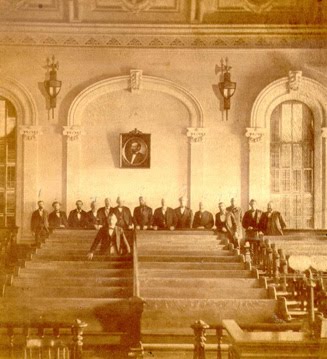
Judge Lewis H. Goodwin was one of the most honored members of the Erie County Bar. He was born in Geauga County, Ohio, to Dr. and Mrs. Erastus Goodwin on December 29, 1833. Judge Goodwin started his education at Western Reserve University, but he completed his studies in law at Marietta in 1854. He practiced law in Ohio for two years, but moved in Wabash, Indiana in 1858. When the Civil War broke out, Goodwin enlisted as a private in Company B of the 47th Indiana Infantry. In October, 1862 he was elected Captain of his company, and later was promoted to the rank of Major. During the war he took an active part in the campaign around New Madrid, and he also took part in the Vicksburg campaign with General Grant and in the Red River campaign with General Banks. At the battle of Champion’s Hill he was severely wounded. After being furloughed for a time, he rejoined his command at New Orleans. Major Goodwin mustered out in January, 1865. At the close of the Civil War, he returned to Wabash, Indiana where he practiced law for ten years. In 1874 he entered into partnership with his brother Homer Goodwin. By 1892 Mr. Lewis H. Goodwin went into practice for himself. He was elected Probate Judge of Erie County in November 1893, an office he held for two terms. Lewis H. Goodwin is the fourth individual from the right in the row of men standing at the back of the courtroom at the Erie County Courthouse in the 1874 stereographic image created by A.C. Platt.


On March 5, 1906, Judge Lewis H. Goodwin died at his home on South Columbus Avenue, after a lengthy illness. He was survived by his widow, the former Hattie Smith, a daughter Nina, and a son, Walter. Two daughters had preceded him in death. A lengthy obituary appeared in the March 6, 1906 issue of the Sandusky Register. The article read, in part: “Judge Goodwin’s army record was excellent. Twice he received promotion for bravery and merit. In his many years of service at the Erie County Bar he had formed a vast circle of friends who deeply mourn their loss.” Members of the McMeens Post of the G.A.R. attended his funeral. Burial was at the North Ridge section of Sandusky’s Oakland Cemetery.

Monday, September 20, 2010

Judge James L. DeWitt

James Lloyd DeWitt was born on September 20, 1848 in Perkins Township of Erie County, Ohio to Mr. and Mrs. James DeWitt, pioneer settlers of the Firelands. (He was usually known as Lloyd DeWitt.) He attended Oberlin College, and studied law in Sandusky. In April of 1873, J.L. DeWitt was admitted to the bar. Mr. DeWitt practiced law in Sandusky, until he was elected Mayor of Sandusky and served as Mayor from 1883 to 1886. From 1887 until 1890, James L. DeWitt was the Common Pleas Judge for Erie County, Ohio.

On the afternoon of October 11, 1890, Judge J. L. DeWitt was killed while walking along the Lake Shore Railroad tracks just east of Sandusky. Some young boys saw the judge walking, and he stepped aside to avoid a freight train approaching from the west. He did not see the other train which was coming from the east. Judge DeWitt was struck by the east bound train, and died instantly. The judge’s faithful dog did not leave his side. His pocket watch was found to have stopped exactly at eight minutes to four o’clock, the accident having caused it to stop. A front page article about the tragic accident appeared on the front page of the October 12, 1890 issue of the Sandusky Register. The first paragraph read in part, “No man in the city was more generally known or better liked by people of all classes than Judge DeWitt, and the expressions of sorrow on all sides were most sincere and heartfelt.”

On the day of the funeral of Judge DeWitt, several members of the bar formed a procession and marched in a unit from the Erie County Courthouse to the DeWitt residence on Columbus Avenue, where the funeral was held. The courtroom of the Erie County Common Pleas Court was draped in mourning, as an expression of sympathy felt by the members of the bar and officials of the Courthouse. Newspaper accounts stated that funeral services were officiated by Rev. J. F. Brant of the Methodist Episcopal Church, and included several hymns. The red cedar casket was covered with broadcloth, and the plate on the casket bore his name. Burial was at Oakland Cemetery. In the proceedings of the Ohio Bar Association in 1891, E.B. King made these remarks:

Mr. DeWitt was at the time of his death a Common Pleas Judge in the first sub-division of this district, and had been holding that position for four years. He was a young man, in the prime of his life, and in the full vigor of his strength and manhood, and was regarded, both by the bar and a very large circle of acquaintances and friends, both as a citizen and as a judge, as a man of perfect, upright character, conscientious and faithful, to a fault, in the discharge of judicial duties, exceedingly careful in the decision of causes and the rendition of opinions, and popular with all classes of his fellow men. He was elected to the Bench at the age of thirty seven years, and in his forty-first year was accidentally and suddenly killed by a railroad train. No event that has happened in our community for a score of years cast the gloom over society and the public in general that the death of Judge DeWitt did, under the circumstances that it occurred.
Judge J. L. DeWitt was survived by his wife and a son and daughter. Judge DeWitt is the first individual on the left in picture below. This stereographic image of the Erie County Common Pleas Courtroom was created by A.C. Platt in 1874.

Wednesday, May 09, 2007

Ebenezer B. Sadler: A Judge Who Lived Without an Enemy


Judge Ebenezer B. Sadler was born at Grafton, Mass., on Nov. 16, 1808, and died March 25, 1888 in Rochester, New York. His mother died in Geneva, New York when Judge Sadler was not yet ten years old. He first studied law in the office of Hon. John Dickson, of West Bloomfield, New York.

In the summer of 1835, at age 26, E.B. Sadler took a stagecoach to Buffalo, and from there embarked for Sandusky. Soon after reaching Sandusky, he was admitted to the bar, and in 1836 formed a law partnership with F.D. Parish, which continued for eleven years.

He married Emily Webb, of West Bloomfield, New York, in 1843. Mrs. Sadler died of cholera in 1849, and Judge Sadler never re-married. His only child was C. Webb Sadler.

In 1844-1845 E. B. Sadler was mayor of Sandusky, and in 1847 he was appointed presiding judge of the Court of Common Pleas of the 13th Judicial Circuit, then embracing the counties of Erie, Huron, Sandusky, Ottawa, Lucas, Wood and Henry. He served in this capacity for five years. In 1852 he was the Whig candidate for Congress. In the years 1866-1867 he was State Senator from this district. He was the Sandusky Postmaster from 1869 to 1871. After the Civil War, E. B. Sadler was involved in several area railroads.
His obituary in the Sandusky Register March 27, 1888, indicates that E.B. Sadler was in politics originally an anti-slavery Whig. He became a Republican at the birth of that party. The obituary continues to say that Judge Sadler “was the friend of every good work, broad, liberal and charitable in his views, and ever ready to do others a kind turn even at the cost of his own comfort." In the HISTORY OF ERIE COUNTY, edited by Lewis Cass Aldrich, it is stated that Ebenezer B. Sadler lived without an enemy.

Thursday, February 15, 2007

Judge Ebenezer Lane: the “Walking Library”


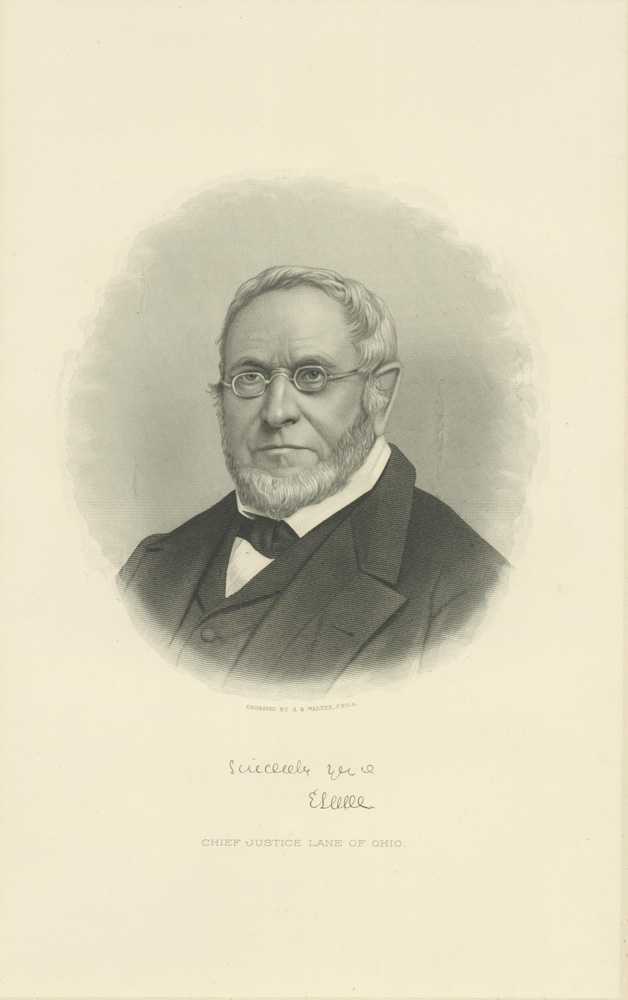
Early Ohio lawyer Ebenezer Lane was a Harvard University graduate who moved to Ohio in 1817. Born in Massachusetts in 1793, he received his degree from Harvard in 1811. After briefly practicing law in New England, he migrated westward and settled in Ohio, where he established his legal practice (around 1817). He was appointed Judge of Common Pleas of the Second Circuit in 1824, and became a Judge of the Supreme Court of Ohio in 1830. After he retired from the court, he had interests in the Junction Railroad, the Mad River and Lake Erie Railroad, and the Illinois Central Railroad.

While Judge Lane lived simply, he was an avid book collector. He read every one of the four thousand books he owned. Rev. Alfred Newton said in his memoirs of Ebenezer Lane that he could so accurately retain the knowledge of what he had read that he was a “walking library.”

After Judge Lane’s death in 1866, his book collection was passed down to his son Dr. Ebenezer S. Lane, in Chicago. The Ebenezer Lane library was the only library collection within the city limits of Chicago to survive the Great Chicago Fire of 1871. In 1922 the Ebenezer Lane book collection was donated to the University of Chicago by his grandchildren, the third Ebenezer Lane and Fanny Griswold Lane.

Judge Lane’s granddaughter, Mrs. Charles H. Moss, served on the first Board of Trustees of the “Library Association of Sandusky” which was incorporated in 1895.

A sketch of the life of Judge Ebenezer Lane can be found in the June 1867 Firelands Pioneer. The Ohio Supreme Court's Cases of Judge Ebenezer Lane are available in the Archives Research Center in the Sandusky Library.