Showing posts with label Bull. Show all posts

Friday, June 02, 2023

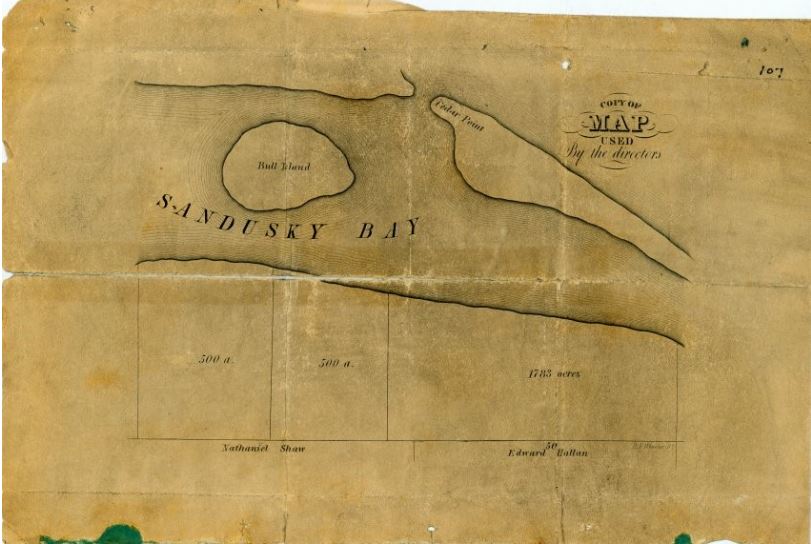
When Johnson’s Island Was Known as Bull’s Island


An early map of Sandusky Bay, published by H.F. Wheeler, is in the map collection of the Sandusky Library Archives Research Center. (A copy of this map was used as evidence in a case before the Ohio Supreme Court in 1844, "B. Lockwood and others v. Wildman, Mills, and others.") The island was first owned by Epaphras W. Bull, an early settler of the Firelands region, who died in 1812. In 1852, Leonard B. Johnson, a native of Ireland, purchased the island from the Bull family, and re-named it Johnson’s Island.

Leonard B. Johnson, 1808-1898

The epitaph on Mr. Johnson’s tombstone at Oakland Cemetery mentions Johnson’s Island.

During the Civil War, Johnson’s Island was selected as the site for a prison camp which housed Confederate prisoners of war. Many soldiers died at Johnson’s Island, and a cemetery on the island is the final resting place of 206 (or more) Confederate officers and soldiers. Today the Confederate Stockade Cemetery on Johnson’s Island is operated by the National Park Service. The website of the Johnson’s Island Preservation Society includes a listing of all the soldiers buried at the Confederate Cemetery on Johnson’s Island.

Friday, October 22, 2010

Letter from Epaphras W. Bull to Zalmon Wildman, 1811

Epaphras W. Bull, a graduate of Yale College, was a distinguished lawyer in Danbury, Connecticut. In September of 1811, Epaphras Bull, along with his wife Polly, their three small children, and an African American servant named Patience, headed from Connecticut to Danbury Township, located in what is now Ottawa County, Ohio. The Hoyt Patch family and two hired men also made the trip. The group shared a common wagon, which was led by a saddle horse. On October 5, 1811, Epaphras W. Bull wrote a letter to Zalmon Wildman, of Danbury, Connecticut. The letter was written while the Bull family was at Buffalo, New York for five days during their westward journey. He discussed seeing various acquaintances during his trip, and his plans to take a schooner from Buffalo to Sandusky, Ohio. Bull wrote, “It now seems to be conceded by the different Capts. on the Lake that Sandusky is the Best harbor the Island excepted.” He also spoke of the great expense associated with moving a family. He said that “upon my arrival at Sandusky I shall have completely got rid of the bigger part of my money.”

President James Madison appointed Epaphras W. Bull to be the first Collector of Customs of the Port of Sandusky. Mr. Bull was also the first owner of the property now known as Johnson’s Island. The Marblehead Lighthouse was situated on property that had originally belonged to Epaphras Bull. Mrs. Bull wrote in a memoir in the March 1859 issue of the Firelands Pioneer that fish and game were abundant in the Sandusky Bay area, and there were orchards of apple, peach and cherry trees. Native Americans, who sometimes camped nearby, behaved in a friendly manner. After the War of 1812 broke out, the Bull family moved to Cleveland, Ohio. Epaphras W. Bull died in Cleveland on October 6, 1812, at the age of 33. Mrs. Bull and her youngsters moved to Connecticut after the death of her husband. She lived to 93 years of age.

Visit the Sandusky Library Archives Research Center to read Mr. Bull’s original letter, or its transcription, or to read the “Firelands Reminiscences” of Mrs. Polly Bull 1859 issue of the Firelands Pioneer.