Showing posts with label scrapbooks. Show all posts

Wednesday, June 23, 2021

Thoughts Preserved in a Scrapbook by M.F. Cowdery


A large scrapbook that once belonged to prominent Sanduskian M.F. Cowdery is preserved at the Sandusky Library Archives Research Center. The scrapbook contains a compilation of biographical sketches, engravings, poems, and religious passages, many from newspapers. Some entries are patriotic and others are written from an abolitionist perspective. Many articles and poems are sentimental in nature, bringing to mind thoughts of home and family. Below is a portion of a tribute to Dean Richmond, a former New York Central Railroad official who died in 1866.


Echoes is a poem written by Marian Ross, and originally appeared in a New York newspaper in October of 1866.

The tribute to General James McPherson, a native of Clyde, Ohio who died during the siege of Atlanta in the Civil War, was first published in the Memphis Avalanche. The article points out that General McPherson had been brave and gallant, even though it was written by someone from the South.

This poem was dedicated to “the cause of truth by Datus Kelley and his wife” by Mrs. Frances D. Gage on October 23, 1861. Kelley was the namesake for Kelleys Island, where he acquired and developed land, and lived from 1836 to his death in 1866.


Marcellus F. Cowdery was superintendent of schools for Sandusky City Schools in the 1860s.


He was also associated with the Western School Supply Company, which was a forerunner of the American Crayon Company. It is interesting to see what types of articles were important to an early educator in our community in the nineteenth century.

Tuesday, January 05, 2021

Clarabelle Cayhoe’s Memory Book

Scrapbooking is now a billion dollar a year business, but it has been done in a variety of forms for centuries. Throughout history people have kept scrapbooks of newspaper clippings, funeral cards, photographs, and greeting cards to keep a record of special memories. Thomas Jefferson kept a scrapbook of poetry and prose. The Hayes Presidential Center has both diaries and scrapbooks of former President Rutherford B. Hayes. Often a grandmother’s clipping book is a prized family heirloom.

Clarabelle Cayhoe’s memory book is one of the many scrapbooks housed at the Archives Research Center of the Sandusky Library.


Clarabelle was the daughter of Charles G. Cayhoe, who taught writing and drawing in the Sandusky Schools from 1909 through 1919; he was also one the organizers of Sandusky’s First Christian Church.

Clarabelle graduated from Sandusky High School in 1922.  Some of the items which Clarabelle kept in her memory book are: grade cards, candid photos of her classmates, notes and photographs from trips, newspaper articles, mementos from parties, and several poems and autographs.

Charles E. Frohman, who later became noted as a local historian and author, signed Clarabelle’s memory book on page 42.

On June 29, 1921, Clarabelle and several family and friends went to Put in Bay.


Though she had many friends, Clarabelle Cayhoe never married. She worked as a bookkeeper for the Citizen’s Banking Company. She died the same year as her mother, Eliza, in 1947. Clarabelle Cayhoe is buried in Oakland Cemetery with her parents and brother.

If your ancestors lived in Sandusky, you can learn interesting details about their lives by looking through old yearbooks, city directories, and several histories of Sandusky and Erie County.

Thursday, September 07, 2017

Norbert A. Lange’s Remembrances from the Summer of 1915

             
Dr. Norbert A. Lange bequeathed a scrapbook to the Sandusky Library Archives Research Center, which he kept during the years he attended the University of Michigan. In the snapshot above, he is wearing a hat in a photo with friends. 

Here he is on the Cedar Point beach:


An envelope containing several season passes is included in the Lange scrapbook, including this 1915 employee pass, which was good on all boats of the Cedar Point Line. Note the signature of G.A. Boeckling.


A souvenir program from the Carnival of Boxing held on Labor Day at Cedar Point in 1915 is tucked in the pages of the scrapbook.


Promoter Matt Hinkel gave away some complimentary tickets to Cedar Point employees.


Featherweight champion Johnny Kilbane defeated Alvie Miller of Lorain, Ohio, in twelve rounds.


Because of the generosity of the Langes, we have a better understanding of how area residents spent leisure time during the summer of 1915.

Sunday, March 12, 2017

Hugo Engels' Scrapbook of Performances


From 1882 through the 1890s, Hugo Engels kept a scrapbook containing programs and newspaper articles from local concerts, recitals, and plays. Many of the newspaper articles are in German. 

Hugo Engels was born in Germany on February 9, 1863. He came to the United States with his family in 1876, when his father Herman came to Sandusky to take over the wine business of his uncle Jacob Engels, who had died in 1875. Herman and Louisa Engels had five children, Hermine, Otto, Hugo, and Paul. Hugo and his brothers worked with their father in the winery, which became the Engels and Krudwig Wine Company when R. P. Krudwig joined the company in 1878. Hugo’s brother Carl L. Engels was also associated with the “Big Store,” a Sandusky department store.  

On June 4 1885, Hugo Engels performed Das Bild der Rose in Harmony Hall. Gesang Vereins is the German phrase for Singing Association.


On May 28, 1890, Mrs. A. P. Lange and Hugo Engels played a duet entitled Kucken in a Musicale.


Hugo Engels died on November 7, 1912. His wife Charlotte Engels donated the scrapbook to the historical collections of the Sandusky Library after his death. By looking through the scrapbook, one can learn more about the musical entertainment of Sandusky area residents in the late nineteenth century. It is interesting to note that many of the pioneer residents of Sandusky shared the love of music with residents of German descent who came to Sandusky as immigrants. 

The obituary of Hugo Engels, in the November 9, 1912 Sandusky Register stated that he participated in all of the Elks entertainments, particularly the musical performances.


At the funeral, Mayor John J. Molter delivered an address in German. Music was performed by a string quartet, under the organization of George F. Anderson. Hugo Engels was buried at Oakland Cemetery, with the Elks Lodge conducting the graveyard services.

Thursday, December 15, 2011

World War II Civilian Defense

In 1982, a scrapbook was donated to the Sandusky Library Archives Research Center which features newspaper clippings about Civilian Defense activities in Sandusky between 1941 and 1943, during World War Two. The Civilian Defense Council in Sandusky was established by a city ordinance on December 15, 1941, following the Office of Civilian Defense having been created as a national agency on May 20, 1941. Leland Spore was coordinator of the Sandusky Civilian Defense in the early stages of the organization. When Mr. Spore left for active service duty Vincent F. Schubert took over. Earl C. Krueger served as the third coordinator of the Sandusky Civilian Defense Council.

The entire community joined in the activities of Civil Defense. In December of 1941, Dr. A. R Grierson, chief of the Medical Services Division, began voluntary enlistment for local men and women for the National Red Cross Volunteer Nurse’s Aide Course. Instruction was given so that volunteers had practical experience in hospital wards, kitchen, laboratory, x-ray, and surgery, should a major medical emergency arise. Dr. Grierson emphasized that the program was “no place for weaklings.” Local educator W.E. Weagly stated that “In the time of peace we go our separate ways. In time of war, we act together.” Members of the Erie County Ministerial Association voted unanimously that all members would lend their wholehearted to the Sandusky Civilian Defense Council in connection with work in public relations and civilian morale. In 1942 Fire Chief Wilson McLaughlin and Police Chief R.G. Bravard saw to it that area residents were trained as auxiliary firemen and policemen in case of an emergency. A Civilian Defense WWII Auxiliary Police helmet is now in the collections of the Follett House Museum.

A group of firemen and auxiliary firemen who were trained by the Sandusky Civilian Defense Council during World War Two are pictured below.

The “Salvage for Victory” campaign sponsored by the Sandusky Municipal Defense Council, asked Sandusky residents to save waste paper, rags, rubber and scrap metal. Items were collected by the Volunteers of America and then sold, with all proceeds paid to the Sandusky Municipal Defense Fund. In the fall of 1942 the Lions Club and Commodore Perry Post of the American Legion donated automobiles for the Sandusky Scrap Harvest campaign. Tire and specific food items and other goods were rationed.

The Sandusky Register Star News ran a full page advertisement on What to do in an Air Raid.

Civilian Defense movies were shown at the auditorium of Jackson Junior High School. A Civilian Defense and Flag Day Parade was held on Flag Day in June, 1942. Marching in the parade were members of the State Highway Patrol, Navy Mothers, VFW drum corps, Sandusky High School band, policemen, policemen, fireman, horsemen, ambulances, air wardens, and Civil Defense officials. Representing the War Plant division were Farrell Check, Brightman Nut, Plum Brooks Ordnance Works, and the Civil Air Patrol. The local U.S.O. provided hospitality for servicemen. On December 15, 1942, the Office of Civil Defense conducted a “dim-out” in Sandusky. Residents were asked to turn out all lights in their home. Automobiles were asked to place their headlights on dim, and travel at 15 miles per hour. They were not to use their telephone unless absolutely necessary. Once the “all clear” signal was blasted, lights could be used again. On March 2, 1943, a blackout drill was conducted simultaneously by 29 northern Ohio counties.

To view the World War Two Civilian Defense Scrapbook, inquire at the Reference Services Desk of the Sandusky Library. A concise summary of Civilian Defense activities in Sandusky appears in the Monday, May 7, 1945 issue of the Sandusky Register Star News, in the Victory in Europe edition, available on microfilm.

Tuesday, October 31, 2006

Honoring Our Veterans


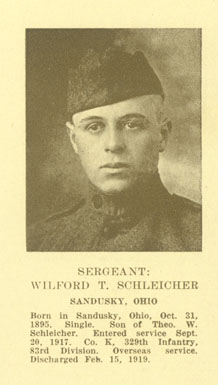
In honor of all veterans, in commemoration of Veterans Day on November 11, we offer a tribute to a World War I veteran from Sandusky. Wilford Schleicher was born in Sandusky on October 30 (or 31), 1895. A sales manager for the American Crayon Company, his life changed dramatically in 1917, when he was called to service when the United States entered the Great War that had been going on in Europe since 1914.

Wilford Schleicher was enlisted into the United States Army on September 20, 1917, and assigned to Company K of the 329th Infantry, 83rd Division. He was trained at Camp Sherman in Chillicothe, where most of Sandusky's recruits went for training. In June of 1918, he and his fellow soldiers departed the United States for the war zone of Europe. By October of that year Corporal Schleicher had been promoted to sergeant. After honorable service in the French war zone, he returned to his native land on January 31, 1919 and received his honorable discharge about two weeks later.

Like most other men who served (unfortunately not all), Wilford Schleicher returned to his normal life, back home in Sandusky. He went back to work at the American Crayon Company, and worked there for nearly fifty years; he was a member of the Trinity United Methodist Church, the American Legion, and the Veterans of Foreign Wars. He lived on Polk Street with his wife, Gladys, who died in 1974. Mr. Schleicher died in November 1982, at age 87.


The Sandusky Library Archives Research Center is privileged to have two scrapbooks compiled by Mr. Schleicher. One scrapbook (two pages of it are shown above) contains photographs of his military adventures, along with mementoes such as postcards, military passes and other official documents, and a wrapper for a candy bar from the Red Cross Canteen. The other scrapbook consists of newspaper clippings describing the war and local soldiers. Additionally, the archives holds many other items relating to the First World War, a war little understood by most Americans.