Showing posts with label philanthropy. Show all posts

Monday, September 17, 2007

J. Leroy Weier

J. Leroy Weier, known as Leroy, is pictured here driving his automobile with 1911 license plates. (We don’t know the names of his passengers.) Leroy’s father, John Weier, along with Leroy’s uncle, Henry Weier, operated a scrapyard business at 1024 Hancock St., which had been started by their father. When the two Weier brothers died in the 1920’s, Leroy continued the family business until shortly before his death in 1971.

Leroy Weier was also the co-owner of the Lake Shore Tire Company. His business partner was Fred Brost. The company operated from about 1915 to 1931. It began as a tire company, but by 1927 it became a sporting goods store.
Leroy married Laura Lechler in 1921. They had no children. Around the beginning of World War II, the Weiers began buying property in Middle Harbor and West Harbor in Ottawa County. Leroy was an avid hunter and outdoorsman. An excerpt from a 1969 letter by Leroy Weier appeared in the April 22, 1974 Sandusky Register. Leroy wrote: “The marshes I have known have been the greatest source of pleasure and relaxation and hobby, that have filled my entire life; one must love the feel of cold wind in the face and hear the ripple of freezing water lapping the side of the hunting boat to absorb all the ingredients that nature puts into the thrill we call wildfowling…:”

Before their deaths, the Weiers sold their Ottawa County property to the State of Ohio, and the land now is part of East Harbor State Park. Seven local organizations benefited from the Estate of J. Leroy and Laura J. Weier. The $600,000 was distributed to three area hospitals, the Firelands Council of Boy Scouts, Firelands Council of Camp Fire Girls, and the Sandusky Y.M.C.A.

An early scene from the Weier Brothers Scrapyard is pictured below:

Monday, March 12, 2007

Erie County’s First Female Deputy

Fanny Facer Everett was a humane agent, probation officer and leading charity worker in Sandusky where she was beloved by the entire community. She was born in Sandusky and lived here most of her life.

For more than 20 years, she was connected with almost every form of benevolent and philanthropic work conducted by the general public in the city of Sandusky. For approximately 25 years, she was the leading figure in the Humane Society of the city and county. When the Erie County Humane Society was first organized in 1900, there were few members and very little financial means to help carry on the work.. For many years she acted as its first female humane agent without compensation and devoted her time, energy and strength to the work just as cheerfully, earnestly and enthusiastically as though it was her only pursuit in life. The activities of the society continued to expand and the society was finally able to render her financial assistance.

When the Federated Associated Charities was organized, Fanny Everett became its superintendent and had personal charge and direction of its expenditures.
When the juvenile court work was taken up by the probate court, Fanny was made probation officer—she was the first woman to be deputized by the sheriff of Erie County to carry a gun and make arrests.

For many years she was in charge of the distribution and adjustment of the mothers’ pensions for the county and also of the blind relief work.

It was said of her that there has perhaps never been a person in the city who was so thoroughly acquainted with the history of the people of the city who needed help, either in a financial, social or moral way. There was no one in the city to whom the weak and the erring would go so gladly, willingly and trustingly as to Mrs. Everett. Mrs. Everett’s home and her time and attention has been open both day and night to the many calls of the people of the city of Sandusky who have had trials and troubles and burdens.

Her son told a story about a memorable episode in her career: Late one night in 1902, she heard screams and cries for help coming from a house in the 200 block of Decatur Street, near where she lived. A man in a drunken rage was beating his wife and attacking his son and daughter. Fanny Everett marched straight to the house, knocked, and when the drunken man answered, she pointed her pistol at him and announced that he was under arrest. At the sight of the gun, the man raised his hands and begged “Don’t shoot, lady, don’t shoot.” Fanny replied, “You ought to be shot, but put on your shoes and you are going straight to jail.” The man obeyed and up Decatur Street they went, the man with his hands in the air. They reached the corner of Adams Street, where there was a saloon, one of the patrons, and finally a dozen or so, poured out of the bar. “Hey Joe!” they taunted, “The lady is taking you to jail, isn’t she?” When the man tried to answer, Fanny said “Keep your mouth shut and keep going.” In a few minutes they were at the door of the Erie County Jail where the man was quickly shown to a cell. At the trial the man was sentenced to ten days in jail. Fanny then took the wife and children to an attorney who advised the woman of her right to seek legal action for a separation and compulsory support payments. He urged her to seek a restraining order to protect her and the children. Many women at this time did not realize they had any legal rights against an abusive husband. Thus did Fanny Everett serve as a pioneer for social reform.

Thursday, March 08, 2007

Eliza Follett

Eliza Gill Ward Follett was born in Albany, New York on September 17, 1801 to Daniel and Martha Ward. Her father died during the war of 1812, and her mother found it impossible to keep the children together, so Eliza lived with various relatives, and worked at household tasks, often feeling neglected and lonely. She married Oran Follett on November 22, 1832 in Fairport, New York. They moved to Sandusky in 1834.

Mrs. Follett was a highly respected member of the community. She was described as “active, unostentatious and faithful worker in this city, doing good, relieving the afflicted, encouraging the fearful, smoothing the pathway of those tempted to go astray, and yet never for a moment forgetting or neglecting the duties she owed her own family. From one end of our city to the other, in out of the way places, in hovel, in every abode of want, this patient, tireless and cheerful spirit was at hand helping and comforting and blessing those who but for her love would have no friends on earth…. If pecuniary assistance were not needed, some more gentle means of relief than the supplying of bodily necessities were sure to be extended by this friend of humanity. A bunch of flowers left in the sick room, a cheerful word of token, slight in itself, yet bearing golden fruit, was ready to witness of unselfish devotion to others. But it was peculiarly to the soldiers and their families during the dark days of the war that Mrs. Follett proved a friend and a comforter. From the opening day of the war to its close she gave herself up to the watchful care of the soldiers and their families. Rain and storm, cold could not keep her back from what she called her duty and loved to regard as a privilege, and today there is no man in this city whose death would be mourned as a personal loss by so many men, women, and children as will be the death of this unassuming woman, who went about doing good because she loved to do good.”

A neighbor said of her “Unless Mrs. Follett was going to church or to some social function, I never remember seeing her leave the house without carrying a bowl of soup. A plate of dainties, a basket of fruit or cooked food, or a bunch of flowers for some sick, needy or lonely person.”

She was generous to a fault. Her gifts of food, clothing and coal were so substantial and so numerous that they taxed the purse of her willing but more prudent husband. She was known to take garments off her back and leave them where she found distress.

A tender and skillful nurse, she never failed to minister at the bedsides of the sick, often spending days and nights away from home during critical illnesses. During a small-pox epidemic, she walked unscathed through the danger of contagion and fearlessly nursed cholera patients with her husband’s help, when doctors and nurses could not be procured, thus saving many lives. Her granddaughter said that she led a charmed life, that she was so selfless, so absorbed in others that no ill befell her.

She felt strongly against slavery and helped countless slaves on their journey to freedom, clothing, feeding and warming them on their way to Lake Erie and Canada. Her husband, Oran Follett also sympathized with the slaves, however he would remonstrate her with “Wife, it is against the law” and she would say “Husband, there is a higher law.”

During the war, she emptied the parlors of furniture and local women met there to pick lint and make bandages which were shipped off to hospitals at the front.

Her granddaughter wrote “I never shall forget going to market with—the walk down Columbus Avenue was like a triumphal progress. It took a long time to make the day’s purchases, because people crowded around her for a smile or word of greeting, or to answer inquiries regarding their well-being and that of their families."

Eliza Follett died April 29, 1876 in Sandusky. Her funeral at the Presbyterian Church was crowded to standing room only, and there were hundreds more people lined up outside in their carriages, having come from all over northern Ohio to pay their silent tribute.

(The Follett family pew in the Presbyterian Church, decorated as a memorial to Eliza Follett.)

Thursday, February 22, 2007

James M. French: Businessman, Community Activist

Born in Sandusky around 1866 (believed to be the son of a former slave), James M. French achieved substantial success in the real estate and insurance professions, overcoming the obstacle of racial discrimination. Mr. French used his wealth and influence to serve the community and African-American youth.
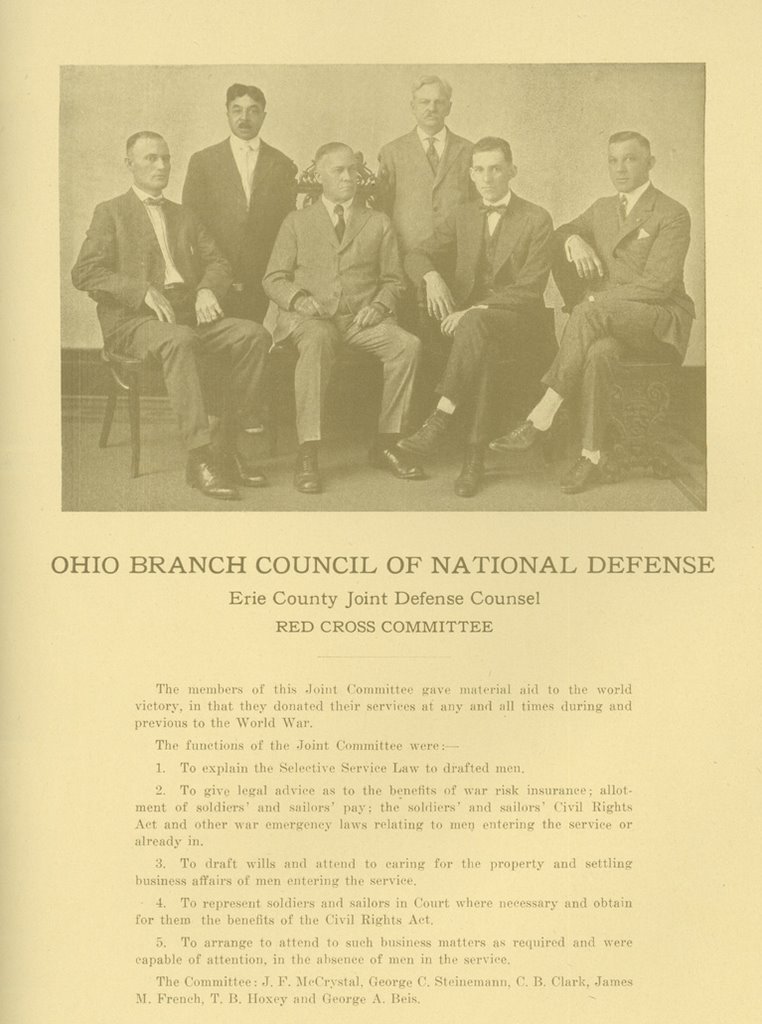
The image above shows James French in his service to the community during the First World War, as a member of the Red Cross Committee of the Erie County Joint Defense Council. Additionally, among other activities, he was president of the local council of the National Association for the Advancement of Colored People, the Loyal Legion of Labor, and the Negro Welfare League. He also helped to found an African-American Boy Scout troop in Sandusky, and was an active member (and treasurer) of the First Congregational Church. In 1895, he gave a eulogy at the funeral of John Brown, Jr., at Put-in-Bay.

James French died suddenly of a heart attack, shortly after conducting business at the courthouse, in August 1922, at age 56. The local newspaper report claimed that his funeral was attended by thousands, including a local congressman, county and city officials, and representatives of many civic and charitable organizations. In his will, he left the bulk of his estate (valued at between $75,000 and $100,000 -- a rather large sum at that time) to Oberlin College, for the benefit of "deserving Afro-American students," a gesture that was recognized by the author James Weldon Johnson in an essay ("A Negro Benefactor") a few weeks later.
The graduation photo of James M. French, Sandusky High School, 1884.