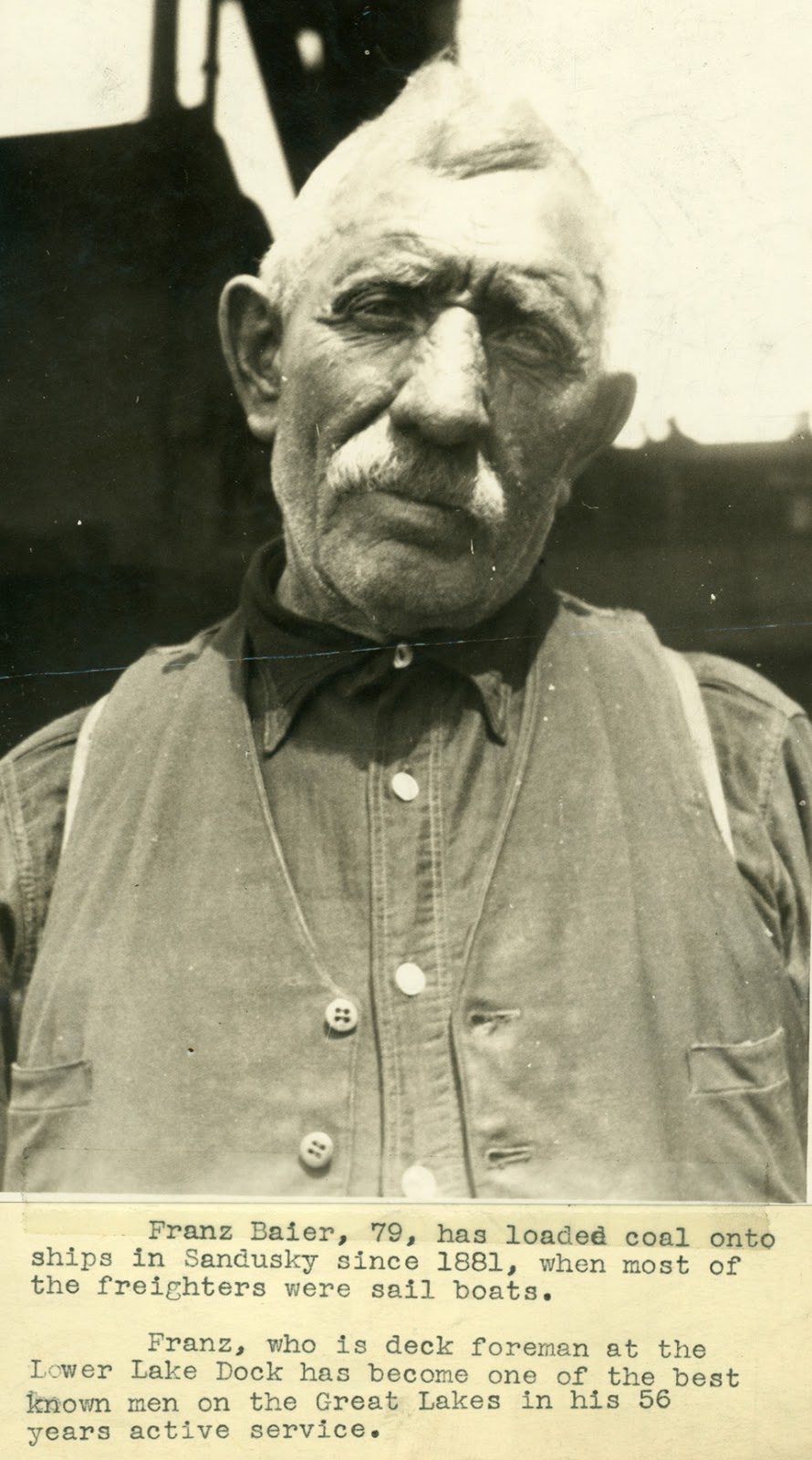
Two centuries ago, Sandusky’s founders assumed that
Sandusky’s protected harbor destined the city to become the leading port on
Lake Erie. Unfortunately, this was not to be the case. The problem was simply
that the entrance to the bay was blocked by shifting sand bars, and the bay
itself was shallow and difficult to dredge because of the underlying limestone.
The original channel into the bay followed the convoluted course of the Sandusky
River bed in the direction of Johnson’s Island and then turned south to the
city’s waterfront. The channel and the waterfront docks were shallow and poorly
marked. Ships often ran aground or hit submerged rocks, and Sandusky soon
earned a reputation as a port to be avoided. Cleveland, Lorain and Toledo
thrived. Sandusky languished.

Recognizing the
situation, improvements were continually made during the course of the 19th
and early 20th Centuries. In 1889, the “Straight” channel 17 ft.
deep was dug from the foot of Warren St. to the tip of Cedar Point and the
channel was marked, but the “Dock Channel” along the waterfront remained
unmarked and quite shallow. In 1895, construction was begun on a Jetty at the
tip of Cedar Point in an ongoing effort to prevent sand from blocking the entrance
to the bay.
Iron ore, lumber, coal, and grain were shipped in
large quantities from the B & O docks at the foot of Warren St. but as
ships got bigger and bigger, these improvements proved to be too little and too late. The mouths of the
Maumee, Black and Cuyahoga Rivers were easy to dredge. Sandusky Bay was not.
Sandusky prospered, but it was unable to attract heavy industries such as steel
manufacturing that depended on deep water ports. One by one companies began to
close their shipping operations in Sandusky in the early years of the 20th
Century with one notable exception – the Coal Docks.

In 1891, the Sandusky & Columbus Short Line
Railroad Company opened a straight track from Sandusky to Columbus and
constructed the original Coal Dock later known as Pier #1 at the foot of King
St. The City of Sandusky helped fund construction of the pier and the cost of
dredging to allow lake freighters access to the pier. The small freighters of
the day were initially loaded by hand using wheelbarrows, but in 1893, Pier #1
was equipped with a steam driven loading apparatus known as the “Whirly.”
Workmen loaded coal in buckets that were then whirled over the side of the
freighter where they were dumped and then whirled back in a continuous circle.
In 1898, the “Whirly” was replaced by a new ship loader that could lift a coal
car to a level above a ship’s deck from where its contents could be dumped into
the cargo hold. It could unload fifteen coal cars per hour which meant that a
four and a half ton cargo could be loaded in just under six hours.
In 1902, the Sandusky & Columbus Short Line
Railroad was purchased by the Pennsylvania Railroad and the coal dumper on Pier
#1 was replaced with one that could handle up to 25 cars per hour. Coal demand
was high, and in 1914, a second dumper was installed on Pier #2 located just to
the west of Pier #1. The coal shipped from the docks was originally destined
primarily for power production, but the docks were beginning to supply more and
more coal for steel production. In 1937,
with Piers #1 and #2 operating around the clock and larger and larger
freighters being constructed, the Pennsylvania Railroad announced a mammoth
project that was destined to transform the Sandusky harbor and finally resolve
the issues associated with the harbor’s channels.

A new Pier, designated #3, was to be constructed west
of Pier #2 that would be almost a mile long and 600 ft. wide. A new dock channel
with a wider turning basin, and a “Bay Channel” that would permit ships to
return to the lake to the north of the “Dock Channel” were part of the project.
Eleven million tons of steel sheeting and
pilings and the 2.5 million cubic yards of silt and debris that were dredged
from the bay were used in the construction of the pier. The crowning
achievement was the construction of a giant new Coal Dumper which Sanduskians
have enjoyed watching operate to this day as it lifts coal cars high in the air
and dumps their contents into the holds of today’s huge lake freighters. The
new dumper stands 172’ above water level and could dump 30-35 50 ton rail cars
per hour. In 1944 when the demand for
coal peaked, a record 14.3 million tons of coal were shipped from Piers #1, #2
and #3.
People enjoy watching freighters enter and leave the
bay and sometimes wonder why we don’t see as many freighters these days. The
answer is simple. In 1955 Sandusky loaded 1123 lake freighters with 8.1 million
tons of coal. It would only take 270 of today’s much larger freighters to haul
the same amount. Piers #1 and #2 could
not accommodate the larger freighters which resulted in Pier #2 being closed in
1957, and Pier #1 being closed in 1969.

When the docks
were sold to the Norfolk and Western Railway Company in 1964, plans were soon
underway to add a coal stockpiling and reclaiming facility to Pier #3. It was
designed to provide space for one million tons of stockpiled coal and
incorporated nearly 2.56 miles of interconnected conveyer belts. Three silos
were installed 40 ft. in diameter and 194 ft. tall each with a capacity of 3,500
tons. Two large pieces of equipment were constructed to move stockpiled coal of
different grades to the silos or directly to a waiting freighter. The “Bucket
Reclaimer” which stands 45 ft. tall and weighs over 320 tons can move 3,000
tons of coal per hour. The “Bandwagon” which stands over 90 ft. tall and weighs
310 tons can stack coal into storage piles and work in conjunction with the “Reclaimer”
to transport coal from storage piles directly to vessels. These two pieces of
equipment increased vessel loading capacity from 3000 to 7,000 tons per hour
and on September 3, 1988, Pier #3 loaded a 989’ long freighter with 59,058 tons
of coal, a record for the Great Lakes.
Now owned and serviced by Norfolk Southern and
operated by Sandusky Dock Corporation, the Pier #3 coal dumper has been in
operation for 79 years. Remarkably, it is able to efficiently handle today’s 100
ton rail cars that are 50 tons heavier than those of the 1930’s. Today 95% of the coal shipped from Sandusky is
used in the manufacture of steel.
Sandusky, like
most cities in along the Great Lakes has lost much of its industry during the
past forty years, but the Sandusky Dock Corporation continues to evolve and prosper
utilizing ever more advanced equipment and technology. Orders for different
grades of coal can be filled promptly and efficiently thanks in large part to
the foresight of the men who designed Pier #3 many years ago. The Sandusky
Docks are a tremendous asset for our community. The Pier #3 coal dumper ranks
with the Top Thrill Dragster as one of Sandusky’s premier attractions. Sandusky would not be the same without it.