Showing posts with label Music Education. Show all posts

Friday, August 12, 2022

Getting to Know Professor J.D. Luse

Image Credit: FamilySearch.org

Jesse Dial Luse is the younger man at the far right in the picture above. This family photograph shows the nine children of Jesse and Sylphina Luse. Often known by his initials J.D., Jesse D. Luse was born in Cuyahoga County in 1847.

In the very late 1800s and early 1900s, J.D. Luse was the Supervisor of Music for Sandusky Schools. During the homecoming parade for Spanish American War soldiers in 1898, “Professor Luse” arranged for a chorus of one thousand individuals to sing patriotic songs.

J.D. Luse was the author of several music books. One of his series was known as the Wreath Music Course. The books were used widely throughout Ohio and beyond. In the book The Royal Wreath of Song, there were several graded lessons in music for use with students in every grade.


Also in the book were: hymns, glees, part songs, patriotic songs and songs for choruses and duets.

Professor Luse advertised often in educational journals. The advertisement below appeared in volume of the Educator Journal in 1906.

Throughout his career, J.D. Luse taught in many different school districts, including Tiffin, Sandusky, Zanesville and Mentor, Ohio. He was a popular speaker at educational institutes for teachers as well. By 1904, he and his family moved to Columbus, Ohio, where he remained active in music publishing. Professor Luse died there in 1920.

You can view the full text of the 1890 version of The Royal Wreath of Song at the Internet Archive. By paging through this book, you can see some of the songs that your ancestors may have sung in school in years gone by. The Sandusky Library Archives Research Center has two of Professor Luse’s music books in its collection. Today you can find copies of his books at college and theological libraries throughout the United States.

Saturday, August 22, 2020

Paul Browne Patterson, Music Educator

Paul Browne Patterson was the son of Rev. and Mrs. Charles D. Patterson, born in 1876 in LaPorte, Ohio. Rev. Patterson had formerly been a minister in the Perkins Methodist Episcopal Church. Paul Browne Patterson graduated from the Oberlin Conservatory of Music in 1896, with a double major in piano and voice. Following graduation, Paul spent three years studying music in England, France, and Germany. From 1900 to 1903, he operated the Patterson School of Music in Sandusky. In 1903 he moved the school to New Castle, Pennsylvania. Below is the cover of a brochure from The Patterson School of Music when it was located in New Castle, Pennsylvania.

While in Pennsylvania, he formed the Festival Choral Society of New Castle, which was comprised of one thousand voices. Through his musical career, Mr. Patterson was the conductor of many symphony orchestras, including orchestras in Minneapolis, Cincinnati, Indianapolis, Pittsburgh, and Dresden, Germany, during their guest appearances with the Choral Society. In 1935 Mr. and Mrs. Patterson moved back to Sandusky, and he helped to organize the local Choral Society. He served as director of the choir at the First Congregational Church for many years, and was active as a teacher of piano and voice at his school, the Patterson School of Music, on East Park Street, until his retirement in 1966. Mrs. Patterson also taught piano lessons. Pictured below is a program from the vocal recital of Mary Louise Clary, a pupil in the Patterson School of Music.

Mrs. Patterson, the former Mary Evelyn Blocher, was a gifted singer, pianist, teacher, and accompanist. She served as the secretary-treasurer of the Patterson School of Music. 

Paul Browne Patterson died on January 12, 1971, at the age of 98, survived by his wife Mary, a daughter Mrs. Thomas Monroe, a granddaughter, and two sisters. He was buried at Sandusky’s Oakland Cemetery. He had been a former member of the American Guild of Organists, and was listed in the International Who’s Who in Music. Mrs. Patterson passed away in 1995, at the age of 90. The cultural life of Sandusky was deeply enriched by the musical talent of both Mr. and Mrs. Paul Browne Patterson.

Thursday, April 18, 2019

John F. Renner on Music


From 1890 until his retirement in 1929, John F. Renner was connected with the music business in Sandusky, Ohio. Above is an image of his store in the Odd Fellows Temple when he was in business with George Doerzbach in the early 1900s. Mr. Renner gave his customers brochures which extolled the virtues of music. The cover of one of these publications suggested that you could “get into the picture” by playing a musical instrument.


The focus of this brochure was unearthing hidden talent in children by teaching them to play a musical instrument. The cover title implies that music could promote harmony in the family home.


Bella Webb’s article on page 9 was entitled Music Instead of Pills. She wrote that improvements in both physical and mental health could be achieved by listening to music. 


 According to the American Music Therapy Association, music therapy is a health profession “in which music is used within a therapeutic relationship to address physical, emotional, cognitive and social needs of individuals.” It seems that Mr. Renner promoted these concepts to Sandusky area residents long before music therapy became a college major.

Wednesday, March 20, 2019

Myrtle Louise Meagher, Music Teacher


Miss Myrtle Louise Meagher was born in Sandusky in 1882, to John E. Meagher, and his wife, the former Margaret Lotz. Myrtle was of both Irish and German descent. Myrtle’s grandfather, Henry Lotz, ran a grocery store in from the 1850s until his death in 1887 at the northeast corner of Shelby and West Washington Streets, where Joe Sundae’s is now located. 

From 1900 through the late 1920s, Myrtle was a piano teacher, having been a student of well known local piano instructor Paul Browne Patterson. The advertisement above appeared in the March 21, 1908 issue of the Woman’s Endeavor, a locally published newspaper edited by Sandusky women. Below is an advertisement which was in the Sandusky Star Journal on October 25, 1922. 


Also appearing in the Star Journal of October 25, 1922 was a brief article by Miss Meagher about the value of music. She maintained that the family and friends of a music student would benefit from music instruction, as well as the individual who was receiving the training. She held many piano recitals in her home studio on Shelby Street.


 By 1957 her health was declining, and she moved to a nursing home. Myrtle Louise Meagher died on June 4, 1965. Miss Meagher’s funeral was held at the Frey Funeral Home, and burial was at St. Joseph’s Cemetery in Sandusky, Ohio.

Monday, August 11, 2014

Elmer J. Frank, Musician, Instructor, and Conductor

Young Elmer Frank, with his parents, Julius and Emma
Elmer J. Frank was born in Sandusky in 1904 to Julius and Emma Frank, both of German descent. As a youth, Elmer studied piano with Elmer F. Steuk, a well known Sandusky piano instructor. In 1931 he went to Austria to study piano under Madam Bree. He also studied composition, harmony, and instrumentation under Johanna Muller Herman, and choral and orchestra conducting under Professor Julius Katay. Mr. Frank’s musical studies took him also to Germany, France, Switzerland, Poland, Czechoslovakia, Hungary, Romania, Italy, and Tunisia. During the summer of 1939 he was on a scholarship in Poland to study folk and classical music, and while there, Poland was conquered by Nazi Germany. Luckily he made it home safely. During World War II, he served for two years in the Panama Canal Zone with the United States Army.

Back in the United States, Elmer Frank was the organist and choir director for several churches. He also taught music for several years, having studios in the Odd Fellows Hall and later in the Feick Building. He organized the Sandusky Choral Society and the Sandusky Male Chorus, and served as the director of both organizations for many years. Later he was the director of music at the International School of Art, which was at 507 Wayne Street. 

Mr. Frank is the conductor in the group picture of the Sandusky Choral Society, taken around 1940 by photographer William Mound.


On April 14, 1961, Elmer J. Frank died at Good Samaritan Hospital. He had been hospitalized after an automobile accident six weeks prior to his death, but he died from an underlying illness. Funeral services were held at the Quick’s Funeral Home, where Christian Science Services were held. He was buried in Oakland Cemetery. On November 4, 1962, a Memorial Concert in honor of Elmer J. Frank was held at Adams Junior High School. Jay Perine, Tenor, provided musical performance, with William E. Didelius accompanying, assisted by Beryl Beckwith Dureck.


Friday, July 12, 2013

William F. Peters, Composer


William Frederick Peters was born in Sandusky, Ohio in 1871 to Mr. and Mrs. Jacob Peters; he graduated from Sandusky High School in 1891.  He is pictured above with his student Reber N. Johnson in 1896. Mr. Peters received his musical education in Leipzig, Germany.  In the 1890s, William F. Peters composed The Alpha Tau Omega Waltzes, The Elks March, and The Catalpa Waltz. Copies of these compositions are held in the historical collections of the Sandusky Library Archives Research Center. (Inquire at the Reference Services desk at the Sandusky Library if you would like to view them.)


William F. Peters was the music director of the Empire Stock Company for twelve years, working with Charles Frohman and David Belasco. He wrote the music for Robert H. McLaughlin’s drama, “The Rites of Spring,” which premiered at the Euclid Avenue Opera House in Cleveland, Ohio in 1920.  The New York Times of December 2, 1938 stated that he was “the first composer to write an original score for the movies.” Some of his notable scores include: “The Four Feathers,” “The Hungarian Rhapsody,” and “Orphans of the Storm.”  You can view the titles of several of his compositions at the Internet Broadway Database and the Internet Movie Database. The National Jukebox project of the Library of Congress features four recordings of William F. Peters compositions. 

After suffering from heart disease for several months, William F. Peters died at his home in Englewood, New Jersey on December 1, 1938. Funeral services for Mr. Peters were held in Manhattan, and burial was in Hartsdale, New York. Obituaries were published locally in the Sandusky Register and the Sandusky Star Journal.

Thursday, March 28, 2013

Mrs. Portia Follett Gardner


Portia Bartholomew married Foster Valentine Follett in Cuyahoga County in 1866. Foster V. Follett was the son of Foster Morse Follett, and the nephew of Oran Follett, publisher of the Lincoln-Douglas Debates. Mr. and Mrs. Foster Valentine Follett had three children, two of whom died quite young from diphtheria. Their son Foster Morse Follett became a well known cartoonist. His work appeared in the New York Herald, The World, and the Saturday Evening Post

After the untimely death of her first husband (at age 40), Portia married J. Henry Gardner, a musician who led bands in Michigan and Ohio. In the 1890 Sandusky City Directory, J. Henry Gardner is listed as the Manager of a Piano and Organ Warehouse, as well as a piano tuner and repairer. Mrs. P.A. Follett Gardner was listed as a Music Teacher and also a Dealer in Pianos, Organs, and Musical Merchandise. Mrs. Portia Follett Gardner died in 1906 in Flint, Michigan, and was buried in Oakland Cemetery in Sandusky. She was a strong woman, having outlived two children and her first husband, and was a full partner with her second husband in the music business. 

Sunday, December 09, 2012

Ludwig Altstaetter’s German Music Books

In the Archives Research Center at the Sandusky Library are two books of handwritten music. The books were prepared by Frederick Altstaetter for his son Ludwig Altstaetter. One book, entitled Practische Klanierschule, includes scales and other musical segments intended for a student who is practicing piano skills.


The other book contains several musical pieces. All the musical notes, clefs, and tempos were meticulously handwritten. Below is a portion of the piece entitled Air de Ballet de Guillaume Tell de Rossini (using the old style of the first 's'). It appears to be a ballet based on the opera William Tell.


Louis Altstaetter, the Americanized name of Ludwig Altstaetter, was born in Germany on June 21, 1832. He married Matilda Steuk. Louis and his brother William Altstaetter are listed in the 1880 Sandusky City Directory as being the proprietors of a grocery store at 836 Market Street in Sandusky. Louis Altstaetter died on March 1, 1900, and he was buried at Oakland Cemetery. Mr. Altstaetter’s obituary, which appeared in the March 2, 1900 Sandusky Register, stated that he had lived in Sandusky for a number of years, during which time “he won the respect and esteem of all.” He was survived by a son and five daughters. Later, his son Edward Altstaetter would become the Mayor of Sandusky.

The name of Louis Altstaetter’s father, Frederick Altstaetter, would be familiar in Sandusky, Ohio for many years. Louis Altstaetter’s grandson was named Frederick Altstaetter, and Louis had a great granddaughter named Frederica Altstaetter.

Friday, October 05, 2012

Sandusky High School Orchestra in 1904


The group of students with Mr. Cornelius Schnaitter made up an early orchestra at Sandusky High School in 1904. Pictured are: Front row, Verna Murphy and Edna Becker; middle row, George Lehrer, Bess Lawrence, Theresa Winkler, Mr. Schnaitter; top row, Maude Claus, Ralph Scherz, and Margeruite Andrews. Edna Becker went on to teach at Sandusky City Schools for twenty five years. George Lehrer became involved in theatrical productions, and was known nationally for his Lincoln impersonation. Ralph Scherz got his medical degree and practiced medicine in Cleveland for over fifty years.
Visit the Sandusky Library Archives Research Center to view this and hundreds of other vintage photographs from Erie County and Sandusky.

Tuesday, May 22, 2012

Sandusky High School Band in 1925


Here is the Sandusky High School band from the academic year of 1924-1925. The band is seated in front of the steps at Sandusky High School, now Adams Junior High. Mr. Byron Aldrich served as the director of Sandusky High School’s band from 1923 until his retirement in 1955. Below is a picture of the band from the 1925 Fram.

On Monday, November 3, 1924, the Sandusky High School band led a parade of over two thousand students through the streets of Sandusky in support of an upcoming levy. The band gave a concert at the high school auditorium on Friday, December 12, 1924, to a near capacity crowd. The musical numbers played by the 58-piece were so popular, that several encores were requested. Special numbers included a baritone solo by Wayne Pfaff, a coronet duet by Arthur Lange and Richard Smith, and a clarinet trio consisting of Marion Bailey, Wade Miller, and Charles Fettel. Though they didn’t place, the Sandusky High School band went to a State High School Band Contest in Akron, on May 21 and 22, 1925. The Sandusky Star Journal of May 23, 1925 indicated that “Sandusky gave a splendid account of itself” at Akron. Fostoria’s band took first place, with West High School of Akron finishing second. Earl Cheetham, a sousaphone player in the Sandusky High School Band, was selected to perform with the All-Ohio High School, which performed at the Ohio State Band in the summer of 1925 under the direction of Professor Wainwright of Fostoria, Ohio. Visit the Sandusky Library Archives Research Center to learn more about the history of past residents of Sandusky and Erie County, Ohio.

Thursday, March 15, 2012

Ella McCormick, Elementary Teacher

In the 1880 U.S. Census, Ella McCormick resided with her siblings John and Jennie and her parents, Pat and Bridget McCormick on Miami Avenue, now known as Central Avenue, in Sandusky, Ohio. Both Pat and Bridget McCormick listed their birthplace as Ireland. Jennie McCormick was a music teacher at this time, and Ella McCormick was a school teacher. In December of 1902, the Sandusky Star newspaper ran a contest to choose the most popular teacher in the Sandusky City Schools. Miss Ella McCormick won the contest, with 267 votes. Ella, along with Miss Elizabeth Koegle and Miss Jennie Long, received tickets to see a performance of “The Merchant of Venice” which played at the Nielsen Opera House on December 5, 1902.

On Friday, June 2, 1911, Ella McCormick was among the large group of teachers and students of the Seventh Ward School who enjoyed a lawn social. An orchestra made of students of the Seventh Ward School provided musical entertainment during the evening hours of the lawn social.

Miss Ella McCormick passed away in Tiffin, Ohio on December 30, 1914. Funeral services for Ella McCormick were held at the home of her sister, Mrs. F. H. Zerbe. Miss McCormick was buried in St. Joseph’s Cemetery in Sandusky, Ohio.

Friday, March 09, 2012

Mandolin Clubs in Sandusky

An article in the December 2, 1920 issue of the Sandusky Star Journal reported that Mr. H.L. McCullough, a math instructor at Sandusky High School, had recently established two Mandolin Clubs. Club members varied through the years, and included both adults and high school aged students. Pictured in the musical group above are: Carroll Post, mandolin; Verna Murphy, mandolin; Ella Aust, mandolin; Edwin Aust, guitar; and Mr. H.L. McCullough, guitar. In the early 1920s, members of the Mandolin Clubs provided musical entertainment for school events, church services, and for meetings of several area civic organizations. On February of 1921 a quartet from the Mandolin Club performed at a W.C.T.U. meeting in honor of the memory of Francis Willard, a well known temperance leader who had died on February 17, 1898. Live musical entertainment was an important part of the social life of Americans in the nineteenth century and early twentieth century.

Saturday, December 03, 2011

Sandusky High School Orchestra in 1910


In 1910 the Sandusky High School Orchestra was directed by Eugene B. Ackley, a well known musician and band leader. Several of the students in the school’s orchestra became prominent individuals in a number of different fields. Edward Hastings Vietmeier became the president of the Sandusky Sash and Door Company. Dr. Elmer H. Wirth was a professor at the University of Illinois from 1922 through1947, serving as Head of the Department of Pharmacognosy for several years. He was the author of seven books and more than 300 articles on pharmacy. Dr. Norbert Lange was a chemistry professor at Western Reserve University, who is known for writing the classic text Handbook of Chemistry. Dr. Lange and his wife were the benefactors for The Norbert A. and Marion Cleaveland Lange Trust of Sandusky Library, which has provided cultural and educational programs for Erie County residents for over twenty five years. Leonard Osberg served three two year terms as the Mayor of Vermilion in the 1940s. Corydon Bell, along with his wife Thelma, wrote several children’s books in the 1940s and 1950s. William Kerber lived to be 96 years of age. Mr. Kerber was a steel executive who managed the country's pig iron production during World War II. He died in Washington D.C. in April, 1990. These men, who achieved great things, got their start in Sandusky. Visit the Sandusky Library Archives Research Center to learn more about the lives of the individuals who called Sandusky home.

Monday, September 26, 2011

Professor J.D. Luse

An article in the September 26, 1900 issue of the Sandusky Daily Star reported that Professor J. D. Luse had moved to Sandusky to become supervisor of music in the Sandusky schools. Between 1890 and 1909, Jesse D. Luse authored several music books. The series of books in his “Wreath Music Course” were used in the curriculum of public schools, as well as in one room schools throughout the Midwest.

The Laurel Wreath of Song was published by J. D. Luse in 1902, when he resided in Sandusky. The book contained popular songs, patriotic songs, selections to sing in harmony, as well as hymns.

“Sweet Spring is Returning” was written by F. Silcher, and arranged by J. D. Luse.

In 1904, Professor Luse moved back to Columbus, where he planned to devote his time to his publishing business.

Thursday, December 09, 2010

Teacher’s Institute in Sandusky, 1845

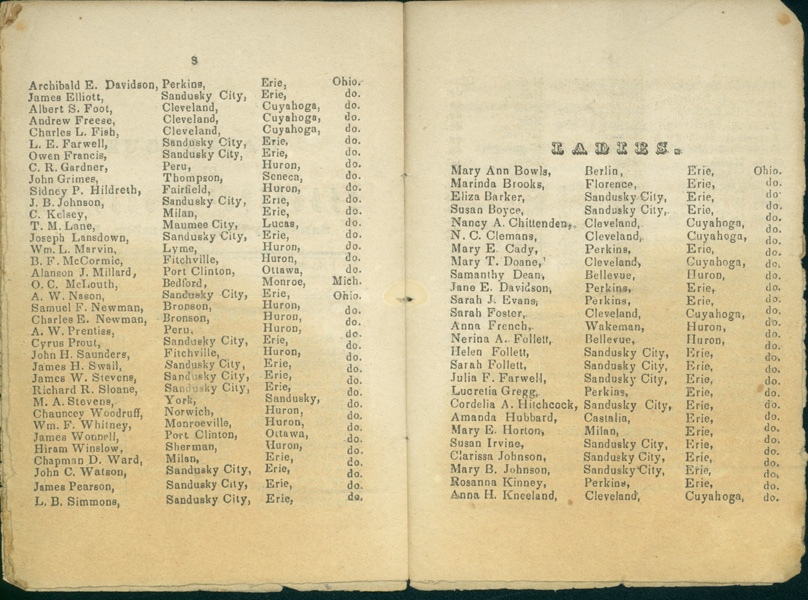
The first Teachers’ Institute in Ohio met in Sandusky on September 2, 1845. Hewson L. Peeke wrote in his book, A Standard History of Erie County, that Ebenezer Lane, Rev. Leverett Hull, and C. B. Squires were active in securing lecturers for the Institute. The purpose of the Teachers’ Institute was for the improvement of common schools. Any Ohio teacher was invited to attend the Institute. Those who attended the Institute were not charged any fees, except for their own paper and paying board while in Sandusky. Private homes were opened to the teachers for a fee of not over $2.00 a week.

The main speakers of the Teachers’ Institute were Salem Lord, a teacher from New York State, Asa Lord, and M.F. Cowdery, who would later serve as Superintendent of Sandusky’s school system. Asa Lord was a teacher of mathematics, while M.F. Cowdery specialized in geography. Over ninety Ohio teachers attended the Teacher’s Institute. The Catalogue of the Instructors and Students of the Teachers’ Institute held in Sandusky, Ohio in 1845 was printed by W. S. Mills and Sylvester Ross. Sessions continued for two weeks, with instruction during the day, and lectures and general discussion held during the evening hours.

The names of the teachers who attended the Teachers’ Institute were listed in the Catalogue. Usually known as Rush R. Sloane, Mr. Sloane’s name was given as Richard Rush Sloane in the catalogue. Rush Sloane became well known as an abolitionist and served as Mayor of Sandusky from 1879 to 1880. Daughters of another Sandusky Mayor, Foster M. Follett, also attended the Teacher’s Institute. Helen and Sarah Follett worked along side their parents in attending to the sick during the 1849 cholera epidemic in Sandusky. Sarah and Emily Townsend were daughters of pioneer Sandusky resident, William Townsend. Sadly, Sarah Townsend and both her parents died in the cholera epidemic in 1849.

Several resolutions were adopted at the closing of the Institute. One encouraged the continuation of Teachers’ Institutes so that teachers could obtain practical instruction on subjects connected with teaching and governing schools. Another resolution demanded that the business of teaching be made a distinct profession. A significant resolution recommended “the introduction of vocal music into the Common Schools of this state, as an aid in mental and moral improvement, and an agreeable relaxation from study.” Paul D. Sanders wrote about this early support of vocal music education in Ohio in an article in the October 2001 issue of the Journal of Historical Research in Music Education. (subscription required)