Showing posts with label holidays. Show all posts

Thursday, March 17, 2022

A St. Patrick's Day Celebration

In honor of St. Patrick's Day we are reposting this article from 2014.


On the evening of St. Patrick’s Day, most likely in the 1880s or 1890s, a program of entertainment was held at Biemiller’s Opera House in SanduskyOhio.


Though the church was not identified, the evening began and closed with selections from a church choir. Judge A.E. Merrill gave the introduction, followed by a lecture on the Land League by Rev. P. F. Quigley, a Catholic priest. Several musical numbers were performed. Mr. Buyer, Mr. Farrell, Mr. Dempsey, and another Mr. Farrell sang a serenade. While we do not know precisely which members of the Dempsey and Farrell families sang the Serenade, Helen Hansen wrote about the William Farrell and Thomas Dempsey in Supplement 13 of At Home in Early Sandusky. Both gentlemen were Irish immigrants, and they lived at 525 and 527 Columbus Avenue for many years.


Immediately before I. F. Mack gave remarks, Miss Kate Farrell sang When I Left My Home in Erin,” by William Shakespeare Hays. You can view the sheet music to this song at the Musicfor the Nation exhibit of the Library of Congress. A midi version of the song can be found online as well.

Saturday, December 31, 2016

New Year’s Pretzel

This article was originally posted on December 27, 2006

The tradition of the New Year's Pretzel appears to date from the turn of the 20th century in Sandusky. As the city of Sandusky grew, it was home to a very large German population. Sandusky had German neighborhoods and even supported a German language newspaper or two. It was the strong influence of the German community that brought about a holiday tradition known to very few communities.

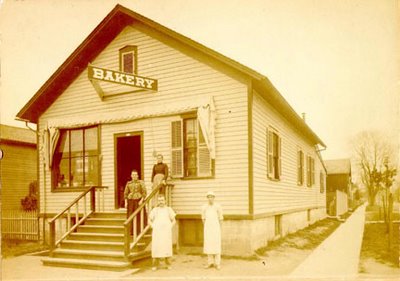
The New Year’s Pretzel is different from the pretzels we know today. It is soft and made from an egg dough, and instead of being sprinkled with salt, it is washed with a glaze. The finished product is chewy. The pretzels were anywhere from 15 to 36 inches across and were made by a number of bakeries in Sandusky, including Becherer, Frank’s (pictured here, at 834 Columbus Ave.), Knoerle, Feddersen, Kanzler, Schweinfurth, Michel, Smith’s, Sandusky Baking, H & S, Park, and others.

The pretzels are usually eaten for breakfast on New Year’s Day. Wilbert Ohlemacher recalled that his father would hang the pretzel by a ribbon from the gas chandelier over the dining room table. He would cut the ribbon and then cut the pretzel into smaller pieces for everyone in the family. When the custom was practiced in early Sandusky, the pretzels were often decorated with intricate braids made from the same dough.

There are a few different theories about the origins of the German New Years Pretzel. One is that they were first baked by monks in Southern Germany as a reward for children who learned their prayers. Thus they were shaped to represent the crossed arms of a child praying.

Another story is that the circular shape of the symbolic loaf is derived from the old calendar sign for the winter solstice, which was a circle with a dot in its center. The central cross was added to represent the four seasons.

Yet another story tells of German citizens parading through the streets with pretzels piled onto long sticks, and groups of people would go calling on friends and relatives and exchange pretzels instead of greetings.

While the exact origin is unknown, the New Years Pretzel is fondly remembered by countless residents of Sandusky.

Friday, December 25, 2015

Christmas Gifts for the 1915 Holiday Season in Sandusky

By browsing through historical issues of the Sandusky Register, we can determine some of the popular gifts that were advertised to area residents in 1915. Mr. Bamberger carried winter scarves and hats at The Avenue Store on Columbus Avenue.


C.V. Baumgardner advertised pianos, while J.H. carried a wide variety of “talking machines.”


The Manhattan store sold suits, overcoats, and other men’s clothing.


Scheurer’s advertisement pictured toys, so that children could look at the newspaper and select a gift.


The Herb and Myers suggested that local residents purchase the unexpected gift of furniture as a Christmas present.


According to the December 17, 1915 issue of the Sandusky Register, many local stores planned to close by 6:00 p.m. on December 24, to allow the employees time off to spend with their families for the holiday. Several organizations proposed the early store closings, including the Business Girls Association, officers of the Trades and Labor Assembly, and every clergyman in the immediate area. 

Monday, March 17, 2014

St. Patrick’s Day Entertainment at Biemiller’s Opera House


On the evening of St. Patrick’s Day, most likely in the 1880s or 1890s, a program of entertainment was held at Biemiller’s Opera House in Sandusky, Ohio.


Though the church was not identified, the evening began and closed with selections from a church choir. Judge A.E. Merrill gave the introduction, followed by a lecture on the Land League by Rev. P. F. Quigley, a Catholic priest. Several musical numbers were performed. Mr. Buyer, Mr. Farrell, Mr. Dempsey, and another Mr. Farrell sang a serenade. While we do not know precisely which members of the Dempsey and Farrell families sang the Serenade, Helen Hansen wrote about the William Farrell and Thomas Dempsey in Supplement 13 of At Home in Early Sandusky. Both gentlemen were Irish immigrants, and they lived at 525 and 527 Columbus Avenue for many years.


Immediately before I. F. Mack gave remarks, Miss Kate Farrell sang When I Left My Home in Erin,” by William Shakespeare Hays. You can view the sheet music to this song at the Musicfor the Nation exhibit of the Library of Congress. A midi version of the song can be found online as well.

Thursday, July 04, 2013

Fourth of July Celebration in Sandusky in 1889


During the latter part of June, 1889, George Frohman spent three days putting up posters all over Erie County, informing residents of the upcoming Fourth of July Celebration to be held in Sandusky. According to a lengthy article in the July 5, 1889 issue of the Sandusky Register, the July Fourth Celebration in 1889 was a huge success. The weather was perfect, and people came from near and far for the festivities. The day’s events began with a concert by the Great Western Band. A parade was held at 10 a.m. and included the bicycle club, the Great Western Band, City Police and Firemen, men from the McMeens Post G.A.R., the G.A.R. Drum Corps, and many city officials. Several businesses had floats in the parade. The Sandusky Wheel Company, Sandusky Box Company, Germania Basket Company, Sandusky Tool Company, Sandusky Ice Company, and many other manufacturers and merchants from Sandusky participated in the parade. The Weier Brothers Scrapyard had a display of junk on a wagon for the parade.


At 1 p.m., the crowd proceded to the Fair Grounds, where Major E.B. King gave a stirring patriotic address. At 2 p.m., a variety of races were held,  which included horse and goat races, a bicycle race, foot race, and a farmers’ wagon race. After the races, the crowd was mesmerized as Professor King Burk went 1,000 feet up into the sky in a hot air balloon. After he cut the ropes from the balloon, he abruptly landed in a field near the railroad. The Fouth of July festivities concluded with a display of fireworks held at the Grandstand at the Fair Grounds from 8:30 to 10:30. (In the latter half of the nineteenth century, the Erie County Fair Grounds were located on Wayne Street, south of Scott Street.)


An article in the July 5, 1889 Sandusky Register stated that the “parade was a dandy,” and that the executive committee had done a fine job. Visit the Sandusky Library Archives Research Center to read the complete article about the 1889 Fourth of July festivities, in the 1889 Sandusky Register, now on microfilm.

Thursday, December 22, 2011

Christmas Observance at Sandusky Junior High School in 1944

On December 22, 1944, the employees of Plum Brook Ordnance Works and their families and friends, met at Sandusky’s Junior High School (later known as Jackson Junior High School) for the third annual old-fashioned Christmas observance. All those in attendance received a program which included the words to several traditional Christmas carols.

Brief messages by local ministers, Rev. Theo J.C. Stellhorn, Sr. and Rev. C. J. Dobmeyer, offered reflections on peace while America was at war.

Sunday, December 18, 2011

The Christmas Season in Sandusky, 1891

This was the menu for Christmas time at the West House, a large hotel in Sandusky:

A variety of game and seafood were the main course, along with cold ham, chicken and tongue. Desserts included mince pie, lemon pie, cake, ice cream, and English plum pudding with brandy sauce.

Local companies advertised in the Sandusky Register for several weeks in December of 1891. The Fair, a store managed by M.N. Sisenwain opposite the Sloane House, sold dolls, books, mechanical toys, jewelry, china cups, glassware, pictures, and a wide assortment of gift items of “Christmas delights.” J. Krupp and Son sold books cases, beds, rockers, tapestries and furniture for the home or office. M. & A. Lebensburger, a leading Sandusky clothier, sold several styles of overcoats. The Bazar at 615 and 617 Market Street slashed prices just a few days before Christmas Day.

D.C. Powers ran a lengthy poem advertising the many items for sale at the D.C. Powers dry goods store at 142 Columbus Avenue. The first three stanzas, which appeared in the December 18, 1891 issue of the Sandusky Register, were:


Mother Christmas’ Answer

Santa came to “Mother Christmas”-
“Dear,” said he, “I’m sore perplexed!
Knotted was the kind old forehead,
One might almost think him vexed.
“Where I’m going to get my sleighful
of the rarest, brightest, best,
Prettiest things to please this worldful
Grown so captious, can’t be guessed!

Said his Dame, “I wonder at you!
Must be you’ve forgotten Powers;
I have found there gifts to rapture
These expectant bairns of ours.
For, you know, with all the worldful-
Stockings large, and stockings small,
You must cram form out your sleighful-
Nothing’s left for ours at all!”
“Then the quaint, delightful boxes-
Filled, the yare, with daintiest things-
Charming souvenirs, cards and booklets –
Everything the season brings,
Kerchiefs, hemstitched, plain, embroidered,
Silk and linen, grave and gay-
Finest values for the prices –
In bewildering display!”

The poem concludes with Santa deciding to fill his sleigh with items from D.C. Powers’ stock. This photograph, which shows an interior view of the D.C. Powers store, was taken in the latter part of the 1800s:

Thursday, November 24, 2011

WLEC's Holiday Cookbook

In November 1974, Radio Station WLEC (1450 AM and 102.7 FM) published a “Holiday Foods Edition” cookbook. Nat Marshall and several other staff members of WLEC compiled the recipes, which were sent in by area listeners. Recipes included main dishes, desserts, beverages and several unique side dishes. Here is a recipe for eggnog pie:

Local businesses ran advertisements in the cookbook, primarily in shades of green.

Holiday greetings from the staff of WLEC appear in the middle of the cookbook.

Here is the staff of WLEC about 1975:

Sunday, December 12, 2010

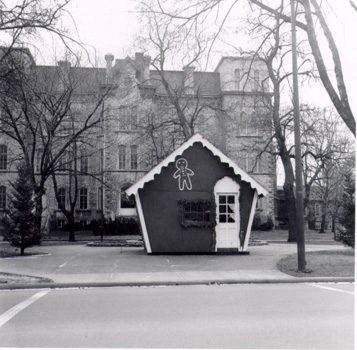
The Cookie House

Sandusky's Cookie House has been in the news lately. After a lot of hard work, it's looking good again!

Here are a couple of views of what it looked like in the early days:

In the 1950s, in front of Sandusky High School (now Adams Junior High).

In 1952, in front of the Erie County Courthouse.

(A closer view.)

Sunday, July 04, 2010

Sandusky’s Centennial Fourth

On July 4, 1876, Sandusky had a grand celebration of the 100th anniversary of the nation’s independence from Great Britain. A.H. Moss was the president of the day. Each township in Erie County, as well as representatives from Ottawa County, Sandusky County, and Huron County were vice presidents of the Centennial Fourth. Several additional committees helped plan the events of the day, including committees on music, decoration, oration, transportation, regatta, printing, finance, reception, and fireworks.


The Centennial Fourth celebration began with a 100 gun salute. A grand procession began with a detachment of police. Elisha M. Colver was the Marshal of the First Division, which included military units, lodges, and church organizations. James Douglas led the Second Division, which was comprised of delegations from the various townships of Erie County, and groups from outside Erie County. The Third Division was led by I.F. Mack, and included the Great Western Band, Sandusky Fire Department, and over fifty groups from the trades and industries of the area. The Active Turners occupied a wagon in the Third Division, and they performed gymnastic feats during the parade. The Sandusky Tool Company’s wagon can be seen in the photograph above.

Professor Leon performed acrobatics at the foot of Columbus Avenue during the Centennial Celebration.
Formal Exercises took place at the Fair Grounds. The exercises included music by the Great Western Band, “Hail Columbia” by the full chorus, prayer, an address of welcome, several patriotic musical numbers, and a reading of the Declaration of Independence by F. W. Alvord. Words to the hymns sung at the Centennial Fourth were distributed to the crowd.
A regatta of two classes of boats took place at the foot of Columbus Avenue. Excursion trains ran to and from the city of Sandusky to bring visitors to the celebration, and the steamers Gazelle and B.F. Ferris advertised special excursions for the event. Fireworks began at 8:15 on Columbus Avenue, at the two parks just south of Monroe Street. The day’s events ended with a “Salute of 1776” at sundown.
The Archives Research Center of Sandusky Library features several primary sources and items of historical interest in the Sandusky and Erie County History Collections. Contact the Reference Services Staff at Sandusky Library if you would like to view the Archival Finding Aid to see a listing of specific items.

Friday, February 09, 2007

Valentines

Valentine's Day has been celebrated for centuries in the West. Derived from a Pagan festival, Valentine's Day became a Christian feast day around the fifth century A.D. Today, February 14 is observed as a day for romance (and commerce, in chocolate, flowers, and greeting cards).

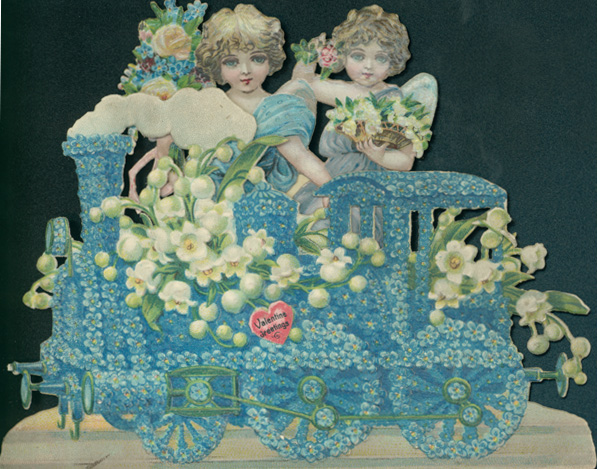
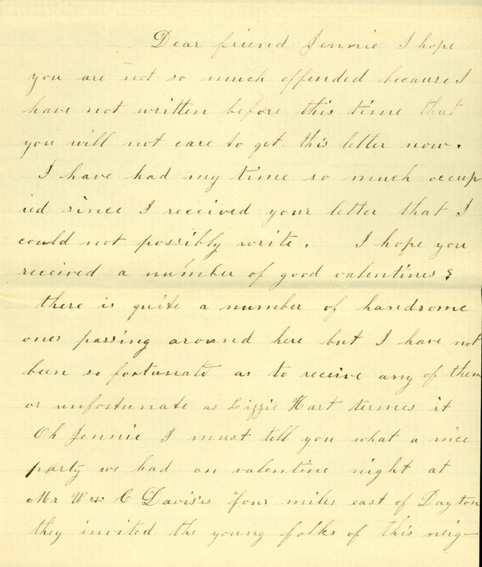
Of course, Valentine's Day was celebrated in Sandusky from its earliest days. Items from the collections of the Sandusky Library Archives Research Center and Follett House Museum provide evidence of Valentine's Day observances in Sandusky. The Valentine train above is one of many Victorian-era Valentines from the Follett House collections. Below is an excerpt of a letter written by "Lizzie" to her "Dear Friend Jennie," where she talks about (not) receiving Valentines, and attending a Valentine party that year: "I hope you received a number of good valentines . . . "
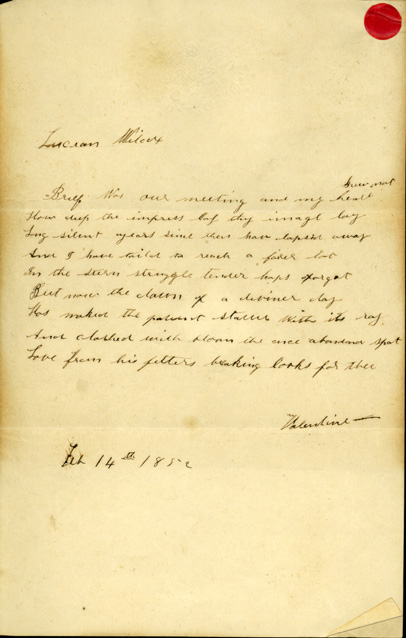
The note below is a love letter to Lucian Wilcox to his "Valentine" in 1852: "Brief was our meeting and my heart knew not / How deep the impress of thy image lay / Long silent years since then have lapsed away / And I have toild to reach a fairer lot / In the stern struggle tender hope forgot / But now the dawn of a diviner day / Has waked the patient [?] with its ray / And clothed with bloom the once abandoned spot / Love from its fetters breaking looks for thee."
Below are two of the earliest Valentines from the Follett House collections (from the 1850s):

Friday, December 15, 2006

Scenes of Christmas in Sandusky

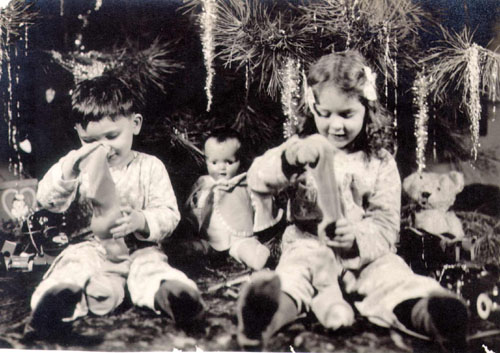
Some scenes from past Christmases in Sandusky. . . . The children above are opening their presents in 1938.


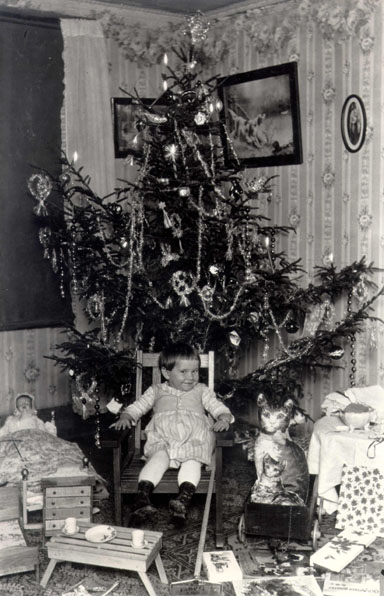
These Christmas trees were from around 1900. It looks like the child was enjoying her Christmas. (I think Santa Claus was, too.)


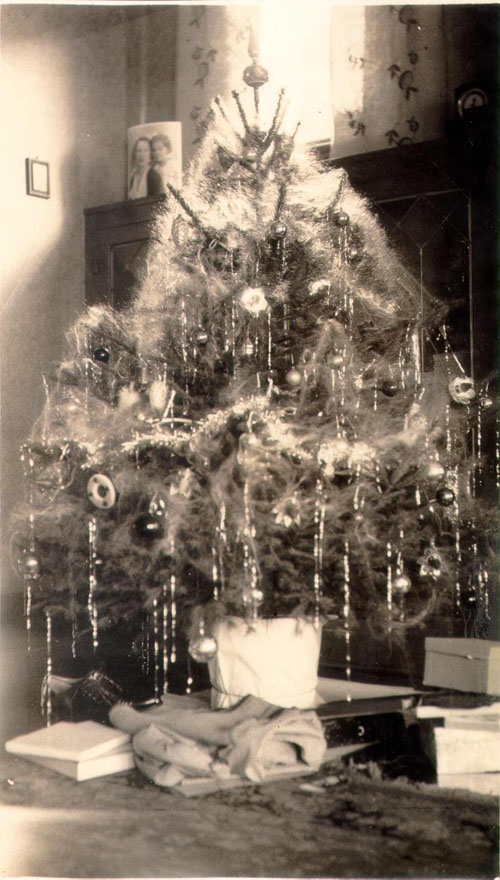
A Christmas tree from 1905, and another from 1938.


A view of Columbus Avenue in downtown Sandusky, circa 1935.

Wednesday, December 13, 2006

Christmas Traditions in Sandusky

Sandusky, like much of the United States, did very little to celebrate Christmas and the winter holidays in the early part of the 19th century.

Ohio became a state in 1803, and the City of Sandusky was platted in 1818. In 1818, and for many of the following years, Sandusky was still on the edge of the wilderness, gradually becoming an established city. Sandusky grew along with the nation, and as the nation grew, it established holiday traditions.

These traditions have certainly evolved over time. An 1818 resident of Sandusky wouldn’t recognize our holidays of today, and vice versa. Christmas in the early 19th century was usually just another day, perhaps marked by a visit to church, or reading a few passages from the bible. No holiday decorations were put out, or special meals prepared. However, as the 19th century progressed, so too did the celebration of Christmas.

A study of the Sandusky Register and ads and announcements related to the Christmas holidays (or the lack thereof) offer insight in to how Sanduskians marked the day. In 1822, 1824 and 1825, the papers on Christmas Eve Day and Christmas Day are like the papers preceding and following—no mention of Christmas whatsoever. No newspapers from the 1830s are extant, however no mention of Christmas appears in the 1840s until Christmas Day 1849, when an announcement in the Sandusky Clarion stated “We wish you all a Merry Christmas.” This is also the first time that advertisements for holiday gifts appear in the newspaper: suggested by the advertisers are feathers (from a milliner), books and toys. These ads are small and one must read through the entire paper to find them.

In 1851, a lengthy ad mentioned a variety of book titles that would make suitable gifts Another long ad proclaimed “We beg leave to call the attention of the Ladies of Sandusky City and vicinity to our stock of Fancy goods just received from New York.”
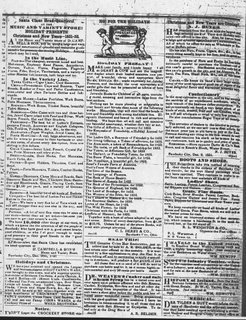

Also in 1851, we find a mention of Santa Claus—“Santa Claus Head-Quarters! At the Music and Variety Store!” A few years later, in 1853, the paper published a short story entitled “TOPPS FASHION’S Christmas Eve Adventures,” which was written expressly for the Sandusky Register. An ad later in that paper suggested several different items for Christmas including silver plate tea sets, coffee urns, cake baskets, sugar and butter dishes, fish knives and forks, candlesticks and more. Paper mache items such as work boxes, backgammon boards, glove boxes and ink trays were for sale, along with rosewood cases, Parian marble statues and figurines, terra cotta ware, porte monnaies in silver, gilt, pearl, velvet silk and more. A wide variety of games were advertised, many of them unknown to us, including Uncle Tom, Peter Abroad, Sham Fights, bell and Hammer, What do you Buy, Fox and geese, lots, domino’s mansion of happiness, reward of virtue, doct. Busby, Tivoli boards, puzzles, magic lanterns, flags of all nations, dissecting maps, ninepins, backgammon boards and more. In addition, ads mentioned tea trays and cutlery.

An 1852 ad from William Burnet announces the latest selection of French and German toys. While most of these are familiar to us today, it’s unlikely to find many of these items on a 21st century child’s Christmas list.
Magic Lanterns
Cosmoramas
Building blocks
Menageries
Butcher shops,
Bureaus
Stables
Houses
Kitchens
Noah’s Arks
Horse and Drays
Carts
Carriages
Wagons
Soldiers
Horsemen
Guns
Swords
Whips
Musicians
Bows and Arrows
Elephants
Camels
Rhinoceros
Monkeys
Horses
Dogs
Cats
Rabbits
Geese
Sheep
Squirrels
Children
Cradles

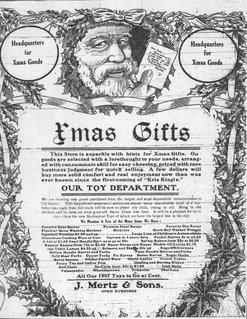
By 1908, holiday editions of the Sandusky Register of packed full of advertisements meant to catch shoppers’ attention. J. Mertz’s eye catching ad, surrounded by holly and topped off with St. Nick proclaims “This store is asparkle with hints for Xmas Gifts. Our goods are selected with a forethought to your needs, arranged with consummate skill for easy choosing, priced with rare business judgment for quick selling. A few dollars will buy more solid comfort and real enjoyment now than was ever known since the first coming of “Kris Kringle” Other ads shout out “Only 20 shopping days left between now and Xmas” just as they do in modern times!
Thursday, November 16, 2006

Happy Thanksgiving!
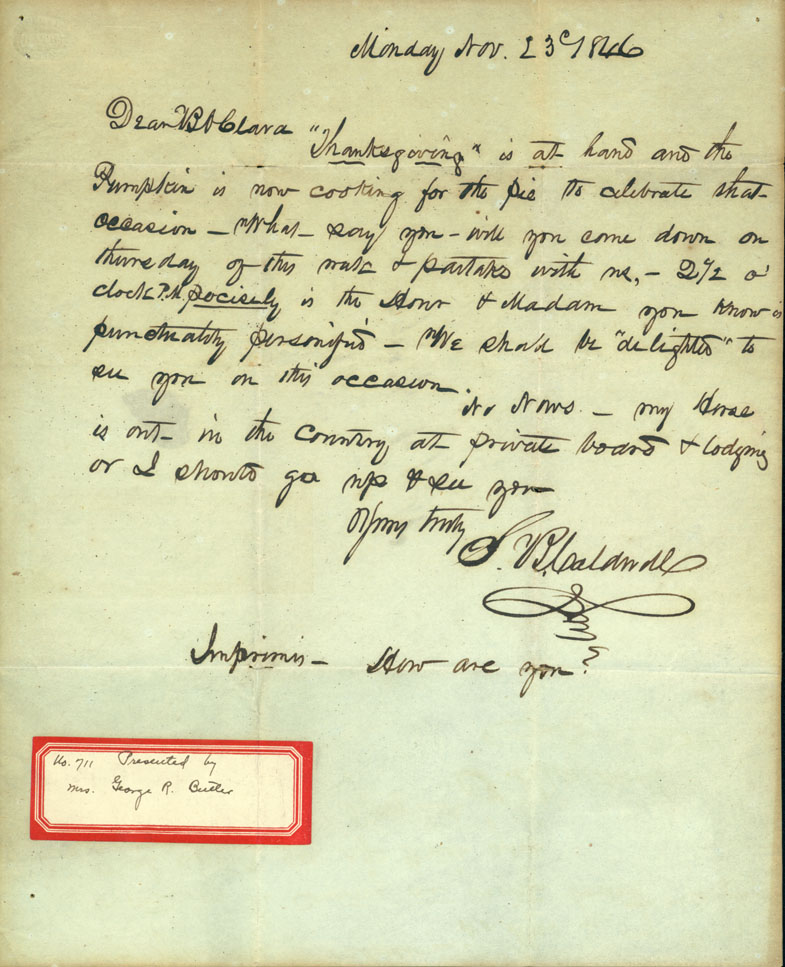
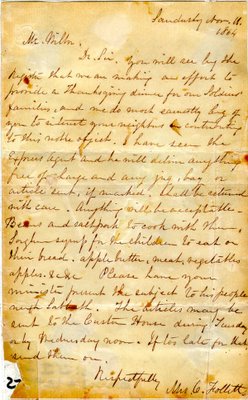
As many of you might remember learning in grade school, the first "official" Thanksgiving was proclaimed by President Abraham Lincoln during the height of the Civil War, in 1863, in honor of the first Thanksgiving held by the pilgrims in Plymouth during the 17th century. But even before President Lincoln made Thanksgiving a holiday, it was traditionally celebrated by many people. The first letter below is evidence of that:

In this letter, Judge Samuel Caldwell of Sandusky has invited Samuel Butler and his wife Clara to his home for Thanksgiving dinner. (We know pumpkin pie was on the menu!) The date of the letter is November 23, 1846, nearly twenty years before the national holiday was observed. (It is also interesting to note that even then Thanksgiving was celebrated on a Thursday in November -- nobody seems to know for sure why this day was chosen.)


The second letter is from Eliza Follett, the wife of Oran Follett, requesting contributions from local residents to provide Thanksgiving food to the wives and children of soldiers serving in the Civil War. Mrs. Follett was very active in community service and charitable work, as can be inferred from this letter.

Have a happy Thanksgiving. . .

Monday, August 28, 2006

Labor Day

In honor of the working men and women throughout the history of our community, this post commemorates Labor Day. Labor Day was first celebrated in 1882 in New York. It was made a national holiday in 1894.


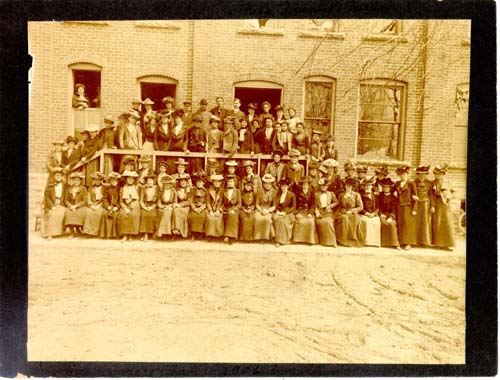
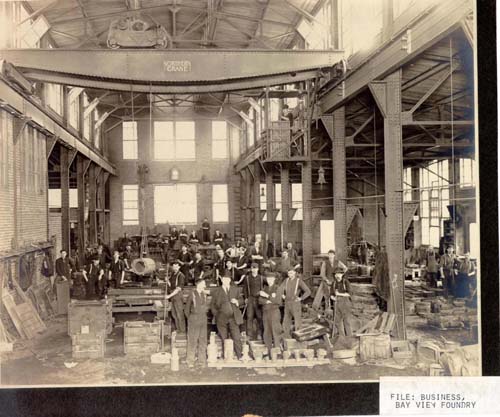
The men in the picture on the left (below) are workers at the Bay View Foundry (which operated from around the beginning of the 20th century to the 1930s), at Shelby and Water Streets, circa 1905; the photo on the right (above) shows the women workers (and their male supervisors) at the Jackson Underwear Factory, North Depot and McDonough Streets, circa 1906. The Jackson Factory operated from 1899 to around 1933.

If you have historical documents describing the activities of working people in Sandusky and Erie County -- documents such as: labor union records; photographs of people at work; personal letters and papers; business records; etc. -- please consider donating those documents to the Sandusky Library Archives Research Center. Contact the Archives Librarian via email or at 419-625-3834.