Showing posts with label Water Street. Show all posts

Wednesday, September 27, 2023

What Products did Barney and Ferris Sell?


F.T. Barney and B.F. Ferris owned the Barney and Ferris hardware store at the northeast corner of Jackson and Water Streets in the 1870s and 1880s. The building still stands in Sandusky today. 

The building the housed the former Barney & Ferris store, circa 2016

All varieties of hardware were sold at Barney and Ferris, including nails, paint, mantels, grates, hearths and glass. You could even purchase agricultural implements there. By 1881 the company branched out into selling sporting goods to hunters and fishermen. Several different kinds of gunpowder were sold by Barney and Ferris, many from the Oriental Powder Company.

An advertisement from1886 referred to Barney and Company as the “Old Pioneer Hardware House.” At that time, Barney’s was an agent for products like the Nickle Barn Door Roller and the Eureka Mower.

After the deaths of F.T. Barney and B.F. Ferris, other individuals operated hardware stores at the same site, including Pierre Van Alstyne and members of the Donahue family.


Visit the Sandusky Library Archives Research Center to learn more about the former businesses that were a big part of the lives of the early residents of Erie County, Ohio.

Friday, October 09, 2020

West Water Street Businesses from Behind in 1926


Sandusky photographer Ernst Niebergall took this picture of the rear side of the buildings along West Water Street between Columbus Avenue and Jackson Street about 1926. Today we know this area as the newly renovated Shoreline Drive. The first building on the eastern part of this block is known as Hubbard’s Block, at what is now 101 West Water Street. The building was originally owned by Sandusky businessman Lester Hubbard, and designed by Sheldon Smith, was built in the Romanesque Revival style of architecture. Hubbard’s Block was home to the Cosmopolitan Art and Literary Association in the 1850s. Moving down the street, next is the Stiles E. Hubbard building at 115 West Water Street, which had as its first tenants a grocery and dry goods store, and Austin Ferry’s hat shop. In 1926 George M. Rinkleff had a hardware store at 121 West Water Street. This advertisement shows us some of the items that were carried by the Rinkleff Hardware store in the 1910s, a few years before Mr. Niebergall took the picture of the block.


Known as the Lawrence Cable building, the structure at 121 West Water Street was built in 1868. Samuel Love had a men’s clothing store at 201 West Water Street in the mid-1920s. Charles R. Carroll ran a transfer business and a second hand store at 211 West Water Street. Many of the vintage trucks parked on the street were probably used to transport goods to local residents by employees of Mr. Carroll’s transfer business.


Chicken dinners were served at a restaurant to the west of Mr. Carroll’s business. At the corner of West Water Street and Jackson Street is the Freeland T. Barney building, which was built about 1870 and renovated in 1892. Most of the buildings that are pictured had businesses on the street level and apartments on the upper floors. You can read more historical details about the commercial property on West Water Street in Ellie Damm’s book, Treasure by the Bay. Pages 53 to 58 are devoted to the architectural background of these historic buildings.

Friday, August 07, 2020

Busy Northwest Corner of Jackson and West Water Streets


The northwest corner of Jackson and West Water Streets was the location of the passenger depot for the Mad River and Lake Erie Railroad in Sandusky beginning in 1838. By 1867 Peter Gilcher and Son operated a lumber business at that corner. Eventually R.E. Schuck joined the firm and the company was known as Gilcher and Schuck. On May 9, 1911, a notice in the Sandusky Register stated that the stock of Gilcher and Schuck was to be sold without delay, following the death of Mr. Schuck.


In 1923, it was announced that William Py had purchased the building at the corner. The new Sandusky Butter and Egg Company building was opened to the public on March 20, 1924. The company had its beginnings by delivering butter, eggs, flour, cheese and sugar with horse-drawn buggies. In 1912 the business opened at 217 West Water Street, and soon after switched from horse and buggies to trucks. By the 1960s, the Sandusky Butter and Egg Company was best known as being the local distributor for Stroh’s Beer products.


From the mid-1960s to the mid-1990s, the Feddersen Bakery was located at 301 West Water Street, at the site of the former Sandusky Butter and Egg Company’s plant.


Feddersen’s was just one of the many bakeries in Sandusky that sold New Year’s Pretzels in years gone by. Do you have any special memories of Feddersen’s Bakery?

Sunday, May 22, 2016

Commercial Building at the Northeast Corner of Jackson and West Water Streets


The three story brick building at the northeast corner of Jackson and West Water Streets in downtown Sandusky was built about 1870, and has been a key commercial property in Sandusky for more than a century. For several years, Freeland T. Barney and Benjamin F. Ferris operated a hardware store at this location.


After Mr. Barney died in 1875, his widow, Mary Barney took over the business, with the help of a bookkeeper named Pierre VanAlstyne. Mr. VanAlstyne took over the business after the death of Mrs. Barney in 1881. 

The building underwent a major renovation in 1892, including the addition of a Romanesque Revival facade. Arches adorn the windows of upper levels of the building, and decorative brackets trim the upper most portion of the building.  The hardware store that had started as Barney and Ferris eventually became the Donahue Hardware Store. Below is a picture of the Donahue Hardware Store about 1900. In the early twentieth century, the Donahue Hardware Store occupied 735-737-739 Water Street. 


By 1915, the Donahues had moved the hardware store to Market Street, and Schnaitter and Bechberger Plumbing and Heating took over the location of the former Donahue Hardware, which was now known as 231-233 West Water Street.  Bender & Woodward Wholesale Grocers had temporary quarters at 225-229 West Water Street at that time.  In 1932, the Elks Hall was on the upper floor of 231 West Water Street. Later businesses in the large block from 225-233 West Water Street were Hessler Plumbing and Heating, Trophy Specialists, the Yankee Clipper barber shop, an art gallery and the Sandusky Athletic Club. To learn the exact years and names of businesses at this location in downtown Sandusky, see the historical Sandusky City Directories housed in the lower level of the Sandusky Library. 

The large 20 Mule Team Borax advertisement below was painted on the former Barney & Ferris building at the time of the 1913 Perry Centennial Celebration in Sandusky.


The side of the building which faces to the west is likely where the old Borax ad was painted.


More details about the businesses that have been located on West Water Street are found in an article by Helen Hansen and Virginia Steinemann in the January 19, 1992 issue of the Sandusky Register, now available on microfilm at the Sandusky Library Archives Research Center.

Wednesday, September 09, 2015

The Granary Building at 149 East Water Street


Now home to the offices of Dr. James Gallagher and Dr. Susan Gallagher, the building at 149 East Water Street in Sandusky has had a long history as a commercial property. From 1860 to the late 1880s, William Robertson (and later his sons) ran a wholesale grocery store at what was once known as 611 and 613 Water Steet.  While Mr. Robertson was originally from Northumberland, England, his neighbors in 1886 were of German descent. The Active Turners met on the second floor of  Fisher’s Hall to the east of Robertson’s Grocery, and the Turner Hall Hotel was just down the street, as seen in this 1886 Sanborn Fire Insurance Map.


In the early 1890s, George and John Esch ran a store that sold draperies and carpets at 611 and 613 Water StreetFrom 1898 to 1908, T.C. Adams, and later his son Robert Adams, sold flour and feed at 611 Water Street. Many  local residents will recall that the Gallagher Brothers ran a granary at this location from about 1911 until 1950. The business operated as an outlet for Gallagher’s Mill in Venice, Ohio. In 1915 the street number was changed to 149 East Water Street.  From the mid 1950s to the mid 1970s the Merrill Mank Plumbing Company was in business here. For a time, Lake Erie Rusco sold storm doors and windows at this location. 

Ellie Damm wrote in her book Treasure by the Bay that the building was built in the High Victorian style. The foundation is stone, and the main portion of the structure is limestone covered with mastic. You can learn more about many of Sandusky’s historic buildings in the Ohio Historic Inventory for Erie County, shelved behind the Reference Services desk in the Lower Level of the Sandusky Library.

Sunday, April 27, 2014

Euterpean Hall


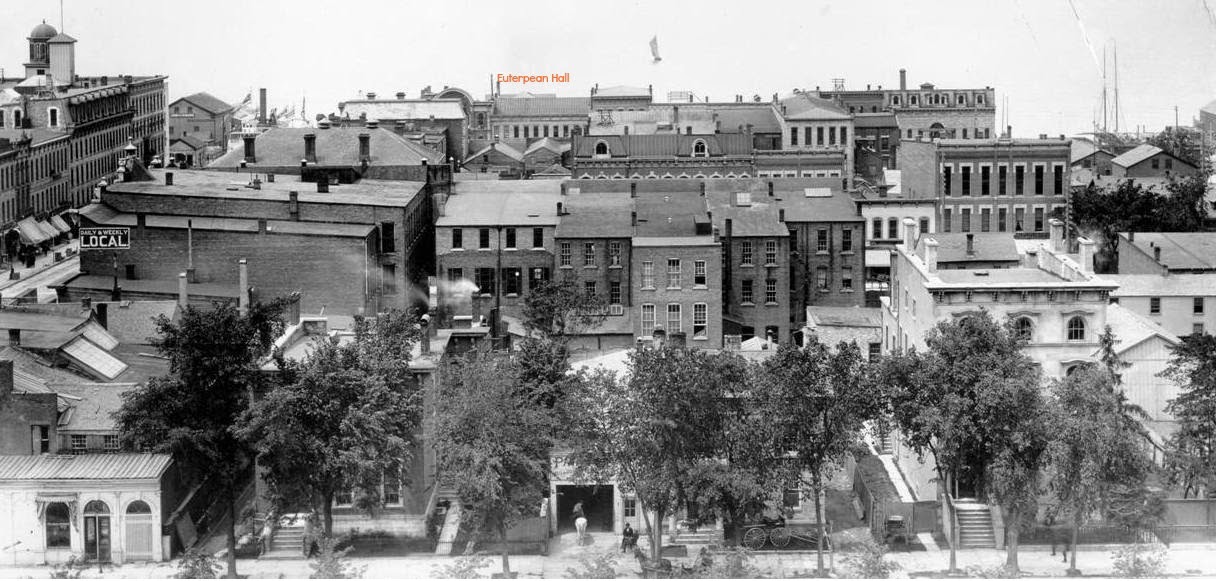
Euterpean Hall was on the third floor of the Phoenix block on the north side of Water Street, east of Columbus Avenue. The Phoenix building (#2 in the drawing below) was just to the east of the Post, Lewis and Radcliffe building, now home to the Water Street Bar and Grille. Leroy Hinkey provided us with a a key to this stereograph image, which was created by Sandusky photographer A.C. Platt in the 1870s. 


You can see the top floor of the Phoenix Block, containing Euterpean Hall, in this aerial view of Sandusky, from  the latter part of the nineteenth century.


The Phoenix building was built in 1849.  It was named because it “rose from the ashes” of an earlier building that had burned.  The name of the Euterpean Hall came from Euterpe, one of the daughters of the Roman god Jupiter. She was a muse who presided over music. Euterpean Hall was capable of seating 600 people. The hall was used for music, dancing and lectures. On December 16, 1854, the famous nineteenth-century reformer Horace Greeley gave a lecture there. The Sandusky Register of December 18, 1854 stated about Mr. Greeley’s lecture, “ The speaker appeared in his usual spirits and delivered his sound and suggestive lecture in his usual way. Mr. G. makes no pretentions to oratory, but in his sterling thought, philosophical analysis of character and keen insight in principles of action, he affords the hearer much food for after reflection.”  In 1855 P.T. Barnum appeared at the Euterpean Hall. 

Several different businesses found their home in the Phoenix building through the years, including the American Express Company and the R.B. and C.B. Wilcox Company, which stored carpets in the upper levels. See Ellie Damm’s book, Treasure by the Bay,  to read more about the Phoenix building and several other historic buildings in Sandusky.  In her book, Mrs. Damm points out that many early commercial buildings in Sandusky were built from native limestone, showing the thrift and practicality of the early residents of Sandusky.

Tuesday, June 13, 2006

No TV, No Internet, No Video Games

Have you ever heard kids (or yourself) wonder what people did before there were movies, television, computers, or even radio? Going to the neighborhood saloon for a beer was one of the more common social activities in the nineteenth century. Here is a view of some men having a drink at an unidentified saloon on Water Street in 1889. It's impossible to guess which saloon this is, because in 1889 there were forty-one saloons -- on Water Street alone!!! That's right -- the neighborhood saloon was in every neighborhood back then. Sometimes there were more than one on a block. (For example, in 1889, Adolph Ernst had a saloon at 202 Tiffin Ave., and George Ferback operated one at 210 Tiffin Ave.) The 1889 Sandusky city directory lists 181 saloons in the city.
The saloon was a place where men met to socialize with their friends and enjoy a beer, and maybe even get something to eat, just like they or their fathers or grandfathers did in the "old country" (most likely Germany). This image probably represents a typical scene in a neighborhood saloon of the era: men who may have just finished work for the day, gathered together to talk about their day and the world they lived in. Note the spittoons and hand towels at intervals along the bar, and the hearty, dark beer that was common then. (None of that wimpy pale beer, like we drink today!)

While most saloons were small neighborhood operations, some were a bit more elaborate. Louis Zistel was proprietor of the Atlantic Garden Saloon (sometimes identified as the Atlantic Pleasure Garden) on Meigs Street (near where the city building is today). You can see a bowling alley in the foreground of this picture of Zistel's saloon.
Zistel also operated a boat yard and (briefly) an aquarium, where visitors could view aquatic life through glass in a tank twelve feet deep and one hundred feet in circumfrence.