Showing posts with label Sandusky Library. Show all posts

Wednesday, October 23, 2024

Sandusky and Vacationland in WPA Guides


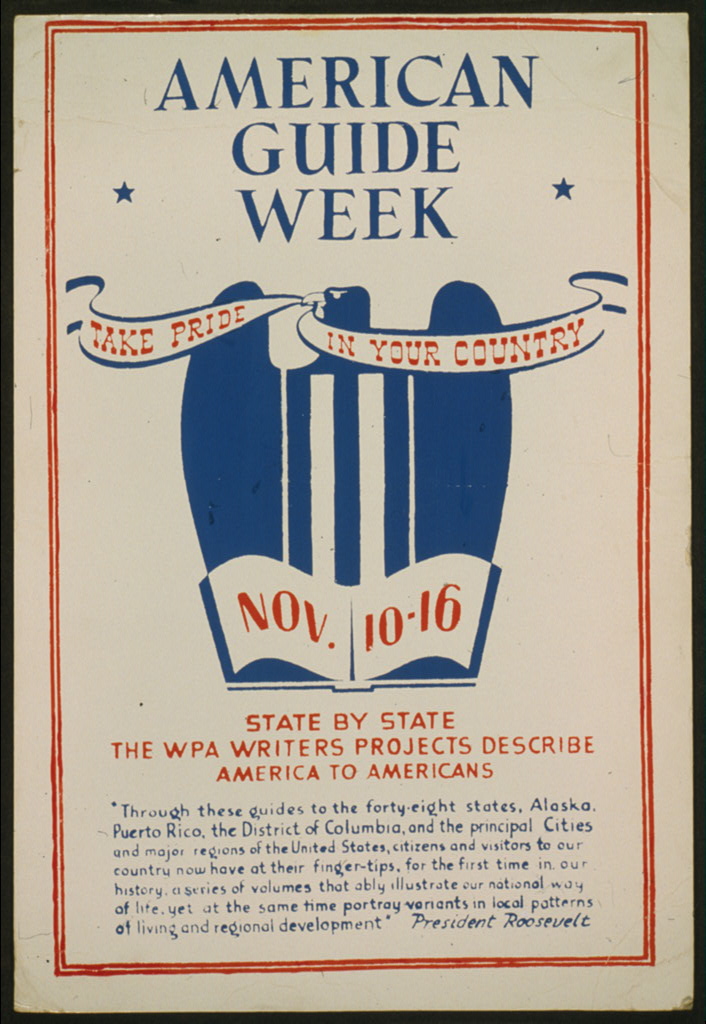
The Federal Writers’ Project was a part of President Franklin D. Roosevelt’s W.P.A. - known as the Works Progress Administration from 1935 to 1939, and the Work Projects Administration from 1939 to its conclusion in 1943. Guides to each of the then 48 states in the U.S., as well as Alaska, Puerto Rico and Washington D.C., were written during these years, along with guides to smaller regions, including "Vacationland," a term used at the time for the Lake Erie Islands region (including Sandusky). 

The WPA Guide to Ohio featured three sections: general background, cities, and tours. Sandusky was one of the featured cities in the Ohio Guide. 


On page 308 of the book, the authors described Sandusky as “a magical place, when its numerous parks and old shade trees shower their colors everywhere, its limestone buildings take on a regal dignity, its bay quickens with the touch-and-go of barges, tugs, pleasure boats and freighters, and thousands of brightly dressed tourists overrun the city.”

The section of the book on Sandusky continues with historical facts about the city, along with a description of local industries. The Oran Follett House was listed as one of the “Points of Interest” in Sandusky.


The Lake Erie Vacationland in Ohio book offered descriptions of Ohio's Lake Erie islands and communities in Erie and Ottawa Counties, and some suggested tour routes.

It also included a number of photographs and a map of the region.

In November, 1941, the Sandusky Library celebrated American Guide Week, with a display of books from the American Guide Week series.

The Ohio Guide can be borrowed through the Hoopla digital service, or a print copy can be requested through Clevnet. A reprint copy of the Vacationland book can be checked out from the Sandusky Library, or you can view an original copy in the library's Archives Research Center to learn more about our region as it looked in the 1930s.

Monday, January 08, 2024

An Important Tool in the Early Library


The pencil dater pictured above was recently found by a member of the Sandusky Library’s administrative staff. This piece of library equipment was devised by the Milwaukee Public Library in the late 1800s. With just a slight motion of the hand, library staff could jot down the patron’s library card number, as well as stamp the date due on a slip of paper in the back of the library book. The pencil dater sold for seventy-five cents (about $25 today) in the Classified Illustrated Catalog of the  Library Bureau in 1891. This type of manual charging system was used at the Sandusky Library well into the 1970s.

Today the Sandusky Library is a member of the CLEVNET Consortium. The SirsiDynix computerized charging and discharging system used by CLEVNET libraries allows for efficient and accurate charging, discharging, and searches for items by author, title, subject, or series. The online catalog further enhances searches by providing a graphical interface, links to new arrivals, award winners, and best sellers.

Monday, August 21, 2023

Merlin Wolcott, Library Director in Several Ohio Libraries

Merlin Wolcott in the 1950 BGSU Key

Merlin Wolcott was a son of Melvin and Adelia Wolcott. He and his twin sister Merriam Wolcott Washburn were born in 1920; they grew up on Shelby Street in Sandusky. As a youngster, Merlin was a frequent patron of the Sandusky Library, and worked one summer at the library during his college years. 

After earning a library degree at Kent State University, Mr. Wolcott went on to become the director of several Ohio libraries including Elyria, Avon Lake, and Canton. As part of his requirements for the degree of Master of Arts from Kent State University, he wrote a thesis titled The History and Development of the Sandusky Library Association, Sandusky, Ohio in 1953. A bound copy is on file at the Sandusky Library Archives Research Center.

The thesis covered the history, growth and development of the Sandusky Library from its earliest years to the early 1950s. In the publication, he pointed out that the Sandusky Library, which opened on July 3, 1901, looked similar to a medieval castle. He stated that the library represented the ultimate ideal of the “university of the common man.”  Mr. Wolcott also discusses the earliest libraries in Sandusky, including the Portland Library Association and the Lyceum from the 1820s, and the Philomathesian Society that grew out of the Young Men’s Debating Association in 1840. He went on to cover the Ladies Library Association that met in 1870 for the purpose of forming a library association, and the Library Association of Sandusky which was incorporated in 1895.  In 1896 the Ladies Building Fund Association was organized, and two years later the Association purchased property at the corner of Columbus Avenue and Adams Street. The philanthropist Andrew Carnegie gave $50,000 for the library building and equipment, with the stipulation that no part was to be used for maintenance.  The original building was constructed with blue limestone from the Wagner Quarries, caps and sills in Berea sandstone, and the base in Columbus limestone.


Mr. Wolcott provided statistics about the Sandusky Library between 1921 and 1951. Today the Sandusky Library owns over 200,000 items, which include books, periodicals, DVDs, compact discs, books on tape, and e-books.  A host of online research databases provide instant access to information to library patrons twenty four hours a day.

Merlin Wolcott died in 1993 at the age of 73. He was a World War II Army Veteran, a member of Grace Episcopal Church, the Mayflower Society, the Descendants of Henry Wolcott, Masonic Lodge, the American Library Association and the Ohio Library Association. Mr. Wolcott had a deep interest in family and local history. He was a direct descendant of Benajah Wolcott, the first keeper of the Marblehead Lighthouse.

Saturday, June 10, 2023

When Picnics Were in the News


On Kelleys Island

Picnics in Sandusky and the Lake Erie Islands area were held quite often, by families, church groups, companies, and clubs. The proximity to Lake Erie provided nice lake breezes for the picnic-goers. Local newspapers frequently reported on picnics held in the area. The Sandusky Register of September 8, 1868, announced the “Grandest Pic-Nic of the Nineteenth Century” when students of the Buckeye and Great Western Business College chartered steamers for a picnic at Put in Bay.

In 1911, the Castalia Telephone operators enjoyed a picnic at the Blue Hole, while two other Castalia groups met at Rye Beach with their lunch baskets.


The Sandusky Star Journal of July 30, 1931 reported on a picnic at Bay View Park held for members of the Sandusky Typographical Union, #237, who were employees of the Sandusky Register and the Sandusky Star Journal. A ball game between the two newspapers started off the festivities. Other contests included horseshoe pitching, egg throwing, nail driving, a wheelbarrow race, and a blindfolded fly swatting contest.


In 1942, about 300 members of the Eagles Club and their families had their annual picnic at Lions Park. Some of the events were rolling pin throwing, balloon blowing, and a peanut scramble.


Cedar Point has been a popular picnic destination for large group picnics for over a century.


The Jaycees held a picnic at Cedar Point in August of 1954.


In this picture, it appears as though the employees of the Sandusky Library in the 1920s had an impromptu picnic outside the library building:

If you would like to see if the names of your family members ever appeared in local newspapers, whether for a picnic or other news event, browse through the historical Sandusky newspapers on microfilm at the Sandusky Library Archives Research Center, or check Newspaper Archive, accessible from home with a Sandusky Library card number.

Wednesday, March 15, 2023

Mrs. Josephine Leeson, Descendant of Pilgrims


Josephine Adelia Cook was the daughter of Dr. Thomas M. Cook, who was the surgeon of the 101st Ohio Volunteer Infantry during the Civil War. The Cook family traces its roots back to Francis Cooke, who came to America on board the Mayflower. (Through the years, some family members dropped the final letter “e” on the surname Cooke.)

Josephine Cook married Joel Byington Leeson about 1874. In the 1880 U.S. Census, J.B. Leeson and Josephine Cook Leeson were residing with her parents, Dr. and Mrs. Thomas M. Cook. In the 1880s, J.B. Leeson was associated with the Sandusky Wheel Company, and later the American Wheel Company.

By 1900 the Leeson family moved to New York State. Joel Byington Leeson died in Cleveland, Ohio on October 30, 1922. He was buried in the Whitney Cemetery in Ontario County, New York. When Mrs. Josephine Lesson died in 1929, an article in the March 2, 1929 issue of the Sandusky Register reported on her death


Mrs. Leeson was buried next to her husband in the Whitney Cemetery. She was survived by two sons and four nephews. She had been on the Board of Trustees of the Sandusky Library from 1888 to 1891. When she lived in Sandusky, Mrs. Leeson sang in the choir of Grace Episcopal Church.

Friday, October 14, 2022

Treasure Chest Campaign for War-Torn Countries in 1945


Sandusky Library staff members Esther Moreland and Harry Meisler are seated beside one of the treasure chests of books collected in 1945, to be sent off to Europe. Miss Yvonne Fievet, then Children’s Librarian, directed the project. Miss Fievet is pictured at the far right in the picture of 1940s library staff below.

Local school children all over Sandusky collected books, and decorated the boxes that held them. The campaign to donate books from the United States to countries in Europe was a national project of the Book Committee of the Women’s Council for Postwar Europe. The purpose was to provide underprivileged children with books and pictures of the American way of life, in order to promote a better understanding of life in the U.S. Included in the boxes were blank paper, crayons, and an empty scrapbook, so that children in other countries could tell Americans about life in their nation. Books collected from Junior High students were sent to China; Madison School’s treasure chest was sent to the Philippines; and books from Madison School were sent to Holland. Items collected by students at Barker, Osborne, Saint Mary’s, Saints Peter and Paul, and Holy Angels Schools were sent to Austria. 


Before being sent to Europe, the treasure chests were on display for a week at: the Ohio Public Service Company, Chamber of Commerce, Spector’s, and the adult section of the Sandusky Library.

Friday, September 02, 2022

Mrs. Caroline Curtis Moss Wilcox


Caroline Curtis was born in Massachusetts in 1871 to Myron B. Curtis and the former Georgette Ainsworth. After her father died in 1880, Caroline moved to Sandusky, Ohio, and married Augustus L. Moss, of a family of bankers, in 1891. According to Hewson Peeke’s book, A Standard History of Erie County, Ohio (Lewis Publishing, 1916), Mr. Moss “had the advantages of being reared in a home of culture and wealth." A.L. and Caroline Moss had one child, Wolcott Griswold Moss; sadly, Wolcott died in an auto accident in 1915 at the age of 22. Mr. A.L. Moss died in 1917, and some believe that the loss of his only son contributed to his early death.

In 1921, Caroline Curtis Moss married Clinton B. Wilcox, a Sandusky businessman and veteran of the Ohio National Guard, who had become a widower in 1909. A newspaper article in the September 13, 1933 issue of the Sandusky Register reported that Mr. and Mrs. C.B. Wilcox had just returned to their home on Wayne Street, after spending the summer at their home on the Cedar Point Chausee.


Caroline became a widow again, when Clinton B. Wilcox died in 1933.

Caroline Curtis Moss Wilcox suffered a great deal of loss in her life, but she kept busy with community organizations. She was an early member of the Board of Trustees of the Sandusky Library Association, as well as the Daughters of the American Revolution, and the Nineteenth Century Club. 

Caroline Wilcox died on March 15, 1944. She was buried in Sandusky’s Oakland Cemetery.

You may recall from previous posts that in 1899, Caroline’s mother in law, Mrs. J.O. Moss, was successful in securing funds from Andrew Carnegie to go towards the building of a public library in Sandusky, Ohio.

Saturday, August 20, 2022

Mr. and Mrs. James Ellis Marshall


James Ellis Marshall was born in 1808 in Bradford, England. He came to the United States in 1855, having interests in the textile and iron industries in Berkshire County, Massachusetts. In about 1860 he settled in Sandusky, Ohio, where he became one of the incorporators of the Sandusky Tool Company, founded in 1869..

Mr. Marshall and his wife, the former Clara Robinson, were the parents of four children: Joseph Marshall, who moved west; Mary Elizabeth Marshall, the wife of Lewis Moss; Hannah Sophia Marshall, who married Rush Sloane, and sadly died in 1872; and Benjamin Marshall, whose death was believed to have been hastened by his experience in the 1900 flood in Galveston, Texas. Clara Robinson Marshall served on the Board of the Sandusky Library Association from 1870 to 1873.

Clara Robinson Marshall

Known as Deacon Marshall, James E. Marshall was very active in the Congregational Church in Sandusky. The Marshall family lived in this lovely Wayne Street home, built in the 1870s, now on the National Register of Historic Places.

According to the Ohio Historic Places Dictionary (State History Publications, 2008), the Marshall home was the first residence in Sandusky to be connected to the city’s new water and sewer lines. 

James E. Marshall died at the age of 98 on March 20, 1907. He and his wife were both interred at Troy, New York in the family vault at Oakwood Cemetery. Though Mr. and Mrs. Marshall were not born in Sandusky, and were not buried here, they definitely contributed greatly to the community in which they lived for over forty years.

Friday, January 28, 2022

Petition from Sandusky Residents Requesting Purchase of Library Materials


Sometime in the first decade of the twentieth century, local residents gave a petition to the Carnegie Library Committee (Sandusky Library) requesting that the library purchase the title International Library of Technology.

The first name listed on the petition was that of E.B. Krieger, a reporter with the Sandusky Star Journal. Most of the individuals who signed the petition were men in technical fields who worked in transportation or manufacturing businesses in the area.


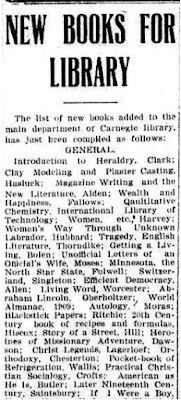
The International Library of Technology was a series of textbooks for persons in the trades or the field of engineering, published in Scranton, Pennsylvania, by the International Textbook Company, in conjunction with the International Correspondence Schools. The textbooks were published on a wide variety of topics, and came in several editions. An article in the February 14, 1909 issue of the Sandusky Register indicated that the Sandusky Library indeed did purchase a copy of the International Library of Technology.


Monday, November 22, 2021

Sanborn Maps, An Invaluable Historical Resource


The Sanborn Map Company published maps between 1867 and 1970 to help fire insurance companies determine potential risks for buildings in American cities. While their value for insurance policies has long ended, these maps serve a new purpose for historians and family history researchers. Precise locations of buildings and streets are included on the maps, as well as the types of construction materials used, water sources available, and how buildings were heated, among other information. While individual property owners are not usually given, researchers can find out the location of the homes and places of employment of their ancestors. 

At the Sandusky Library Archives Research Center, Sanborn Maps can be accessed in a variety of formats. There are physical copies of the 1886 and 1905 atlases stored in the Archives, another atlas, with revisions into the 1950s, is also available for viewing. Microfilm roll 6885 contains copies of the 1886, 1893, and 1905 Sanborn Maps for Sandusky. And a digital collection of 40,000 Sanborn Maps of Ohio cities is accessible to Ohio library users through OPLIN Databases. This digital collection can be accessed twenty-four hours a day, seven days a week, to holders of Ohio library cards. Some examples from this collection are below.

The J. Kuebeler and Company Brewery was located on the west side of Sandusky in 1886, on Tiffin Avenue.


This 1886 Sanborn Map shows locations of the Kuebeler brewery’s malt storage, fermenting unit and ice houses, along with many other details about the facility.

The Sandusky Library appeared on page 25 of the 1905 Sanborn Fire Insurance Map.


In the original library building, the reading room in the east wing of the Carnegie building had a skylight, and a music hall was in the west wing, complete with an area for storing scenery. Notes indicate that the library was heated with steam heat.

The street names and house numbers found on the Sanborn Fire Insurance Maps seem to come alive when one can locate photographs taken of a specific location. Below is a section of the 1893 Sanborn Fire Insurance Map which shows the corner of Monroe and Hancock Streets.


William Brehm had a dry goods store at 631 Hancock Street in 1893. The front window of Mr. Brehm’s store is visible in the picture below which also shows car number 9 of the Sandusky, Milan and Norwalk Electric Railway in 1893.

Visit the Sandusky Library Archives Research Center to learn more about the Sanborn Fire Insurance Maps for Sandusky.

Tuesday, April 06, 2021

Historic Photos from the Sandusky Library

In commemoration of National Library Week, we are sharing some historical photos from the Sandusky Library.


Cora Rehfus looks up from her duties in the adult department of the Sandusky Library in the 1940s. Note the portrait of Andrew Carnegie above the book shelves. Through the efforts of Sanduskian Mrs. Jay O. Moss, in 1899 Andrew Carnegie, wealthy philanthropist, offered to give $50,000 for a public library in our city. 

In the picture below, Miss Mary McCann, longtime Head Librarian at Sandusky Library, checks out books in the Bookmobile, which operated in the 1950s and 1960s throughout Erie County. 


Long before Netflix and Hoopla, Mrs. Louise Kuemmel inspected and cleaned 16mm films from the Sandusky Library’s circulating collection of films. The film department of the library was in the basement, where the Sandusky Library Archives Research Collection is currently located. 


In August of 1980, Sandusky Library staff was delighted to have completed its inventory project.

Wednesday, March 31, 2021

Miss Jessie Wilcox, Cultural Leader


Jessie Martha Wilcox was born in Sandusky, Ohio in April of 1861, the same week that the Civil War broke out in the United States. Her parents were Rollin M. Wilcox and the former Martha Ellen Newton. For many years, Jessie’s father was a partner in the R.M. and C.B. Wilcox Company, a popular department store in downtown Sandusky. 


When Jessie was just a toddler, her mother Martha passed away at age 28. 

Jessie graduated from Sandusky High School on June 27, 1879; her niece, Esther Sloane Curtis, donated her aunt's high school diploma to the Sandusky Library Archives Research Center. 


In 1884, she graduated from Wellesley College in Massachusetts. After graduation, she taught school in Fond du Lac, Wisconsin, before moving back to her hometown of Sandusky, where she also taught school. 

From 1904 to 1937, Miss Wilcox was a member of the Board of Trustees of the Sandusky Library, serving for a time as President of the Board. She was also a member of the Nineteenth Century Club, the Martha Pitkin Chapter of the Daughters of the American Revolution, and Trinity United Methodist Church. 

On August 12, 1937, Jessie Wilcox died suddenly at her home on Franklin Street in Sandusky. Funeral services were held at the home of Jessie’s niece, Mrs. Worth Curtis, with the Rev. Roy Smith of Trinity Methodist Church officiating. Burial was at Oakland Cemetery. An obituary in the August 12, 1937 issue of the Sandusky Star Journal reported that Jessie had been one of the area’s most prominent women, and she had been a leader in the cultural life of Sandusky. The Sandusky Library closed from 2:30 to 3:30 on Saturday, August 14, 1937, during the funeral service, in honor of her many years of service to the Library.

Thursday, November 05, 2020

Sandusky Library: 125 Years


In commemoration of the 125th anniversary of the Sandusky Library, here is a "re-run" of a post on the history of libraries in Sandusky:

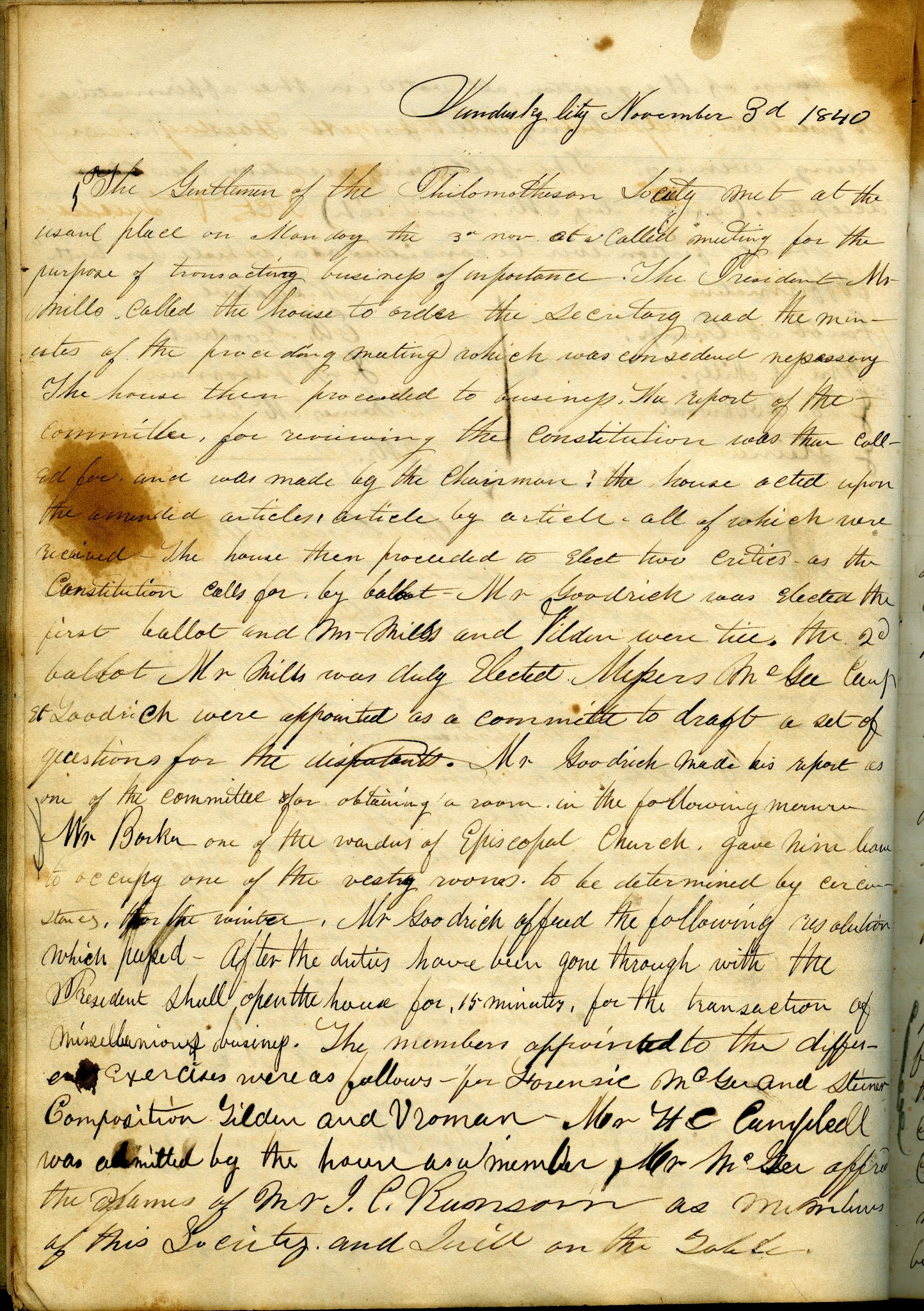
The public library in Sandusky can trace its roots back to 1825 (only seven years after Sandusky was founded), when a subscription library was created, called the Portland Library. F.D. Parish, one of the city's first lawyers, was the first librarian, with about 300 books under his care. This organization was succeeded around 1840 by the Sandusky Lyceum, a literary study society; the Lyceum was in turn replaced by the Philomathesian Society in 1845. 

A page from a minute book of the Philomathesian Society

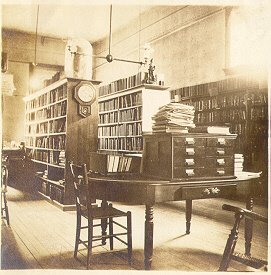
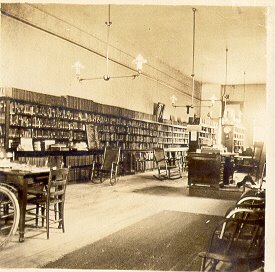
In 1855, the Young Men's Library Association took over the role of public library for Sandusky, until 1870, when the Library Association of Sandusky was founded. This organization was commonly known as the "Ladies' Library Association," because the membership of its board was composed entirely of women of the community. In 1886 the Library Building Fund Association was created to raise funds for the construction of a library building. In November 1895, the Library was incorporated and became the first free public library in the community. (Membership fees were no longer charged.) Originally located in the High School, the library operated in the Masonic Temple (seen here)from 1896 until 1901, when what is now the Carnegie wing of the present library was opened. Today's Sandusky Library has served the community at its present location for over 100 years, with expanded facilities for the 21st century.