Showing posts with label legal. Show all posts

Wednesday, January 09, 2019

Law Partnership of F.D. Parish and E.B. Sadler


Two of Sandusky's most prominent early lawyers, F.D. Parish and E.B. Sadler were partners in a legal office in Sandusky, Ohio. Hewson Peeke wrote in A Standard History of Erie County, Ohio (Lewis Publishing Company, 1916), that F.D. Parish was the second lawyer in Erie County, following Eleutheros Cooke. In 1836 F.D. Parish went into a legal partnership with E.B. Sadler. Their office was on Public Square in Sandusky, near the old Courthouse, often known as the Academy because it once served as a school.


It appears that F.D. Parish was the senior partner, because his name always appeared first in the listing.


The partnership continued until 1847, when Mr. Sadler left to take the position of presiding judge of the Court of Common Pleas of the 13th Judicial Circuit, which then included the counties of Erie, Huron, Sandusky, Ottawa, Lucas, Wood and Henry. On February 15, 1847, the partnership between F.D. Parish and E.B. Sadler was dissolved.


A copy of the dissolution notice is found in the historical files of the Sandusky Library Archives Research Center. Though the partnership ended, it appears that E.B. Sadler was trying to tie up loose ends. In the letter below from Mr. Sadler to a “Brother Norman,” E.B. Sadler requested that fees owed in some recent legal matters were to be paid.


F.D. Parish went to become well known as an abolitionist who took an active part in the Underground Railroad. E.B. Sadler served as Mayor of Sandusky from 1844 to 1845.

Tuesday, December 18, 2018

Historic Notary Seal


This historic Ohio notary seal is now in the collections of the Follett House Museum. It is much larger than the notary seals in use today. A Notary Public is a person authorized to witness the signing of important documents. Many banks, legal offices, and government offices have staff on hand who are recognized as notary publics (or notaries public -- both are acceptable according to Merriam-Webster) by the state of Ohio. Wills, deeds, and other legal transactions often need to be notarized. 

Several certificates of the commissions of notary publics that were  issued to Hewson L. Peeke and Rush R. Sloane are found in the files of the Sandusky Library Archives Research Center. Below is a document that indicates that Rush R. Sloane was appointed as Notary Public by Governor Seabury Ford, on September 8, 1849.


Rush R. Sloane was Mayor of Sandusky (1879-80), owned the former Sloane House Hotel, and was very active in the Underground Railroad activities of the Firelands.

Monday, October 06, 2014

I.F. Mack’s Address on “The Four Pioneers”

On June 8, 1881, I.F. Mack, the well-known publisher of the Sandusky Register, gave an address at the twenty fifth annual meeting of the Firelands Historical Society in Norwalk, Ohio.


His address, entitled “The Four Pioneers,” featured sketches of four well known pioneer attorneys in the Firelands area.


In the eight years prior to the 1881 meeting, four respected judges from Erie County had passed away. They were: Walter F. Stone, William G. Lane, Joseph M. Root, and Cooper K. Watson. Mr. Mack had known each of these men personally. He gave a brief biography of each of the deceased attorneys, and then he examined the character of each of the men. According to Mack, Walter F. Stone was very gentle in nature, and was a man of peace. “He was a gentleman always, in the practice of his profession as well as social life.”  

William G. Lane was described as having the combination of diffidence, mental strength, fidelity to the highest duty, patience and courage. Mr. Mack also said that Judge Lane had “sincerity, coupled with unquestioned purity of thought and feeling,” and claimed that he was the “wisest counsellor we ever had at our bar.” 


About Joseph M. Root, I.F. Mack said that he was sincere, honest, and brave, but “his prejudices were too intense to make him an agreeable social companion.” When someone disagreed with Joseph M. Root, his wrath was often excited and he was known to “draw forth a torrent of abuse.” Mr. Mack said simply that Root “was not a great lawyer.”

According to Mack, Cooper K. Watson “possessed legal ability of the highest order.” He had a consummate knowledge of the laws, and a thorough understanding of the intricate rules and modes of practice, and was known to be severe in the sentencing of criminals. Mack wrote that Judge Watson “read books, law, theology, poetry, history, romance, and science greedily, remembered what he read, and made it useful, in the practice of his profession and in his intercourse with friends.”

Mr. Mack concluded by stating that all four of the pioneer lawyers were regarded as honest men, in a profession popularly believed to contain its full share of dishonest men. He stressed the importance of honesty and integrity as the chief cornerstone of character, to be regarded as more important than owning lands, stocks and bonds. 

To read I.F. Mack’s address “The Four Pioneers,” see the Firelands Pioneer of June 1882. His address is found on pages 62 to 70. You can see a framed picture of each of the four attorneys discussed in Mack’s speech on the third floor of the Erie County Courthouse.


Monday, September 15, 2014

Judge E.B. King


Edmund Burritt King was born on a farm in July 4, 1850 in Medina County, Ohio to Cyrus and Harriet (Bennett) King. After attending the Oberlin Academy and Baldwin-Wallace University, Edmund studied law. He was admitted to the Ohio Bar in 1873, and in 1875 he moved to Sandusky, where he practiced law for twenty years. He was associated with several attorneys at various times in Sandusky, including W.W. Bowen, S.F. Taylor, E.M. Culver, and Lynn Hull. From 1894 to 1899, Mr. King was Judge of the circuit court for the Sixth Judicial Circuit of Ohio. Judge King is pictured below with fellow circuit judges Robert S. Parker and George S. Haynes.


In 1899 Judge King returned to private practice with W.E. Guerin, and later, in a law partnership with Russell K. Ramsey. From 1880 to 1898, he was a member of the Ohio National Guard, attaining the rank of major. Judge King was a presidential elector in 1888 and was a delegate to the fourth constitutional convention of the state of Ohio in 1912. In 1916 Judge King served as president of the Ohio State Bar Association. An article in volume 62 of the Ohio Law Bulletin stated that at the thirty-eighth annual meeting of the Ohio State Bar Association, which met at Cedar Point, “Hon. E.B. King further distinguished himself as the presiding genius of the several sessions of the meeting, gracefully controlling and firmly pressing the business in hand to prompt conclusions.” 

Late in 1933, Judge King began suffering from heart problems. He passed away from heart disease on December 30, 1934. Judge King was survived by his wife, the former Edith E. Hackett, daughter Cora King Graves, and son Clifford King. Funeral services for Judge E.B. King were held at the Masonic Temple under the auspices of the Thirty-third Degree Scottish Rite Masons, as well as at the Presbyterian Church with the Rev. A.J. Funnell officiating. Burial was at Oakland Cemetery. Shortly after Judge King’s death, Judge Roy Williams stated that “it will be a long time before Erie County again has a citizen of the outstanding principles of Judge King. His predominating character was his unselfishness. There was not a movement in the community that he was not to the fore in. Sandusky has lost one of its finest friends.” You can read Judge King’s history of the early years of the Erie County Bar Association in chapter 25 of Hewson Peeke’s book  A Standard History of Erie County, Ohio (1916).

Thursday, December 10, 2009

Judge Thomas M. Sloane


Thomas Morrison Sloane was the son of Rush R. Sloane and his wife, the former Sarah E. Morrison, born in Sandusky on July 28, 1854. He graduated from Harvard University in 1877. After he studied law with Homer and L. H. Goodwin, he entered law school at the University and Michigan, where he received his law degree in 1880. He was associated for a time with Judge E. B. King. On June 22, 1881, Thomas M. Sloane married Sarah Maria Carswell Cooke, the daughter of Pitt Cooke, and his wife, the former Mary E. Townsend. Sarah Cooke was a granddaughter of Eleutheros Cooke, the first lawyer in Sandusky, and a niece of Jay Cooke, the Civil War financier. Mrs. Thomas M. Sloane is pictured below with sons Rush Sloane and Thomas M. Sloane, Jr. about 1893.


Judge and Mrs. Thomas M. Sloane and their family lived at the lovely home located at what is now 1415 Columbus Avenue. The home was originally built for Eleutheros Cooke in 1843-1844, and stood at the northwest corner of Columbus Avenue and Washington Row. Rush Sloane acquired the house in the late 1870’s, and he had the house taken down, and rebuilt at 1415 Columbus Avenue. It was given to Thomas and Sarah Sloane as a wedding gift. Pictured below is the Sloane’s home on Columbus Avenue, which is now known as the Cooke House.

In 1905, Thomas M. Sloane was elected Judge of Erie County Probate Court, and he was re-elected to this position twice. Judge Sloane was also very active in the civic affairs of Sandusky and Erie County. He served on City Council, the Sandusky Board of Education, the Board of Trade, Businessmen’s Association, and he was secretary-treasurer of the Good Samaritan Hospital. Mr. Sloane was instrumental in the organization of the Sunyendeand Club and was a member and past president of the Men’s Literary Club. Judge Sloane was also a leading layman in the Protestant Episcopal Church of Northern Ohio, and was Adjutant General of the Sixteenth Regiment of the Ohio National Guard for several years.

Thomas Morrison Sloane died on March 23, 1920, after a lingering illness. He was only 65 years of age at the time of his death. Funeral services were held at Grace Episcopal Church, and burial at Oakland Cemetery. Articles about the death of Judge Sloane were carried in the Sandusky Register and the Sandusky Star Journal on March 23, 1920. A tribute from the Erie County Bar Association was published in the March 28 issue of the Sandusky Register. The Register article stated that Judge Sloane was a man show life “was devoted entirely to the service of others…..He won many honors and distinctions but instead of making him boastful and proud, the noble humility with which he bore them but enhanced their value in the eyes of others upon who they were conferred.”

The tribute from the Bar Association concluded with these words: “So has passed from the ranks of our profession this whole souled, genial and pure minded member of our profession. These few words fall far short of enumerating his many excellencies, but after all his best epitaph is the love and respect his numberless friends and relatives.”

Wednesday, October 29, 2008

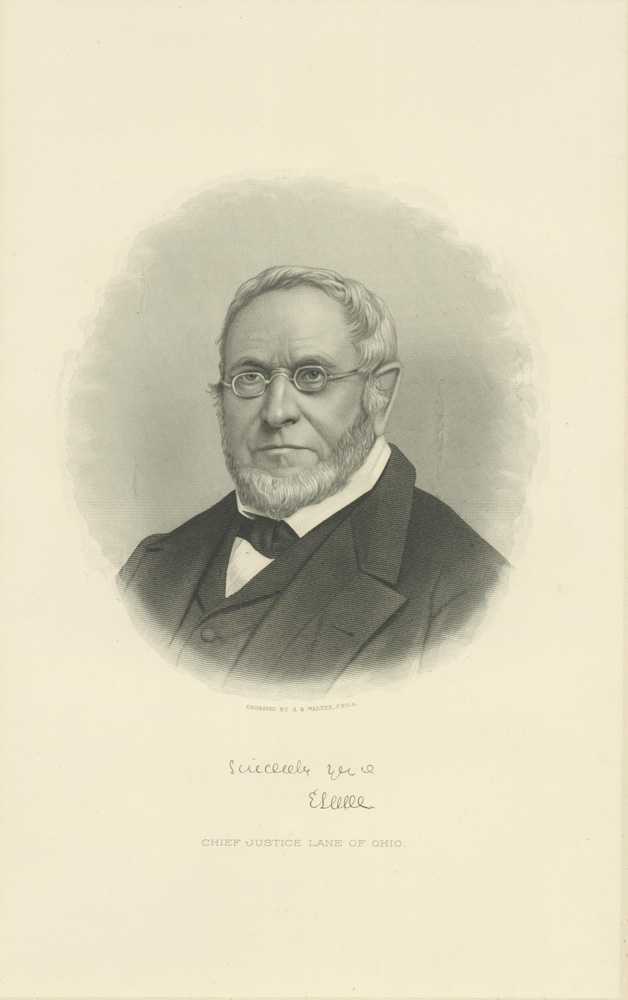
William Griswold Lane

William Griswold Lane was born in Norwalk, Ohio in 1824 to Ebenezer Lane and Frances Griswold. When William was twelve years old he became acquainted with fellow student Rutherford B. Hayes, at the Maple Grove Academy, in Middletown, Connecticut. They became lifelong friends. William Lane attended college at Yale and Harvard, and spent a year studying law in Berlin, Germany.

After returning to the United States, William practiced law with his father. In 1850, William married Elizabeth Diodate Griswold. In February 1873 William G. Lane was appointed Judge of Common Pleas for the Fourth Judicial District.

William G. Lane died in October 1877, at the age of 52. Resolutions from the Court and Bar of Erie County appeared in the Sandusky Register. One resolution stated “In this death, the bench and bar have lost an able, impartial and upright Judge – one of the most esteemed, high minded and scholarly members of the profession – and this community a citizen of great mental and moral worth – a man just, honorable and honest in all his dealings with his fellow men and conscientious and faithful in the discharge of all the public and private duties that devolved upon him. While we mourn his loss we delight to honor his memory.”

The Lane family monument at Oakland Cemetery is a beautiful sculpture in honor of William Griswold Lane and his family. I.F. Mack wrote in an article in the June 1882 Firelands Pioneer, that Judge William G. Lane was “without doubt, the wisest counsellor we ever had at our bar.” A memorial tribute to Judge William G. Lane is on file at the library at the Rutherford B. Hayes Presidential Center in Fremont, Ohio.

A view below of the Lane Family monument at Oakland Cemetery in Sandusky, Ohio. Several family members’ names are inscribed on the stone.

Tuesday, October 14, 2008

Ulysses Thompson Curran, Educator and Judge, and His Son Charles, Artist

Ulysses Thompson Curran was the superintendent of the public schools in Sandusky from 1872 through 1880. After leaving the field of education, U. T. Curran practiced law in Sandusky. He served as Erie County Common Pleas Judge in the Probate Division, from 1899 to 1905. He was a lifetime member of the National Education Association.
Under Mr. Curran’s leadership, the “Sandusky Training School” was founded in 1874. New teachers were mentored by more experienced teachers to prepare them for their profession. Miss Mary Alice Chenoweth was the lead teacher at the training school. Mary Alice later changed her name to Helen Hamilton Gardener. She was a suffragist leader, an author, and was appointed to the U.S. Civil Service Commission by President Woodrow Wilson in 1920. (She willed her brain to Cornell University for medical research.)

On February 28, 1914, Ulysses Thompson Curran died at the home of his son Charles Courtney Curran in New York City. Charles Courtney Curran graduated from Sandusky High School in 1879. After high school, Charles Curran attended the Cincinnati School of Design, and later the Art Students’ League, and the National of Academy of Design in New York City. In 1888, he won the Academy’s Hallgarten Prize for his painting, A Breezy Day. Also in 1888, Charles Courtney Curran married Grace Winthrop Wickham, daughter of Huron County Judge Charles Preston Wickham.

After his marriage, Charles Curran studied art in Paris, where he developed his impressionistic style. Three works by Charles Courtney Curran can be seen at the Follett House Museum, including Laurel Among the Rocks, pictured below.

Charles Courtney Curran painted a portrait of his father, which is also on display at the Follett House Museum. Local author Patty Pascoe wrote about both U. T. Curran and Charles Courtney Curran in the book, Elected to Serve, available from the Sandusky Library.

Wednesday, May 09, 2007

Ebenezer B. Sadler: A Judge Who Lived Without an Enemy


Judge Ebenezer B. Sadler was born at Grafton, Mass., on Nov. 16, 1808, and died March 25, 1888 in Rochester, New York. His mother died in Geneva, New York when Judge Sadler was not yet ten years old. He first studied law in the office of Hon. John Dickson, of West Bloomfield, New York.

In the summer of 1835, at age 26, E.B. Sadler took a stagecoach to Buffalo, and from there embarked for Sandusky. Soon after reaching Sandusky, he was admitted to the bar, and in 1836 formed a law partnership with F.D. Parish, which continued for eleven years.

He married Emily Webb, of West Bloomfield, New York, in 1843. Mrs. Sadler died of cholera in 1849, and Judge Sadler never re-married. His only child was C. Webb Sadler.

In 1844-1845 E. B. Sadler was mayor of Sandusky, and in 1847 he was appointed presiding judge of the Court of Common Pleas of the 13th Judicial Circuit, then embracing the counties of Erie, Huron, Sandusky, Ottawa, Lucas, Wood and Henry. He served in this capacity for five years. In 1852 he was the Whig candidate for Congress. In the years 1866-1867 he was State Senator from this district. He was the Sandusky Postmaster from 1869 to 1871. After the Civil War, E. B. Sadler was involved in several area railroads.
His obituary in the Sandusky Register March 27, 1888, indicates that E.B. Sadler was in politics originally an anti-slavery Whig. He became a Republican at the birth of that party. The obituary continues to say that Judge Sadler “was the friend of every good work, broad, liberal and charitable in his views, and ever ready to do others a kind turn even at the cost of his own comfort." In the HISTORY OF ERIE COUNTY, edited by Lewis Cass Aldrich, it is stated that Ebenezer B. Sadler lived without an enemy.

Tuesday, March 06, 2007

The First Female Jury in Erie County

On August 26, 1920, an important ‘first’ quietly took place at the Erie County Courthouse in Sandusky. Early that morning, the ratification of the nineteenth Amendment to the Constitution of the United States was certified. That Amendment read in part “The right of citizens in the United States to vote shall not be denied or abridged by the United States or by any State on account of sex. “ On August 18, 1920, Tennessee was the thirty-sixth state to ratify the nineteenth amendment. Ohio had ratified the amendment on June 16, 1919.

On the morning of August 26, 1920, at the Erie County Courthouse, Judge Roy Williams was to conduct the trial of Pennok Jeffries vs. the Pennsylvania Railroad, for an automobile accident that occurred in 1919, when a train car struck Jeffries’ automobile.

Ten men were summoned to serve on the jury, but nine offered excuses as to why they couldn’t serve. Having heard that the 19th amendment had been ratified, Judge Williams said “I decided to impanel a woman jury. Twelve women were summoned. Twelve women responded and twelve women served.”

The women were sworn in, the cases were stated, and cross examinations were made. When the statements were concluded, the judge gave the women of the jury their instructions and they retired to the jury room. They made their decision in four minutes and shortly returned to their seats in the jury box. They decided for the plaintiff, who was awarded $1500.

After the trial was over, the judge congratulated the women for their service on the jury. Each of the twelve women were paid two dollars for serving on the jury. This was the first all female jury in Erie County, and one of the earliest in the United States.

The women of the jury included Katherine H. Biller, Mary R. Boehmer, Sarah Cooke Sloane, Alice K. Hertlein, Alice D. Mack, Anna Sutton, Emma Broadbent, Sallie W.D. Neill, Mabel. L. Magill, Sarah C. Scott, Henrietta Zerbe, Bertrha Mitchell. The three men in the photo are Roy Williams, George Beis and Claude Minor.

This historic event was commemorated with an Ohio historical marker erected during Ohio’s 2003 Bicentennial. The marker is located near the north entrance of the Erie County Courthouse where the photograph of the women of the jury was taken.

Thursday, February 15, 2007

Judge Ebenezer Lane: the “Walking Library”


Early Ohio lawyer Ebenezer Lane was a Harvard University graduate who moved to Ohio in 1817. Born in Massachusetts in 1793, he received his degree from Harvard in 1811. After briefly practicing law in New England, he migrated westward and settled in Ohio, where he established his legal practice (around 1817). He was appointed Judge of Common Pleas of the Second Circuit in 1824, and became a Judge of the Supreme Court of Ohio in 1830. After he retired from the court, he had interests in the Junction Railroad, the Mad River and Lake Erie Railroad, and the Illinois Central Railroad.

While Judge Lane lived simply, he was an avid book collector. He read every one of the four thousand books he owned. Rev. Alfred Newton said in his memoirs of Ebenezer Lane that he could so accurately retain the knowledge of what he had read that he was a “walking library.”

After Judge Lane’s death in 1866, his book collection was passed down to his son Dr. Ebenezer S. Lane, in Chicago. The Ebenezer Lane library was the only library collection within the city limits of Chicago to survive the Great Chicago Fire of 1871. In 1922 the Ebenezer Lane book collection was donated to the University of Chicago by his grandchildren, the third Ebenezer Lane and Fanny Griswold Lane.

Judge Lane’s granddaughter, Mrs. Charles H. Moss, served on the first Board of Trustees of the “Library Association of Sandusky” which was incorporated in 1895.

A sketch of the life of Judge Ebenezer Lane can be found in the June 1867 Firelands Pioneer. The Ohio Supreme Court's Cases of Judge Ebenezer Lane are available in the Archives Research Center in the Sandusky Library.