Showing posts with label Baetz. Show all posts

Saturday, August 03, 2019

Midsummernight Concert of the Philharmonic Orchestra Society


On Friday evening, August 5, 1892, Charles Baetz conducted the Philharmonic Orchestra Society in a concert held at Cedar Point’s Grand Pavilion. Many popular Sandusky musicians took part in the performance.


Michael A. McAdams played contra bass with the orchestra.


The Sandusky Register of August 4, 1892 reported that the Fenz Brothers, vocalists from Vienna, were to perform at the concert. 

Fare for the round trip from Sandusky to Cedar Point was twenty five cents, which included admission to the concert. The steamer R.B. Hayes ran extra trips to Cedar Point during weekday evenings in the summer of 1892, to accommodate the increase in visitors to the resort. 

An article in the August 6, 1892 issue of the Sandusky Register stated that the mid-summer concert of the Philharmonic Orchestra Society proved to be “one of the best features of the summer program at that famous resort and all our music loving people who heard it were thoroughly delighted.”


Tuesday, December 30, 2014

The Wedding of Cora H. Arndt and George F. Hagenman


 On Thursday afternoon, December 29, 1881, Rev. L.S. Osborne officiated at the marriage of Cora H. Arndt and George F. Hagenman at the bride’s home on 410 Adams Street in Sandusky, Ohio. A listing of the gifts that were presented to the bride was printed for the friends and family of the newlyweds.


 Cora H. Arndt was the only daughter of David M. Arndt, superintendent of the Sandusky Water Works, and her groom, George F. Hagenman, was a young lawyer from Reading, Pennsylvania. An article which appeared in the December 30, 1881 issue of the Sandusky Register gave a lengthy description of the wedding.  Cora wore a brocade cream dress with satin shirrings, and a magnificent set of diamond earrings, which had been a gift of her bridegroom. William Dilger, proprietor of the Hayes Avenue Conservatories, decorated the Arndt home with flowers and vines. A floral archway took the place of the traditional wedding bell. Music was provided by the Great Western Orchestra, who played an arrangement of Lohengrin’s Wedding March that had been rendered by Eugene Baetz especially for the wedding. Wedding gifts included several items of silver and crystal.


Sadly, the marriage did not last. Erie County Probate Court records indicate that on February 17, 1885, Cora married lawyer George Henry White. The couple moved to Chicago, and had two children. Cora Arndt White died on January 26, 1914, following a lengthy illness. Her obituary, which was in the January 29, 1914 issue of the Sandusky Register, stated that Cora had been one of “Sandusky’s charming young ladies.” She had been an active member of the community, especially in the parish work of Grace Church. Cora Arndt White was buried in the White family lot in a cemetery in Harvard, Illinois. George F. Hagenman died in 1907 when he was in a tragic railway accident during a Shriner’s trip to California.

Tuesday, October 15, 2013

Music and Musicians at Cedar Point

(Reposted) The premiere of the video presentation, Under the Baton: Music at Old Cedar Point, will be at the Sandusky Library on Friday, November 1, at 7PM; a lecture on the subject by Dr. Steven Plank, Oberlin College, with a question & answer session, will follow. 

Since the late nineteenth century, a variety of bands, orchestras, and singers have been associated with Cedar Point.  Highlighted in this post are just a few of the individuals and groups associated with the resort's long, rich musical history. Charles Baetz an early general manager at Cedar Point, founded the Great Western Band in 1867. Baetz was born in RenghausenGermany in 1836, where he learned the violin and cornet as a young man.  In 1854 he immigrated to the United States. He was the principal musician for Company A of the 128th Ohio Volunteer Infantry during the Civil War.  He participated in seven battles, and then returned home where he directed the military band at the federal prison on Johnson's Island, which was just across the bay from Sandusky.


The Great Western Band performed at Cedar Point for concerts and dances until about 1892.


The Ackley Band, founded by E.B. Ackley, was the successor to the Great Western Band.


E.B. Ackley came to Sandusky in 1893. He was the instructor of the Sandusky Band and Orchestra, and he also worked as the director of music at Cedar Point. Several members of Ackley's Band appear in the picture below, taken at Cedar Point.


In 1902, E.B. Ackley published the Cedar Point Two-Step. The music was arranged for Band, Orchestra, Mandolin and Guitar, and was dedicated to the Cedar Point Pleasure Resort Company.


Other compositions of sheet music dedicated to Cedar Point include Cedar Point March, by Francesco P. Russo (1910), the Cedar Point March composed by T. J. Martin (no date listed),  and Cedar Point That’s the Place, composed in honor of G.A. Boeckling by J. Otto Martin in 1922.

Charles Bauman was a member of both the Great Western Band and Ackley's Band.


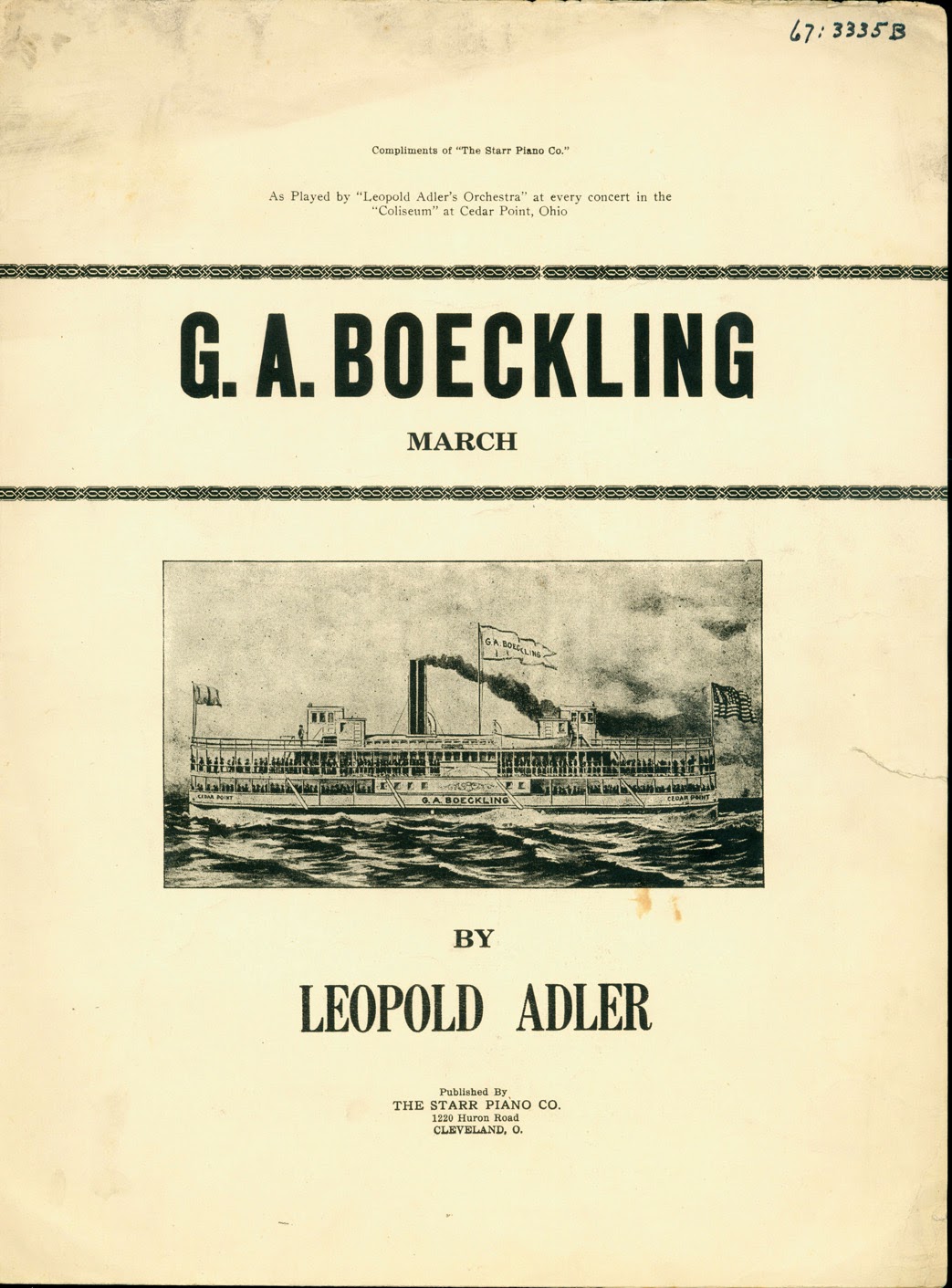
From 1914 to 1919, Leopold Adler was the popular director of the orchestra at Cedar Point. He conducted hundreds of concerts in the Coliseum.


 Leopold Adler composed the G.A. Boeckling March in 1916. The G.A. Boeckling March was played in the Coliseum at every concert directed by Leopold Adler.


During the Great Depression and World War Two, big bands performed in the Coliseum's Grand Ballroom. Bands included: Woody Herman, Blue Barron, Guy Lombardo, Benny Goodman, and Ozzie Nelson’s band.


Today several venues at Cedar Point offer live musical performances throughout the park's season. To read more about the history of Cedar Point, see the book Cedar Point: The Queen of American Watering Places, by David W. and Francis (Amusement Park Books, 1995), available at the Sandusky Library.

Monday, April 19, 2010

Charles Baetz, Bandmaster

Charles Baetz was born in Renghausen, Germany on November 27, 1836. A musician by training, he learned to play the violin, and later, the cornet. He came to the United States in 1854. According to the U.S. Civil War Soldiers database, Baetz was the principal musician for Company A of the 128th Ohio Volunteer Infantry during the Civil War. He directed the military band at the federal prison at Johnson’s Island during the Civil War.

In 1862, Charles Baetz married Mary Graul. They had a family of four children: Sophia, Eugene, Meta, and Gertrude. The first Mrs. Charles Baetz died in 1894. By 1900, Charles Baetz had remarried. The second Mrs. Charles Baetz was Dorothy Matern, the daughter of a local stove merchant. (Dorothy’s sister Emma Matern Weaver was a talented artist.)

When the Cedar Point Pleasure Resort Company was formed in 1887, the partnership consisted of Charles Baetz, Louis Adolph, Adam Stoll, Jacob Kuebeler and Benjamin Dwelle. The group chose Baetz to be the General Manager of Cedar Point for the 1888 season. Mr. Baetz continued to be connected with Cedar Point until 1897.
In 1867, Charles Baetz had founded the Great Western Band. The Great Western Band played for concerts and dances at Cedar Point. This band became well known, and won several competitions. Baetz had also been involved in the insurance business in Sandusky, and for a time was the manager of the Biemiller's Opera House.

Charles Baetz died in Battle Creek Michigan, on September 26, 1907. His funeral was held at the family residence on Washington Street. He was buried in Sandusky’s Oakland Cemetery. A lovely tribute to Mr. Baetz appeared in the October 11, 1907 issue of the Sandusky Star Journal. The article read in part, “A story of the life of Charles Baetz must necessarily embrace much of the history of band music and entertainment in Sandusky….”

To read more about the history of the Great Western Band and Cedar Point, check out the book Cedar Point: The Queen of American Watering Places, by David W. and Diane Demali Francis, available at the Sandusky Library.