Showing posts with label Ohio Veterans Home. Show all posts

Wednesday, December 28, 2022

Officers Row at the Ohio Soldiers and Sailors Home


Several houses on Dewitt Avenue in Sandusky were built as homes for officers of the Ohio Soldiers’ and Sailors’ Home, now known as the Ohio Veterans Home. The picture above was taken about 1910. The postcard below is dated 1920.

In the 1910 United States Census, three of the residents of Officers’ Row are enumerated at the top of the survey page:


William Burnett is listed with his wife Mary. William was the Commandant of the Ohio Soldiers’ and Sailors’ Home in 1910. He served with Company A, Fourth Battalion, Ohio Independent Cavalry during the Civil War, and once was the Mayor of Springfield, Ohio.

Nathan Holloway was the Quartermaster of the Ohio Soldiers’ and Sailor’s Home. He continued to live in Sandusky, Ohio after retirement, and died in 1928 at the age of 91.

Jonathan D. Wheeler achieved the rank of Captain in the Civil War. He was the Adjutant at the home in 1910. A mention of Mrs. Emma L. White visiting Captain J.D. Wheeler and his wife at their “cozy home” in Officers’ Row appeared in the Sandusky Register on July 12, 1907.


The homes built for Officers’ Row are now privately owned. To read more about the Ohio Soldiers’ and Sailors’ Home, see several posts at the Sandusky History website.

Tuesday, September 27, 2022

Visitors to the Ohio Soldiers’ and Sailors’ Home


Now the Ohio Veterans Home, the Ohio Soldiers’ and Sailors’ Home in Erie County, Ohio, was established in the late 1880s to provide homes for honorably discharged Veterans. Its earliest residents served in the Civil War. Through the years several notable persons have visited the home.

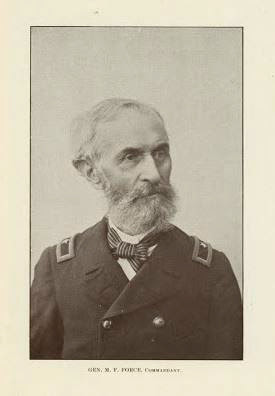
In 1890 and 1892, former President Rutherford B. Hayes visited Manning Force, the first Commandant of the Ohio Soldiers’ and Sailors’ Home.

R.B. Hayes and Manning F. Force were lifelong friends. Hayes and his wife  Lucy named their youngest son after him. Born in 1873, young Manning Force Hayes died as an infant in 1874.

In February 1894, William Henry Gibson, a former Civil War General, gave an address at the Ohio Soldiers’ and Sailors’ Home in commemoration of George Washington’s Birthday.

Known as the “Silver Tongued Orator,” General Gibson spoke about George Washington’s leadership, President Abraham Lincoln’s accomplishments, and he recalled several of his own experiences in the Civil War. The Sandusky Register of February 23, 1894 printed highlights of General Gibson’s speech.

In 1908 future president William Howard Taft visited Sandusky. He spent the night at the home of Edward H. Marsh, and visited the Ohio Soldiers’ and Sailors’ Home, where he gave a speech of a non-political nature.

In November of 1912,  the editor of the National Tribune, J.M. McElroy spoke at the Home. Between 500 and 600 veterans listened as McElroy encouraged all to vote for President Taft in the upcoming election. Of course, Woodrow Wilson went on to win the election for the presidency in 1912.

Happenings at the Home have been covered by the local newspapers for many years.  Below is a portion of the “Soldiers’ Home News” from the Sandusky Register of January 29, 1913.

Sunday, November 10, 2019

The Hospital at the Ohio Soldiers’ and Sailors’ Home


The postcard pictured above was created by the Alexander Manufacturing Company, and was taken of the hospital at the Ohio Soldiers’ and Sailors’ Home in 1918. Below is a view of the hospital in 1928, with a closer view and a slightly different angle.


The original hospital at the Ohio Soldiers’ and Sailors’ Home (now the Ohio Veterans Home) opened in January of 1899, with seven trained nurses employed to care for those veterans who needed in-hospital care. An annual report from the Home in 1902 gave this description of the hospital.


In the early 1950s, a new hospital opened at the Ohio Soldiers’ and Sailors’ Home. It was known as the John T. Haynes Memorial Hospital, named for the former chief surgeon of the Home, Dr. J.T. Haynes.


Fifty nursing home beds had become available at the Ohio Soldiers’ and Sailors’ Home in 1950. Today’s the nursing home facility at the Ohio Veteran Home has 427 beds in three separate units: the Giffin Wing, Secrest North and Secrest South. In continuous operation since it opened in 1888, over 50,000 honorably discharged veterans have been admitted to the Ohio Veterans Home in Erie County, Ohio. 

You can see some vintage pictures of the former Ohio Soldiers’ and Sailors’ Home at a previous blog post on Sandusky History.


Thursday, May 30, 2019

Group Photograph at the Ohio Soldiers’ and Sailors’ Home


Ernst Niebergall took this group picture at the Ohio Soldiers’ and Sailors’ Home in the late 1910s, possibly at a “Decoration Day” celebration.   Close up views of the photograph show details of the individuals in attendance. The tone was somber.


Some of the older people were seated during the event.


There were men and women of all ages in attendance.


The cemetery at the Ohio Soldiers’ and Sailors’ Home is visible in the background. Several American flags were flown at the cemetery behind the large gathering of people.


Now known as the Ohio Veterans Home, this facility was established in 1888 to care for Ohio soldiers and sailors who served in United States wars. The earliest residents of the home were Civil War veterans. Over 50,000 veterans have been served by the Ohio Veterans Home. 

Monday, May 27, 2019

Memorial Day Celebrations in Sandusky in 1923


There were three Memorial Day celebrations in Sandusky in the year 1923. The first one took place at the Ohio Soldiers’ and Sailors’ Home at 8:30 on Wednesday, May 30. At 10 a.m. a service was held on the deck of the steamer Chippewa. A third event began with members of patriotic organizations marching from the G.A.R. Hall to Oakland Cemetery. Commandant Perry Null of the Ohio Soldiers’ and Sailors’ Home led the parade. Other parade participants included the Camp Fire Girls, a drum and bugle corps, members of the American Legion, and a group of Civil War Veterans, who rode in automobiles.

    
The Sandusky High School Band also took part in the parade.  The band played the song “Our Heroes” as the parade grew closer to Oakland Cemetery, where  members of the G.A.R. and the Women’s Relief Corps had gathered.                                  
     

Commodore R.G. Denig spoke about a renewal of honor for the nation’s flag. Rev. Charles Huffer gave the benediction. Adjutant of the G.A.R. W.P. Thompson, read General John Logan’s Memorial Day proclamation. Mrs. Nina Goodwin Braby read the Gettysburg Address, just prior to the address given by Elyria Mayor A.E. Jones. Mayor Jones in his address, called for greater devotion to the laws of the country, a more universal observance of Memorial Day, and greater appreciation for those who made sacrifices in military service. A firing squad salute was given by members of the American Legion and the Ohio National Guard, and taps were played by bugler Harold Mertz to conclude the services. Below, a group is seen gathering to talk at the cemetery on Memorial Day. A large crowd is visible in the background.
You can read more about how Sandusky celebrated Memorial Day in 1923 in the Sandusky Register of May 31, 1923, now on microfilm at the Sandusky Library Archives Research Center.          

Sunday, May 27, 2018

The Former Library at the Ohio Soldiers’ and Sailors’ Home

                                     
Built shortly after the Ohio Soldiers’ and Sailors’ Home (now the Ohio Veterans Home) opened in 1888, this library building served the Home for many years. Residents of the Home could read books and magazines in the Library. A picture of the Library appeared in the book Art Work of Huron and Erie Counties in the 1890s.

    
A large assembly hall, often called “Library Hall” was on the upper level of the library, which was used for meetings and card parties. The McMeens Post No. 19, Grand Army of the Republic, an organization of Civil War Veterans, often held its meetings there.  During World War II, the U.S. Civil Air Patrol held drills in Library Hall. Sometimes church services were held in the building. 

This picture of the Library was taken in 1983.


A series of twenty photographs of the Library at the Ohio Soldiers’ and Sailors’ Home is found in the Prints and Photographs Collection of the Library of Congress Online Catalog. These views give a detailed view of each floor of the Library, as well as several exterior views. 

By 1988, this building was no longer used as a Library. It was demolished, along with several other buildings on the grounds of the Ohio Veterans Home, because it would have been too costly to make the improvements that would have been necessary were the buildings to remain in use.  Today a research library is housed in the Military Museum at the Ohio Veterans Home. The library is available for use by Ohio Veterans Home residents as well as the general public.  

Friday, December 01, 2017

A Look Back at Area Depots


Ernst Niebergall took this picture of the New York Central Depot in Sandusky in 1920. This depot still stands today, where it also serves as home to the Sandusky Transit System. 

From the late 1800s until 1938, a depot for the interurban lines was located at Ohio Soldiers’ and Sailors’ Home (now the Ohio Veterans Home.)

  
The Lake Shore and Michigan Southern railway built a small depot in Bay Bridge, Ohio in the 1870s. A telegraph office was also at this location for many years.

                                      
Greyhound’s bus depot was on Columbus Avenue in 1939, between Joe Weske’s barber shop and Weber’s men’s clothing store. Newspapers were also sold at the bus depot.


To view more vintage pictures of Sandusky and Erie County, visit the website of the Sandusky Library’s Past Perfect Local History Archives.

Friday, November 10, 2017

Ohio Veterans Home Death Records


Staff members of the Ohio Soldiers’ and Sailors’ Home, now the Ohio Veterans Home, are pictured above in 1915. Doors were first opened to the Home in Erie County, Ohio on November 19, 1888. 

The first person to be buried at the Ohio Soldiers’ and Sailors’ Home Cemetery was Levi Drummond, who died on January 3, 1889, at the age of 47. He had served in Company F of the 57th Ohio Infantry during the Civil War. As part of a Cemetery Census project undertaken in the 1980s, members of the Erie County Chapter of the Ohio Genealogical Society collected data from the Ohio Veterans Home. This resulted in a compilation of brief death records of hundreds of residents who died at the Home from January 3, 1889 through December 31, 1983. Many volunteer hours were devoted to getting this compilation completed.


The book is arranged alphabetically by surname. The five columns provide:
  • Name of the Veteran
  • Age at the time of death
  • Date of death
  • Place of burial
  • Registration number of the deceased while a resident at the Home
Over 7,000 death records were abstracted during the compilation of these records. 3,528 were buried at the cemetery on the grounds of the Ohio Veterans Home, and 393 were buried elsewhere in Erie County. The rest of the Veterans were buried outside of Erie County.  Below is the listing for William L. Carr.


William Louis Carr received the China Relief Expedition Congressional Medal of Honor while he was serving as a Corporal in the U.S. Marine Corps during the Boxer Rebellion. Corporal Carr died in April 1921. (Note: Corporal Carr’s tombstone reads April 14, but the death record lists his death date as April 4.)


James Jardine served in Company F, 53rd Ohio Infantry during the Civil War. He was awarded the Medal of Honor for gallant service at Vicksburg, Mississippi on May 22, 1863. First Lieutenant Jardine died on December 9, 1922.


If you have ancestors who resided at the Ohio Soldiers’ and Sailor’s Home, visit the Sandusky Library to learn a few more facts about your military ancestor in the Ohio Veterans Home Death Records publication.

Monday, October 17, 2016

The Barker Family Left Its Mark on Sandusky


If you have ever seen Barker School (now a Day Care Center) or driven down Barker Street on Sandusky’s west side, then you are familiar with the surname of a family whose many members  have made contributions to the development of the city of Sandusky. Zenas Ward Barker, who served in the War of 1812, moved his family from Buffalo, New York to Sandusky, Ohio in 1834. He was one of several individuals who helped organize Grace Episcopal Church in Sandusky in 1835. He was Erie County Clerk in 1838-1839. In the early 1840s, he was one of the directors of Sandusky’s public schools, and was Sandusky’s Mayor in 1846. This Zenas W. Barker died in Sandusky in 1879. His father, also named Zenas Ward Barker (1765-1834) was a pioneer settler of Buffalo, New York. One of the sons of Zenas W. Barker (1818-1879) also named Zenas W. Barker (1834-1861), became a First Sergeant in Company E of the Ohio 8th Volunteer Infantry. He lost his life during military service on August 28, 1861. 

Another son of Zenas Ward Barker, the former Sandusky Mayor, was Jacob A. Barker.


Jacob A. Barker began working at the Mad River and Lake Erie Railroad in 1846. He eventually became the freight agent for the railroad. From the early 1860s until he retired in 1891, he was the local agent for the United States Express Company. He was a member of the Sandusky City Council, the Board of Education of Sandusky City Schools, and he was a senior warden of Calvary Episcopal Church for several years. An article in volume 14 of the Firelands Pioneer said of him: “He was possessed of a generous, kind disposition and many instances of his generosity will be gratefully remembered by the recipients.” Jacob A. Barker died on December 22, 1898, and he was buried in the family lot at Oakland Cemetery. He was survived by his wife, the former Mary E. Paterson, and four sons. 

The son of Jacob A. and Mary Paterson Barker was George P. Barker:


He was born in Sandusky in May of 1852, and was associated with the United States Express Company in Sandusky for over forty years. From 1915 to 1929 Mr. Barker was storekeeper at the Ohio Soldiers’ and Sailors’ Home. During the Spanish American War, he rose to the rank of Major. He began with Company B of the Sixteenth Infantry, and mustered out with the Sixth Infantry. For four months Major Barker held the position of military governor of the district of Santa Clara in Cuba. On January 24, 1930 George P. Barker died as a result of heart disease. Funeral services for Major Barker were held on January 27 at Grace Episcopal Church, and burial was at Oakland Cemetery following a military salute at the gravesite. Many other members of the Barker family are also buried in the family lot in the North Ridge section of Oakland Cemetery.

Monday, July 11, 2016

Laying the Cornerstone for the Administration Building of the Ohio Soldiers’ and Sailors’ Home


The cornerstone for the administration building of the Ohio Soldiers’ and Sailors’ Home was set in place on July 11, 1888. Still in operation, this facility is now known as the Ohio Veterans Home. The officers of the McMeens Post, No. 19, Grand Army of the Republic, sent out invitations to fellow G.A.R. members for the special event.


 At 11:00 a.m. on July 11, 1888, members of several Ohio G.A.R.  posts met at the foot of Columbus Avenue, to be reviewed by Department Commander Joseph W. O’Neall. After the procession, all those in attendance took the train to the grounds of the future Soldiers’ and Sailors’ Home, in Perkins Township, just south of the city limits of Sandusky. The cornerstone laying ceremony began at 2 p.m. with music by the Great Western Band and the Aeolian Quartette. After a prayer, Commander O’Neall laid the cornerstone. Addresses were given by General W.H. Gibson, Ohio Governor J.G. Foraker, and other Ohio military leaders. Several musical selections concluded the cornerstone laying ceremony. 

A grand camp fire was held under the auspices of the McMeens Post of the G.A.R. at Cedar Point on the evening of July 11. The steamers Hayes and Ferris were chartered to take guests to Cedar Point, with a round trip fare of twenty cents. Former soldiers, families, friends, and interested citizens were invited to the camp fire. Among the featured speakers were: Governor Foraker, General Manning F. Force, Colonel John W. Chapin, General W.H. Gibson, C.J. Colgan, C.B. Dennis and General John C. Lee. General John Beatty spoke on “The Citizen Soldier, The Soldier Citizen.”


The event concluded with the playing of Auld Lang Syne by the Great Western Band. 

In 1908, William Howard Taft spoke in front of the Administration Building at the Ohio Soldiers’ and Sailors’ Home while campaigning for President.


 Here is a picture of the staff at the Ohio Soldiers’ and Sailors’ Home in 1915:


Today the Ohio Soldiers’ and Sailors’ Home is known as the Ohio Veterans Home, and the former administration building is now home to a museum which features historical photographs and artifacts from Ohio veterans which date back to the Civil War. 

Sunday, June 05, 2016

People Living in Non-Traditional Homes Described in U.S. Census Records


When searching for ancestors in United States Census records, you may find them residing in a location other than a traditional family home. Since 1888, many U.S. Veterans have made their home at the Ohio Soldiers’ and Sailors’ Home, now known as the Ohio Veterans Home. Below is a portion of the 1910 Census Page for this Home, in Perkins Township, Erie County, Ohio. In these listings, you find the person’s name, place of birth, and occupation, and information about where their parents were born.


For many years, the Children’s Home provided a home for children in Erie County whose parents could not adequately provide for them.


Census records enumerated in 1910, 1920, 1930 and 1940 list the residents of the Erie County Children’s Home on the day of the enumeration. Some of the residents of the Home are listed below in the 1920 U.S. Census. Listings include staff members, as well as the names of  the children for whom they cared.


In 1930, Sheriff John W. Taylor and his family lived at the Erie County Jail, which now is a part of the Sandusky Library. The Census shows John W. Parker, occupation Sheriff, along with his wife and three children. The names of the prisoners residing at the Erie County Jail at the time of the 1930 Census enumeration are provided on the next page.


Other types of facilities that included in the U.S. Census are hospitals, mental institutions, boarding schools, county homes, convents and monasteries, just to name a few. Don’t give up on finding your ancestor in the Census, if they do not turn where you expect to find them. In nineteenth century census records, teenagers and young adults often worked as farm hands or domestic employees, and were enumerated with the families who provided them with a home.

Tuesday, March 15, 2016

Caroline Cady, Christian Worker


This obituary of Mrs. Caroline Cady appeared in the Sandusky Register on April 25, 1905. A transcription of her obituary reads:

Mrs. Caroline Cady
Mrs. Caroline Cady entered into rest at her home, 115 Bell Street Monday morning, April 24th at 5 o’clock, aged 77 years and 8 months, after an illness of several weeks. Only for one week was she thought to be critically ill, pneumonia having developed.
In the death of Mrs. Cady Sandusky has lost one of its pioneer Christian workers. For 25 years past she has proclaimed the gospel of Christ to the prisoners at the jail, police station and hospital at the Soldiers’ home, distributing hundreds of Bibles in which she had marked God’s loving promises to those that see Him, and has seen many give up their ways of sin for a holy and happy life. She has rendered assistance to many, given wise counsel and encouragement. Homes have been made happy in times of sorrow and need. Always remembering the words of our Lord: “Inasmuch as ye have done it unto one of the least of these, ye have done it unto me.” About two years ago she lost her sight but still worked the Master, sending out God’s word in leaflets, well knowing it would not return unto Him void but accomplish that whereunto it was sent. The end of her life was like an ideal setting of the sun to rise again in a perfect day. She realized and said underneath her were the everlasting arms. “On Christ the solid rock I stand. All other ground is sinking sand.”
She leaves three daughters, Mrs. Lewis Lea, Mrs. W.G. Myers and Mrs. Minnie Kelley; one sister, Mrs. Josephine J. Couch, and three brothers, J.W. Jennings of New York, J.T. Jennings of Seattle, Wash., and H.C. Jennings of Fostoria.
The funeral services will be held at her home, 115 Bell Street, Wednesday at 2 p.m. Burial private.
Dearest mother, thou has left us.
Here they loss we deeply feel.
But ‘tis God that has bereft us,
He can all our sorrows heal.

Caroline Cady was the daughter of Mr. and Mrs. Hector Jennings, and the widow of William Cady, a Civil War Veteran. In her younger days she operated a millinery shop in downtown Sandusky. 

Obituaries in newspapers in the late nineteenth century and the early twentieth century were filled with descriptive language, and pointed out the character of the deceased. They were generally written by someone who had known the deceased well, and often included Bible verses and poems. Below is a postcard of the old hospital on the grounds of the Ohio Soldiers’ and Sailors’ Home (now the Ohio Veterans Home) where Mrs. Cady frequently paid visits to provide counsel and encouragement to the patients.