Showing posts with label Hubbard. Show all posts

Sunday, August 01, 2021

Rollin B. Hubbard, Pioneer Citizen of Sandusky


Rollin B. Hubbard was a pioneer in the lumber industry in both Ohio and Michigan. He was born in Connecticut in 1817 to John Mills Hubbard, and his wife, the former Mabel Barnard. As a young man, Rollin made his way from Connecticut to Ohio, and he settled in Sandusky. 

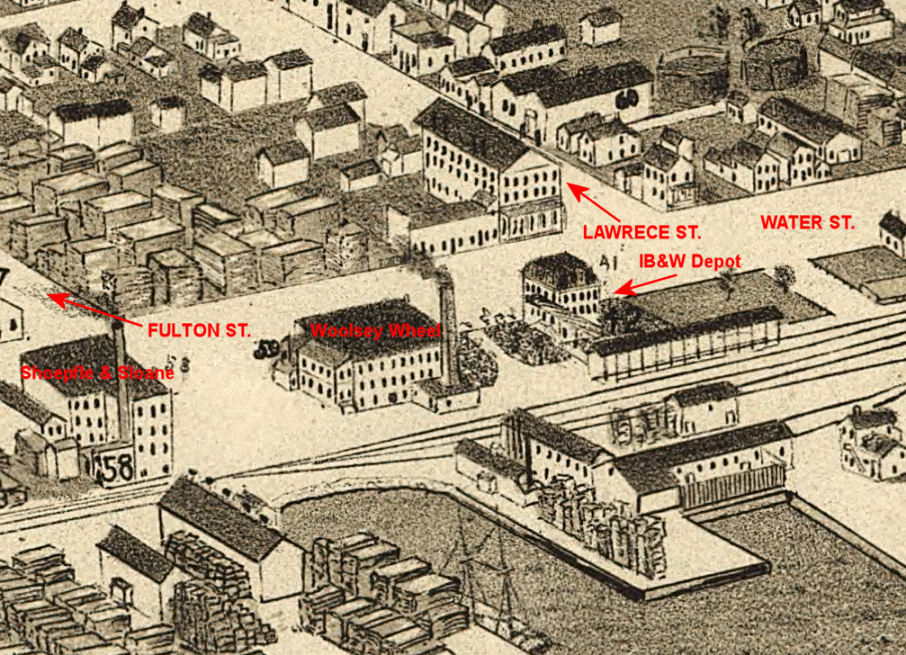
In the 1840s, he purchased timber land in what is now Sanilac County, Michigan. He operated saw mills in Michigan. Later he went into business with his cousins Langdon Hubbard and Watson Hubbard. They operated R.B. Hubbard and Company, a large lumber business on the waterfront in Sandusky, Ohio. By 1886, the company had become known as R.B. Hubbard and Son. The 1886 Sanborn Map shows the lumber yard south of Water Street, between Lawrence and Fulton Streets, and the planing mill was located on the north side of Water Street.


R.B. Hubbard once served as president of the Second National Bank, and he served for several years on the Board of Education. Mr. Hubbard was very active in Grace Episcopal Church, where he served as a vestryman. Mr. Hubbard’s first wife was Anne Massey, who died in 1871; he married Dorothea Hoffman in 1881. 

Rollin B. Hubbard died on May 18, 1904, after a lengthy illness. An obituary for R.B. Hubbard, which appeared in the May 19, 1904 issue of the Sandusky Register, read in part, “A man of fine presence and bearing; a gentleman of the old school in all that means in high character and intelligence; wise in counsel, charitable in judgment; closely identified through a long and successful career with the commercial and educational interests of Sandusky, Rollin B. Hubbard has left his impress on this community and it is an impress for good.” You can read much more about the history of the Hubbard family in the book One Thousand Years of Hubbard History, compiled by Edward Warren Day (Harlan Page Hubbard, 1895) available at the Internet Archive.


R.B. Hubbard was buried next to his first wife in the Hubbard family lot at Oakland Cemetery.

Saturday, May 29, 2021

Dramatic Entertainment, May 29, 1874

On May 29, 1874, a program of Dramatic Entertainment was given at the Sandusky High School, now known as Adams Junior High School in Sandusky. It was considered “A Very Serious Drama in Two Acts.” The first act was “Among the Breakers,” and the second act was “The Day After the Wedding.”

An article in the May 29, 1874 issue of the Sandusky Register reported that the dramatic entertainment was put on by the Sandusky Dramatic Association, and was a most enjoyable affair. Many familiar names were part of the cast. George P. Barker, cast in the leading role, was later a Major during the Spanish American War. Oran Follett Foster, who portrayed Larry Divine, was the grandson of Oran Follett, a well known publisher. Jessie and Allie Stem were the daughters of former Indian agent Jesse Stem, who was killed in Texas in 1854 when his wagon was ambushed. Miss Emma Marsh later married C. Webb Sadler, and they were the parents of C. Webb Sadler, Jr., once the City Manager of Sandusky, Ohio. Charles Livingston Hubbard married Jennie M. West, the daughter of early Sandusky businessman William T. West.

Major George P. Barker, during the war with Spain

Visit the Sandusky Library Archives Research Center to view this program, and many other primary sources from Sandusky and Erie County, Ohio.

Friday, October 09, 2020

West Water Street Businesses from Behind in 1926


Sandusky photographer Ernst Niebergall took this picture of the rear side of the buildings along West Water Street between Columbus Avenue and Jackson Street about 1926. Today we know this area as the newly renovated Shoreline Drive. The first building on the eastern part of this block is known as Hubbard’s Block, at what is now 101 West Water Street. The building was originally owned by Sandusky businessman Lester Hubbard, and designed by Sheldon Smith, was built in the Romanesque Revival style of architecture. Hubbard’s Block was home to the Cosmopolitan Art and Literary Association in the 1850s. Moving down the street, next is the Stiles E. Hubbard building at 115 West Water Street, which had as its first tenants a grocery and dry goods store, and Austin Ferry’s hat shop. In 1926 George M. Rinkleff had a hardware store at 121 West Water Street. This advertisement shows us some of the items that were carried by the Rinkleff Hardware store in the 1910s, a few years before Mr. Niebergall took the picture of the block.


Known as the Lawrence Cable building, the structure at 121 West Water Street was built in 1868. Samuel Love had a men’s clothing store at 201 West Water Street in the mid-1920s. Charles R. Carroll ran a transfer business and a second hand store at 211 West Water Street. Many of the vintage trucks parked on the street were probably used to transport goods to local residents by employees of Mr. Carroll’s transfer business.


Chicken dinners were served at a restaurant to the west of Mr. Carroll’s business. At the corner of West Water Street and Jackson Street is the Freeland T. Barney building, which was built about 1870 and renovated in 1892. Most of the buildings that are pictured had businesses on the street level and apartments on the upper floors. You can read more historical details about the commercial property on West Water Street in Ellie Damm’s book, Treasure by the Bay. Pages 53 to 58 are devoted to the architectural background of these historic buildings.

Saturday, November 03, 2018

Election of November 3, 1891


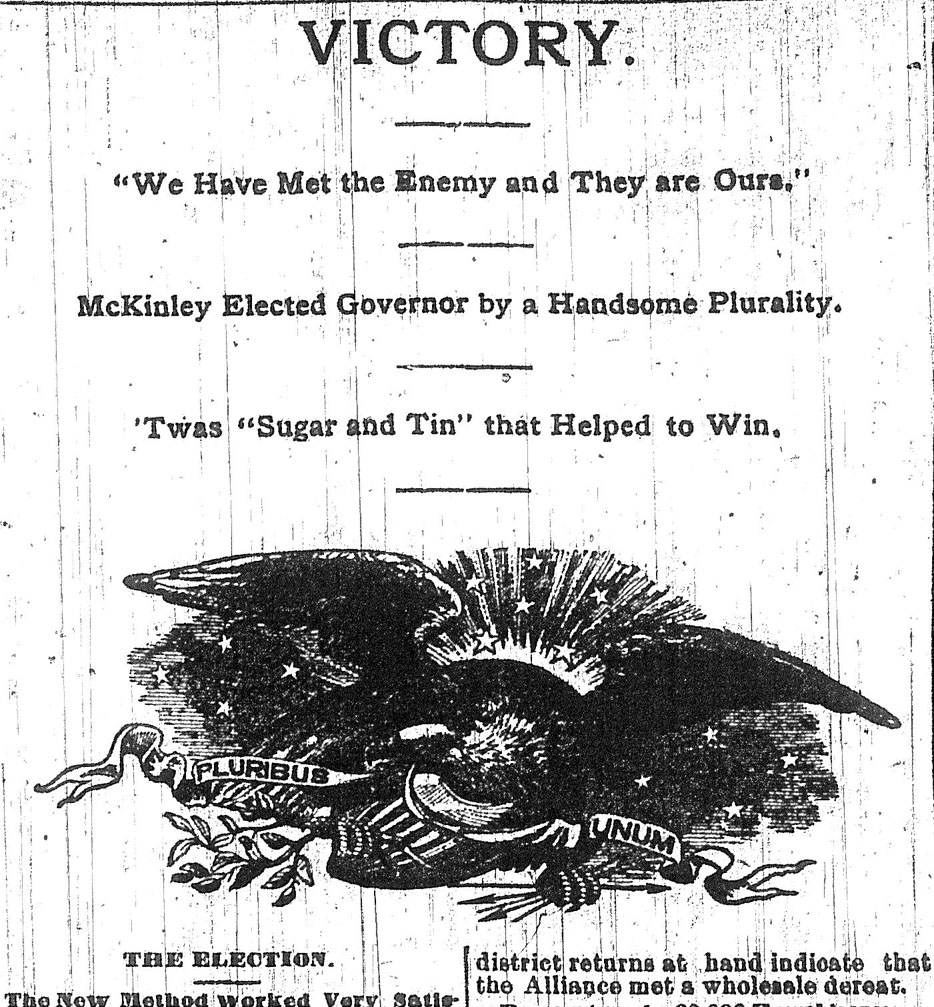
On October 12, 1891, Erie County Sheriff Christian Wiedel posted a proclamation which notified area residents that the November election of 1891 was to be held on November 3, 1891. The Sandusky Register of November 4, 1891 listed a tabulation of election results.


Governor McKinley won “by a handsome plurality.” Of course he would later win the Presidential election, and he served as U.S. President from March of 1897 until he was assassinated in 1901.


A local election winner was Dr. B.R. Hubbard, who was chosen to serve as the Erie County Coroner:


You can read much more about Erie County’s elected officials in the book Elected to Serve: Erie County, Ohio, 1838-2003, by Patty Dahm Pascoe, available in the library's Genealogy collections.

Tuesday, September 11, 2018

Servants' Call Box from the Lester S. Hubbard Home


A descendant of the Hubbard family, Dorothy Denig Shaw Speir, donated this servants’ call box, which was once in use at the home of Mr. and Mrs. Lester S. Hubbard at 134 East Adams Street, to the Follett House Museum.

       
In this close up view, you can see the listings of the various rooms from which the family members could call on the household servants.


We can learn the names of some of the individuals who may have answered these call bells from the U.S. Census. In 1860, the names of the domestic servants residing at the Hubbard home were: Ann Maloy and Margaret Cavanagh, who were both natives of Ireland, and Susan Bass who had come to Ohio from New Jersey. In the 1870 U.S. Census, the names of the servants working at the Hubbard home included: Authy Harlb, from Germany, Minnie Schwine, from Ohio, and Ann Cora from Ireland. 

Mrs. L.S. Hubbard was the lady of the house in 1860 and 1870:

   
After the death of Mr. and Mrs. L.S. Hubbard, other members of the family lived in the Hubbard home. In 1920, their daughter Jeannie L.H. Denig lived there with her husband Robert. At this time there were no servants listed in the U.S. Census records.

Jean Livingston Hubbard Denig
   
While most of us have probably never had the opportunity to use a servants’ call bell, it was not unusual for prominent families who employed household servants to have such an item in their homes.

Monday, May 21, 2018

Our American Cousin Played in Sandusky


On May 19, 1875, the play Our American Cousin was presented at the Sandusky Opera House in Sandusky by the Sandusky Amateur Dramatic Association. Admission to the play was fifty cents, and proceeds were donated to the Young Men’s Christian Association. Of course Our American Cousin is best known as being the play that President and Mrs. Lincoln were watching on the evening of  the President’s assassination at Ford’s Theatre on April 16, 1865. 

In 1875 the building known as the Sandusky Opera House was Norman Hall, on the north side of Water Street between Jackson and Decatur.


The building later known as the Sandusky Opera House, the Biemiller Opera House, was not built until 1877. 

Ulysses T. Curran, superintendent of Sandusky Schools, played the part of Lord Dundreary.


Two of the local play’s performers, Miss Jennie M. West and Mr. C.L. Hubbard, would marry in 1877. 

A brief article which appeared in the May 20, 1875 issue of the Sandusky Register reported that, “The play was received in the best possible manner, and that it deserved such a reception will not be gainsaid by anyone who saw it. The members of the Sandusky Amateur Dramatic Association deserve the highest praise for their faultless interpretation of the many difficult characters in the piece.”

Sunday, December 31, 2017

Harrison Ball, 1840


An invitation to the Harrison Ball of 1840 is on file at the Archives Research Center of the Sandusky Library. The ball was to be held at H. Victor’s Assembly Room on Thursday, December 31 at 5 p.m. This New Year's Eve festivity was in honor of William Henry Harrison, a fellow Ohioan, elected President earlier that year.

The managers of the ball were:

Maj. John G. Camp                 Henry D. Ward
Dr. Daniel Tilden                    Ebenezer B. Sadler
Oran Follett                             Charles Barney
Josiah W. Hollister                  Wm. Durbin, Jr.
Freeland T. Barney                 John M. Boalt
Sidney S. Hosmer                   Jno. G. Poole
Marshall Burton                      Lester S. Hubbard
Henry P Radcliff                    Theodore Hosmer
Davis Miller                            Alex. A. Camp
Dewitt C. Henderson              Jno. G. Camp, Jr.
Wm. A. Simpson                     Joseph B. Higbee

The list of names of people serving as managers of the Harrison Ball reads like a “Who’s Who” of early Sandusky. Major John G. Camp, Sr. fought in the War of 1812, and was active in the early years of Sandusky. Helen Hansen wrote in her book At Home in Early Sandusky, that Major Camp, along with Isaac Mills, Thomas Neill, and William Reese, laid out the addition known as “Southwark,” which was south of Monroe Street and west of Sycamore Line. John G. Camp, Jr. was an attorney in Sandusky, and he devoted a great deal of time negotiating plans for early railroad transportation in Ohio.

Dr. Daniel Tilden was a local physician who also was involved in the Underground Railroad:


Sidney S. Hosmer was an early Sandusky merchant, while his son Theodore Hosmer went west and became the first mayor of Tacoma Washington. 

Oran Follett was a prominent publisher in New York and Ohio, and his former home is now The Follett House Museum:


Ebenezer B. Sadler was a well liked early judge in Erie County:


Lester S.  Hubbard was a banker and prosperous businessman in Sandusky. Henry Clay Victor, whose Assembly Room was the location of the ball, was the father of Orville James Victor, author and editor.


To learn more about these and many other early residents of Sandusky and Erie County, visit the Archives Research Center. Here you will find county histories, historical journal and newspaper articles, and finding aids to the many archival resources available at the Sandusky Library.

Tuesday, August 29, 2017

Charles Livingston Hubbard, Yale 1873


This tintype portrait of Charles Livingston Hubbard was taken when he was a young man. Charles was born in 1851 to Lester S. Hubbard and his wife, the former Jane Patterson Livingston. When Charles was still an infant, his family moved into an impressive large home at the southwest corner of Wayne and Adams Streets, which still stands today.


Charles was educated at Kenyon College and Yale College, graduating from Yale in 1873. After being associated with an iron manufacturing plant in Chicago for a brief time, he returned to his hometown of Sandusky to practice law. In 1876 he lived with his mother, who was by then a widow, in his childhood home. His law office was in the Hubbard Block. You can see the Law Office sign in this stereographic image, taken at Sandusky’s Centennial Fourth of July Celebration in 1876.


When Charles L. Hubbard married Jennie West in 1877, it was reported as “grandest wedding of the season” in the October 20, 1877 issue of the Sandusky Register. Both the bride and groom were the children of pioneer residents of Sandusky. The marriage produced four daughters: Eleanor (who died in early childhood), Millicent, Marion, and Jenna. 

Charles Livingston Hubbard died unexpectedly after suffering a stroke on May 20, 1904. He was only 53 at the time of his sudden death. The Sandusky Register of June 2, 1904, published a lengthy memorial article which featured numerous tributes from members of the Erie County Bar. A Resolution read, in part:

 Resolved, that in the death of Charles Livingston Hubbard, late a member of this Bar, having assembled at the court house to express in some manner their sorrow at his death and their appreciation of him as a man and a lawyer duly adopt the following resolutions:
Resolved, that in the death of Charles Livingston Hubbard the community has lost a valuable and high minded citizen who has for years been identified with the best interests of this city in which he was brought up.

The Resolutions continued, and pointed out that Mr. Hubbard was an avid reader, an agreeable companion, and a friend to many. C.W. Sadler noted that he was “pure in word and deed.” Several other local attorneys offered high praise of  the deceased, and noted that he had helped tutor high school students in Latin, Greek and mathematics. 

Mr. Hubbard was buried in the family plot at Oakland Cemetery. Though Charles L. Hubbard died as a relatively young man, his wife Jennie lived to be 103 years of age. Daughters Marion and Jennie lived until their nineties. 

Wednesday, August 02, 2017

Watson Hubbard, Sandusky Businessman


Watson Hubbard was born in Bloomfield, Connecticut on July 11, 1819. He married Georgiana A. Holcomb in 1845. Mr. and Mrs. Watson Hubbard, along with Watson’s brother Langdon, moved to Lexington, Michigan in 1848, where the brothers began work in the lumber business. The lumber business they founded developed into the firm of R.B. Hubbard and Company. 

Watson Hubbard moved to Sandusky, Ohio in 1860, where he lived with his family in the West House for eight years. He had a house built at the northwest corner of Wayne and Jefferson Streets, just down the block from the home of his cousin, Lester S.Hubbard. Watson Hubbard served as Director and Vice President of the Second National Bank, and he was on the Board of Directors of the Sandusky Plow Company and the Nes Silicon Steel Works. He was among the earliest contributors to Good Samaritan Hospital. 

Watson and Georgiana Hubbard had three children, but only one survived to adulthood, Elizabeth Hubbard. Elizabeth married Jay Caldwell Butler, a Civil War Veteran who ran a business in Sandusky that manufactured sashes, doors, blinds and other wooden items. Pictured below are the daughter and granddaughter of Mr. and Mrs. Watson Hubbard, Mrs. Elizabeth Hubbard Butler and Mrs. Elizabeth Butler Harten.


In 1955, the former home of Watson Hubbard and his descendants, at 429 Wayne Street, was razed, to make room for an office for the telephone company. Before the house was razed, a neighbor, Mary Dauch, made this sketch of the home at 429 Wayne Street.


To read a biographical sketch about Watson Hubbard, written by his daughter Elizabeth, see the April 1925 issue of the FirelandsPioneer.

Tuesday, April 04, 2017

George W. Campbell and His Letter to Mrs. Hubbard


George W. Campbell was born in the state of New York to David and Mary Jones Todd Campbell on January 12, 1817. In the early 1820s he moved with his parents to Sandusky, Ohio, where his father published the Sandusky Clarion. The Clarion was the first newspaper published in the Firelands area, and was the predecessor of the Sandusky Register. Mr. Campbell worked with his father in the publishing business in Sandusky, until he relocated to Delaware, Ohio in 1849. In Delaware, he worked in the mercantile business. Later he devoted his pursuits to the propagation of a wide variety of fruits, and he became well known as a horticulturist. Mr. Campbell was best known for his promotion of the Delaware grape. The popular Delaware grape was known for its hardiness, productivity, and unsurpassed flavor and quality. 

George W. Campbell died on July 15, 1898 and was buried at Oak Grove Cemetery in Delaware County, Ohio. He was survived by his widow, the former Elizabeth Little. He had been president of the Ohio Horticultural Society and was appointed by President Rutherford B. Hayes as United States Commissioner to the Paris Exposition of 1878.  In 2002 an Ohio historic marker was dedicated at the former Campbell home, now the Delaware County Cultural Arts Center.


A letter from George W. Campbell to Mrs. Jennie West Hubbard is housed at the Sandusky Library Archives Research Center. Mrs. Hubbard was working on a project to collect biographical information about women who resided in the Western Reserve before 1850. She was hoping that her relative, Mr. Campbell, could tell her some of the birth and death dates of their mutual female relatives. It turns out that he did not recall the dates exactly, but he did remember with fondness the work that several Sandusky ladies did when creating a banner for the visit of William Henry Harrison to Sandusky. The letter and transcription are below.


Delaware, O., June 3, 1896
My dear Jennie:
            I am really ashamed of myself for allowing your letter of last March to remain so long unanswered, asking for information about the pioneer women of the Western Reserve; and I now regret that I am unable to give you so little of interest. I have somewhere, a book of records of my father’s family; but it has been mislaid, and I have been unable to find it; but I am not certain that it contains much. I have filled out the blank record of names you sent me, as far as I can. I have not the date of Aunt Eleanor’s birth or death – but I think they are recorded on her headstone in the cemetery of Sandusky. Of Wealthy’s record, I have only the state of her marriage to brother Henry.
            As to that flag, I am sorry my memory is so indistinct. I feel certain that Aunt Eleanor did work on a flag, and I think I saw the design; but cannot recall much about it. I was under the impression that it was modeled in whole or in part from the inclosed picture which I drew for the heading of a little campaign paper printed in the days of “Tippecanoe and Tyler too,” and had engraved at Buffalo by Mr. J.W. Orr. If you find the design on the flag is the same, or substantially so, you may be pretty sure that it is the same upon which Aunt Eleanor and other ladies worked. When I come to Sandusky, as I hope to do sometime this season I will investigate it and I think the sight of the flag will enable me to mark the names on the printed list which enclose also. When I am in Sandusky, perhaps I may be able to give you some items of interest with your assistance in prompting me as to what you would like to have.
            We are in health about as usual. Weather has been pleasant generally, with play of rain and sunshine; and lately cool, but without frost. Everything sure now must propicous for a fruitful answer, if we are not visited by storms or hail or cyclones. I sincerely hope you and your family and all the connections are well and happy, and that you and your mother – my sweet little Auntie had a delightful visit at Cincinnati. With kindred love from both, at this end of the line. I am affectionately and truly yours.
                                                            George W. Campbell

Friday, March 25, 2016

Mrs. Charles Livingston Hubbard, Nee Jennie Matilda West


Mrs. Charles Livingston Hubbard was born Jennie Matilda West in 1855, to Sandusky businessman WilliamT. West and his wife, the former Lydia Mahala Todd. When Jennie married Charles Livingston Hubbard in 1877, it was reported as “grandest wedding of the season” in the October 20, 1877 issue of the Sandusky Register.


C.L. Hubbard’s were Mr. and Mrs. Lester S. Hubbard. L.S. Hubbard was a prominent Sandusky banker. Rev. A.B. Nicholas officiated at the Hubbard-West wedding, which took place at the home of Mr. and Mrs. W.T. West at the southwest corner of East Washington and Warren Streets on October 18, 1877. The Register article stated that relatives and friends of the couple came from various parts of the United States. The bride wore a dress which was made of taille and satin, ornamented with rushes of silk illusion and scarves of satin. The dress was adorned with garlands of lilies of the valley and orange blossoms, and featured a long duchess train that was “a marvel of grace and elegance.” Jennie West’s bridal costume and trousseau had been purchased from Lord & Taylor of New York City. The West House was trimmed with evergreens, ferns, and beautiful flowers and lace, along with an arch and wedding bell. The refreshments “surpassed in elegance anything ever before given in this city.”  Two large bride’s and groom’s cakes were accompanied by all the delicacies of the season.  A long list of wedding gifts appeared in the Sandusky Register, including items of cut glass and silver, golden candlesticks, a marble mantle clock, several vases, and lovely art pieces.

Charles Livingston Hubbard worked as an attorney in Sandusky for many years. He and Jennie had four daughters, one of whom died in childhood. C.L. Hubbard died in May of 1904 when he was age 53. He was buried in the Hubbard family lot at Oakland Cemetery.  In 1935 Mrs. Jennie West Hubbard moved to Carmel, New York, where she lived until the age of 103. Mrs. Hubbard died there on December 31, 1958 and she was buried in the West family lot at Oakland Cemetery. Her obituary, which appeared in the January 1, 1959 issue of the Putnam County Courier stated that on her father’s side, Mrs. Jennie West Hubbard was descended from Sir Thomas West, Baron de Lawarr, who was once the Governor of the Virginia colonies, and for whom the state of Delaware derived its name. 

Mrs. Jennie West Hubbard is the third individual from the left, in the row of ladies seated in the front row in the picture below.


To read more about the Hubbard and West families in Sandusky, see the book At Home in Early Sandusky, available at the Sandusky Library.

Friday, November 11, 2011

A Military Family: Commodore Robert Gracey Denig and Jean Livingston Hubbard Denig

Robert Gracey Denig was born in Columbus, Ohio on May 22, 1851. After high school, he attended and graduated from the United States Naval Academy at Annapolis, Maryland. Robert Gracey Denig had a long and distinguished naval career which spanned thirty five years. During the Panama Revolution, Denig served on three different vessels, the Saranac, Tuscarora, and Benicia. Before that, when the U.S.S. Huron was wrecked off the coast of North Carolina on November 24, 1877, Denig was one of the few survivors.

Robert Gracey Denig's wife was the former Jane Livingston Hubbard, whom he married in 1878. Jane was the daughter of Lester Hubbard and Jane Livingston, prominent pioneer residents of Sandusky.

Mr. and Mrs. Denig had two children, a daughter Garcia, and a son named Robert L. Denig. Commodore Robert Gracey Denig retired from the Navy on June 30, 1908. He died on April 9, 1924, and he was buried with full military honors in the Arlington National Cemetery, Washington. D. C. Mrs. Denig died in 1945 in the same home in which she was born, at 134 East Adams Street in Sandusky.

Commodore Denig’s son, Robert L. Denig, who was born in 1884, became a Brigadier General with the United States Marine Corps. He served with the Fifth Marines, 3rd and 2nd Divisions in the American Expeditionary Forces in World War One and in Nicaragua in 1930-1931.

Brigadier General Robert L. Denig was the first Director of Public Relations for the U.S. Marines in 1941. The September 2007 issue of the Leatherneck magazine features an article about “Denig’s Demons.” Robert L. Denig recruited hundreds of reporters, photographers, artists, and radio men to inform the American public about the role of the Marines during World War II. Brigadier General Robert L. Denig passed away in 1979.

Several members of the Denig family are buried at Arlington National Cemetery, including Commodore Robert Gracey Denig and his wife Jean; their son Brigadier General Robert L. Denig, his wife Maud, and their sons Charles Alfred Ely Denig and Robert L. Denig, Jr.

Another son of Brigadier General Robert L. Denig, a Marine tank officer named James L. Denig, lost his life during World War II.

To learn more details about the military careers of Commodore Robert Gracey Denig and Brigadier General Robert L. Denig, see volume IV of History of Ohio, by Charles B. Galbreath, available in the section of genealogical books at the Sandusky Library. (Page 301-303 are devoted to the Denigs.) See Article 2 in Helen Hanson’s book At Home in Early Sandusky, for more information about the Hubbard and Denig families and their Sandusky home at the corner of Adams and Wayne Streets.

Wednesday, August 18, 2010

Sandusky Coal Company

In the early 1890’s, the Sandusky Coal Company had its offices at R. B. Hubbard & Son. Mr. Rollin B. Hubbard and his son were wholesale lumber dealers, located at 903 Water Street in downtown Sandusky.

The 1890 Sandusky City Directory lists R. B. Hubbard as president of The Sandusky Coal Company, as well as the proprietor of R. B. Hubbard & Son. Rollin’s son, Shannon B. Hubbard was the treasurer and manager of The Sandusky Coal Company.
An article that appeared in the November 21, 1889 issue of the Sandusky Register reported that Jackson Hill coal was being transported by barge from Sandusky to Port Huron, Michigan, for the Sandusky Coal Company. The “Big Four” railway transported Jackson Hill Coal from southern Ohio to the railway derricks in Sandusky. Jackson Hill Coal was considered one of the best domestic and steam coals mined in the state of Ohio.

At some point in time the Sandusky Coal Company was called the Hubbard Coal Company. The ruler below advertised that Jackson Coal was the "Best Steam Coal Mined."
Besides running the lumber business, Rollin B. Hubbard was also associated with the Second National Bank in Sandusky. His son S.B. Hubbard died at the age of 37, in 1894.

Tuesday, April 13, 2010

Lake Erie Sanitarium in Sandusky

Dr. Burnett Roswell Hubbard was the son of Emmett and Delight Hubbard, born in the state of New York about 1853. On February 12 and 13, 1896, an advertisement for Dr. B. Roswell Hubbard’s “Lake Erie Sanitarium” appeared in a program for a charity opera, “Egypta” that was featured at the Nielsen Opera House in Sandusky. Dr. B. Roswell Hubbard was a physician educated in the field of eclectic medicine, a field of medicine popular for its botanical remedies and use of physical therapy. The Lake Erie Sanitarium, located at 927 West Washington Street, claimed to be “New and complete in all its departments,” and offered patients treatment for medical and surgical cases and provided therapeutic baths of all kinds. The building was complete with heat, an electric bell system, and an elevator.

While living in Sandusky, Dr. B. Roswell Hubbard wrote a paper on “Modern Gynecology” for the Transactions of the National Eclectic Medical Association of the U.S.A., For the Years 1896-1897. By 1913, Dr. Hubbard had moved to California, where he was a professor of surgery at the California Medical College of Los Angeles. In 1911, he authored a book entitled Hubbard's Practical Surgery.

Dr. B. Roswell Hubbard had a brother who also was a physician. Dr. Rockwell B. Hubbard started his medical practice in Sandusky in 1896, and he continued in that practice for more than fifty years. Dr. Rockwell B. Hubbard’s office was in the Graham building for many years, and later he moved to an office on Hancock Street. Dr. R. B. Hubbard was listed as the surgeon for the Big Four Railroad in the 1912 Sandusky City Directory. It is quite easy to confuse the two brothers, as they often went by their initials, Dr. B. R. Hubbard and Dr. R.B. Hubbard.

See Supplement Number 16 in Helen Hansen’s book At Home in Early Sandusky to read more about the building located at what is now 609 West Washington Street in Sandusky. Prior to the Dr. B. Roswell Hubbard’s sanitarium, Dr. Edwin Gillard also had a sanitarium at this location. After Dr. B. Roswell Hubbard moved to California, a boarding house was in operation at the site of the former sanitarium.

Saturday, March 06, 2010

The Lester S. Hubbard House

Sandusky businessman and banker Lester S. Hubbard built the lovely stone house at the southwest corner of Wayne and Adams Streets in 1852. Helen Hansen wrote in At Home in Early Sandusky that the house was originally on an L-shaped lot, and a large barn and barnyard were located at the rear of the lot. Lester S. Hubbard and his wife, the former Jane Patterson Livingston, had a family of ten children.

A Hubbard descendant, Mrs. Garcia Denig Shaw, wrote in 1958 that six generations of the Hubbard family had lived in the Hubbard house, as the home had remained in the family for almost one hundred years. After the death of Jean Hubbard Denig, the home was purchased by Dr. V.A. Killoran a Sandusky physician who lived next door to the Hubbard house. Mrs. Hansen noted in her book that though Dr. Killoran converted the home into apartments and offices, he “preserved the original charm of its outward appearance.”

Here are two interior views of the Hubbard house, taken in the latter part of the nineteenth century.

The Hubbard house has been named to the List of Registered Historic Places in Ohio. In the biographical files of the Sandusky Library Archives Research Center is a letter by Mrs. Lester Hubbard in which she describes the death and funeral of her husband’s business partner, William Durbin. Mr. Durbin died on May 21, 1863, though he had the “untiring attention of devoted friends.” His coffin was taken to the library of Hubbard house, and it remained there the entire weekend. The funeral for William Durbin was held at the Hubbard residence on Sunday morning, May 24, 1863. Several members of the extended Durbin family stayed with the Hubbard family for several days at the time of Mr. Durbin’s death.

See Ellie Damm’s book Treasure by the Bay to learn more about the architectural history of the Hubbard house. Helen Hansen’s At Home in Early Sandusky features several articles about the Hubbard family and many other early residents of the city of Sandusky.

Wednesday, June 03, 2009

The Woolsey Wheel Company

The Woolsey Wheel Company was located for many years at the northwest corner of Water and Fulton Streets. Harlan Hatcher wrote in his book The Western Reserve, that Sandusky wheel factories “turned out more carriage and wagon wheels” than the factories of any other town in the Western Reserve. In the 1850’s, the business began as Pierce, Woolsey & Co. The company manufactured components for wagon and carriage wheels. In the 1860’s, Charles and Rollin Hubbard joined the firm and it was then known as Hubbards and Woolsey.

In 1875, when Fred Woolsey, son of Johnston V. Woolsey, joined the company, the named changed to J. V. Woolsey & Son. Later the business name was changed to the Woolsey Wheel Company, and even later, the business was known as the Woolsey Spoke and Wheel Co. Eventually the business moved to the foot of First Street. The company ceased operations after a fire in 1905.

J.V. Woolsey was listed as the president of the J. W. Woolsey Wheel Company in the 1882-1883 Sandusky City Directory. He was born in New York State, and moved to Sandusky about 1851. J. V. Woolsey died in 1893. He is buried with his wife Ann in Sandusky’s Oakland Cemetery.
J. V. Woolsey filed for several patents. Patent Number 156449, for An Improvement in Wheels for Vehicles, was filed on May 16, 1874. A search for Woolsey and Sandusky in Google Patents will result in several patent applications filed by J. V. Woolsey between 1867 and 1880.

Picture below is the home of Fred M. Woolsey, around 1890, at the southwest corner of Huron Avenue and Adams Street. Though they are barely visible, Lee and Lucille Woolsey are in the horse and cart with their neighbor Jenna Hubbard, and Leontine Woolsey is on the bicycle. Lee, Lucille and Leontine are all children of Fred and Ida Woolsey, and grandchildren of Mr. and Mrs. J. V. Woolsey.