A blog dedicated to the discussion of topics relating to the history of Sandusky and Erie County, Ohio, the Lake Erie Islands, and nearby communities; inspired by the collections of the Sandusky Library Archives Research Center and the Sandusky History Museum at the Follett House. A service of the Sandusky Library.
Showing posts with label Cooperages. Show all posts
Saturday, June 20, 2020
Michel Brothers Cooperage
In 1880, August Michel began his career as a cooper in Sandusky, Ohio. Soon after he opened his own business, his brother Robert joined the venture. The Michel Brothers manufactured barrels and casks for wine, whiskey, and beer, and their products were especially known for being watertight. Originally on Townsend Street, the Michel Cooperage Company was incorporated in 1902. By 1905 the business took up an entire city block, bordered by Warren, Market, Perry and Washington Streets, as seen in the 1905 Sanborn Map below.
Both August and Robert Michel died in the year 1906, at which time August’s son George A. Michel took over the cooperage business. Three of George Michel’s brothers also worked in the family business.
In May of 1909 President Taft won a barrel of sauerkraut from an Elks’ Fair held in Sandusky. The barrel which held the sauerkraut was manufactured by the Michel Cooperage Company in Sandusky.
Karl Kurtz wrote in an article in the June 18, 1977 issue of the Sandusky Register that after Prohibition was enacted, Sandusky cooperage firms made barrels for bootleggers and home brewers, along with making containers for sauerkraut, lard, pickles, and other products.
The Michel Cooperage Company was severely damaged in the 1924 tornado, and the company closed soon after.
Visit the Sandusky Library Archives Research Center to learn more about the historic businesses of Sandusky and Erie County. Books, county histories, photographs, and other documents can help you gain facts about those who have gone before us, and the places where they conducted business.
Saturday, November 25, 2017
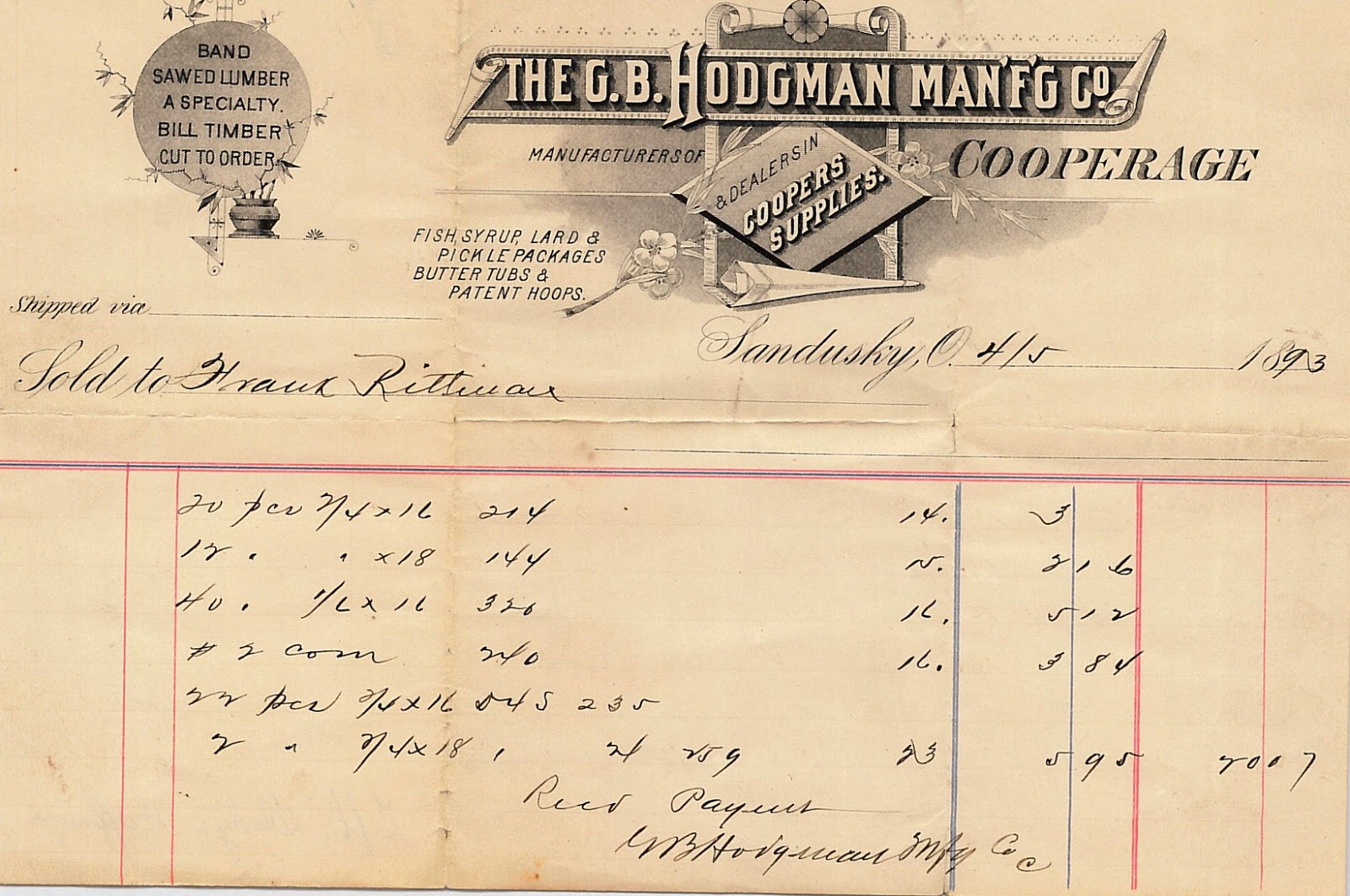
G.B. Hodgman Manufacturing Company
Above is a receipt for goods sold to Frank Rittman
from the G.B. Hodgman Manufacturing Company in Sandusky in 1893. The company
was located on the very eastern end of First Street along the waterfront.
The G.B.
Hodgman Company started out as a cooperage in the 1870s, and later became a lumber
mill; it was founded by George B. Hodgman, who served as president of
the organization. O.A. Knight was vice-president, and Henry Knight was the
secretary-treasurer.
An article in the Sandusky
Register of July 30, 1881 reported that the G.B. Hodgman Manufacturing Company
gave constant employment to over one hundred workmen. At that time the factory
sat on two acres, and had two docks for shipment of products. There was a
branch factory in St. Louis, Missouri. The book History of Erie County, ed. by Lewis Cass Aldrich (D. Mason, 1889)
described the company as sitting on twenty acres,
which included a warehouse, sawmill, band factory, cooper shop, stables,
blacksmith shop and wagon shop. The buildings had incandescent lighting, and
the company had its own generator. Products were shipped throughout a large
portion of the United States, and the proprietors were known for “business integrity
and thoroughness.” The 1890 Sandusky City Directory listed the company as a
manufacturer of lumber and cooperage, specializing in fish, syrup, lard and
pickle packaging.
During the Panic of 1893, the G.B. Hodgman Manufacturing Company went into receivership, as did
many companies throughout the United States. Mr. and Mrs. Hodgman moved to
Chicago, where George worked in wood manufacturing, and later they moved to St.
Louis, Missouri. George B. Hodgman died in St. Louis on May 8, 1934. His
remains were returned to Sandusky, Ohio for burial in Oakland Cemetery.
Marian
Hodgman, a sister to George, was an early member of the Board of Trustees of
the Sandusky Library.
Sunday, January 24, 2016
Cooperages in Sandusky
Throughout much of the world, wooden barrels have been the primary method for storing and transporting bulk materials for centuries. Those who make and repair casks, barrels and other containers are known as coopers, and a cooperage is their business place. (A famous cooper from the past was John Alden, hired as the ship’s cooper on the Mayflower.) Though no cooperages are listed in today’s Sandusky telephone directory, they were an important business in Sandusky, Ohio in the 19th and early 20th centuries. In the 1867 Sandusky City Directory, there were over fifty listings for coopers, many who worked from their own home or barn.
At the Elks’ Fair in 1909, President William Howard
Taft won a barrel of sauerkraut. The barrel holding the sauerkraut had been
made by the Michel Cooperage Company of Sandusky. Hewson Peeke wrote in his
book A Standard History of Erie County,
Ohio (Lewis Publishing Co., 1916), that barrels made in Sandusky were found
all over the U.S. as well as in foreign countries. Lumber was shipped to Sandusky lumberyards via
the Great Lakes. Local cooperages then made barrels and kegs that were filled
with goods and products made in Erie County. The railway system enabled
efficient delivery of the filled barrels and kegs to other cities in Ohio and
across the United States.
An article from the September, 1921 issue of The National Coopers’ Journal reported on a manufacturers’ display at Cedar
Point, which included several cooperages from Sandusky. At that time the Michel
Cooperage Company manufactured containers for wine, pickles, beer and oil. The
Brumm brothers were known for their fruit barrels, while the Kilbourn Cooperage
made primarily fish kegs at that time.
As packaging and shipping innovations developed in the twentieth century, the number of cooperages in Sandusky began to decline. In 1912, only five cooper shops were listed in the Sandusky City Directory. And to compound matters, the 1924 tornado did severe damage to both the Michel and the Kilbourn Cooperages.
The Sandusky Register of May 6, 1934 reported that only one cooperage
remained in Sandusky, the cooper shop operated by Fred Schwab at
317 Perry Street. Besides technological advances, other factors leading to the decline in the cooperage manufacturing
in our location included Prohibition, the disappearance of thousands of acres of
forests, as well as the lack of laborers skilled in the art of cooperage. Today
there are still a number of cooperages throughout the United States. The Associated Cooperage Industries of America, Inc. is a trade association which is located in the state of
Delaware. To read a general history of barrels, you can borrow the book Wood, Whiskey and Wine, by Henry Work,
(Reakton Books, 2014), available for loan through the ClevNet system.
Subscribe to:
Posts (Atom)