Showing posts with label First Congregational Church. Show all posts

Friday, June 17, 2022

Sandusky Souvenir Letter Tablet


Around the turn of the twentieth century, the Alexander Manufacturing Company published a "Souvenir Letter Tablet," which featured scenes from Sandusky and the surrounding area. Since the Lake Erie Islands was such a popular vacation destination, it is likely that tourists bought the tablets to write letters home to their family and friends while they were on vacation. The cover of the tablet (above) had a picture of the Sandusky Yacht Club building (then between Wayne Street and Columbus Avenue) and nautical decorations. 

Another page showed the boat landing at the foot of Columbus Avenue:


This page shows the Erie County Courthouse prior to its renovation in the 1930s:


The Congregational Church was featured on this page of the Sandusky souvenir letter tablet:


In addition to the souvenir tablet, the Alexander Manufacturing Company published souvenir postcards of Sandusky, several of which are in the collections of the Sandusky Library Archives Research Center.

Friday, April 08, 2022

Funeral Notice of Mrs. E. P. Ingersoll


Volume 52 of The Bible Society Record of the American Bible Society, reported that Rev. Edward Payson Ingersoll, son of William and Samantha Bassett Ingersoll, married Julia DeForest, daughter of Tracy R. and Julia Sutherland DeForest on September 11, 1860 in Cleveland, Ohio. Rev. E. P. Ingersoll was the pastor of the Congregational Church in Sandusky from 1863 to 1867. He later served churches in Indianapolis, Indiana; St. Paul, Minnesota; and Brooklyn, New York. A New York Times reporter wrote that Rev. Ingersoll gave an “exceedingly interesting discourse” in Brooklyn in July of 1867.


Miss Jessie Wilcox donated several items to the historical collections of the Sandusky Library, including the funeral notice of Mrs. Ingersoll. Julia Ingersoll passed away in August 1865, after only three years of marriage. Her funeral was to take place at the Sandusky parsonage at No. 9 Hancock Street, with burial to be in Cleveland, Ohio. Mrs. Ingersoll left behind two little girls, Annie and Alice, both under five years of age. Rev. Ingersoll married Helen Abbott in 1866. By 1880 Rev. Ingersoll, his wife and two daughters, as well as Helen’s sister Kate Abbott, were living in Brooklyn, New York. Rev. Ingersoll died on February 5, 1907, and he is buried in Cleveland’s Lake View Cemetery.


An interesting side note is that Julia DeForest Ingersoll was a cousin to radio pioneer Lee DeForest. Pedigree charts from the Worldconnect portions of Rootsweb indicate that Julia DeForest was the granddaughter of Gideon and Hannah DeForest, while Lee DeForest was the great grandson of Gideon and Hannah DeForest.

Wednesday, November 10, 2021

Rev. George H. Peeke


George Hewson Peeke was born on March 18, 1833 in Rotterdam, New York. He graduated from Rutgers College in 1857, and from the Reformed Dutch Theologial Seminary in 1860. Rev. Peeke’s active years of ministry spanned fifty-five years. He served as the minister of churches in New York, New Jersey, Illinois, Iowa, and Ohio. From 1883 until 1890, he was the pastor of the First Congregational Church in Sandusky, Ohio. Rev. Peeke was the first clergyman in Sandusky to advocate prohibition of liquor. 

In 1884, Rev. Peeke was selected to be the speaker at Sandusky’s Memorial Day ceremony at Oakland Cemetery. The Sandusky Library Archives Research Center has a small collection of documents from Rev. Peeke's life's work, including life memberships in the American Bible Society, American Tract Society, and the American Home Missionary Society. When Rev. Peeke left the Sandusky Congregational Church, he went on to serve as the minister of the Congregational Church in Brooklyn, Ohio. He often came back to Sandusky to officiate at funerals, and speak at local churches.

Rev. Peeke and his wife Margaret Bloodgood Peeke had six children; their eldest son, Hewson L. Peeke, was a well known attorney and local historian in Sandusky.  

On December 28, 1915, Rev. George H. Peeke died after suffering a stroke.  Funeral services were held at the home of his son, attorney Hewson L. Peeke. The three pastors who officiated at the funeral services were: Rev. Keller of the Presbyterian Church, Rev. Ross Sanderson of the First Congregational Church, and Rev. Hilberry of Trinity Methodist Church. Burial was in Sandusky’s Oakland Cemetery. A lengthy obituary appeared in the December 29, 1915 issue of the Sandusky Register.

Saturday, March 02, 2019

“A Woman’s Club”


A poem titled “A Woman’s Club” appeared in the Sandusky Register on August 13, 1899. Written by Sarah Palmer, and originally appearing in the periodical Club Woman, the poem was said then to have been the best club poem ever written. The first twelve lines are:

What is a woman’s club? A meeting ground
For those of purpose great and broad and strong.
Whose aim is toward the stars: who ever long
To make the patient, listening world resound
With sweeter music, purer, nobler tones.
A place where kindly, helpful words are said
And kindlier deeds are done; where hearts are fed:
Where wealth of brain and poverty atones
And hand grasps hand, and souls find touch with soul.
Where victors in the race for fame power
Look backward even in their triumph hour,
To beckon others toward the shining goal.

Women in Sandusky and Erie County have met together informally as well as in clubs and organizations for many years. Hewson Peeke wrote about local women’s clubs in Chapter 23 of his book, A Standard History of Erie County, Ohio. During the Civil War, the Ladies Aid Society of Grace Church sent food to soldiers in need. The Ladies’ Library Association of Sandusky worked diligently to raise funds for the building of a public library in Sandusky.

Members of the Benevolent Society of the First Congregational Church of Sandusky are participating in a quilting bee in the late nineteenth century in the image below.


Here is a photograph of Mrs. Charles Emrich’s Reading Club:


The Pythian Sisters decorated a car with a patriotic theme in an unidentified parade:


Five Red Cross volunteers are pictured at the corner of Wayne and Jefferson Streets during World War One.


Visit the Sandusky Library Archives Research Center to view historic photographs and documents relating to women’s organizations in Sandusky and Erie County. Included in the Sandusky Library Archives Research Center are records from the Erie County Federation of Women’s Clubs, the Martha Pitkin Chapter, Daughters of the American Revolution, Art Study Club, the Nineteenth Century Club, Business Women’s Club, United Ladies Sewing Circle, College Women’s Club, and the Catholic Women’s Study Club, and others.

Tuesday, April 03, 2018

Congregational Church Cookbook


In 1909 a committee was formed to publish a cookbook by the members of the Congregational Church in Sandusky. It was printed by the Register Publishing Company.The preface read, in part: “We endorse all the literature between these covers, and hope that young housekeepers may find it a subtle oil for the cog-wheels of domestic machinery, and that older housewives may find it a refuge when harassed by the cry, ‘Can we never have anything new?’” The cookbook is filled with recipes that are arranged in over twenty categories. Throughout the book are blank pages, so that owner of the book could add their own recipes to the book. There is an index at the back of the book, and many advertisements from local businesses are scattered all through the cookbook.  Below is an excerpt from page 20,  which gives information about how to make roast meat and gravy.


Accompanying the recipe for almond cookies is a poem about how many weary mothers wish for a cookie bush or a doughnut tree.


Five ways to prepare cabbage are provided on this page from the vegetable section of the Congregational Church Cookbook.


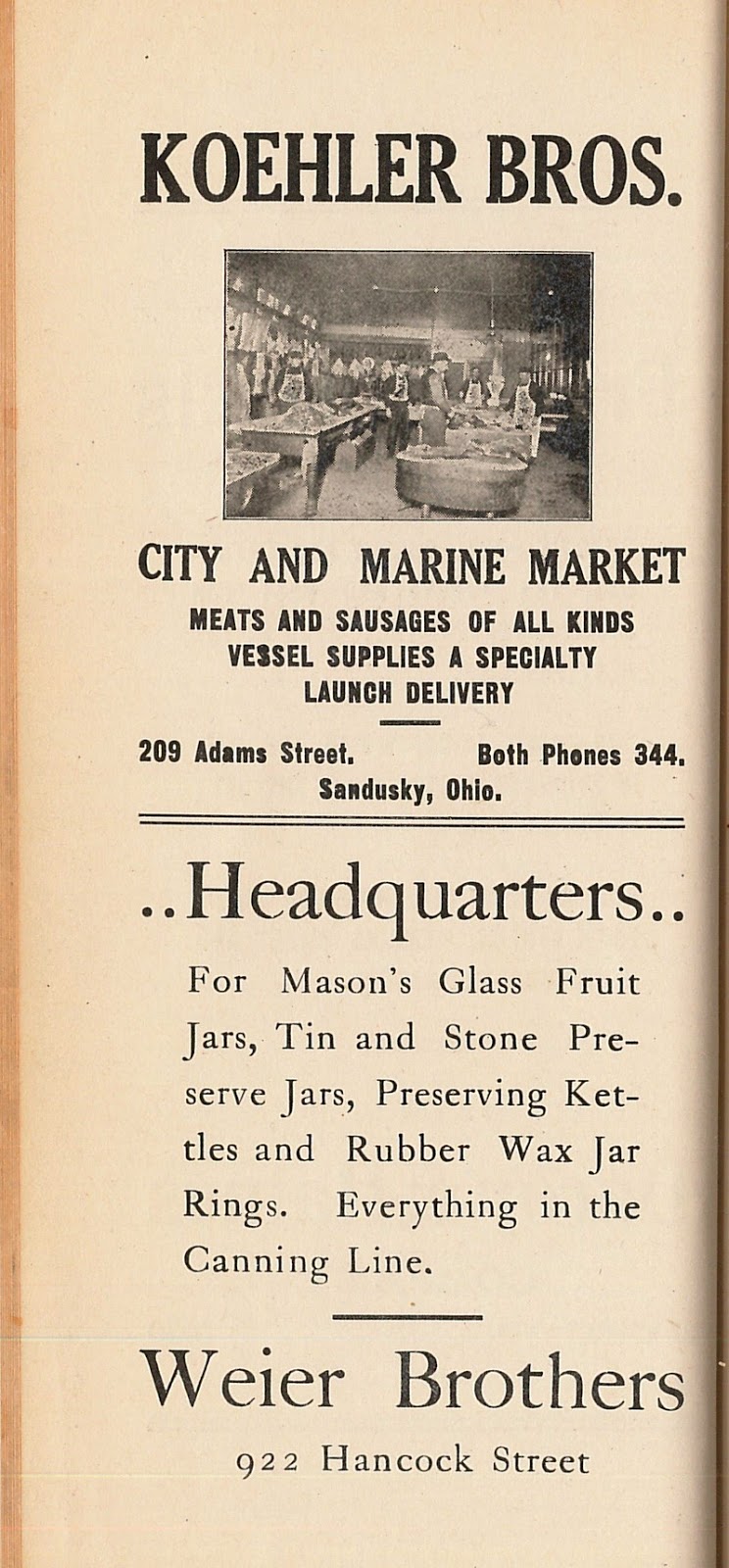
Koehler Brothers and Weier Brothers were just two of the local companies that placed advertisements in the cookbook.


Looking through the pages of the Congregational Church Cookbook gives us a look into the lives of past residents of Sandusky, indicating where they may have shopped and what kind of meals they made for their families. Visit the Sandusky Library Archives Research Center to view this vintage cookbook.

Tuesday, August 04, 2015

The Rich History of the First Congregational Church


After having been organized in 1819, the First Congregational Church opened its first church building in Sandusky in 1835. This church stood in Washington Park until it was razed in 1896. An article in the January 1920 issue of the Firelands Pioneer stated that in the early years, the First Congregational Church was considered a social center for Sandusky. It was the site of a number of meetings dealing with temperance and antislavery issues. At a church meeting held on August 16, 1847, resolutions denouncing slavery were introduced by Moors Farwell, and passed unanimously. 

Rev. N.W. Fisher was minister of the First Congregational Church in 1849, when a cholera epidemic swept through Sandusky. Rev. Fisher died from cholera on July 30, 1849. He was buried at Oakland Cemetery along with two other local ministers who also fell victim to cholera, Rev. Thomas Cooper and Rev. Hibbard P. Ward.

             
Under the leadership of Rev. Clarence Vincent, a new church building was constructed at what is now 431 Columbus Avenue. The builder was by George Philip Feick. (He would later also build Zion Lutheran Church across the street from the Congregational Church.)


From May 25 to May 28, 1919, the First Congregational Church celebrated its centennial services. A copy of the program from the centennial celebration is located in the church collections of the Sandusky Library Archives Research Center.


Now known as the First Congregational United Church of Christ, this church continues to play a vital role in the spiritual life of many local residents. Visit the Sandusky Library Archives Research Center to learn more about the history of churches in Sandusky and Erie County.

Friday, November 14, 2014

Stereograph Cards by A.C. Platt


Stereographs are a pair of nearly identical images that give a three dimensional effect when viewed through a device called a stereoscope. Several stereographic cards are found in the collections of the Sandusky Library and the Follett House Museum. Above is a stereograph card of the Erie County Courthouse created by Sandusky photographer A.C. Platt, probably around 1876. A group of stereographs created by Mr. Platt were donated to the Sandusky Library by Mrs. John H. Jacques. The cards originally belonged to her father, Willis Merry. Mrs. Jacques was a direct descendant of Ebenezer Merry, a pioneer settler of the Firelands. A view of Sandusky High School and the old academy building can be seen in the stereograph card below. The academy building was used as a courthouse prior to the construction of the Erie County Courthouse in 1875. It was torn down in 1884.


This view of downtown Sandusky was taken from the upper level of the Erie County Courthouse. The steeples of the Congregational Church, then in Washington Park, are visible. This church was demolished in 1896, and a new church was built at the northwest corner of Columbus Avenue and Jefferson Street. In the background, you can see a portion of the Cedar Point peninsula


     In 1875, the first city water works was under construction, at Meigs and Washington Streets. Here you see construction scaffolding around the standpipe. If you look closely, you can see men at the top of the scaffolding.


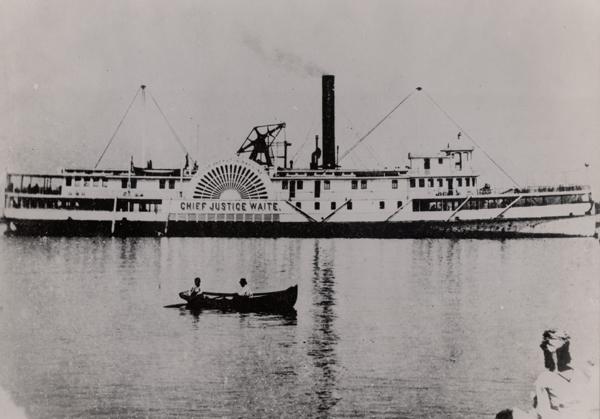
Below is a view of the Sandusky’s waterfront in the early 1880s. The vessel Chief Justice Waite is partially obscured by an unidentified ship in Sandusky Bay.


Thanks to A.C. Platt’s stereograph cards, we can get a sense of what life was like in Sandusky in a bygone era.

Friday, November 30, 2012

Three Churches at the Intersection of Columbus Avenue and Jefferson Street

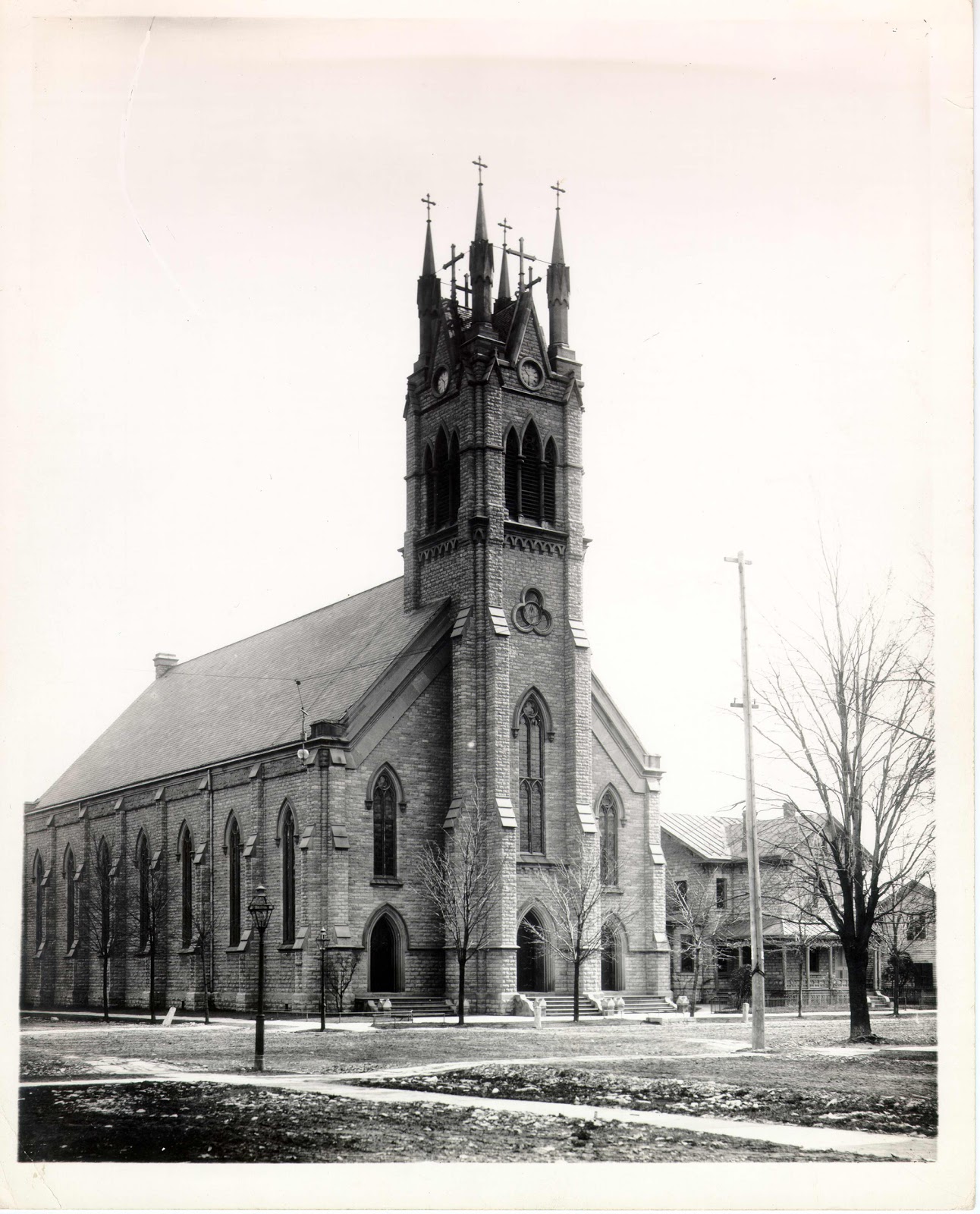
In this aerial view of Columbus Avenue, taken around 1920, one can see the three churches located at the intersection of Columbus Avenue and Jefferson Street. (The church steeple in the right foreground of the picture is Emmanuel Church.) The oldest of the three churches at this intersection is Saints Peter and Paul Church, located at the southeast corner of Columbus Avenue and Jefferson Street. According to the Dictionary of Ohio Historic Places, Saints Peter and Paul Church (below) was built of limestone in 1865 by Patrick Charles Keely in the Victorian Gothic style. The triple windows in the tower and the three front doors are reflective of the Trinitarian theme often used by Keely.


The First Congregational Church was built in 1895 by George Philip Feick in the Romanesque Revival style of architecture. Tiffany glass is featured in this two story church, located at 431 Columbus Avenue.

George Feick was also the builder of Zion Lutheran Church, built in 1898-1899 at the southwest corner of Columbus Avenue and Jefferson Street. The church was built from limestone in the Victorian Romanesque style. Many early German immigrants worshipped at this church, whose congregation formed in 1847. Well into the twentieth century, there was a German language service held here every Sunday. Zion Lutheran Church served as a mother church for several other Lutheran churches in the area.

Visit the Sandusky Library Archives Research Center to learn more about these and several other area churches. In the Church Collections of the Archives Research Center are many vintage photographs, church histories, and church records on microfilm.