Tuesday, November 28, 2006

Announcement: New Local History Photograph Book


A new local history book, Erie County and the Erie Isles: A Pictorial History of the Early Years, has been published (just in time for the holidays) by Pediment Publishing. Presented by the Sandusky Register and the Sandusky Library, the book contains hundreds of images of scenes of life in Erie County before 1940, from photographs in the library's collections and from contributions of local residents.

A great coffee table book, Erie County and the Erie Isles is available for purchase ($39.95) at the Register or at the library's gift shop -- or you may order it online via the Register's website.

Join us in the Library Program Room on Sunday, December 10 at 1PM for a book release celebration, where you can purchase copies of the book, learn about how it came together, and see original copies of some of the images in the book (some more than 100 years old).

Thursday, November 16, 2006

Happy Thanksgiving!

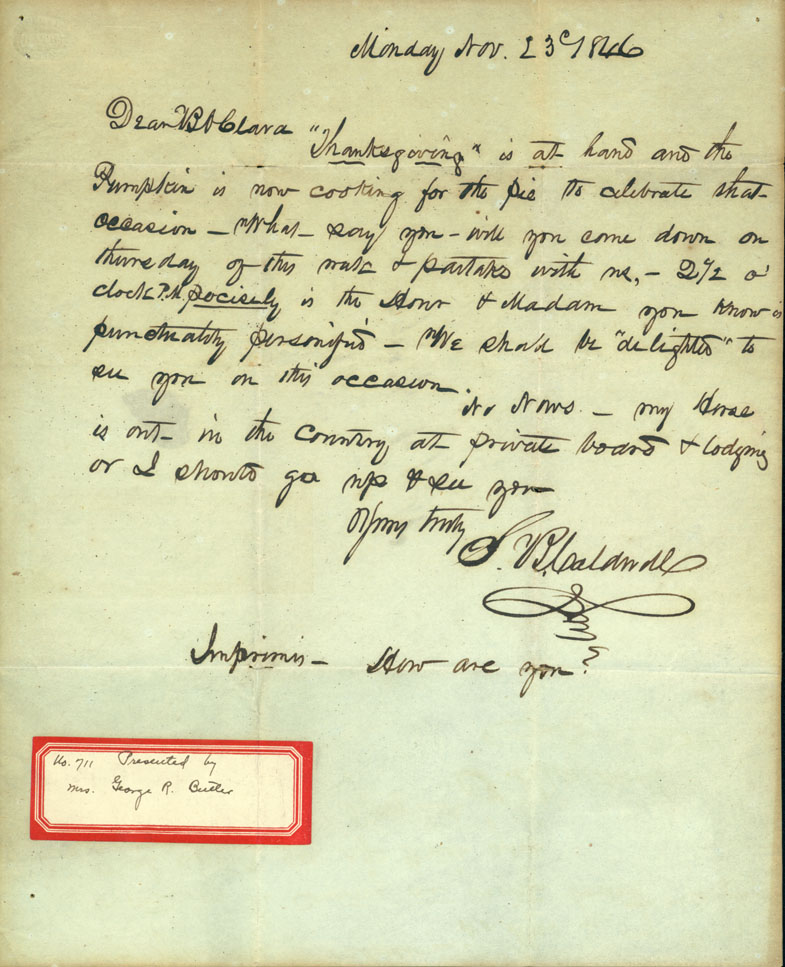
As many of you might remember learning in grade school, the first "official" Thanksgiving was proclaimed by President Abraham Lincoln during the height of the Civil War, in 1863, in honor of the first Thanksgiving held by the pilgrims in Plymouth during the 17th century. But even before President Lincoln made Thanksgiving a holiday, it was traditionally celebrated by many people. The first letter below is evidence of that:

In this letter, Judge Samuel Caldwell of Sandusky has invited Samuel Butler and his wife Clara to his home for Thanksgiving dinner. (We know pumpkin pie was on the menu!) The date of the letter is November 23, 1846, nearly twenty years before the national holiday was observed. (It is also interesting to note that even then Thanksgiving was celebrated on a Thursday in November -- nobody seems to know for sure why this day was chosen.)


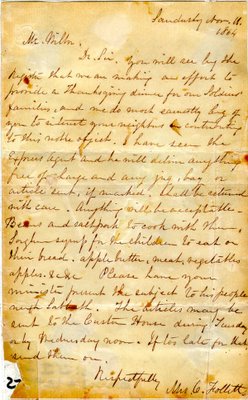
The second letter is from Eliza Follett, the wife of Oran Follett, requesting contributions from local residents to provide Thanksgiving food to the wives and children of soldiers serving in the Civil War. Mrs. Follett was very active in community service and charitable work, as can be inferred from this letter.

Have a happy Thanksgiving. . .

Tuesday, November 14, 2006

Football Season!

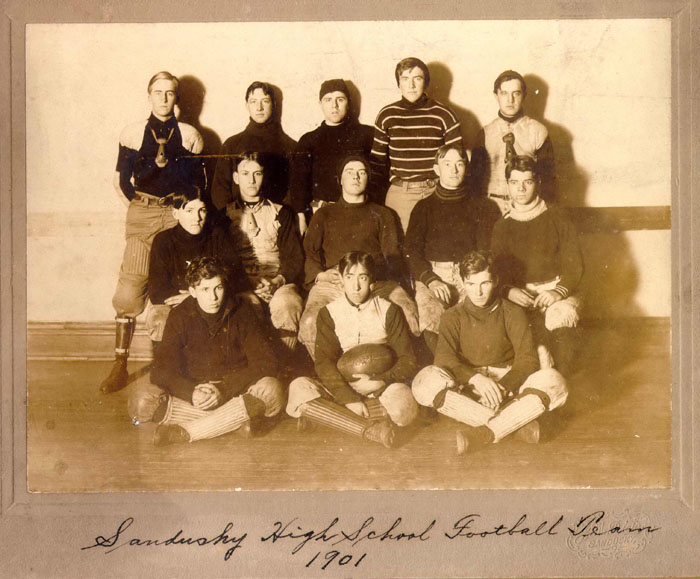
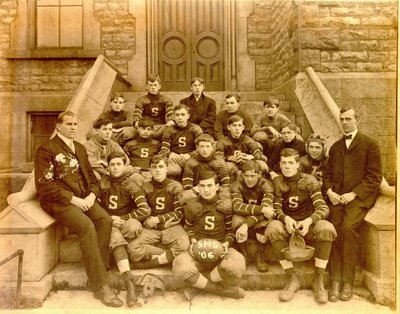
In commemoration of the big football game coming up this weekend (no, not Manchester United v. Chelsea -- that's later in the month; I mean the one between those schools on US 23) , I thought I'd show some scenes from early football in Sandusky.

The image above is of the very first Sandusky High School football team in 1901. (Did you know that SHS had a basketball team before it had a football team?) The 1901 team went 2-1, defeating Cleveland West (16-5) and Norwalk (10-5), but losing to Toledo Scott, 34-0.

The 1906 SHS team (pictured here) was Sandusky's first undefeated team, winning all five of its games without allowing a single point. They defeated Fremont twice, Lorain Senior twice, and Norwalk.

Monday, November 13, 2006

Helen M. Hansen, 1902-2006


Helen Hansen, a former curator of the Follett House Museum, died Sunday morning, after a long and rich life. She was 104. The photo above shows Mrs. Hansen while at work in the museum, holding a copy of an original plat map of the city of Sandusky. She served at the museum beyond the age of 90.

As many know, Mrs. Hansen was a dedicated local historian; with Virginia Steinemann, she wrote a series of history-related articles for the Sandusky Register for several years. These articles were the foundation for a two-volume book series, From the Widow's Walk. Additionally, Mrs. Hansen was the author of At Home in Early Sandusky, a book about the histories of early homes in Sandusky and their occupants. In her many years of service at the Follett House Museum and as an independent historian, Mrs. Hansen was instrumental in preserving and promoting the history of Sandusky, through her curatorship of the historical collections and her extensive historical research. The collections of the museum and the Archives Research Center substantially reflect her contributions.

The community owes a deep debt of gratitude to Helen Hansen for her contributions to preserving its history.

Tuesday, November 07, 2006

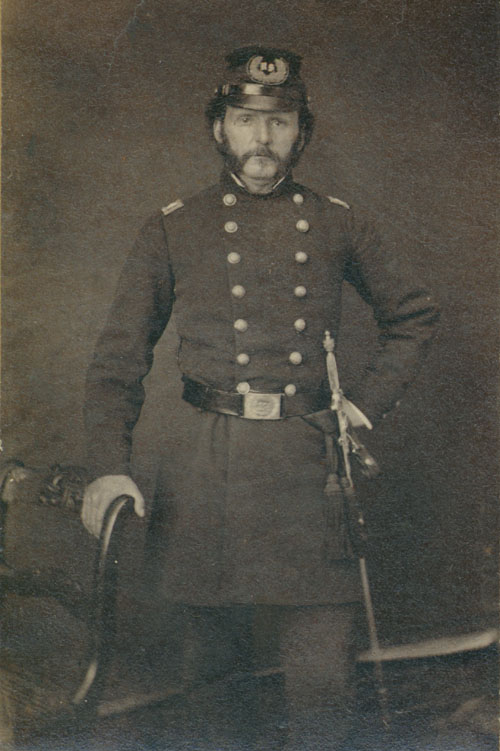
Dr. McMeens Inducted into Ohio Veterans Hall of Fame

Dr. Robert R. McMeens, who served in both the Mexican War and the Civil War, was inducted into the Ohio Veterans Hall of Fame during a ceremony in Columbus on Thursday, November 2.

Born in Pennsylvania in 1820, Dr. McMeens received his M.D. from the University of Pennsylvania in 1841, and migrated to Tiffin, Ohio shortly thereafter. He settled in Sandusky in 1849. During his medical practice in Sandusky, he treated many of the victims of the several cholera outbreaks that struck the city (in 1849, 1852, and 1854). (A report he wrote on cholera for the Ohio State Medical Society in 1857 is excerpted in Peeke's book, A Standard History of Erie County, Ohio, available in the library.)

As a soldier, Dr. McMeens served as a surgeon in the Mexican War of 1846-48. Back in Sandusky, in 1851, he founded and commanded the Bay City Guards, a local militia. Upon the outbreak of the Civil War in April 1861, Dr. McMeens returned to active duty, again as a surgeon, in the Third Regiment of the Ohio Volunteer Infantry. He died while serving at the Battle of Perryville, Kentucky on October 30, 1862. The Firelands Pioneer of January 1888 quoted a letter written by a fellow surgeon on the day after Dr. McMeens' death: "He has fallen while nobly working at his post; although suffering greatly from disease, he refused to abandon his work, and performed several important surgical operations only a few hours before his death."

Sandusky resident Dr. Robert Bartholomew, who was instrumental in garnering this recognition for Dr. McMeens, accepted the award in Dr. McMeens' honor at the induction ceremony.

Thursday, November 02, 2006

Some Gave All . . .

As I hope you know, Veterans Day is commemorated on November 11 in recognition of the armistice that ended World War I, on the 11th hour of the 11th day of the 11th month of 1918. Millions of lives were lost in that war, including more than 125,000 American soldiers. Sandusky and Erie County suffered its share of losses, with around 40 men dying in service. The Sandusky Library Archives Research Center holds material relating to the lives and deaths of two men of Erie County who gave their lives in the First World War.

John A. Michel was born in Cleveland on November 24, 1892, the son of William and Caroline Michel. He lived with his parents in the family home on Huntington Avenue in Sandusky, and worked for the Hinde and Dauch Paper Company before entering the war. Drafted into the Army, he was inducted on May 26, 1918 and sent to the European battlefield for the final offensive at Meuse-Argonne. Private Michel was killed in battle on November 8, 1918 -- three days before the end of the war; one of the last Sandusky men to die in the war.

The first man from Sandusky to die in the First World War, was Corporal Elmer A. Reese of the U.S. Marine Corps. Born in Niles, Ohio on August 12, 1896, he volunteered for service on May 19, 1917, and was sent to Quantico for training on August 1, 1917. While in Quantico, he wrote a letter to the local chapter of the Daughters of the American Revolution, offering thanks for the gifts they sent and describing life at camp. (This letter is part of the archival collections at the Sandusky Library; you can read it online here.) He was shipped to France on February 12, 1918 with the American Expeditionary Forces. On June 18, 1918, Corporal Reese was killed in the battle of Belleau Wood. His body was returned to Sandusky in 1921, and he was buried in Oakland Cemetery.

To see a photo of Elmer Reese and most other men and women from Erie County who served in World War I, see the book, Honor Roll of Ohio, 1917-1918, Erie County Edition, which is available in the genealogy department of the Sandusky Library. (I had intended to post Corporal Reese's picture in this entry, but . . . let's not talk about Blogger again.)

Tuesday, October 31, 2006

Honoring Our Veterans


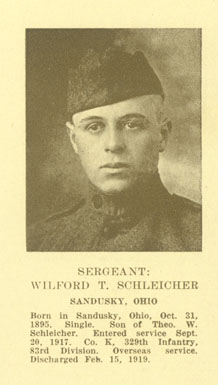
In honor of all veterans, in commemoration of Veterans Day on November 11, we offer a tribute to a World War I veteran from Sandusky. Wilford Schleicher was born in Sandusky on October 30 (or 31), 1895. A sales manager for the American Crayon Company, his life changed dramatically in 1917, when he was called to service when the United States entered the Great War that had been going on in Europe since 1914.

Wilford Schleicher was enlisted into the United States Army on September 20, 1917, and assigned to Company K of the 329th Infantry, 83rd Division. He was trained at Camp Sherman in Chillicothe, where most of Sandusky's recruits went for training. In June of 1918, he and his fellow soldiers departed the United States for the war zone of Europe. By October of that year Corporal Schleicher had been promoted to sergeant. After honorable service in the French war zone, he returned to his native land on January 31, 1919 and received his honorable discharge about two weeks later.

Like most other men who served (unfortunately not all), Wilford Schleicher returned to his normal life, back home in Sandusky. He went back to work at the American Crayon Company, and worked there for nearly fifty years; he was a member of the Trinity United Methodist Church, the American Legion, and the Veterans of Foreign Wars. He lived on Polk Street with his wife, Gladys, who died in 1974. Mr. Schleicher died in November 1982, at age 87.


The Sandusky Library Archives Research Center is privileged to have two scrapbooks compiled by Mr. Schleicher. One scrapbook (two pages of it are shown above) contains photographs of his military adventures, along with mementoes such as postcards, military passes and other official documents, and a wrapper for a candy bar from the Red Cross Canteen. The other scrapbook consists of newspaper clippings describing the war and local soldiers. Additionally, the archives holds many other items relating to the First World War, a war little understood by most Americans.

Monday, October 30, 2006

Harry Van Stack and the Convict Ship Success

It was 43 years ago this month that the writer Harry Van Stack died in Sandusky. Born in South Africa, he was a world-traveller, and made his name by writing about his journeys in newspaper columns and in books. He wrote a column for the Sandusky Register from the mid-1940s to the early 1960s.

His longest "journey" was aboard the prison ship Success, where, from the 1920s to the 1940s, he frequently spent time travelling throughout North America, presenting lectures about the ship and its history and legends. According to one of those legends, the Success was built in Burma in 1790, and was used to transport convicts from England to the newly-settled land of Australia. Although it was in fact built in Burma, the real story is that the Success did not come into existence until 1840. All available evidence indicates that the ship was actually built in 1840 as a merchant ship sailing the Indian Ocean; from 1847 to 1852, it transported emigrants from England to Australia. In 1852 the Australian government purchased it for use as a prison, and later for ammunition storage. The Australian government used it for these purposes probably until the mid-1880s. (It was not used to transport English convicts to Australia, as some legends claim.)

Alexander Phillips purchased the ship in 1890 and soon began using it for travelling exhibitions, presenting exhibits and lectures on crime and punishment. (This is probably when the fictitious stories became popular.) The cells of the ship were opened for viewing and various articles of punishment were displayed on the decks -- only some of which might have been actually used on the ship during its prison days. For example, the "iron maiden," displayed on the ship, certainly was not used as a means of punishment in 19th-century Australia, and is possibly simply an artifact of legend.

In 1943 the ship sank while moored in Sandusky. In 1945 it was refloated and towed to Port Clinton, where the then-owner lived. This owner (along with vandals) began stripping the ship for its valuable items. After long neglect, the Success burned to the water line in July 1946, in a fire of mysterious circumstances. Perhaps fate directed this result because, with the demise of the Success near Sandusky, Harry Van Stack also ended his journey and settled in Sandusky for the remainder of his life.

The Sandusky Library Archives Research Center holds materials relating to the ship Success during the time it was a travelling exhibit site, including books and pamphlets on the history (both real and invented) of the ship, souvenir catalogs, announcement brochures, and a set of roughly 75 photographs taken by Harry Van Stack during a voyage from Portland, Maine to Chicago for the 1933 World's Fair. Additionally, the library owns a collection of Harry Van Stack's writings and papers, including many of his newspaper columns and personal correspondence. Unfortunately, Blogger has once again refused to cooperate and allow image of some of these artifacts to be posted with this entry. If you are interested in researching any of these materials (or others) at the library, feel free to contact us or just stop in.

Monday, October 23, 2006

Political Campaigns in Sandusky

As election day is approaching, it's a good time to talk about political campaigns that passed through Sandusky. I know it's not a presidential election year, but let's talk about some candidates for President of the United States who made campaign visits to Sandusky.


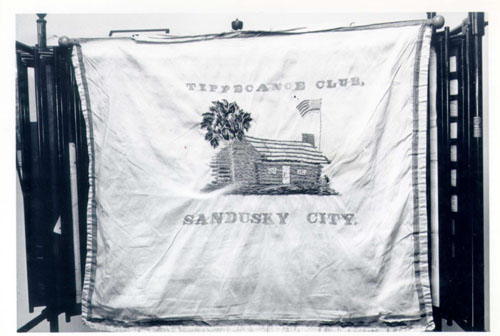
Possibly the earliest campaign visit to Sandusky by a presidential candidate was in 1840, when William Henry Harrison, the Whig Party candidate, came to town. To commemorate his visit, several women of Sandusky (including Mrs. Eleutheros Cooke) created an embroidered banner in honor of the campaign (shown above in a b&w photo). The banner, showing a log cabin on one side and an eagle on the other, is on display at the Follett House Museum. This story behind this banner is related on page 13 of the October 1896 issue of the Firelands Pioneer, available in the Genealogy section of the Sandusky Library.

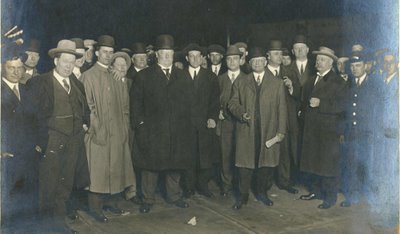
During his successful 1908 presidential campaign, William Howard Taft spoke at the Ohio Soldiers' and Sailors' Home (now the Ohio Veterans Home). The photo below shows the soon-to-be President-Elect with a group of local dignitaries outside of the Soldiers Home. Taft was a close friend of Sandusky resident Edward Marsh, and apparently visited the area several times for social occasions.


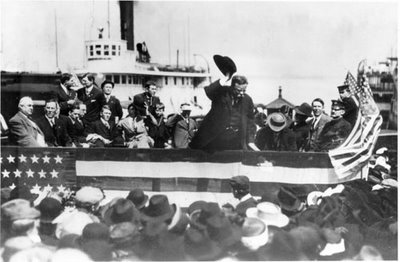
Taft's former political ally, Theodore Roosevelt, became his political opponent during the 1912 presidential campaign. Believing that Taft betrayed the progressive principles that formed the core of Roosevelt's beliefs, "TR" ran for president that year as the candidate of the Progressive Party (often called the "Bull Moose" party, in honor of a popular nickname for Roosevelt). In May of that year, Roosevelt gave a whistle-stop speech at the foot of Columbus Avenue to a large crowd of Sanduskians. Here is one of several images of that event from the library's photo collections:

In the 1916 election, Charles Evans Hughes was the Republican candidate for president, seeking to unseat President Woodrow Wilson from his position. In September 1916, Hughes gave a speech in front of the American Crayon factory on Hayes Avenue. (Unfortunately, that photo will not post properly on Blogger.)

Another interesting local story of presidential campaigns can be found in the November 11, 1940 issue of Life magazine. In an article titled "The People's Choice," the publishers used Erie County, Ohio as a microcosm for the nation, with images of local residents and descriptions of why they chose to vote the way they did. You can read the article, and see photographs of local residents of the time (as well as a picture of candidate Wendell Willkie in Sandusky), in the Sandusky Library. Ask a reference librarian for that issue of Life magazine from closed storage.

Thursday, October 19, 2006

Sandusky City Ordinances

You never know what interesting things you can find in a book -- and it doesn't always have to be a novel or history book (my preference), either. You can find some interesting reading in the Revised Ordinances of the City of Sandusky of 1887 and 1906. (Copies of each are in the Archives Research Center and local history collection at the Sandusky Library.)

Saloons

For example, on the first page of the 1887 ordinances is "an ordinance to regulate ale, beer and porter houses, to aid in the preservation of peace and good order of the City of Sandusky and to abate the nuisance arising from offensive practices prohibited by this ordinance." The first section of this law stated that "it shall be unlawful for the keeper or proprietor . . . of any saloon . . . to employ any female in the supplying of or waiting on customers in furnishing ale, beer, porter, or intoxicating liquors of any kind whatever . . ." (although they did make exceptions for women who were married to the owner or were his daughters). The penalty for violating this ordinance was up to fifty dollars. (This rule was still in effect in the 1906 laws.)

In 1889, a law was passed outlawing the playing of music in saloons.

Bathing

Another law, on page 6 of the 1887 ordinances, stated "it shall be unlawful for any person, in a unclothed and naked condition, to go into or bathe in the open waters of Sandusky Bay, within the corporate limits of the city, at any time after the rising of the sun and before dark." Nighttime skinny-dipping was okay, apparently.

Keep Your Cows off the Sidewalk!

In 1887, it was "unlawful for the owner or owners or any person having the custody or control of any horse, mare, mule or other beast of burden, or of any ox, steer, heifer, cow, calf, or of any swine, sheep, goat or goose, to suffer or permit the same to run at large, upon any sidewalk, street, alley, park, common or public ground, within the corporate limits of the city of Sandusky." (I hope it is still unlawful today!)

No Dressing Fish in the Summer

Also in the 1887 laws, it was forbidden "at any time between the 25th day of May and the 1st day of September of each and every year, to receive into any fish shanty, store room, store house or any other building, any fresh fish, for the purpose of dressing or salting the same."

Only a Little Gunpowder

In 1887, residents of Sandusky were prohibited from storing more than 28 pounds of gunpowder on their property, and nobody was allowed to sell gunpowder at night.

Watch Your Speed!

By 1906, it was necessary to have some laws regulating that new invention, the motorized automobile. For example, Section 397 of the 1906 city ordinances stated that "No person, driver or operator in charge of any automobile or motor vehicle shall move or permit the same to be driven, operated and moved at a rate of more than eight miles per hour within the limits of the city."