Sunday, February 23, 2014

A Closer Look at a Photo of the Feick Building in 1910


Sandusky photographer E.H. Schlessman took this photograph of a portion of the Feick Building in 1910. Though the picture is torn, it is interesting to see a slice of life from an earlier time in our community. From about 1910 to 1915, the Mayer Lebensburger Company, which sold men’s clothing, and the Sandusky Business College both were in operation in the Feick Building on East Market Street. The Mayer Lebensburger store occupied the street level of 154 to 162 East Market Street. The Sandusky Business College held classes on the third floor of the Feick Building, which only had three stories at that time. The automobile in from the Mayer Lebensburger store had a convertible top, and the tail light and headlights were lanterns, possibly fueled with kerosene.


The poster in the store window was advertising an event to take place on Thursday, August 10. The lady pictured below is looking at another poster in the men’s clothing store, where several pairs of trousers are displayed.

On the second floor, we can see a man, presumably working at his desk.


By 1916, the Mayer Lebensburger Company went out of business, and the Sandusky Business College eventually moved to 403 East Adams Street. Of course, the Feick Building later had a total of eight stories, and many other businesses were in operation there. The Citizens Banking Company was in business at the Feick Building for several decades. Because of the generosity of many donors, the Sandusky Library Archives Center has a rich collection of historic photographs, scrapbooks, books, and other primary resources which help us learn about the past residents of Sandusky and Erie County.

Thursday, February 20, 2014

"It's Kleenex Time in America" -- Including Sandusky


In 1938 the window of the Bechberger and Kubach drugstore in the Sloane House in downtown Sandusky featured a display entitled “It’s Kleenex Time in America.” The display showed the Seven Dwarfs explaining why they liked Kleenex. Snow White and the Seven Dwarfs, an animated movie produced by Walt Disney in 1937, was still very popular in the U.S. at that time. In the display Doc said “Don’t  put a cold in your purse – use Kleenex.” Happy was happy about the price of Kleenex, which in 1938 was 13 cents for a package of 200, or 28 cents for a package of 500. Dopey said “I’m dopey because I was the last one to get the Kleenex habit.” The sign by Grumpy read, “Grumpy is so pleased with Kleenex  that he intends to smile soon.”


John H. Bechberger retired in 1945, after sixty years in the pharmacy business. Rol Kubach had joined the business in 1921. Prior to Bechberger & Kubach’s partership, John H. Bechberger had been in business with Henry Henkelman, and later with Nicholas Brown. Below is a picture from 1909 of the pharmacy at the Sloane House when it was operated by Mr. Henkelman & Mr. Bechberger. 

Monday, February 17, 2014

Advertising Card from Henry Eichler and Company


The 1882 Sandusky City Directory lists Henry Eichler and Charles A. Lehrer as manufacturers and dealers of German roots and herb bitters. (Unfortunately, we do not know which man is Mr. Eichler and which is Mr. Lehrer.) Their business, Henry Eichler and Co.,  was located at 420 Decatur Street in Sandusky, Ohio. Sandusky photographer C.A. Cross created this advertising card, now housed in the Sandusky Library Archives Research Center.


German root and herb bitters were a digestive aid, and it was felt that they helped “impurities of the blood” and many other health problems. Both Henry Eichler and Charles A. Lehrer were of German descent. Mr. Eichler eventually moved to Cleveland, Ohio, where he was a dealer in patent medicines. Both Charles A. Lehrer and his brother George Lehrer operated drugstores in Sandusky for several years. In his later years, Charles A. Lehrer moved to North Carolina, where he was engaged in vineyard culture.

Friday, February 14, 2014

Fred A. Martin, Proprietor of Martin’s Confectionery


Fred A. Martin was born in Belgium on January 27, 1882 to Mr. and Mrs. Julius Martin. The Martin family came to the United States when Fred was a youngster. After residing for a time in Indiana, the family moved to Sandusky in 1901. As a young man, Fred worked as a glass worker, along with his father. In 1905 he married Alpha Steen, and they had two sons, Fred A. Martin, Jr. and Harry Martin. In 1910 Mr. Martin began a confectionery and ice cream business on the west side of Columbus Avenue. By 1915 Martin’s Confectionery had moved to the Cooke Block at the northeast corner of Columbus Avenue and Market Street. You can see the name Martin’s under the small clock on the right side of this 1931 photograph of downtown Sandusky.


In the 1916 Sandusky City Directory, Martin’s Confectionery was listed as a wholesale and retail ice cream manufacturer, with a full line of bakery goods and confections. Martin’s also featured a dining room. Local residents often called upon Martin’s for catering large parties and family gatherings. In 1921, Mr. Martin gave up the wholesale ice cream business, and focused on making candy. A separate manufacturing plant for Martin’s was located at 206 East Water Street during much of the 1920s and 1930s. This advertisement, which appeared in the Sandusky Star Journal on February 12, 1923, encouraged customers to purchase their Valentine’s Day treats from Martin’s.


Heart shaped cakes and a variety of fine boxed chocolates were popular at Martin’s for Valentine’s Day in 1923.

On September 25, 1939, Fred A. Martin died, following a lengthy illness. A lengthy obituary for Fred A. Martin, Sr. appeared in the September 26, 1939 issue of the Sandusky Register. Fred Martin had been known as a “booster” of Sandusky, and his business was well respected in the area. Following his death, Mr. Martin’s wife and sons operated Martin’s Restaurant at 225 West Market Street.


Wednesday, February 12, 2014

Employees of Sandusky’s American Railway Express Company in 1927


Pictured above are several employees of the American Railway Express Company in 1927 near the New York Central Railroad Depot.  At that time, there were two offices of the company in Sandusky, one on East Water Street, and one at the New York Central Railroad’s passenger depot, located on the south side of North Depot Street, between Hayes Avenue and Camp Street. The only individual who has been identified is Chester Piper, who is the fourth individual from the right. In the picture below, you can see the railroad depot in the background.


The American Railway Express Agency was created in 1917, when the U.S. government consolidated several of the country’s already existing express companies. The United States Railroads purchased the American Express Agency in 1929, and its name was changed to Railway Express Agency. Later known as REA Express, the company ceased operations in the mid-1970s.

Monday, February 10, 2014

Stereographic Cards from the American Views Series

Nicholas H. Hammond was the proprietor of the Great Bazar, a large dry goods store in business in downtown Sandusky from the 1880s through the early 1900s. As a side business, Mr. Hammond also created stereographic views of downtown Sandusky. These stereographic cards are all from the American Views series. 

Now known as St. Mary’s Catholic Church, this church was known as the German Catholic Church in the 1880s. Note the cigar stand next door.


Here is a view of Sandusky’s bustling waterfront in the nineteenth century:


You can see the steeple of Emmanuel Church in this stereographic image of the Erie County Courthouse.


Sandusky High School was constructed in 1867, and about ninety years later became Adams Junior High School. Grace Church is at the left of the image.


Visit the Sandusky Library Archives Research Center to learn more about the history of Sandusky and Erie County, Ohio.


Thursday, January 16, 2014


William F. Schoenemann was born in Westphalia, Germany in 1851. He came to the United States in 1870, and soon settled in Sandusky, Ohio. As a young man, William worked for Klotz and Kromer’s machine works. After briefly working in the grocery business with Frank Herberlein, William F. Schoenemann operated his own grocery store on Market Street from the late 1870s to the 1890s. In 1896, he was also associated with Hans Paysen in the fish business. By 1900, William F. Schoenemann was an agent for Fleischmann & Company’s Pressed Yeast. Records at Erie County Probate Court indicate that William F. Schoenemann married Louisa Biglin on September 21, 1877.


Mr. and Mrs. Schoenemann had a large family of seven children.  William F. Schoenemann died at the age of 51 on December 21, 1902, after suffering a stroke. An obituary for Mr. Schoenemann, which appeared in the December 22, 1902 issue of the Sandusky Register, stated that the news of his death brought much regret. He was “well known, beloved, and highly respected by all who knew him.”  Besides his many business ventures, Mr. Schoenemann had been a director of the Wagner Lake Ice and Coal Company, the Erie County Investment Company, and the Citizens Banking and Trust Company, and was a member of the Ogontz Lodge of the I.O.O.F. He was survived by two sons and five daughters.  Mrs. Louise Biglin Schoenemann (sometimes spelled Schoeneman) died on April 4, 1953 at the age of 95. At the time of her death, Mrs. Schoenemann had been the oldest living member of Zion Lutheran Church. Her obituary appeared in the April 6, 1953 issue of the Sandusky Register Star News.

Thursday, January 09, 2014

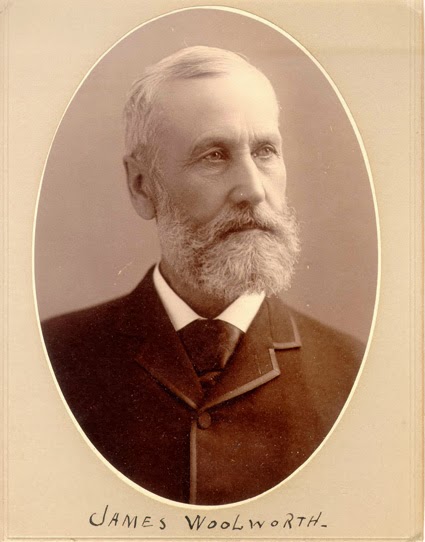
James Woolworth, Manufacturer


James Woolworth was born on May 4, 1824 in Westfield, Massachusetts to Chester and Chloe (Lewis) Woolworth. He came to Sandusky in 1852, and in 1854 he founded the Woolworth Handle Works, manufacturing handles for axes and other tools. An article from volume 11 of Wood Craft said about James Woolworth: “His business was well managed and he was very successful. In a few years the name of James Woolworth was known in all the handle markets of the world. He managed his business with great ability and he undoubtedly was the most active and progressive and largest manufacturer during his active connection with the business.”  For several years, James Woolworth’s brother Chester Woolworth was also associated with the Woolworth handle factory.


During the Civil War, the demand for handles increased and prices increased as well. James and Chester Woolworth paid careful attention to business, and the profits for the company were great. After the war, however, on October 18, 1872, the Woolworth Handle Works was destroyed by fire. A lengthy article in the June 26, 1873 issue of the Sandusky Register described the new factory, which had been rebuilt.  The article reported that the new Woolworth Handle Works factory was “an imposing substantial three story stone structure, with a slate roof and iron cornice and as far as possible proof against the fiery element.” The main part of the factory was 175 by 41 feet, and 35 feet in height. The machine shop was in a separate building. Twenty-five saws were constantly in use, manufacturing wooden implements. A three foot gauge railway connected the machine shop to the south side of the building, and to  the dock fronts on the north. Wood scraps from the factory were deposited in a wood yard, and delivered to various locations in Sandusky for use as fuel. Between the local Woolworth factory and the branch operation in Mound City, Illinois, the company employed 110 men in 1873. The Register article concluded by saying that, “the enterprise manifested by Mr. Woolworth under the recent difficulties is commendable and establishes the reputation he has always sustained as thorough business man and worthy citizen.”

In 1884 the Woolworth Handle Works was consolidated with the Turner & Day Company of Louisville, Kentucky, but James Woolworth continued to operate the plant at Sandusky as a branch.By 1886, however, the Woolworth Handle Works was no longer in operation in Sandusky. This Sanborn Fire Insurance Map shows the location of the former  factory along Sandusky’s waterfront.


There is a connection with the James Woolworth family and the Sandusky Library. In 1898, Mr. and Mrs. James Woolworth sold their home on Adams Street to the Library Association of Sandusky, as the future site of the Carnegie Library. Mrs. Woolworth presented a large bookcase to the library, and it is still in use in the Quiet Reading Room of the Sandusky Library. Mrs. Woolworth’s donation of the ornately carved bookcase represents the beginning of the Sandusky Library’s local history collection. Mrs. Woolworth was a member of the early board of the Library Association of Sandusky.


Stop by the quiet reading room at the Sandusky Library to see the ornately carved bookcase donated by Mrs. Woolworth.

Monday, January 06, 2014

Rev. John G. Ensslin


According to his death certificate, John George Ensslin was born in Bopfingen, Germany on September 9, 1840 to Casper and Mary Ensslin. Rev. Ensslin’s surname was spelled many different ways through the years, including Enszlin, Enslin, and Ennslin. After studying for six years at the Mission Institute at Basil, Switzerland, John G. Ensslin was ordained in 1868. In that same year Rev. Ensslin emigrated to the United States. After serving as a minister at two different churches in Michigan, Rev. Ensslin began his ministry at Sandusky’s Emmanuel Church on May 1, 1876.


Rev. Ensslin served as the pastor at Emmanuel Church for over thirty five years, officiating at many baptisms, funerals, weddings, and confirmations. Due to declining health, he resigned from active ministry in January of 1912. At that time he was the oldest active member of the clergy in Sandusky, Ohio. For eleven years, Rev. Ensslin also had charge of St. John’s Evangelical Church in Oxford Township. On January 6, 1914, Rev. John G. Ensslin died at his Jackson Street home in Sandusky. He was survived by three daughters and three sons. Mrs. Ensslin had predeceased him in 1910. Funeral services for Rev. Ensslin were held on Friday, January 9, 1914, at Emmanuel Church, under the direction of Rev. Theo. Eisen. Several clergymen from other cities were also in attendance. Burial was at Sandusky’s Oakland Cemetery. 

Friday, January 03, 2014

Murschel Family Home on Columbus Avenue


According to listings in Sandusky City Directories, this lovely Queen Anne home at 615 Columbus Avenue was the home of the William Y. Murschel family. Members of the Murschel family lived at this residence from 1900 through the 1980s. This photograph was taken by L.C. Sartorius, a photographer in Sandusky in the late 1890s. Mr. Sartorius lived not far from the Murschel family on East Park Street. William Y. Murschel is most likely the gentleman seated in the chair on the porch.  William Y. Murschel, along with his father Jacob, built the Murschel House, a popular hotel opposite the New York Central depot for many decades. William Y. Murschel died on March 21, 1926. Mrs. Elizabeth Murschel passed away in 1946. Children of Mr. and Mrs. Murschel continued to reside at this home for several years.