Monday, August 28, 2006

Labor Day

In honor of the working men and women throughout the history of our community, this post commemorates Labor Day. Labor Day was first celebrated in 1882 in New York. It was made a national holiday in 1894.


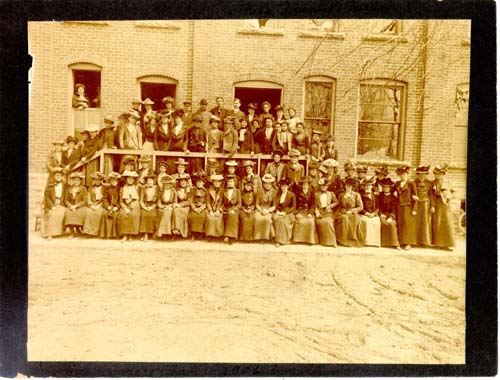
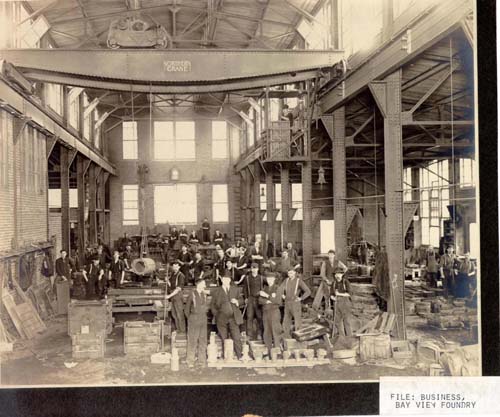
The men in the picture on the left (below) are workers at the Bay View Foundry (which operated from around the beginning of the 20th century to the 1930s), at Shelby and Water Streets, circa 1905; the photo on the right (above) shows the women workers (and their male supervisors) at the Jackson Underwear Factory, North Depot and McDonough Streets, circa 1906. The Jackson Factory operated from 1899 to around 1933.

If you have historical documents describing the activities of working people in Sandusky and Erie County -- documents such as: labor union records; photographs of people at work; personal letters and papers; business records; etc. -- please consider donating those documents to the Sandusky Library Archives Research Center. Contact the Archives Librarian via email or at 419-625-3834.

Wednesday, August 23, 2006

Clubs and Organizations in Erie County

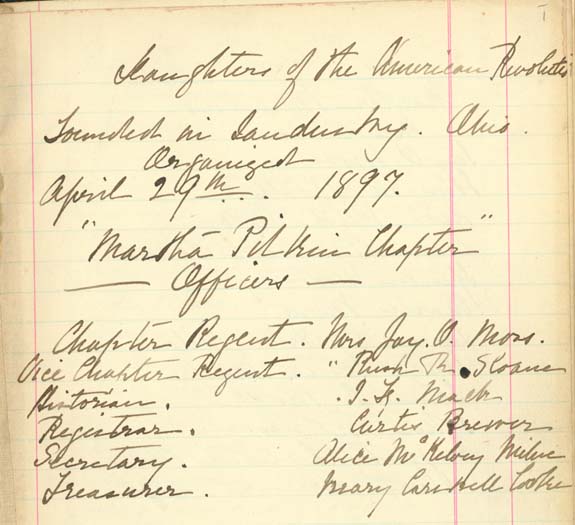
For better or worse, social clubs and community organizations are not as popular as they once were. With the advent of movies, television, the Internet, the automobile, and many other developments in technology and culture, clubs and organizations play a smaller role in the community than they did, say, in 1897, when the Daughters of the American Revolution, Martha Pitkin Chapter, was founded in Sandusky. (An excerpt from the D.A.R. secretary's book is shown above.) In the nineteenth century and well into the twentieth century, the role of clubs and organizations in the community was dominant. For an analysis of this development in society, you might want to read Robert Putnam's book Bowling Alone (in our library collection at 306.0973 PU) -- but don't take my world for it, since I haven't read the book yet.


It does seem clear, however, that studying the history of local clubs and organizations will help you understand the culture and society from which they come (or at least that portion of society represented by the members of that particular club). The Sandusky Library Archives Research Center holds records and documents from several local clubs and service organizations, including: the Daughters of the American Revolution, Martha Pitkin Chapter; the Erie County Federation of Women's Clubs, and the Sandusky Federation of Women's Clubs; the Art Study Club; the Men's Literary Club; the Sunyendeand Club; the Nineteenth Century Club; the Sandusky Concert Association; and others. Thanks to the help of our summer archives intern, we have new and updated finding aids describing many of these documents and collections, for those interested in researching this aspect of our history.

For those of you involved in a local organization or who owns the records of local clubs from the past, we encourage you to consider depositing those records with the Archives Research Center, to preserve these documents for future generations. We will be glad to explain how we will store and record your donation in the library as a record of our community. For more information, call (419-625-3834) or email the Archives Librarian.


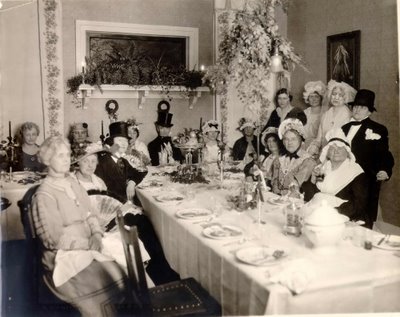
The photo above is of a costume party given by the Art Study Club (probably circa 1920), where guests came dressed as famous literary characters. (From the Library's historic photo collection -- CLUB-047.)

Tuesday, August 15, 2006

Do you know where this is?

It looks a lot different today, but it's an intersection in Erie County.

The answer is in the comments section.

Monday, August 14, 2006

Edwin Lincoln Moseley -- Teacher, Scientist, Scholar


One of the most interesting characters to contribute to Sandusky's history is Edwin Lincoln Moseley, a science teacher at Sandusky High School, and later one of the original professors on the science faculty at what is now Bowling Green State University.

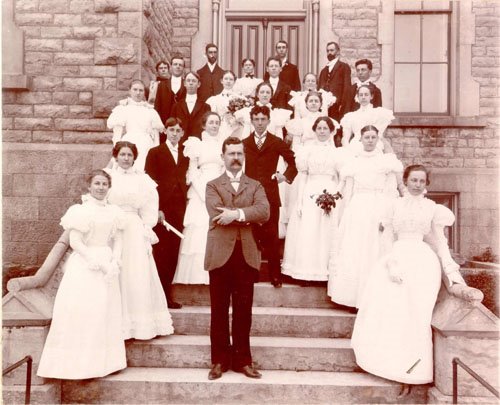
Edwin Moseley was born in Michigan in 1865 and graduated from the University of Michigan in 1885, the youngest in his class. He joined the faculty of Sandusky High School in 1889, after he returned from participating in a scientific expedition that took him across the Pacific to Hawaii, the Philippines, China, and Japan. (Here is SHS class of 1912, with faculty. E.L. Moseley is in the back row.)
While at Sandusky High School, Moseley was perhaps most admired for inspiring his students to learn through direct observation and to develop independent thinking.
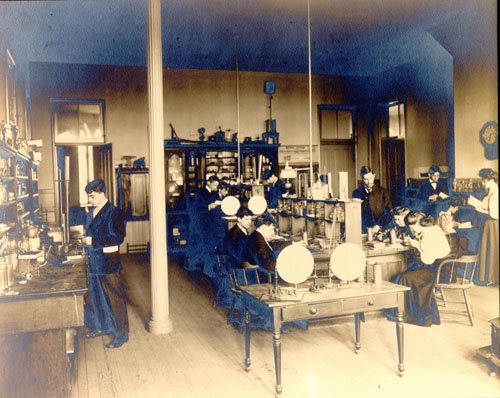
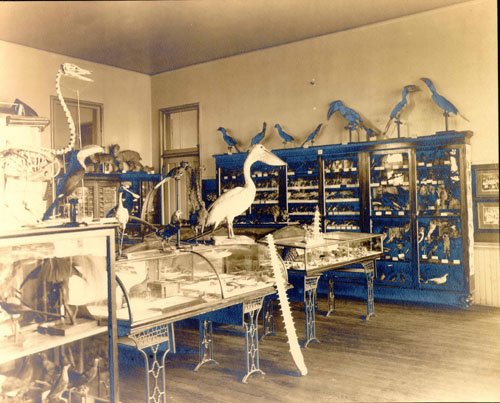
He used both the school laboratory (one of his SHS physics classes is shown here) and field trips to teach his students -- he frequently brought his students on scientific explorations of Sandusky Bay and the Lake Erie Islands, to study the geology and flora of the region. While a teacher at SHS, he operated a natural history museum in the school building, managing a collection of about 17,000 specimens (an exhibit area of the museum is pictured below).

While in Sandusky, his reputation as a scientist and a scholar became so great that, in 1914, he was invited to become the founding science faculty (yes, faculty -- he was the only science professor when he started there) at the new Bowling Green State Normal College (now Bowling Green State University). He continued his research and teaching in Bowling Green until his retirement in 1936. He died in 1948, leaving a legacy of strong scholarship and devoted students.

For more information about Professor Moseley: Relda E. Niederhofer and Ronald L. Stuckey have produced a book that may be the definitive biography of the professor, Edwin Lincoln Moseley: Naturalist, Scientist, Educator; the book is available in the Biography section of the Sandusky Library and as a reference book in the Genealogy department.
The Sandusky Library Archives Research Center has a small collection of papers and publications by and about Professor Moseley, including many of his scientific publications (such as: Sandusky Flora; Trees, Stars, and Birds; Lake Erie: Floods, Lake Levels, Northeast Storms; and others) and a small number of letters and documents he wrote. A finding aid to the collection is available; contact the library reference department (419-625-3834) or the Archives Librarian for more information. Additionally, The Center for Archival Collections at Bowling Green State University holds a collection of Edwin Lincoln Moseley papers, primarily covering his time in Bowling Green.

Tuesday, August 08, 2006

Friday, August 04, 2006

The Ohio State Fair in Sandusky, 1858


As many of you probably know the 2006 Erie County Fair begins on August 8, and has been held annually for more than 150 years. (Be sure to see the online exhibit, Celebrating 150 Years of the Erie County Fair on the Library's website.) But did you know that Erie County once hosted the Ohio State Fair?

The first Ohio State Fair was held in Cincinnati in October 1850. In its early years (1850-1874), the site of the fair was rotated among cities throughout the state. In 1858, it was Sandusky's turn to host the fair. The Ohio State Board of Agriculture selected Sandusky over Toledo, Zanesville, and Cleveland after a committee of local community leaders, led by F.D. Parish, made the case for Sandusky during meetings in December 1857. The Board wanted to hold the fair in the northern part of the state that year, and Sandusky was selected because of its central location and easy accessibility by railroads from all over the state. The Sandusky fair was held September 14-17, 1858.

Much preparation went into developing the grounds and exhibition halls. The fairgrounds were placed on what was then the southeast outskirts of town -- Huron Avenue and Hancock Street were the main thoroughfares into the fair. The Sandusky Commercial Register (August 5, 1858) noted with pride that "[s]even hundred stalls [for livestock] are to be erected on the Fair Grounds -- fully three hundred more than have been provided at any State Fair in Ohio." Additionally, there was a Farm Implement Hall, Mechanic's Hall, Floral Hall, and other exhibit buildings and tents, as well as a horse racing track. The Dining Hall, according to the Register was "an almost interminable structure . . . capable of feeding an almost indefinite number of persons." Sanduskians expected thousands would come to the fair, and hotels and steamboat were prepared to accommodate the visitors. The West House, a huge hotel for the time, was opened in time for the fair. (One newspaper article estimated that around 16,000 people visited the fair on its busiest day, although that might be exaggerated.)

Along with the usual livestock and produce competitions, and displays of new farm implements and household devices, an interesting event was the "Female Equestrianism" competition. The first prize award was a "Side-Saddle, Bridle, and Martingal [sic] made by F.H. Francisco of Sandusky." Women who wanted to enter the competition were allowed to register "incognita." The newspaper article describing this event noted that '[t]he most celebrated physicians have declared their opinion that nothing contributes more to the development of health, bodily vigor, blooming beauty, and that grace of action which is impossible without strength of muscle, in which our American women are too deficient, than riding on horse-back."

Aside from some rain on a couple of the fair days, it appears that the Ohio State Fair in Sandusky was a success.

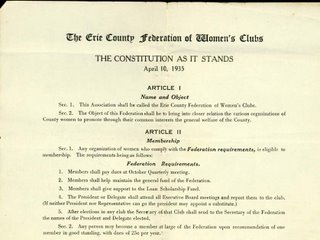
The Sandusky Library Archives Research Center holds a copy of the fair's regulations (shown above) and a catalog of cattle and horses to be exhibited, as well as a "diploma" issued to E.J. Messer for a threshing machine.

(I was hoping to have a couple more graphics for this post, but as is all-too-common, Blogger has failed to cooperate. Sorry.)

Friday, July 28, 2006

Bay City Guards

. . . No, not the Scottish pop band from the 1970s (that was the Bay City Rollers). . . .

The Bay City Guards were a volunteer infantry militia formed in Sandusky in the mid-nineteenth century. Led by a Sandusky physician, Captain R.R. McMeens, the Guards were organized in the Fall of 1851, with 62 men serving as original members. A retrospective article about the Bay City Guards in the July 23, 1875 Sandusky Register stated that the members of the guard were all native-born American citizens; the Sandusky Yager Rifle Company, another militia formed at about the same time, consisted exclusively of German-born American citizens. Also operating at that time was a company called the Sandusky Artillery. It is not clear exactly when these militias disbanded, but the same Register article mentioned above noted that the Yager Company was the only group still in existence at the outbreak of the Civil War.

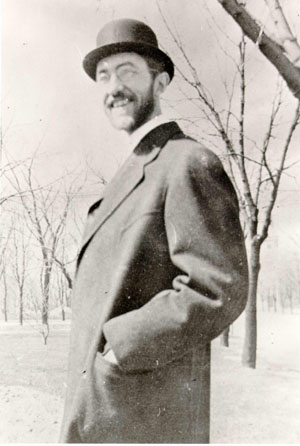
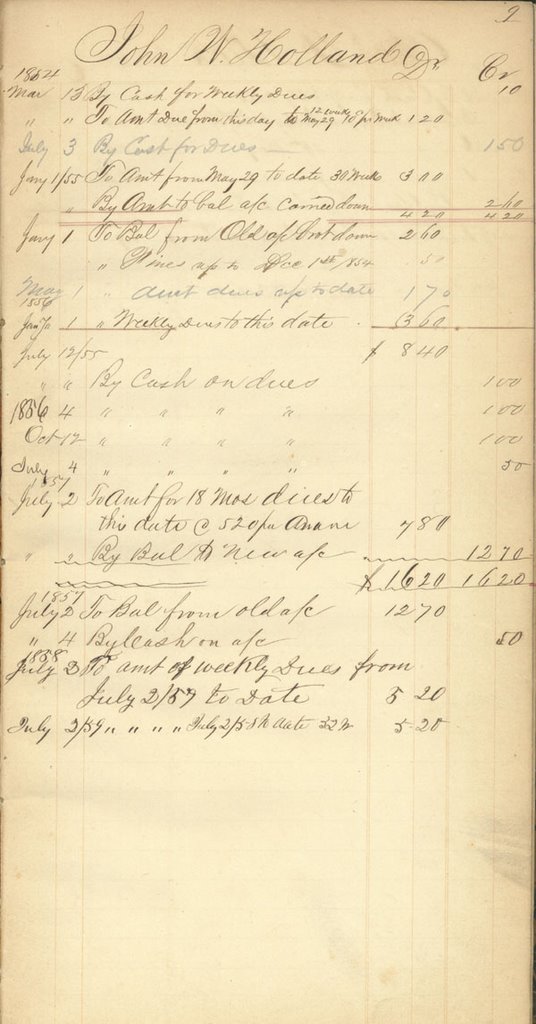
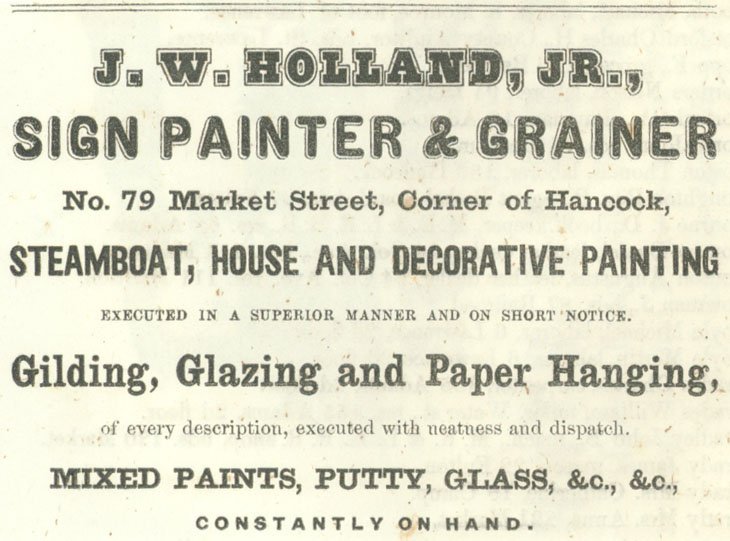
The Sandusky Library Archives Research Center holds a "petit ledger" that was opened on March 13, 1854 to record financial transactions for each member (the last transaction looks to have been in 1857). It appears that the men paid dues, from which they received payments for expenses. The page shown above records the transactions of John Holland, who was a sign painter by profession, and who was the last surviving member of the Bay City Guards before his death in 1924 at age 99. Here is his photograph from the W.A. Bishop portrait collection, circa 1900.


Now that you have seen the preserved records of a military veteran, why not help to record and preserve the history of our veterans today? The Veterans History Project needs your help. This project, sponsored by the Library of Congress and hosted locally by the Sandusky Library and the Ohio Veterans Home, seeks to record the stories of living veterans through oral history. We need your help, to interview veterans and record their stories for future generations. It's not difficult -- and will even be fun and rewarding! You can record your conversations with veterans on your own, or you can make arrangements to use the facilities provided at the Ohio Veterans Home. Your contribution will help to preserve the stories of our veterans for future generations. For more information, contact the Sandusky Library or the Ohio Veterans Home.

Monday, July 17, 2006

Sandusky Library's Stained Glass


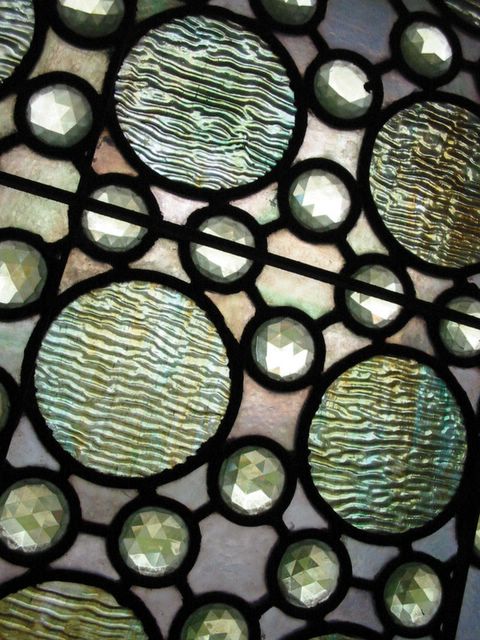
Have you ever paused to notice the stained glass in the doors, transom and windows in the Adams Street entrance to the Sandusky Library? Tracking down the artist who designed them revealed quite a history.

The windows were designed by Jessie May Livermore. Jessie May was born and raised in Chicago, but her mother was a Carpenter from Bloomingville. When the library was under construction, Jessie May's father, Darius Livermore, a Chicago decorator, won the contract for the stained glass in the library. The local papers commented that it was appropriate that a woman designed the windows, as the library was such a labor of love for the women of Sandusky.

In her early life, Jessie May made her living as an artist. She took a four year course in architectural and mechanical drawing and continued her studies at the Dearborn Seminary, from which she graduated in 1889. In 1901, it was said that her designs had been used in some of the largest decorative contracts that have been given out in the country. She competed with seven leading designers to obtain the contract to design the decorative elements for the Gougar home in Lafayette, IN. Mrs. Gougar was a nationally known suffragist. Jessie May designed a six pane oriole window that depicted all the seasons in a single scheme. She also designed an apple blossom scheme for one room. In addition to art glass, she also designed frescoes for the interior of the house. The house still stands today in Lafayette, where it is a funeral home.
For reasons unknown, Jessie May gave up her career as an artist, and became a teacher in the Chicago Public Schools, where she worked for 37 years, until being forced into retirement at age 65. She didn't receive a pension, and her retirement assets had suffered during the Great Depression.

Her father was a homesteader in Oklahoma, which is where Jessie May spent her summer and holiday vacations. She had hoped to start an artistic dude ranch. In the cellar of the home were rows of saddles, hand painted china, party favors, and chairs, as well as cases of fancy foods, all meant for the dude ranch she was never able to open.

Her health suffered dramatically after being forced into retirement and she died in December, 1935. She is buried in the family plot in Oakland Cemetery. Posted by Picasa

Thursday, July 06, 2006

Freedom Fighters

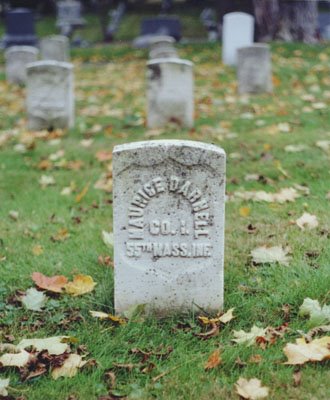
It has been only relatively recently that the service of African-American soldiers in the Civil War has been adequately recognized. In the Sandusky area during the war, fifteen African-American men volunteered for service in Company I of the 55th Massachusetts Volunteer Infantry. The men were mustered into service in May and June of 1863 at Camp Meigs in Readville, Massachusetts.

In January 1863, Governor John Andrew of Massachusetts received permission to recruit an African-American regiment to fight for the Union. The 55th was a sister regiment to the 54th Massachusetts Volunteer Infantry, whose heroic service in the war was featured in the movie, Glory. This second unit was formed due to the overwhelming response from men who sought to serve in the 54th. A total of 222 men from Ohio served in the Massachusetts 55th.

Among the Sanduskians who served, William H. Johnson was killed in battle on July 2, 1864 at James Island, South Carolina. Morris Darnell and Elijah J. Brown
returned home to Sandusky after the war, and are buried in Oakland Cemetery; Frank Gardner, Joshua Cole, and Thomas Robinson are buried at the Ohio Veterans Home.


African American soldiers comprised over ten percent of the Union Army, and over 18,000 African-American men served in the Navy. You can read an article about the Sandusky recruits in the June 2, 1863 issue of the Sandusky Daily Commercial Register, available on microfilm in the Sandusky Library Archives Research Center. Military records from the Civil War and other wars may be found on the Ancestry Library Edition research database, which can be accessed from within the library.

Thursday, June 29, 2006

Mysterious People

The Sandusky Library Archives Research Center has a collection of about 10,000 photographic images documenting many facets of the history of Sandusky, Erie County, the Lake Erie islands, and the Firelands region. Nearly all of these pictures have been donated to the library over the last 100+ years by local residents, former residents, and the historically-minded. However, some of these images have lost their 'stories' -- the names of the people in them have been long forgotten, the event depicted has been lost from memory, or we aren't sure anymore where or why the picture was taken. Nevertheless, these images are still important to us in helping to describe the early days of the community and culture.


The names of the women pictured above are unknown to us. What we do know about this image is that it was taken by the C.A. Cross studio in Sandusky. Charles Cross operated a photography business on Columbus Avenue in Sandusky from about 1880 until the late 1890s. We don't know the ladies' names, but they still can tell us things about life in the late nineteenth century. Does this photo tell you anything?

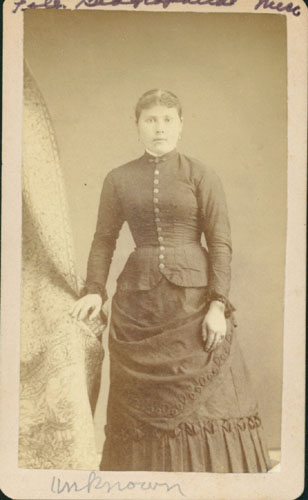
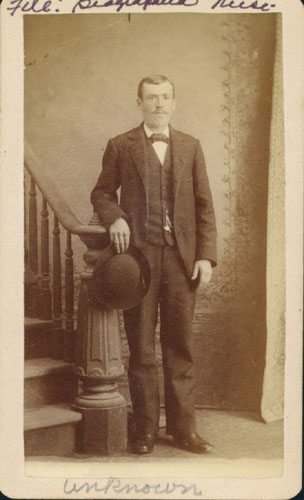
The Archives Research Center has a number of cartes-de-visite, which were used as photographic calling cards in the early days of print photography. (The peak years of the carte-de-visite were roughly from around 1860 to the 1880s.) Here is a sample of cartes-de-visite from the library's collections. Again, the names of the people and the story of their lives is unknown, but their images still can tell us something.


Both of these images were taken at the Wetherell Studio in Sandusky, probably in the mid-1880s.

(We will have more about the early history of photography -- and mystery photos -- in later entries.)