Saturday, December 10, 2022

Harry Mewborn and the Development of Phone Service in Sandusky


Harry Mewborn was named the Commercial Manager for the Ohio Bell Telephone Company in Sandusky on January 1, 1939. He started with Ohio Bell in Toledo in 1925, and worked in several positions, including outside representative, credit manager, assistant unit manager, and unit commercial manager. During his time in Sandusky, telephone service in Sandusky, Castalia and Bloomingville was greatly expanded, and local telephone equipment was converted to dial operation. (Before the advent of the rotary dial telephone, an “operator” was needed to connect anyone making a telephone call to the party to whom they wished to speak.) 

Below are Sandusky operators in the 1930s demonstrating their work to a group of observers. A poster on the wall stated that “The 9700 Sandusky subscribers make 45,000 local calls each day. These calls are handled by a force of 75 operators.”

During Harry Mewborn’s time in Sandusky, there was no area code in use. Sandusky phone numbers started with 625; Castalia phone numbers started with 684, and Bloomingville phone numbers began with 359. Older readers may recall when Sandusky telephone numbers were in the “Main” exchange and Castalia numbers were in the “Mutual” exchange. By correlating the first two letters of each of those exchanges to the telephone buttons, the numeric equivalent for MAIN is 62, for MUTUAL is 68. For example the Sandusky Register telephone number in 1958 was MA 5-5500, or 625-5500. Now the area code 419 is needed to make a call to the Sandusky Register. The MAIN and MUTUAL exchanges were discontinued in 1962, as phone numbers were switched to all numeric dialing.


Mr. Mewborn was active in civic affairs in Sandusky. In 1942 he was the chairman of the campaign committee of the annual Sandusky Community Fund appeal. He was a director of the Citizens Banking Company, member of the Rotary Club, Sandusky Yacht Club, and Telephone Pioneers of America. He was also active in the Masons. He was on the Board of Good Samaritan Hospital, on the Board of the Erie County Chapter of American Red Cross, past president of the Chamber of Commerce, former director of the Salvation Army, former director of the Kiwanis Club, and he served on the Civilian Defense Executive Board.

Harry Mewborn retired from Ohio Telephone Bell Company in 1958, due to declining health. He died on September 20, 1960, and was buried in Oakland Cemetery. Mr. Mewborn made significant contributions to the Sandusky area through his work at Ohio Bell Telephone and through the many hours he donated to community organizations

Tuesday, December 06, 2022

One of the First Motorized Fire Trucks in Sandusky


An article in the December 24, 1913 issue of the Sandusky Register reported that the city of Sandusky had purchased a motorized fire truck for $9500 ($268,000 today) after testing it out thoroughly. The “motor propelled triple combination Ahrens-Fox fire truck” was approved by Board of Control in Mayor George Lehrer’s office, and it was then turned over to Fire Chief Al Hegemer. A mechanic from the factory was to remain with the new fire truck until members of the Sandusky Fire Department were properly trained in its operation.

The two tests of the new fire truck were conducted by R.S. Tucker of the Ohio Inspection Bureau, assisted by H.R. Farnsworth of the Sandusky Foundry and Machine Company. The engine pumped as high as 850 gallons of water, with 120 pounds of water pressure.

The Sandusky Register of December 31, 1922, said about the motorized fire truck being added to the Fire Department, “Jim and Prince, the gallant fire horses, were ousted then and the corn crib was replaced by a gasoline tank.” By 1914, there were two motorized fire trucks in use by the Sandusky Fire Department, as well as an automobile for the Fire Chief, “to ensure speedier runs by him.”

To read more about the history of the Sandusky Fire Department, see the Erie County Historical Society’s website, where the document “The Sandusky Fire Department: A Look Back at History, 1830-2002” is located.

Friday, December 02, 2022

The Ohio State University Lake Laboratory at Cedar Point


From about 1903 to 1917, the Ohio State University had a fresh water marine biology laboratory at Cedar Point. Notes from Dr. Norbert Lange indicate that the lab was located at approximately 2029 Cedar Point Chausee. George Feick was selected to construct the lab. G.A. Boeckling, Jacob Kuebeler, and attorney W.E. Guerin, Jr. met with officials of the Ohio State University, to negotiate the details of the lake laboratory. The property for the lab was donated by the Cedar Point Pleasure Resort Company. The lake laboratory was two stories high, and faced the lake. Students were to study the insect and aquatic life of the region. A map by Professor E.L. Moseley was published in the Sandusky Register to show the location of the Lake Laboratory.


In 1904 the staff included professors of botany, zoology and entomology. Instructors came from Ohio State University and other universities around the U.S. Students were offered outings to various sites in the area, including Lakeside, the Blue Hole in Castalia, the Marblehead Life Saving station, the Lake Erie Islands and the gypsum beds in Ottawa County. Some students stayed at the laboratory building, while others boarded in Sandusky for a fee of $3.50 to $4.50 a week. Professor E.L. Moseley from Sandusky High School gave a lecture on “Physiographic Features of Sandusky Region” during one of the first summer sessions at the Lake Laboratory.

Professor E.L. Moseley

The American Microscopical Society held its annual meeting at Cedar Point in 1905, and attendees visited the Lake Laboratory. Members of the Ohio Academy of Science were invited to all the lectures. On July 5, 1905, a public lecture was given by the American Microscopical Society at Carnegie Hall, inside the Sandusky Library.

Professor Henry B. Ward from the University of Nebraska gave the address at Carnegie Hall, titled “The Relation of Animals to Disease.” Some of the topics he covered were yellow fever, typhoid, and leprosy, and how these diseases may have been spread by insects.

In 1918, Ohio State University moved the Lake Laboratory to South Bass Island. Since 1925, the laboratory has been known as the Franz Theodore Stone Laboratory on Gibraltar Island, not far from Put in Bay on South Bass Island.

Saturday, November 26, 2022

The Phil T. Beer Cafe


A mirror from the Phil T. Beer Café has a saying at the top, “Look at yourself, but think of us.” Phil Beer (a great name for a tavern owner) operated the tavern from about 1910 to 1919, at 301 East Market Street. Grace Episcopal Church now operates a thrift shop at this location. In an advertisement in the Sandusky Register on June 28, 1912, readers were informed that they could “while away an idle hour” or play pool, or eat a meal at Phil’s Café.

At the end of May in 1919, the state of Ohio became a “dry” state, several months before the 18th Amendment became a law on October 28, 1919, prohibiting the manufacture, sale or transportation of intoxicating liquors throughout the United States

The article below from the May 24, 1919 issue of the Sandusky Star Journal reported on the mock funeral for “John Barleycorn.”


A group of men were to meet at midnight, and pay their respects to old man “Booze” who died from an “overdose of votes.” There was a procession that was to start at Washington Park, and then go to Water Street, past Dan Nolan’s, Baldwin’s, Ted Lauber’s Mulharen’s, the Pabst and the old West House. Next they would shed a tear at the old Annex Cafe, pass by Werner & Wagner, and play slow music as they passed by Phil Beer’s Cafe. It was expected that there would singing and speeches, concluding with the song “We’ll be dry for a long, long time.”

Later in 1919, Phil Beer ran a cigar shop at the Rieger Hotel

Mr. Beer died in September, 1959, and was buried at Oakland Cemetery.


You can read more about the residents of
Sandusky and Erie County at the Sandusky Library Archives Research Center, which houses microfilmed copies of decades of local newspapers. A ClevNet database, Newspaper Archive, provides online access to many historical newspapers as well.

Monday, November 21, 2022

Short Line Docks at Foot of Decatur Street


The Sandusky and Columbus Short Line Railway opened in 1893, and it became part of the Pennsylvania Railroad system in 1902. In 1964 the Norfolk and Western Railway acquired the line. The former Norfolk and Western is now part of Norfolk Southern. 

Ships met the railroad at this dock, which was a slip at the foot of Decatur Street. A horse drawn wagon can be seen transporting lumber in the picture above.

Another view of the Short Line Docks appeared in the 1894 publication, Art Work of Huron and Erie Counties:

Coal continued to be shipped from this location until the 1930s and 1940s. In the 1960s, the former Decatur Street slip was filled in as a joint project of Scott Paper and the Westvaco Corporation. Today the Sandusky Boat Basin and Paper District Marina are in the location of the former Decatur Street slip.

Friday, November 18, 2022

A Look Back at 242 Wayne Street


Notes on the postcard above state that the Biemiller Garage was located at 240-242 Wayne Street around 1921. Later operators of the garage at this address were Harry Baldridge, Cecil Smith, and a Mr. Roberts. From the late 1920s to the mid 1960s, the Lee B. Keller Funeral Home was at 242 Wayne Street.


This 1963 image of 242 Wayne Street appeared in the March 10, 1991 issue of the Sandusky Register:


Virginia Steinemann and Helen Hansen wrote in an article titled “Growth Devoured Picturesque Homes” that this home was originally built for the Samuel W. Butler family in 1876.

The building was razed in 1968 when Frisch’s Restaurant built a drive in restaurant at this location. Later Charlie’s Waffle House was in this spot. Now the property formerly known as 242 Wayne Street is part of the Social Security Administration office and parking lot. Below is a view of the 200 block of Wayne Street in Sandusky, Ohio from Google Maps.

Sunday, November 13, 2022

John Jay McKelvey, First Editor of the Harvard Law Review


John Jay McKelvey was born in 1863 to John McKelvey and his wife the former Jane Huntington. The elder John McKelvey and his wife were pioneer residents of Sandusky. McKelvey and Huntington Streets in Sandusky were named after his ancestors. John Jay McKelvey graduated with high honors from Sandusky High School in 1880, from Oberlin College in 1884, and he earned his law degree from Harvard University in 1887; he was one of the co-founders of the Harvard Law Review, serving as its first editor.


In an article which appeared in the Sandusky Star Journal of April 23, 1937, J.J. McKelvey answered those who thought the Harvard Law Review to be “dry, uninteresting, and unleavened with humor.” He said to the critics, “Who would be likely to resort to a legal periodical for its humor? Certainly not a lawyer or judge…the Law Review is the vehicle of thought between legal scholars and the practitioners and judges.”

McKelvey wrote several books on the law, including the Handbook of the Law of Evidence (West Publishing Co., 1907).


As an attorney, his work was in corporate law. He was counsel for the National Wholesale Lumber Dealers Association and the Columbus and Sandusky Short Line, which later merged into the Columbus, Sandusky and Hocking Railroad.

John Jay McKelvey died on October 14, 1947. Here is a portion of an article reporting on his death, from the November 3, 1947 issue of the Sandusky Register Star News:


In April 2022, Mr. McKelvey was honored for his preservation efforts in the Spuyten Duyvil section of The Bronx.

Wednesday, November 09, 2022

Ira C. Krupp, Veteran of the First World War


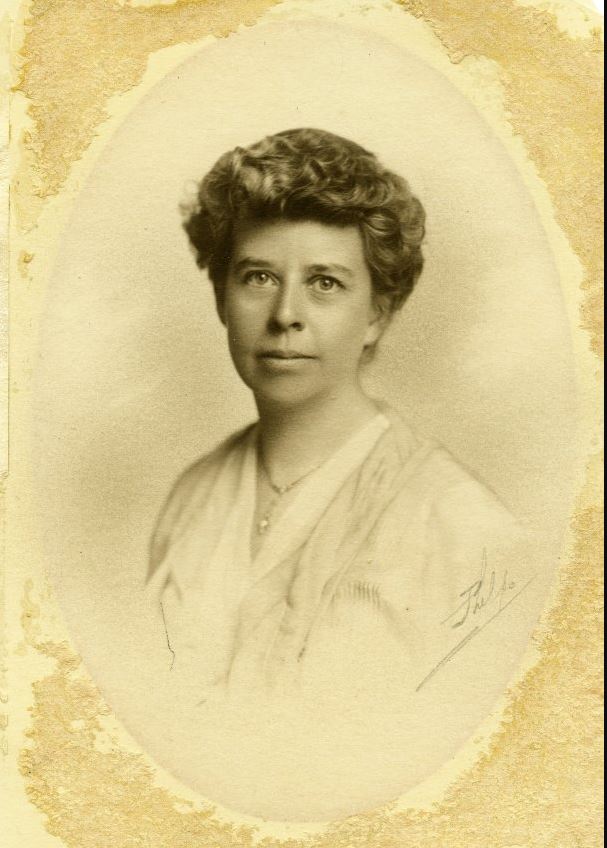
The image above of Captain Ira Charles Krupp appears in the Honor Roll of Ohio, 1917-1918, Erie County Edition. He served as a Captain in the Fourth Corps Artillery Park during World War I.

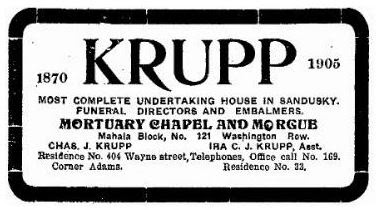
Ira C. Krupp was the son of funeral director Charles J. Krupp and the former Ida May Palmerton. At the turn of the twentieth century, the Krupp family resided at 404 Wayne Street, the former home of Oran Follett, which is now known as the Follett House Museum.

In 1901, Ira Krupp graduated from the Renouard training school for embalmers in New York City. By 1905, he was an assistant at the Krupp Mortuary Chapel. The Sandusky Star Journal of February 27, 1905 reported that he was seriously ill with blood poisoning that he had contracted through a small cut on his skin while embalming someone who had died from the same ailment. For a time, doctors thought they may have to amputate young Krupp’s arm. Fortunately, he recovered.


In 1906, he took a job as a sales representative with a large chemical manufacturing company, working in Boston, and traveling throughout New England. He married Emeline Moss in 1907; she was the daughter of Sandusky banker Charles H. Moss and the granddaughter of Judge William Griswold Lane.

The December 5, 1908 issue of the Sandusky Register featured an article that stated Mr. Krupp was now the proprietor of “Ye Oak Meadow” stock farm and dairy, on South Hayes Avenue. He had recently been at a large farm and dairy exhibit in Chicago, where he purchased a Guernsey bull, Messmate of Ingleside. He said about the animal, “It is one of the finest specimens I have ever seen in all of my experience and is bound to attract the attention of stockmen near and far.”

In 1917 and 1918, Ira C. Krupp achieved the rank of Captain with the Fourth Corps Artillery Park. While in military service in Germany during the war, Ira was the editor of the first American newspaper printed in Germany. The paper was called the “Fourth Corps Flare,” and was considered the official organ of the Fourth Corps Artillery Park. An article in the March 25, 1919 issue of the Sandusky Register featured an article about the publication.


After returning home from military service, Mr. and Mrs. Ira Krupp sold their land in Perkins Township, and moved to Black Hall, Connecticut, where they lived for several years. Ira Krupp died in 1935. His remains were returned to Sandusky. The final resting place of both Mrs. and Mrs. Ira Krupp is in the Lane family lot at Oakland Cemetery in Sandusky, Ohio.

Mrs. Ira Krupp, the former Emeline Moss, was once on the Board of Trustees of the Sandusky Library Association. Mrs. Krupp died in 1957 in Connecticut.


Though Ira and Emeline Krupp lived their final years in Connecticut, they had strong family ties to Sandusky and Erie County, Ohio. Visit the Sandusky Library Archives Research Center if you would like to research your own ancestors from Erie County, Ohio.

Sunday, November 06, 2022

"OLEIDA"


OLEIDA is an acronym for the Ohio Lake Erie Island District Association, which was an organization that promoted tourism in the north central portion of Ohio, later known as “Vacationland.” In July of 1931, uniformed Boy Scouts passed out OLEIDA booklets and area maps at the southeast and northwest corners of Wayne and East Washington Streets.

An advertisement in the July 3, 1930 issue of the Sandusky Star Journal stated that the Lake Shore Electric Railway was the direct line to “Oleida.”


The Sandusky Star Journal of July 11, 1931 announced that Put in Bay would be celebrating “Oleida Day” on July 14, during the Interlake Regatta.


In the winter of 1932-1933, Sandusky area merchants sponsored a contest in which young ladies in Sandusky could win a trip to Bermuda, while ladies from the region outside Sandusky could win a trip to New York and Washington D.C. For every dollar spent at each merchant, 100 votes would be cast for the lady of your choice. The Sandusky Register of January 18, 1933 reported that Alice Mix was chosen as “Miss Oleida” and Mildred Cullen had won the title of “Miss Sandusky.”


During the Depression years of the 1930s, Sandusky area residents’ days were brightened by the promotional activities of the Ohio Lake Erie District Association, and visitors from other parts of the state and country were introduced to the joys of fishing, boating, and other activities found in the north central part of Ohio.

Wednesday, November 02, 2022

The Sandusky High School Band was Busy in 1936


In 1936 the Sandusky High School Band gave a series of free Sunday afternoon concerts, under the direction of Byron F. Aldrich. In February, the band played for the Sandusky Auto Dealers car show held at the Sandusky Junior High School.

The Sandusky Star Journal of March 13, 1936 reported that the Sandusky High School Band played for the Style Promenade put on by the M.R. Herb store at the Junior High School. Elmer Bauer also played selections on the Frohman Memorial organ at the style show. Over three thousand were in attendance. The band also provided musical entertainment for the Postmasters Convention at Cedar Point in June as well as for the district meeting of the American Legion in November.

A large concert put on by the Sandusky High School Band took place at the Sandusky Junior High School in December 11, 1936. For this concert, the admission fee was 25 cents (about $5 today). Hundred of area businesses also sponsored the band concert, and were listed in the Sandusky Star Journal on December 10, 1936.


Byron F. Aldrich directed the Sandusky High School Band from 1923 until 1955. Many Sandusky High School alumni honored Mr. Aldrich at a dinner in the fall of 1981.

The former band director is quoted in the article, from the Sandusky Register of September 20, 1981, “Maybe I can’t remember all the names, but I can remember just where each one sat when they were in the band.”


Byron F. Aldrich passed away on October 6, 1984. He and his wife Florence are buried at Oakland Cemetery. Mr. Aldrich touched the lives of many during his long tenure at Sandusky High School.