Tuesday, April 03, 2018

Congregational Church Cookbook


In 1909 a committee was formed to publish a cookbook by the members of the Congregational Church in Sandusky. It was printed by the Register Publishing Company.The preface read, in part: “We endorse all the literature between these covers, and hope that young housekeepers may find it a subtle oil for the cog-wheels of domestic machinery, and that older housewives may find it a refuge when harassed by the cry, ‘Can we never have anything new?’” The cookbook is filled with recipes that are arranged in over twenty categories. Throughout the book are blank pages, so that owner of the book could add their own recipes to the book. There is an index at the back of the book, and many advertisements from local businesses are scattered all through the cookbook.  Below is an excerpt from page 20,  which gives information about how to make roast meat and gravy.


Accompanying the recipe for almond cookies is a poem about how many weary mothers wish for a cookie bush or a doughnut tree.


Five ways to prepare cabbage are provided on this page from the vegetable section of the Congregational Church Cookbook.


Koehler Brothers and Weier Brothers were just two of the local companies that placed advertisements in the cookbook.
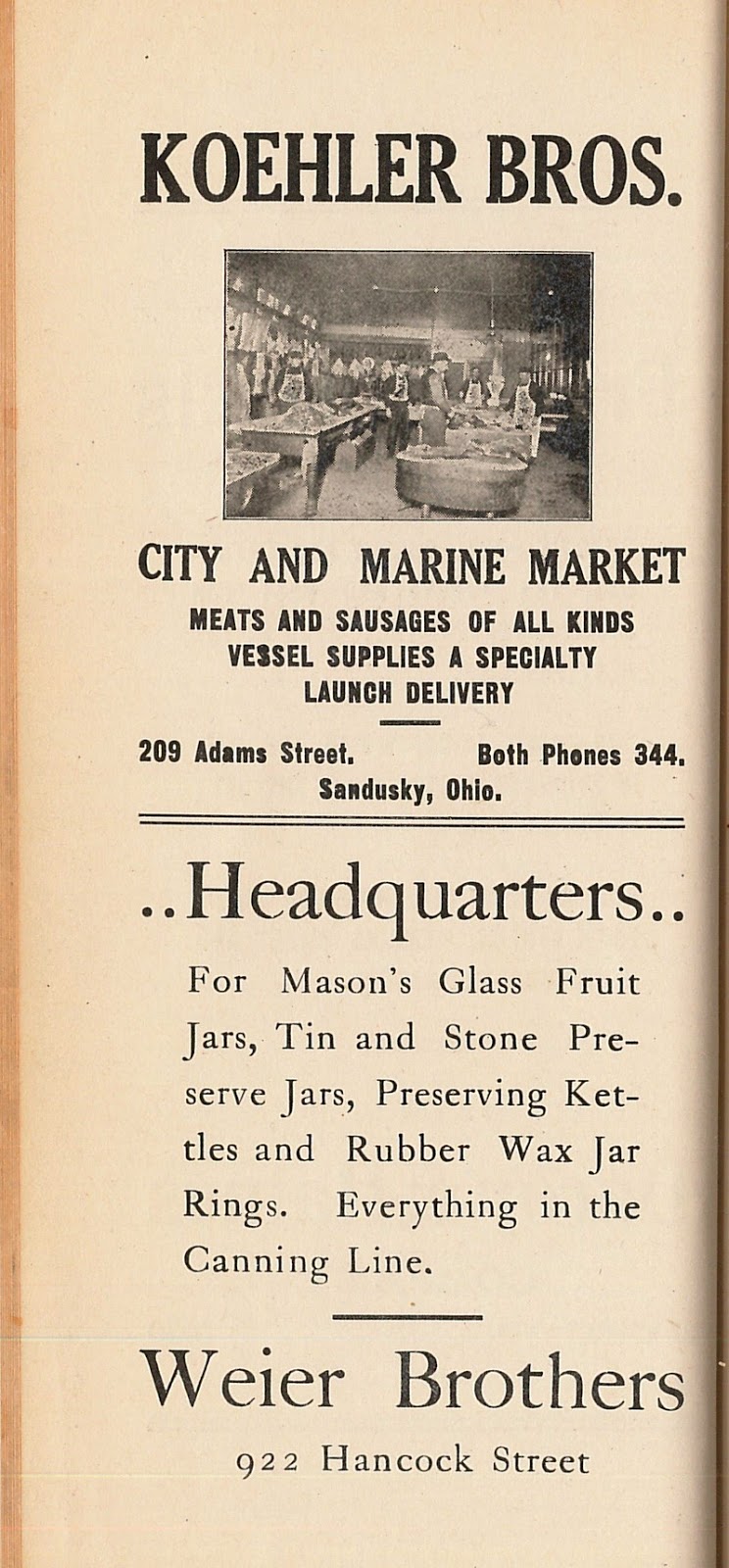


Looking through the pages of the Congregational Church Cookbook gives us a look into the lives of past residents of Sandusky, indicating where they may have shopped and what kind of meals they made for their families. Visit the Sandusky Library Archives Research Center to view this vintage cookbook.

Saturday, March 31, 2018

The Carter Sisters, Sandusky Schoolteachers


In the picture above, taken in July of 1945,  are three Carter sisters, along with three identified individuals. The three older ladies are (left to right): Minnie Carter, Lucy Carter, and Frances Carter. The Carter sisters were the daughters of Robert and Mary Ann Carter, who were natives of England. Robert N. Carter was born in Yorkshire, England in 1855. He came to the United States with his wife Mary Ann and young daughter Emily in 1865. The next three Carter children were born in the United States, including William, born in New York in 1865; Lucy, born in New York in 1868; and Frances, born in New Jersey, in 1871. 

By 1873, the large Carter family was residing in Sandusky, Ohio, where Robert was employed as a plane maker. Mr. and Mrs. Carter had two more children, Minnie, born in 1874, and Amelia, born in 1879. Mrs. Mary Ann Carter died shortly after birth of her youngest child Amelia, known fondly as Millie. When Amelia was only 10, Robert N. Carter died, on March 13, 1899. It is no surprise that after the death of their parents, several of the Carter siblings were residing with their older sister Emily in 1900. By that time, Emily had married George Siggens. Lucy, Frances and Millie Carter all became teachers. In 1955, an article in the May 28, 1955 issue of the Sandusky Register stated that Lucy Carter was believed to be the oldest living teacher in Sandusky, though by then she had been retired for several years. She had taught at Sycamore School and Campbell School, as well as at the Junior High and High School in Sandusky.


Lucy said she was very proud of her former students,who included Attorney Russell Ramsey and Sandusky City Manager Karl Kugel. All of the Carter siblings are buried at Sandusky’s Oakland Cemetery. I am sure that Lucy and all her siblings were also very proud of their nephew, Ernie Siggens, the son of Emily Carter Siggens. Ernest “Ernie” Siggens was a standout athlete at Sandusky High School, and later served as Sandusky’s Mayor. He died at the age of 37.


Wednesday, March 28, 2018

Tolls on the Sandusky Bay Bridge


When the old Sandusky Bay Bridge opened on February 2, 1929, people from both Erie and Ottawa Counties were delighted to have direct automobile access across Sandusky Bay. The thousands of tourists to the Lake Erie Islands region were also very glad to have a quick and easy way to travel across the bay to get to their favorite beach or fishing spot. The bridge was originally operated by the Sandusky Bay Bridge Company, which charged each vehicle fifty cents to cross the bridge. On May 1, 1936, the State Bridge Commission of Ohio took over operation, and immediately  reduced the toll from fifty cents to twenty-five cents. A toll collector was stationed near the drawbridge.


In the close up below, you can clearly read the sign which states the fee for autos is twenty five cents.


On Friday, August 30, 1946, Governor Frank J. Lausche cut the tape across the bridge span near the toll gate, and the Sandusky Bay Bridge became toll free. The first car to head west on the bridge after the ribbon cutting was Howard Higgins of Rochester, New York. The driver of the car traveling east on the bridge was Jay Johnson from Los Angeles, California. You can read more about the Sandusky Bay Bridge becoming toll-free in the August 31, 1946 issue of the Sandusky Register Star News, now on microfilm at the Sandusky Library Archives Research Center. 

The Sandusky Bay Bridge ceased operations in the mid-1980s. Today drivers cross the Sandusky via the Thomas A. Edison Memorial Bridge.

Sunday, March 25, 2018

A Sandusky Team at the American Bowling Congress Championships, 1961


Though these men have not been identified, it appears that they were all on a bowling team during the American Bowling Congress Championships held in Detroit, Michigan in 1961. The same men are in the picture below.


An article on the sports page of the March 31, 1961 issue of the Sandusky Register reported that the Sandusky Bowling Association was going to be sending a squad of bowlers to the American Bowling Congress to be held in Detroit at the “glamorous Cobo Hall.”


If anyone knows who the men are in the group photograph, please leave a message in the comments field of this blog post.

Thursday, March 22, 2018

Who Were Herb and Myers?


Mr. Michael R. Herb and Frank H. Myers were partners in the Herb and Myers Company for over twenty-five years in downtown Sandusky. At one time Herb and Myers was one of the largest department stores in northwest Ohio. An article in the Sandusky Register of February 22, 1900 stated that the business had its formal opening on February 21, 1900. The first location was in the Mahala Block on Washington Row. By 1910 the company had purchased the “Big Store” on East Market Street, which had previously been owned by C.L. Engels. Both Mr. Herb and Mr. Myers had been previously employed at the Big Store. Below is an image of the Herb and Myers store when it was on East Market Street, in the former Big Store location.


Michael R. Herb was born on July 26, 1870, to Mr. and Mrs. Michael Herb, both natives of Baden, Germany. Below is a picture of Michael R. Herb in 1924. The elder Mr. Herb was a Civil War veteran, and he worked as a stone mason in Sandusky, Ohio for many years.


Frank H. Myers was born on June 30, 1875 to Mr. and Mrs. Max Myers. Max Myers had been born in Germany. In 1880, the family resided on Jefferson Street in Sandusky, and Max listed his occupation simply as “laborer.” This picture of Frank H. Myers was taken in 1927.


Throughout their long years of being in business together, Mr. Herb and Mr. Myers sold thousands of dollars of merchandise to residents in the greater Sandusky area. They sponsored bowling and baseball teams. Herb and Myers advertised heavily in local newspapers.


During the First World War, the Herb and Myers Company contributed to the Erie County Liberty Loan Committee, and printed a patriotic songbook for local residents. 

An article in the May 31, 1933 Sandusky Star Journal reported that M.R. Herb had bought out Mr. Myers’ stock in the company. Following a big liquidation sale, the store formerly known as Herb and Myers changed its name to the M.R. Herb Company. This notice appeared in the Sandusky Register of July 6, 1933.

The M.R. Herb Company continued in business until 1939, when it was destroyed by a massive fire in downtown Sandusky. Mr. Michael R. Herb died on November 6, 1962, at the age of 92. He was buried in Calvary Cemetery in Sandusky, Ohio. Frank H. Myers founded the Sandusky Folding Box Company in 1931, with James Plain, and retired as that company’s president in 1955.  Mr. Myers passed away on February 22, 1965, at the age of 89. He was buried in Section L of Sandusky’s Oakland Cemetery. Both Mr. Herb and Mr. Myers are remembered as being vital members of the community. Many of our grandparents and great grandparents probably shopped at the Herb and Myers store.

Monday, March 19, 2018

When St. Stephen’s Church was at the Corner of Lawrence and Jefferson


St. Stephen United Church of Christ began in Sandusky in 1882 as St. Stephen German Evangelical Protestant Church. It was located at the intersection of Poplar, Lawrence, and Jefferson Streets. In 1886 the Rev. Ernst Von Schulenberg was the pastor. He is well known as the author of Sandusky Einst und Jetzt, later translated to Sandusky Then and Now, which chronicles the lives and activities of Sandusky’s early residents of German descent. 

This picture of the interior of St. Stephen’s Church once belonged to Norbert A. Lange. A large pipe organ and several wooden pews are visible inside the church.

 
This organization at St. Stephen’s was known as the Crusaders.

 
The church changed its name to St. Stephen Evangelical and Reformed Church in 1934, and was renamed again in 1957 to St. Stephen United Church of Christ. On April 25, 1965 the church dedicated its new church building at 905 East Perkins Avenue. Photographer Robert Frank took this picture in 1982.

 
Visit the Sandusky Library to learn more about the churches of Sandusky. The historical Sandusky city directories contain church listings that  provide the name and location of the churches in town as well as listings of clergymen.

Wednesday, March 14, 2018

A Plan in 1945 to Drain Sandusky Bay?


Known as the Post-War America Beautiful Commission Project No. 2211411, an interesting plan was set forth in which Sandusky Bay was to be drained, and a concrete wall was to be built from Sandusky Bay to the Sandusky River. Another sea wall was to connect Cedar Point to the eastern end of the Marblehead Peninsula. The result would be the draining of underground caverns from Sandusky to Bellevue. Once the Sandusky Bay was drained, there would be room for a gigantic parking lot for all the visitors to Vacationland. Sound preposterous?


The Sandusky Register Star News of March 14, 1945, reported that the project was the subject of a skit put on at the annual dinner of the Chamber of Commerce, held at Jackson Junior High School. Judge G.W. Collinworth, an employee of the Trojan Powder Company, portrayed the character of secretary of the Post-War America Beautiful Commission. Members of the audience asked him questions. The news article reported that the humorous skit was “a big hit.” Visit the Sandusky Library Archives Research Center to read more about this skit, which of course was never meant to be taken seriously.

Note: There were several obvious mistakes on the fictitious map, including the placement of Elyria on the Marblehead peninsula and Perry Memorial on Kelleys Island.

Saturday, March 10, 2018

The Donahue Building


The building at 126 Columbus Avenue, now home to a resale shop operated by Stein Hospice, began as a bank building. The Moss Brothers Bank, founded by Augustus H. and Horace Moss, was at this location in the early 1850s.


In 1914, C. Faber and Frank Donahue moved their hardware store from Water Street to what is now 126 Columbus Avenue. Ellie Damm wrote in her book Treaure by the Bay (Western Reserve Historical Society, 1989), that the Donahues added the brick façade to the building as well as the stone carved name “Donahue” under the cornice. You can see the original limestone on  the south side of the Donahue building. Interestingly, Ellie Damm, who was well known for her efforts in local preservation, was a descendant of the founders of Donahue Hardware. In 1920, Lew and Ira Wiles purchased this property, and they ran the Dixie Cafeteria here. If you look closely, you can see the sign for the cafeteria in the picture below.
   

Many area residents will recall that the Sherwin-Williams store was in business at 126 Columbus Avenue from 1952 into the 1990s.


Tuesday, March 06, 2018

Group Photos on the Erie County Courthouse Steps


Though we do not know the names of the people in this group, we do know that this photograph was taken by commercial photographer E.H. Schlessman in the first quarter of the twentieth century. The men, and one lady, are posed on the steps of the Erie County Courthouse, prior to the 1930s Art Deco renovation. Most of the men are in jackets and ties, and several are holding their hats. Many of the gentlemen are wearing a small pin on their lapel, which may indicate membership in a local fraternal organization.  This picture was taken in the same location as the ladies of the first jury of women in Erie County on August 26, 1920.


Sunday, March 04, 2018

Leo Wagner, Florist

Leo Wagner began as a florist in Sandusky in 1910. He opened a new shop at the corner of Columbus Avenue and East Monroe Street in 1918. Two interior views of the Wagner flower shop are found in the historical photograph collection of the Sandusky Library Archives Research Center.

              
A company aadvertisement in the November 12, 1927 issue of the Sandusky Register declared that flowers could be telegraphed anywhere.

 
Mr. and Mrs. Wagner hosted the October 1931 meeting of the Sandusky Garden Club. The program included viewing architect’s drawings of the garden planned on the property of the Wagner home on Monroe Street, adjacent to the flower shop. Later, Mr. Wagner showed club members an exhibit of shrubs and hardy chrysanthemums at his shop. In the photograph below, the flower shop can be seen on the left side of the picture, and the Wagner home is on the right.

  
An article in the October 10, 1941 issue of the Sandusky Register Star News reported that the Wagner flower shop was considered one of the finest shops in the country. In the fall of 1941, he sold the property to Dorothy and Edward Russell, a brother and sister who were florists. Many local residents will recall Russell’s Flower Shop which was in business at that site for fifty years.