Showing posts sorted by date for query william henry harrison. Sort by relevance Show all posts

Tuesday, July 20, 2021

Paul F. Laning, Teacher and Railroad Historian


Paul F. Laning was a teacher at Sandusky High School for thirty years. He had previously worked for the Nickle Plate Railroad and taught at Kirtland, Ohio for five years. After retiring from Sandusky High School in 1968, he served as bailiff in the Erie County Court of Common Pleas for six years. Though Mr. Laning had been the head of Sandusky High’s English department, he was extremely interested in history, particularly the history of railroads. His Master’s Thesis at Ohio State University was: The History of the Lake Shore and Michigan Southern Railway in Ohio. 

Mr. Laning was a popular guest speaker for area clubs and organizations. In 1953 he unearthed an original account of the May 1838 trip of David Campbell, founder of the Sandusky Clarion newspaper, on the Mad River and Lake Erie Railroad, to and from Bellevue, Ohio. Campbell was amazed that the return mile trip of fifteen miles from Bellevue to Sandusky took only forty five minutes by rail (about 20 miles per hour). This story of the first commercial trip of the Mad River and Lake Erie Railroad appeared in the June 19, 1953 issue of the Sandusky Register Star News.

Featured in the Twin Anniversary Edition of the Sandusky Register and Star News, November 24, 1947, is an article about the History of Steam Railroads in Erie County, written by Mr. Laning.


He wrote that Eleutheros Cooke and other Sandusky leaders had been quite upset over Cleveland becoming the northern terminal of the Ohio and Erie Canal instead of Sandusky, but these civic leaders felt that Sandusky being chosen as a terminus for the the Mad River and Lake Erie Railroad compensated for the loss of the canal. General William Henry Harrison broke ground for the railroad at the corner of Water and Meigs Streets on September 17, 1835.

The sketch map below, drawn by Mr. Laning, shows Sandusky’s Railroads and competing routes in 1854.

A rough draft of a speech Mr. Laning gave, entitled Sandusky and Cleveland: Railroad Rivals in the 1850s, is on file in the Transportation Collections of the Sandusky Library Archives Research Center. Mr. Laning had a deep understanding of the history of Ohio Railroads, and he enjoyed sharing his knowledge with others.

Paul F. Laning died at the age on 90 on August 30, 1991. He had been a charter member and president of the Erie County Historical Society. He was also a member of the Firelands Historical Society, Ohio Historical Society, Mad River and Nickle Plate Railway Society, Erie County and Ohio Retired Teachers Associations and the Senior Men’s Fellowship Club of the YMCA.

Thursday, April 02, 2020

William H. H. Herbert, Businessman and Civic official


William Henry Harrison Herbert was born on April 24, 1839 in Hagerstown, Maryland. As a young man, he moved to Paw Paw, Virginia where he made his home with his sister. When the Civil War broke out, he fought for the Confederacy, enlisting in the 12th Virginia Cavalry. He spent time in a northern prison camp at Camp Chase in Columbus, Ohio. 

After the war ended, Mr. Herbert left his southern home, and moved north to Sandusky.  He married Elizabeth Davis Lea on November 15, 1877, and by the 1880s was engaged in the lumber business with J. D. Lea. In 1893, he was appointed collector of customs at Sandusky. He also served as a city councilman and on the board of the Water Works at Sandusky. 

On March 28, 1906, William H. H. Herbert died at the residence of his brother-in-law, Edward H. Marsh, on East Washington Street.


An article in the April 16, 1906 issue of the Sandusky Register said about Mr. Herbert, “He left his southern home and came north to engage in business and from that time to the day of his death conducted himself as a high-minded and honorable man of business, taking at the same time an active part in politics and also showing himself ready at all times to bear his share of any public burden connected with any enterprise for the good of the community in which he lived.”

Funeral services were held at the Edward H. Marsh home, with Rev. A.N. Slayton of Grace Church officiating. Members of the Elks and the city council and city officials were in attendance. Burial was at Oakland Cemetery. The pallbearers, all associates of Mr. Herbert were: Judge Thomas M. Sloane, C.W. Sadler, Fred Pickering, T. Pitt Cooke, C.T. Wight, Dr. John T. Haynes, W.H. Gilcher, and Alex M. Wagner. 

Saturday, April 13, 2019

Mary Cooke


Mary A. Cooke, the wife of Sandusky businessman Charles E. Cooke, was an early member of the Board of Trustees of the Sandusky Library Association. She was on the Board in 1870 when the Library Association of Sandusky was founded, and when it was incorporated on November 5, 1895. 

Mrs. Cooke was born Mary Augusta Turney. She married Charles E. Cooke on May 31, 1860. Besides serving on the Library Board, Mrs. Cooke was also very active in the Martha Pitkin Chapter of the Daughters of the American Revolution. She traced her roots back to Noah Hoyt, an ancestor who served as a private with the Connecticut militia during the time of the American Revolution. 

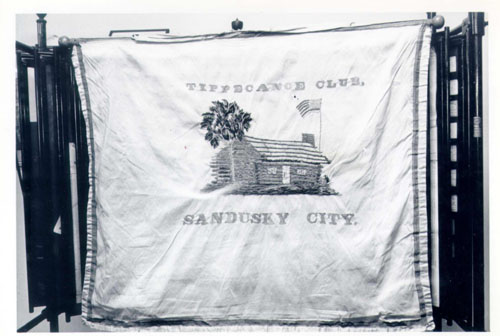
On December 16, 1900, the local D.A.R. celebrated the anniversary of the Boston Tea Party at Mrs. Cooke's home, at the southeast corner of Wayne and Jefferson Streets. Between the parlors of the Cooke home, was displayed the log cabin silk banner which was created by Sandusky women, to welcome William Henry Harrison to Sandusky in 1840. This banner is now in the historical collections of the Follett House Museum.

  
The people at the celebration wore colonial costumes. Colonial era refreshments were served, and a quartet led by Mrs. J.W. Andrews sang patriotic songs, to the accompaniment of Mrs. Frank Sloane on the piano. A summary of the celebration of the Boston Tea Party in Sandusky was featured in volume 18 of the Daughters of the American Revolution magazine. 

Mary Augusta Turney Cooke died at her Wayne Street home in Sandusky on May 4, 1917, after a lengthy illness. Rev. E.G. Mapes officiated at the funeral services, and burial was at Oakland Cemetery. Mrs. Cooke was survived by her daughter, two sisters and grandchildren.

Sunday, December 31, 2017

Harrison Ball, 1840


An invitation to the Harrison Ball of 1840 is on file at the Archives Research Center of the Sandusky Library. The ball was to be held at H. Victor’s Assembly Room on Thursday, December 31 at 5 p.m. This New Year's Eve festivity was in honor of William Henry Harrison, a fellow Ohioan, elected President earlier that year.

The managers of the ball were:

Maj. John G. Camp                 Henry D. Ward
Dr. Daniel Tilden                    Ebenezer B. Sadler
Oran Follett                             Charles Barney
Josiah W. Hollister                  Wm. Durbin, Jr.
Freeland T. Barney                 John M. Boalt
Sidney S. Hosmer                   Jno. G. Poole
Marshall Burton                      Lester S. Hubbard
Henry P Radcliff                    Theodore Hosmer
Davis Miller                            Alex. A. Camp
Dewitt C. Henderson              Jno. G. Camp, Jr.
Wm. A. Simpson                     Joseph B. Higbee

The list of names of people serving as managers of the Harrison Ball reads like a “Who’s Who” of early Sandusky. Major John G. Camp, Sr. fought in the War of 1812, and was active in the early years of Sandusky. Helen Hansen wrote in her book At Home in Early Sandusky, that Major Camp, along with Isaac Mills, Thomas Neill, and William Reese, laid out the addition known as “Southwark,” which was south of Monroe Street and west of Sycamore Line. John G. Camp, Jr. was an attorney in Sandusky, and he devoted a great deal of time negotiating plans for early railroad transportation in Ohio.

Dr. Daniel Tilden was a local physician who also was involved in the Underground Railroad:


Sidney S. Hosmer was an early Sandusky merchant, while his son Theodore Hosmer went west and became the first mayor of Tacoma Washington. 

Oran Follett was a prominent publisher in New York and Ohio, and his former home is now The Follett House Museum:


Ebenezer B. Sadler was a well liked early judge in Erie County:


Lester S.  Hubbard was a banker and prosperous businessman in Sandusky. Henry Clay Victor, whose Assembly Room was the location of the ball, was the father of Orville James Victor, author and editor.


To learn more about these and many other early residents of Sandusky and Erie County, visit the Archives Research Center. Here you will find county histories, historical journal and newspaper articles, and finding aids to the many archival resources available at the Sandusky Library.

Wednesday, May 10, 2017

Stone Houses Owned by Eleutheros Cooke

Between 1827 and 1835 several structures in the 400 block of Columbus Avenue were built by Eleutheros Cooke, Sandusky’s first lawyer.  You can see the properties on the 1893 Sanborn Fire Insurance Map.


You can still see the brackets along the top of the home, under which are geometric designs.


On the porch of the home that is now 410 Columbus Avenue, General William Henry Harrison was presented with a flag made by the ladies of Sandusky. That flag is now in the historical collections of the Follett House Museum.


This home is considered to be Sandusky’s oldest standing house, according to the Ohio Historic Places Dictionary. It was built in the Greek Revival style of architecture in 1821. In the 1890s, Dr. C.T. Stroud and his son had their dental offices at this location. An advertisement which appeared in the Sandusky Register Star News of April 4, 1945 indicates that a beauty shop and “normalizing salon” was in business here.


Through the years, several different medical practices were in business at his location. 

Just to the south of 410 Columbus Avenue is a double stone house, built from limestone, now with the address of 412-414 Columbus Avenue. William Robertson purchased this property in 1865 from the Cooke estate. For many years this structure has been used as apartments. There are doors on either side, at the street level and lower level.


The third stone building, now 416 Columbus Avenue, was razed in 1918 to make way for a Bell Telephone Company office building. The United Way now has its offices at this location. 

To learn much more about the many historic homes and businesses in Sandusky, see At Home in Early Sandusky by Helen Hansen, and Treasure by the Bay, by Ellie Damm, both available at the Sandusky Library. 


Tuesday, April 04, 2017

George W. Campbell and His Letter to Mrs. Hubbard


George W. Campbell was born in the state of New York to David and Mary Jones Todd Campbell on January 12, 1817. In the early 1820s he moved with his parents to Sandusky, Ohio, where his father published the Sandusky Clarion. The Clarion was the first newspaper published in the Firelands area, and was the predecessor of the Sandusky Register. Mr. Campbell worked with his father in the publishing business in Sandusky, until he relocated to Delaware, Ohio in 1849. In Delaware, he worked in the mercantile business. Later he devoted his pursuits to the propagation of a wide variety of fruits, and he became well known as a horticulturist. Mr. Campbell was best known for his promotion of the Delaware grape. The popular Delaware grape was known for its hardiness, productivity, and unsurpassed flavor and quality. 

George W. Campbell died on July 15, 1898 and was buried at Oak Grove Cemetery in Delaware County, Ohio. He was survived by his widow, the former Elizabeth Little. He had been president of the Ohio Horticultural Society and was appointed by President Rutherford B. Hayes as United States Commissioner to the Paris Exposition of 1878.  In 2002 an Ohio historic marker was dedicated at the former Campbell home, now the Delaware County Cultural Arts Center.


A letter from George W. Campbell to Mrs. Jennie West Hubbard is housed at the Sandusky Library Archives Research Center. Mrs. Hubbard was working on a project to collect biographical information about women who resided in the Western Reserve before 1850. She was hoping that her relative, Mr. Campbell, could tell her some of the birth and death dates of their mutual female relatives. It turns out that he did not recall the dates exactly, but he did remember with fondness the work that several Sandusky ladies did when creating a banner for the visit of William Henry Harrison to Sandusky. The letter and transcription are below.


Delaware, O., June 3, 1896
My dear Jennie:
            I am really ashamed of myself for allowing your letter of last March to remain so long unanswered, asking for information about the pioneer women of the Western Reserve; and I now regret that I am unable to give you so little of interest. I have somewhere, a book of records of my father’s family; but it has been mislaid, and I have been unable to find it; but I am not certain that it contains much. I have filled out the blank record of names you sent me, as far as I can. I have not the date of Aunt Eleanor’s birth or death – but I think they are recorded on her headstone in the cemetery of Sandusky. Of Wealthy’s record, I have only the state of her marriage to brother Henry.
            As to that flag, I am sorry my memory is so indistinct. I feel certain that Aunt Eleanor did work on a flag, and I think I saw the design; but cannot recall much about it. I was under the impression that it was modeled in whole or in part from the inclosed picture which I drew for the heading of a little campaign paper printed in the days of “Tippecanoe and Tyler too,” and had engraved at Buffalo by Mr. J.W. Orr. If you find the design on the flag is the same, or substantially so, you may be pretty sure that it is the same upon which Aunt Eleanor and other ladies worked. When I come to Sandusky, as I hope to do sometime this season I will investigate it and I think the sight of the flag will enable me to mark the names on the printed list which enclose also. When I am in Sandusky, perhaps I may be able to give you some items of interest with your assistance in prompting me as to what you would like to have.
            We are in health about as usual. Weather has been pleasant generally, with play of rain and sunshine; and lately cool, but without frost. Everything sure now must propicous for a fruitful answer, if we are not visited by storms or hail or cyclones. I sincerely hope you and your family and all the connections are well and happy, and that you and your mother – my sweet little Auntie had a delightful visit at Cincinnati. With kindred love from both, at this end of the line. I am affectionately and truly yours.
                                                            George W. Campbell

Saturday, April 23, 2011

Services Held in Honor of President William Henry Harrison

Grace Episcopal Church held a special service in honor of recently-deceased President William Henry Harrison on Friday, April 23, 1841. The Order of Exercises included two Odes by the choir, as well as a choral anthem. Prayers were led by the Rev. I.A. Hart and Rev. A.W. Curtis, and the eulogy for President Harrison was give by the Rev. B.H. Hickox. William Henry Harrison was the ninth United States President, serving from March 4, 1841 to April 4, 1841, the shortest term of any American president. He died after he caught a cold that developed into pneumonia.

Before he became President, William Henry Harrison was a frontier leader who fought in several battles during the early Indian wars. He was known his victory over Shawnee chief Tecumseh at the Battle of Tippecanoe on November 7, 1811. During the War of 1812, he commanded the Army of the Northwest as Brigadier General. He became a national hero after the defeat of the combined British and Indian forces at the Battle of the Thames.

In September of 1835, Harrison was in Sandusky to officiate at the groundbreaking of the Mad River and Lake Erie Railroad.

During his presidential campaign in 1840, William Henry Harrison visited Sandusky. The ladies of Sandusky presented him with this embroidered banner in honor of the campaign.
The banner is still on display at the Follett House Museum. The story behind this banner is related on page 13 of the October 1896 issue of the Firelands Pioneer, available in the Genealogy section of the Sandusky Library.

Today few would agree with William Henry Harrison’s views on slavery and Native Americans, but in his day he was heralded as a military hero by the residents of Sandusky, Ohio.

Wednesday, May 13, 2009

William Henry Mills, Vintner

Pictured below is the former home of William Henry Mills. The home was located on the south side of Melville Street, between Camp and Pearl Streets. An article in the December 21, 1922 Sandusky Register featured an article about the home. The house was built for William H. Mills in the 1820’s, when he was a college student. William H. Mills graduated from Yale University in 1825. William T. West and R. B. Hubbard attended parties in the two large parlors on the second floor. Later the home was owned by Mrs. Daniel Newton. (The home no longer stands.)

William Henry Mills was the son of Isaac L. Mills and Abigail Phelps Mills. Isaac L. Mills was one of the proprietors of Sandusky, and was one its earliest settlers. According to Helen Hansen’s At Home in Early Sandusky, the Mills family was closely associated with the development of the Firelands and Sandusky. Mills Street and Mills School are both named for the Mills family. Most of the land holdings of the Mills family were in the Western Liberties section of town. William Henry Mills married Caroline Hurd, the daughter of James C. Hurd, who died in a shipwreck in 1829. They had a large family, and lived in a house on Washington Row, where the Mahala Block later stood.

The June 1937 Firelands Pioneer reported that when ground was broken for the Mad River and Lake Erie Railroad in 1835, a procession was formed in from of the Verandah Hotel, with General William H. Mills as marshall, assisted by Major White and Captain Kenney. General William Henry Harrison came to Sandusky for the great occasion.

In 1861, William Henry Mills began raising grapes for wine. According to History of Erie County, Ohio, ed. by Lewis Cass Aldrich, the first wine from the Mills vineyard was pressed in 1865, and “since which time he has produced an average of 15,000 gallons per year.” Brands of champagne produced by William H. Mills were Sans Pareil and LeDiamont. The following entry appeared in the “Reports and Awards” listings for the United States Centennial Commission’s International Exhibition of 1876. Exhibits of Group IV, which included animal and vegetable products, were on display in the Agricultural Hall.
The wine cellars of William H. Mills were located on the north side of Monroe Street, adjacent to Sandusky Bay, as pictured below in the 1886 Sanborn Map.

William Henry Mills died on March 8, 1897. His obituary appeared in the March 9, 1897 issue of the Sandusky Register. He is buried in the Family Plot in Sandusky’s Oakland Cemetery. You can read about the son of William H. Mills, Judge Grayson Mills, in Patty Pascoe’s book, Elected to Serve Erie County, found at the Archives Research Center of the Sandusky Library. A biography of Sallie Mills Johnson, the daughter of William H. Mills, is found in the book, American Women: Fifteen Hundred Biographies, which is accessible on Google Books.

Wednesday, September 10, 2008

Oliver Hazard Perry’s Victory at the Battle of Lake Erie

Oliver Hazard Perry became a national hero after his victory at the Battle of Lake Erie on September 10, 1813. Perry’s words to William Henry Harrison, “We have met the enemy and they are ours,” have become immortalized. The New York Times covered the celebration of the 45th anniversary of Perry’s Victory in 1858. In 1911 A.G. Field’s minstrels featured a reproduction of Commodore Perry’s victory in “The Naval Review,” which played in Sandusky on May 12. In September 1913 citizens of Sandusky hosted a two-day celebration commemorating the one hundredth anniversary of Oliver Hazard Perry’s victory at the Battle of Lake Erie. The September 8, 1913 headline from the Sandusky Register stated that the Perry Parade was “to be the grandest street spectacle ever witnessed here.” Every downtown street was decorated with flags, bunting and electric lights. 5,000 people marched in the parade, in which there were twelve bands and one hundred floats.
The U.S. Brig Niagara was reconstructed and sailed into Sandusky Bay from Erie, Pennsylvania. Participants in the grand celebration included former President William Howard Taft, Lieutenant-General Nelson A. Miles, and the governors of eight states:Governor James M. Cox of Ohio, Governor Samuel Ralston of Indiana, Governor James McCreary of Kentucky, Governor Woodbridge Ferris of Michigan, Governor John Kinley Tener of Pennsylvania, Governor Aram J. Pothier of Rhode Island, Governor Edward Dunne of Illinois, and Governor Francis McGovern of Wisconsin. Rev. A. J. Carey of Chicago honored the over one hundred African American seamen who served under Commodore Perry. The festivities concluded with a banquet for eight hundred guests at the Hotel Breakers at Cedar Point.

Perry’s Victory inspired books, songs, and paintings, and the city of Perrysburg was named after Oliver Hazard Perry in 1816. You can visit the Perry's Victory and International Peace Memorial at Put in Bay. From atop the Doric column, one can see for miles across Lake Erie. On June 2, 1936 President Franklin Roosevelt established the Perry Victory and International Peace Memorial as part of the National Park Service.

Friday, April 25, 2008

Whigs in Sandusky

For those of you not tired of politics yet. . . .

The Whig Party was active in the United States from 1834–1856, having been formed by those who were strongly opposed to the tyrannical leadership of Andrew Jackson. The Whigs elected two American Presidents, William Henry Harrison in 1841, and Zachary Taylor in 1849. Both Presidents died before their terms ended.

Several Erie County residents were active in the Whig Party. Joseph M. Root, who held many political offices throughout his career, was elected as a Whig to the twenty-ninth Congress of the United States. Judge E. B. Sadler and Homer Goodwin, a well known Sandusky lawyer, both started out their careers as members of the Whig Party.

Newspaper editor Oran Follett, pictured below, was a staunch Whig leader in the 1840’s.
Sandusky’s first lawyer, Eleutheros Cooke, was elected to Congress as an anti-Jacksonian (later, Whig), serving from 1831 through 1833.
An earlier blog entry describes William Henry Harrison’s visit to Sandusky in 1840 when he was the Whig presidential candidate. The ladies of the town created a special banner in his honor. The October 5, 1852 issue of the Daily Commercial Register lists the names of fifty members of the Common Council of the city of Sandusky, who were planning a reception for General Winfield Scott. The council members, without regard to party, planned to welcome General Scott to the “hospitalities of the city, on the occasion of his approaching visit.” Though Scott lost the election, he had a multitude of supporters in Sandusky.

Eventually the Whig Party fell apart due to disunity on the issue of slavery. Most Whigs in the Northern United States joined the newly formed Republican Party. An excellent article about early Ohio political life is found in Edgar Allen Holt’s “Party Politics in Ohio: 1840-1850” available online through the Ohio Historical Society.

Monday, October 23, 2006

Political Campaigns in Sandusky

As election day is approaching, it's a good time to talk about political campaigns that passed through Sandusky. I know it's not a presidential election year, but let's talk about some candidates for President of the United States who made campaign visits to Sandusky.


Possibly the earliest campaign visit to Sandusky by a presidential candidate was in 1840, when William Henry Harrison, the Whig Party candidate, came to town. To commemorate his visit, several women of Sandusky (including Mrs. Eleutheros Cooke) created an embroidered banner in honor of the campaign (shown above in a b&w photo). The banner, showing a log cabin on one side and an eagle on the other, is on display at the Follett House Museum. This story behind this banner is related on page 13 of the October 1896 issue of the Firelands Pioneer, available in the Genealogy section of the Sandusky Library.

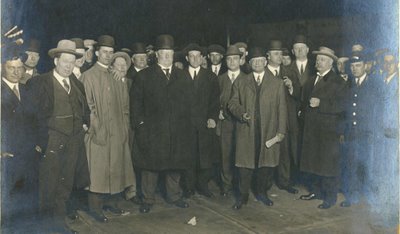
During his successful 1908 presidential campaign, William Howard Taft spoke at the Ohio Soldiers' and Sailors' Home (now the Ohio Veterans Home). The photo below shows the soon-to-be President-Elect with a group of local dignitaries outside of the Soldiers Home. Taft was a close friend of Sandusky resident Edward Marsh, and apparently visited the area several times for social occasions.


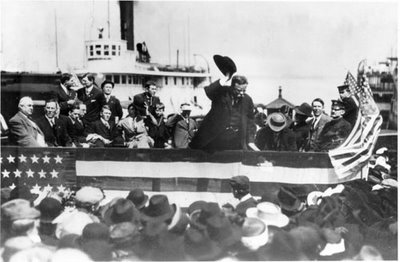
Taft's former political ally, Theodore Roosevelt, became his political opponent during the 1912 presidential campaign. Believing that Taft betrayed the progressive principles that formed the core of Roosevelt's beliefs, "TR" ran for president that year as the candidate of the Progressive Party (often called the "Bull Moose" party, in honor of a popular nickname for Roosevelt). In May of that year, Roosevelt gave a whistle-stop speech at the foot of Columbus Avenue to a large crowd of Sanduskians. Here is one of several images of that event from the library's photo collections:

In the 1916 election, Charles Evans Hughes was the Republican candidate for president, seeking to unseat President Woodrow Wilson from his position. In September 1916, Hughes gave a speech in front of the American Crayon factory on Hayes Avenue. (Unfortunately, that photo will not post properly on Blogger.)

Another interesting local story of presidential campaigns can be found in the November 11, 1940 issue of Life magazine. In an article titled "The People's Choice," the publishers used Erie County, Ohio as a microcosm for the nation, with images of local residents and descriptions of why they chose to vote the way they did. You can read the article, and see photographs of local residents of the time (as well as a picture of candidate Wendell Willkie in Sandusky), in the Sandusky Library. Ask a reference librarian for that issue of Life magazine from closed storage.