Monday, March 12, 2007

Erie County’s First Female Deputy

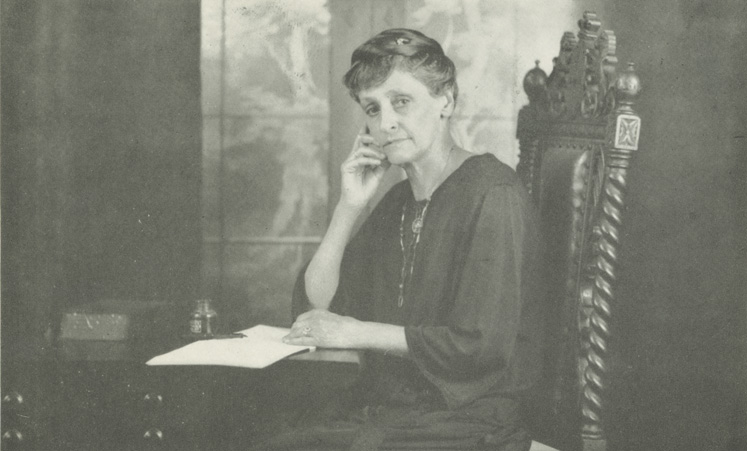
Fanny Facer Everett was a humane agent, probation officer and leading charity worker in Sandusky where she was beloved by the entire community. She was born in Sandusky and lived here most of her life.

For more than 20 years, she was connected with almost every form of benevolent and philanthropic work conducted by the general public in the city of Sandusky. For approximately 25 years, she was the leading figure in the Humane Society of the city and county. When the Erie County Humane Society was first organized in 1900, there were few members and very little financial means to help carry on the work.. For many years she acted as its first female humane agent without compensation and devoted her time, energy and strength to the work just as cheerfully, earnestly and enthusiastically as though it was her only pursuit in life. The activities of the society continued to expand and the society was finally able to render her financial assistance.

When the Federated Associated Charities was organized, Fanny Everett became its superintendent and had personal charge and direction of its expenditures.
When the juvenile court work was taken up by the probate court, Fanny was made probation officer—she was the first woman to be deputized by the sheriff of Erie County to carry a gun and make arrests.

For many years she was in charge of the distribution and adjustment of the mothers’ pensions for the county and also of the blind relief work.

It was said of her that there has perhaps never been a person in the city who was so thoroughly acquainted with the history of the people of the city who needed help, either in a financial, social or moral way. There was no one in the city to whom the weak and the erring would go so gladly, willingly and trustingly as to Mrs. Everett. Mrs. Everett’s home and her time and attention has been open both day and night to the many calls of the people of the city of Sandusky who have had trials and troubles and burdens.

Her son told a story about a memorable episode in her career: Late one night in 1902, she heard screams and cries for help coming from a house in the 200 block of Decatur Street, near where she lived. A man in a drunken rage was beating his wife and attacking his son and daughter. Fanny Everett marched straight to the house, knocked, and when the drunken man answered, she pointed her pistol at him and announced that he was under arrest. At the sight of the gun, the man raised his hands and begged “Don’t shoot, lady, don’t shoot.” Fanny replied, “You ought to be shot, but put on your shoes and you are going straight to jail.” The man obeyed and up Decatur Street they went, the man with his hands in the air. They reached the corner of Adams Street, where there was a saloon, one of the patrons, and finally a dozen or so, poured out of the bar. “Hey Joe!” they taunted, “The lady is taking you to jail, isn’t she?” When the man tried to answer, Fanny said “Keep your mouth shut and keep going.” In a few minutes they were at the door of the Erie County Jail where the man was quickly shown to a cell. At the trial the man was sentenced to ten days in jail. Fanny then took the wife and children to an attorney who advised the woman of her right to seek legal action for a separation and compulsory support payments. He urged her to seek a restraining order to protect her and the children. Many women at this time did not realize they had any legal rights against an abusive husband. Thus did Fanny Everett serve as a pioneer for social reform.

Thursday, March 08, 2007

Eliza Follett

Eliza Gill Ward Follett was born in Albany, New York on September 17, 1801 to Daniel and Martha Ward. Her father died during the war of 1812, and her mother found it impossible to keep the children together, so Eliza lived with various relatives, and worked at household tasks, often feeling neglected and lonely. She married Oran Follett on November 22, 1832 in Fairport, New York. They moved to Sandusky in 1834.

Mrs. Follett was a highly respected member of the community. She was described as “active, unostentatious and faithful worker in this city, doing good, relieving the afflicted, encouraging the fearful, smoothing the pathway of those tempted to go astray, and yet never for a moment forgetting or neglecting the duties she owed her own family. From one end of our city to the other, in out of the way places, in hovel, in every abode of want, this patient, tireless and cheerful spirit was at hand helping and comforting and blessing those who but for her love would have no friends on earth…. If pecuniary assistance were not needed, some more gentle means of relief than the supplying of bodily necessities were sure to be extended by this friend of humanity. A bunch of flowers left in the sick room, a cheerful word of token, slight in itself, yet bearing golden fruit, was ready to witness of unselfish devotion to others. But it was peculiarly to the soldiers and their families during the dark days of the war that Mrs. Follett proved a friend and a comforter. From the opening day of the war to its close she gave herself up to the watchful care of the soldiers and their families. Rain and storm, cold could not keep her back from what she called her duty and loved to regard as a privilege, and today there is no man in this city whose death would be mourned as a personal loss by so many men, women, and children as will be the death of this unassuming woman, who went about doing good because she loved to do good.”

A neighbor said of her “Unless Mrs. Follett was going to church or to some social function, I never remember seeing her leave the house without carrying a bowl of soup. A plate of dainties, a basket of fruit or cooked food, or a bunch of flowers for some sick, needy or lonely person.”

She was generous to a fault. Her gifts of food, clothing and coal were so substantial and so numerous that they taxed the purse of her willing but more prudent husband. She was known to take garments off her back and leave them where she found distress.

A tender and skillful nurse, she never failed to minister at the bedsides of the sick, often spending days and nights away from home during critical illnesses. During a small-pox epidemic, she walked unscathed through the danger of contagion and fearlessly nursed cholera patients with her husband’s help, when doctors and nurses could not be procured, thus saving many lives. Her granddaughter said that she led a charmed life, that she was so selfless, so absorbed in others that no ill befell her.

She felt strongly against slavery and helped countless slaves on their journey to freedom, clothing, feeding and warming them on their way to Lake Erie and Canada. Her husband, Oran Follett also sympathized with the slaves, however he would remonstrate her with “Wife, it is against the law” and she would say “Husband, there is a higher law.”

During the war, she emptied the parlors of furniture and local women met there to pick lint and make bandages which were shipped off to hospitals at the front.

Her granddaughter wrote “I never shall forget going to market with—the walk down Columbus Avenue was like a triumphal progress. It took a long time to make the day’s purchases, because people crowded around her for a smile or word of greeting, or to answer inquiries regarding their well-being and that of their families."

Eliza Follett died April 29, 1876 in Sandusky. Her funeral at the Presbyterian Church was crowded to standing room only, and there were hundreds more people lined up outside in their carriages, having come from all over northern Ohio to pay their silent tribute.

(The Follett family pew in the Presbyterian Church, decorated as a memorial to Eliza Follett.)

Tuesday, March 06, 2007

The First Female Jury in Erie County

On August 26, 1920, an important ‘first’ quietly took place at the Erie County Courthouse in Sandusky. Early that morning, the ratification of the nineteenth Amendment to the Constitution of the United States was certified. That Amendment read in part “The right of citizens in the United States to vote shall not be denied or abridged by the United States or by any State on account of sex. “ On August 18, 1920, Tennessee was the thirty-sixth state to ratify the nineteenth amendment. Ohio had ratified the amendment on June 16, 1919.

On the morning of August 26, 1920, at the Erie County Courthouse, Judge Roy Williams was to conduct the trial of Pennok Jeffries vs. the Pennsylvania Railroad, for an automobile accident that occurred in 1919, when a train car struck Jeffries’ automobile.

Ten men were summoned to serve on the jury, but nine offered excuses as to why they couldn’t serve. Having heard that the 19th amendment had been ratified, Judge Williams said “I decided to impanel a woman jury. Twelve women were summoned. Twelve women responded and twelve women served.”

The women were sworn in, the cases were stated, and cross examinations were made. When the statements were concluded, the judge gave the women of the jury their instructions and they retired to the jury room. They made their decision in four minutes and shortly returned to their seats in the jury box. They decided for the plaintiff, who was awarded $1500.

After the trial was over, the judge congratulated the women for their service on the jury. Each of the twelve women were paid two dollars for serving on the jury. This was the first all female jury in Erie County, and one of the earliest in the United States.

The women of the jury included Katherine H. Biller, Mary R. Boehmer, Sarah Cooke Sloane, Alice K. Hertlein, Alice D. Mack, Anna Sutton, Emma Broadbent, Sallie W.D. Neill, Mabel. L. Magill, Sarah C. Scott, Henrietta Zerbe, Bertrha Mitchell. The three men in the photo are Roy Williams, George Beis and Claude Minor.

This historic event was commemorated with an Ohio historical marker erected during Ohio’s 2003 Bicentennial. The marker is located near the north entrance of the Erie County Courthouse where the photograph of the women of the jury was taken.

Monday, March 05, 2007

Women's History Month -- Brown Bag Program

March is Women's History Month -- in honor that fact, this month's Brown Bag Lunch Series program will be about "Extraordinary Women of Sandusky." Join us on Wednesday, March 21, at noon, in the library program room, when Follett House Museum curator Maggie Marconi will talk about some notable Sandusky women -- including artists, a suffragist, a doctor, an opera singer, a probation officer, and the very first female U.S. Vice Presidential candidate.
. . . And be sure to come back to this blog for stories about women of Sandusky.

Thursday, February 22, 2007

James M. French: Businessman, Community Activist

Born in Sandusky around 1866 (believed to be the son of a former slave), James M. French achieved substantial success in the real estate and insurance professions, overcoming the obstacle of racial discrimination. Mr. French used his wealth and influence to serve the community and African-American youth.
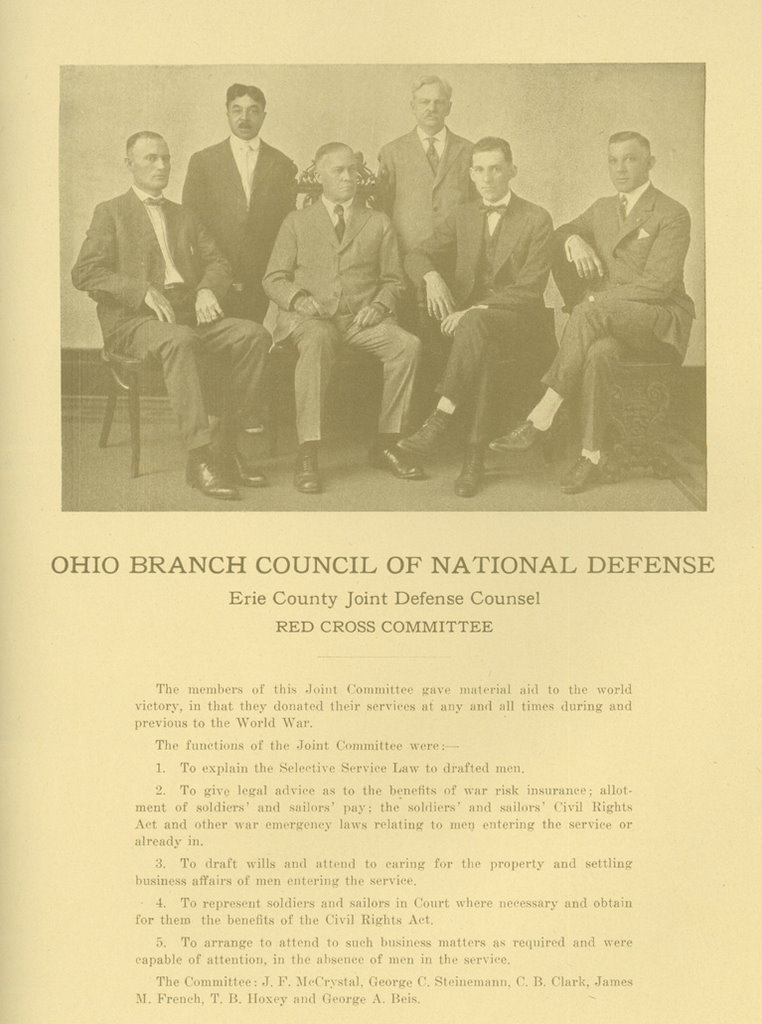
The image above shows James French in his service to the community during the First World War, as a member of the Red Cross Committee of the Erie County Joint Defense Council. Additionally, among other activities, he was president of the local council of the National Association for the Advancement of Colored People, the Loyal Legion of Labor, and the Negro Welfare League. He also helped to found an African-American Boy Scout troop in Sandusky, and was an active member (and treasurer) of the First Congregational Church. In 1895, he gave a eulogy at the funeral of John Brown, Jr., at Put-in-Bay.

James French died suddenly of a heart attack, shortly after conducting business at the courthouse, in August 1922, at age 56. The local newspaper report claimed that his funeral was attended by thousands, including a local congressman, county and city officials, and representatives of many civic and charitable organizations. In his will, he left the bulk of his estate (valued at between $75,000 and $100,000 -- a rather large sum at that time) to Oberlin College, for the benefit of "deserving Afro-American students," a gesture that was recognized by the author James Weldon Johnson in an essay ("A Negro Benefactor") a few weeks later.
The graduation photo of James M. French, Sandusky High School, 1884.

Wednesday, February 21, 2007

Program Announcement: Oral Traditions in African-American Literature

Join us in the Sandusky Library program room this Saturday, February 24, at 2PM, when Dr. Herbert Woodward Martin, Professor of English and Poet-in-Residence at the University of Dayton, will present a talk on "Oral Traditions in African-American Literature,"sponsored by a grant from the Ohio Humanities Council. From the program description on the Ohio Humanities Council website:
"Forms of indigenous speech and song are an influential part of African-American literature. This program explains how the sermon, the spiritual, the worksong, the dozens, the catches, the blues, gospel, jazz, and popular ballads, as well as folk tales operate to keep African-American literature alive and well."

Dr. Martin was in Sandusky a few years ago to speak about the poet Paul Laurence Dunbar, a talk that received much praise in the community. You can be sure that this Saturday's program will be equally as interesting. For more information, contact the library at 419-625-3834.


"Since 1972, the Ohio Humanities Council, state affiliate of the National Endowment for the Humanities, has provided leadership, resources, and financial support for the humanities in Ohio."

Thursday, February 15, 2007

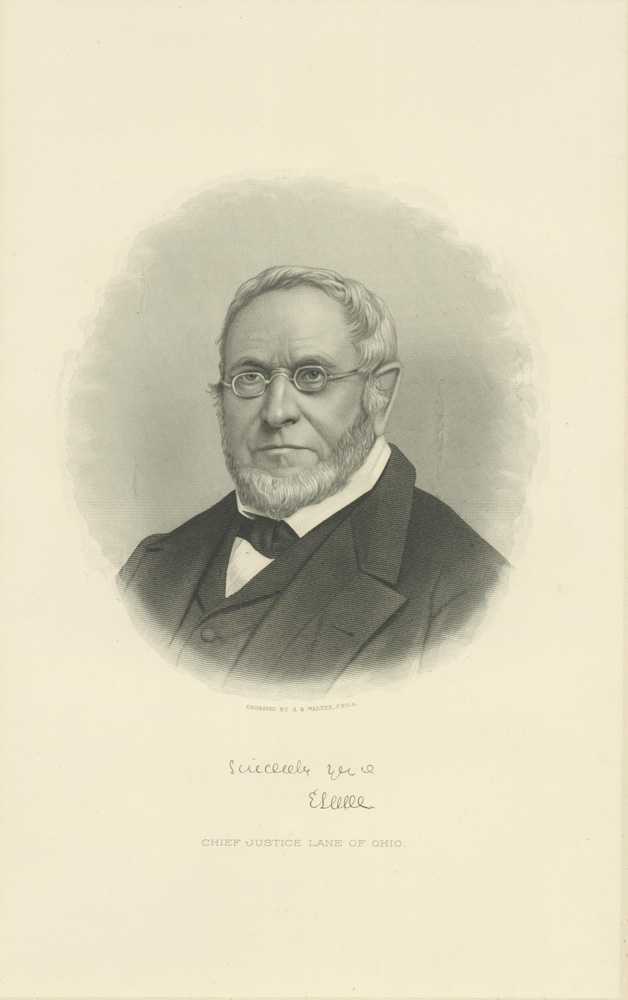
Judge Ebenezer Lane: the “Walking Library”


Early Ohio lawyer Ebenezer Lane was a Harvard University graduate who moved to Ohio in 1817. Born in Massachusetts in 1793, he received his degree from Harvard in 1811. After briefly practicing law in New England, he migrated westward and settled in Ohio, where he established his legal practice (around 1817). He was appointed Judge of Common Pleas of the Second Circuit in 1824, and became a Judge of the Supreme Court of Ohio in 1830. After he retired from the court, he had interests in the Junction Railroad, the Mad River and Lake Erie Railroad, and the Illinois Central Railroad.

While Judge Lane lived simply, he was an avid book collector. He read every one of the four thousand books he owned. Rev. Alfred Newton said in his memoirs of Ebenezer Lane that he could so accurately retain the knowledge of what he had read that he was a “walking library.”

After Judge Lane’s death in 1866, his book collection was passed down to his son Dr. Ebenezer S. Lane, in Chicago. The Ebenezer Lane library was the only library collection within the city limits of Chicago to survive the Great Chicago Fire of 1871. In 1922 the Ebenezer Lane book collection was donated to the University of Chicago by his grandchildren, the third Ebenezer Lane and Fanny Griswold Lane.

Judge Lane’s granddaughter, Mrs. Charles H. Moss, served on the first Board of Trustees of the “Library Association of Sandusky” which was incorporated in 1895.

A sketch of the life of Judge Ebenezer Lane can be found in the June 1867 Firelands Pioneer. The Ohio Supreme Court's Cases of Judge Ebenezer Lane are available in the Archives Research Center in the Sandusky Library.

Friday, February 09, 2007

Valentines

Valentine's Day has been celebrated for centuries in the West. Derived from a Pagan festival, Valentine's Day became a Christian feast day around the fifth century A.D. Today, February 14 is observed as a day for romance (and commerce, in chocolate, flowers, and greeting cards).

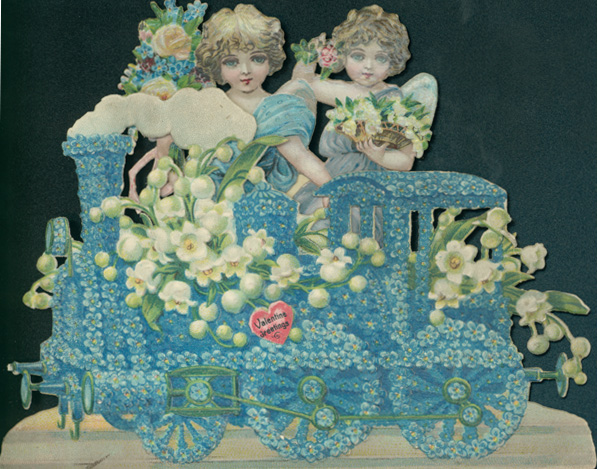
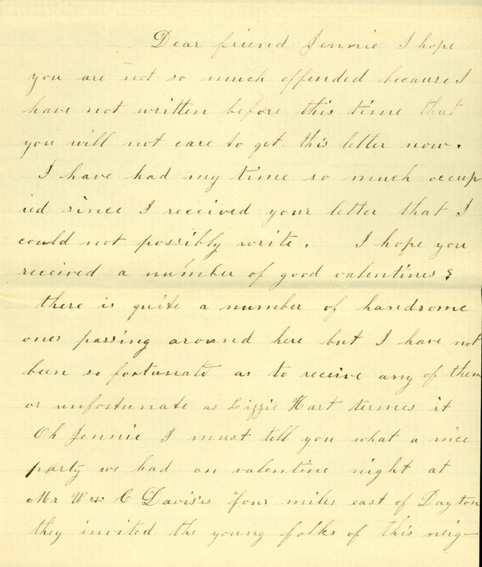
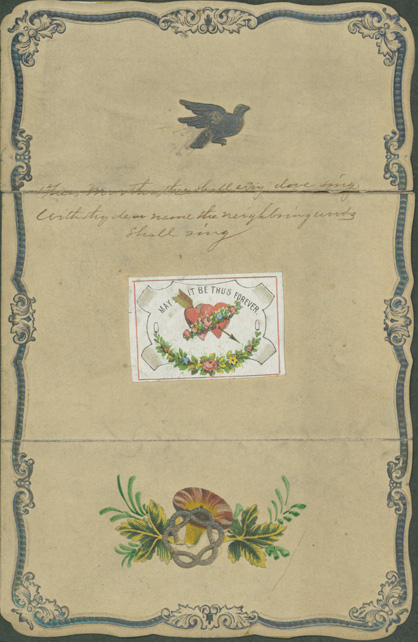
Of course, Valentine's Day was celebrated in Sandusky from its earliest days. Items from the collections of the Sandusky Library Archives Research Center and Follett House Museum provide evidence of Valentine's Day observances in Sandusky. The Valentine train above is one of many Victorian-era Valentines from the Follett House collections. Below is an excerpt of a letter written by "Lizzie" to her "Dear Friend Jennie," where she talks about (not) receiving Valentines, and attending a Valentine party that year: "I hope you received a number of good valentines . . . "
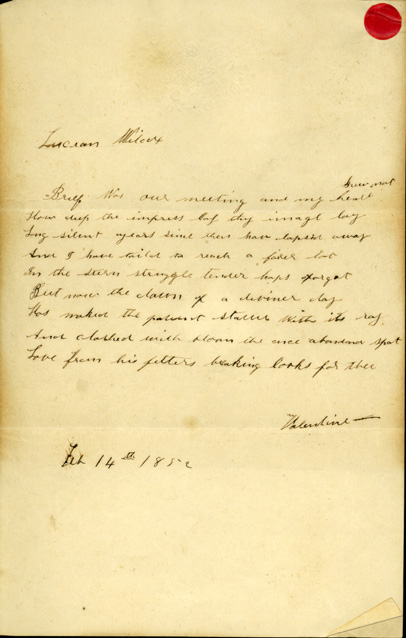
The note below is a love letter to Lucian Wilcox to his "Valentine" in 1852: "Brief was our meeting and my heart knew not / How deep the impress of thy image lay / Long silent years since then have lapsed away / And I have toild to reach a fairer lot / In the stern struggle tender hope forgot / But now the dawn of a diviner day / Has waked the patient [?] with its ray / And clothed with bloom the once abandoned spot / Love from its fetters breaking looks for thee."
Below are two of the earliest Valentines from the Follett House collections (from the 1850s):

Friday, February 02, 2007

Emogene Niver Marshall and Her Civil War Memorial to Her Brother


Mrs. Emogene Niver Marshall was a well known Sandusky resident who died in 1935, at about 85 years old. She gave many years of service to the Soldiers and Sailors Home (now the Ohio Veterans Home), giving entertainment to the residents and cheering the sick in the hospital. Emogene was married to Joseph T. Marshall, who served in the 101st Ohio Volunteer Infantry in the Civil War. Though Mr. Marshall had never been a resident of the home, over four hundred persons associated with the Soldiers and Sailors Home attended the funeral service Joseph T. Marshall in 1910, to show their respect and appreciation to Emogene Niver Marshall for her service at the Home.

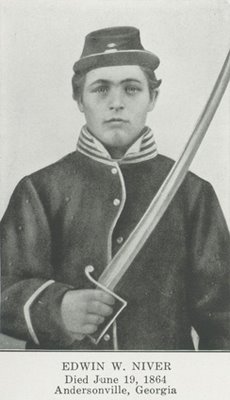
She had an elder brother, Edwin M. Niver, about five years older. In 1861 Edwin enlisted in the 3rd Ohio Volunteer Calvalry, before he reached his seventeenth birthday, and served in battle through Tennessee and Alabama. He was captured by Confederate forces in November 1863, and sent to the Confederate prison at Andersonville, Georgia, where he died on June 19, 1864.

In 1932 Emogene Niver Mashall wrote a book in memory of her brother and his service in the war. In this book, REMINISCENCES OF THE CIVIL WAR AND ANDERSONVILLE PRISON, you can read the letters that Edwin M. Niver wrote home to his family. Emogene writes of the dreadful conditions of the prison, and includes a lengthy poem honoring the dead heroes buried at Andersonville. In the foreword to the book, E.H. Mack, Editor of the Sandusky Register states that Mrs. Emogene Niver Marshall was called the “Angel of the Home.” To view Mrs. Marshall’s tribute to her brother, inquire at Reference Services located on the Lower Level of Sandusky Library.

Thursday, February 01, 2007

Mystery Photos: Know Where This Is?

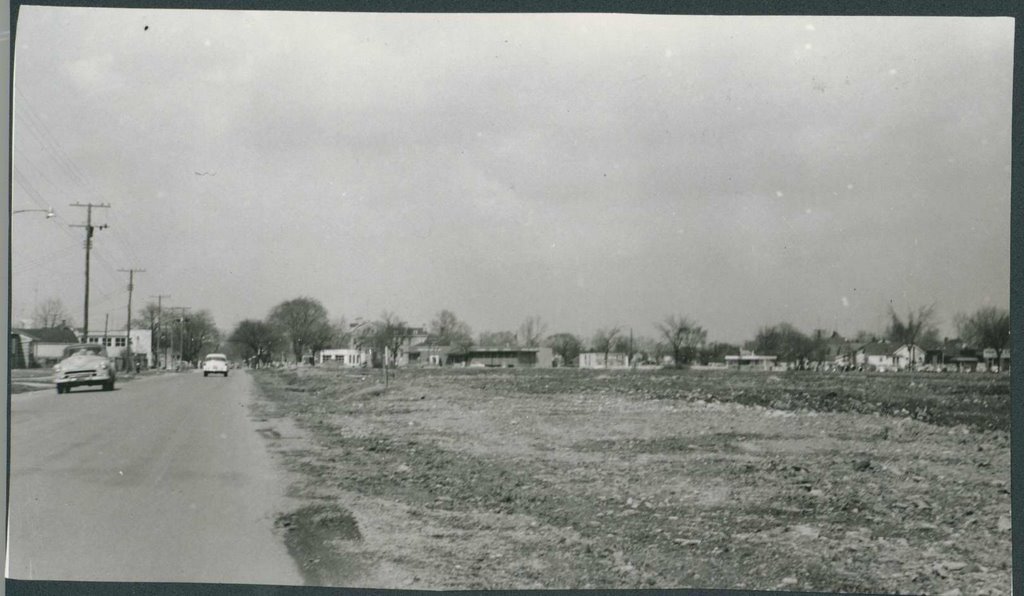
After a hiatus, the "Mystery Photos" game is back. Here are two photos showing different views of the same location. It looks a lot different today, but if you look very closely, you might be able to recognize where it is.
Hints: Both pictures were taken in March 1955, and the scenes in the images are within the city limits of Sandusky.

The answer is in the comments section.