Showing posts sorted by relevance for query hertlein. Sort by date Show all posts

Tuesday, July 28, 2009

History of the Western Reserve, by Harriet Taylor Upton

In 1910, Harriet Taylor Upton, along with H. G. Cutler and the collaboration of “a staff of leading citizens,” wrote a three volume set of books entitled History of the Western Reserve. It was published by the Lewis Publishing Company of Chicago and New York. In the introduction Mrs. Upton stated: “In writing this homely history of a vigorous, prosperous people, the author has purposely kept away from usual lines. The reader will find little geology, topography, or zoology; little of that which is military or political, but instead, the home life of the pioneers and the domestic conditions of today are treated in great fullness.” Mrs. Upton felt that women should be represented in her book, because “women, as well as men, laid the foundation of Western Reserve and helped build its walls….” She spent two years researching and writing the book, which is available in the Archives Research Center of the Sandusky Library, and is also found full text on Google Books. An Every-Name Index to the History of the Western Reserve, a project of the Lake County Genealogical Society, provides ease in searching the three volume set.

In Volume 1, Mrs. Upton wrote about the pioneers and surveyors of the Western Reserve, as well as roadways, mail routes, religious organizations, the press, cemeteries, and schools of the region. Also included in Volume 1 is a chapter devoted to each of the twelve counties of the Western Reserve, including: Trumbull County, Lorain County, Lake County, Geauga County, Summit County, Medina County, Erie County, Huron County, Cuyahoga County, Ashtabula County, Mahoning County, and Portage County.

In Volumes 2 and 3 are biographical sketches about hundreds of residents of the twelve counties of the Western Reserve. Many biographies also include photographs. Volume 3 of History of the Western Reserve features a biographical sketch and photograph of Erie County residents J. J. Dauch and Carrie Chase Davis. See the Every-Name Index to check for other names.

According to Ohio Authors and Their Books, Harriet Taylor Upton was born about 1861. She was the wife of a Warren lawyer, George M. Upton. Mrs. Upton was president of the Ohio Woman Suffrage Association for eighteen years, between 1899 and 1920. She was appointed vice-chairperson of the Republican National Executive Committee under President Harding. Besides knowing President Harding, Harriet Taylor Upton also personally knew President Hayes, President Garfield, President McKinley and President Hoover. Harriet Taylor Upton was named to the Ohio Women’s Hall of Fame in 1981. Harriet’s home for sixty years, the Upton House in Warren, Ohio is continuing to undergo restoration, and achieved National Historic Landmark status in 1993.

Mrs. Alice Kelley Hertlein wrote about Mrs. Upton’s encouragement in the Erie County women’s activities in the Women’s Suffrage movement. Mrs. Hertlein’s article appears in the January 1921 issue of the Firelands Pioneer. An earlier blog post recalls the first female jury in Erie County, on which Alice Hertlein served.

Monday, March 23, 2009

The Woman's Endeavor

(March is Women's History Month.)

A gift from Charles E. Frohman, the newspaper entitled The Woman’s Endeavor was published on Saturday, March 21, 1908, selling for ten cents. The proceeds from the sale of The Woman’s Endeavor were designated to be used for the equipping and maintaining of a Women’s Rest Room and its associated activities.
Featured in the newspaper were articles about pioneers of Sandusky, the Underground Railroad, and histories of several area organizations, including the first Children’s Home, the Erie County Humane Society, and the first ladies literary society. Poems and jokes, as well as articles about fashion, cooking, and household hints, were also included.

Several local business owners purchased advertisements in The Woman’s Endeavor. Besides the many male doctors, dentists, and other businessmen who purchased ads, there were two advertisements placed by women business owners. Jessie Meenan ran a millinery shop in the Sloane block of Washington Row, and Marie Bruckner had a corset shop at 204 Columbus Avenue.

Three members of the editorial staff of The Woman’s Endeavor, Mrs. J. F. Hertlein, Mrs. J. T. Mack, and Mrs. T. M. Sloane, went on to serve on the first female jury in Erie County in 1920. Two female physicians were associated with this newspaper: Dr. Emily Blakeslee had an advertisement, and Dr. Carrie Chase Davis wrote a feature article in this publication.


Many women of Sandusky were active in the Women’s Suffrage movement. In 1903, a state suffrage convention was held in Sandusky. Marie C. Brehm, born in Sandusky in 1859, was a suffragette, and also the first legally qualified female candidate to run for the vice-presidency of the United States. She ran on the Prohibition ticket in 1924, with Herman P. Faris.

Tuesday, March 06, 2007

The First Female Jury in Erie County

On August 26, 1920, an important ‘first’ quietly took place at the Erie County Courthouse in Sandusky. Early that morning, the ratification of the nineteenth Amendment to the Constitution of the United States was certified. That Amendment read in part “The right of citizens in the United States to vote shall not be denied or abridged by the United States or by any State on account of sex. “ On August 18, 1920, Tennessee was the thirty-sixth state to ratify the nineteenth amendment. Ohio had ratified the amendment on June 16, 1919.

On the morning of August 26, 1920, at the Erie County Courthouse, Judge Roy Williams was to conduct the trial of Pennok Jeffries vs. the Pennsylvania Railroad, for an automobile accident that occurred in 1919, when a train car struck Jeffries’ automobile.

Ten men were summoned to serve on the jury, but nine offered excuses as to why they couldn’t serve. Having heard that the 19th amendment had been ratified, Judge Williams said “I decided to impanel a woman jury. Twelve women were summoned. Twelve women responded and twelve women served.”

The women were sworn in, the cases were stated, and cross examinations were made. When the statements were concluded, the judge gave the women of the jury their instructions and they retired to the jury room. They made their decision in four minutes and shortly returned to their seats in the jury box. They decided for the plaintiff, who was awarded $1500.

After the trial was over, the judge congratulated the women for their service on the jury. Each of the twelve women were paid two dollars for serving on the jury. This was the first all female jury in Erie County, and one of the earliest in the United States.

The women of the jury included Katherine H. Biller, Mary R. Boehmer, Sarah Cooke Sloane, Alice K. Hertlein, Alice D. Mack, Anna Sutton, Emma Broadbent, Sallie W.D. Neill, Mabel. L. Magill, Sarah C. Scott, Henrietta Zerbe, Bertrha Mitchell. The three men in the photo are Roy Williams, George Beis and Claude Minor.

This historic event was commemorated with an Ohio historical marker erected during Ohio’s 2003 Bicentennial. The marker is located near the north entrance of the Erie County Courthouse where the photograph of the women of the jury was taken.

Friday, May 15, 2015

The Quinnebog Fishing Club


This vintage photograph from the Dr. Norbert Lange collection was taken shortly after the turn of the twentieth century. Several Sandusky residents were members of the Quinnebog Fishing Club. The group is standing in front of the clubhouse on Hen Island, which is located in the Canadian waters of Lake Erie, west of Pelee Island. A few individuals were identified in the picture:

1. Commodore Huntington
2. Frank Stang
3. Julius Wagner
4. Frank Kerber
5. Mr. Sinnerson
6. Dr. Beatty
7. Mr. Sanderson
8. John Hertlein
11.John Giedeman
12. Mr. Himmelein
14. Frank Stockdale

According to the Sandusky Register of May 15, 1903, ten members of the Quinnebog Fishing Club, and eight guests, went on a fishing party for three days, and they caught a total of 1068 bass.


The Quinnebog Fishing Club was founded in 1890 and is still active today.

Sunday, June 12, 2011

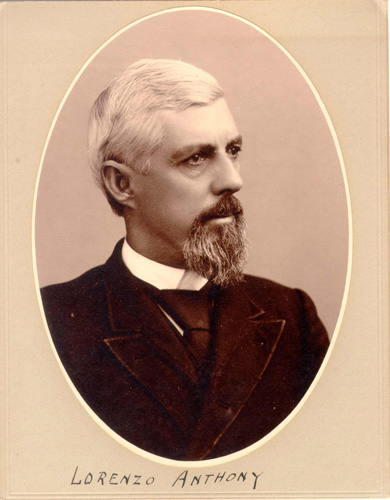
Lorenzo Dow Anthony

Lorenzo Dow Anthony was born on April 10, 1827 at Watertown, New York to Nathan and Esther Finch Anthony. The family moved to Sandusky, Ohio in 1837. As a young man, Mr. Anthony was in the fish business and later he was in the wholesale grocery business.

During his many years spent in Sandusky, he saw many significant events take place. Hewson Peeke wrote in his book, A Standard History of Erie County, Ohio, about the time that Lorenzo Dow Anthony met Charles Dickens when the author visited Sandusky in 1842. In other memorable experiences, Mr. Anthony was only 22 years old when cholera swept through the city, killing hundreds of Sandusky residents, and he was a member of an early local militia group, the Bay City Guards, which was commanded by Dr. R.R. McMeens. Karl Kurtz wrote in an article in the July 9, 1977 Sandusky Register that during the 1924 tornado, the Anthony home, at the northwest corner of Perry and Meigs Streets, was severely damaged. The tornado ripped a photograph of the sailing ship “The Dawn” off the wall, and dropped it in Lorain. Since the back of the picture had the name and address of the Anthony family written on it, residents of Lorain returned the picture to Mr. Anthony.


Lorenzo Dow Anthony was the first commodore of the Sandusky Yacht Club, from 1894 to 1899. He died on December 9, 1922 at the age of 95. Commodore Anthony was survived by his wife, the former Martha McDowell, who he married in 1852, and five daughters. Burial was at Oakland Cemetery. Pallbearers for Mr. Anthony were H.L. Peeke, John F. Hertlein, W. A. Wehrle and A. H. Klotz.

Saturday, June 27, 2009

Bessie Taylor, Teacher at Sandusky High

Miss Bessie Taylor taught at Sandusky High School for thirty four years. She began teaching Latin in 1904. In 1917, Miss Taylor was selected to become the dramatic coach. During her years at Sandusky High, Miss Taylor directed at least forty graduation plays and several other student dramatic productions. Below is an article from the January 20, 1920 Sandusky Star Journal. Miss Taylor was to direct the play “She Stoops to Conquer” at the February commencement exercises. (In the early years of the twentieth century there were two graduation ceremonies held at Sandusky High School, one in the winter, and one in June.)

The newspaper article reported, “The comedy is dainty and charming, abounding in humorous situations, and the lines are clever and give wide opportunity for the young actors.” Appearing in the cast were: Milton Schiller, Carl Appell, Glenn Rose, Harold Homberger, Ernest Dean, Roland Schemenauer, Sydney Knehr, George Hertlein, Albert Esch, Esther Knupke, Inga Nielsen, Elizabeth Schaub, Viola Bing, and Rae Frohman. Similar accounts of many of the plays directed by Miss Bessie Taylor are found in the microfilmed copies of the Sandusky Register and the Sandusky Star Journal, available in the Archives Research Center of the Sandusky Library.

On July 30, 1960, Miss Bessie Taylor died at Good Samaritan Hospital, following a lengthy illness. An obituary for Bessie Taylor was carried in the July 30, 1960 Sandusky Register. An account of Miss Taylor’s long career as an educator was given. Miss Taylor was also very active in her church, Trinity Methodist Church, where she served as the financial secretary. Miss Taylor was a former member of the board of Trustees of the Library Association of Sandusky, and was active in the Red Cross during World War Two. Bessie Taylor was survived by two brothers, a sister, and several nieces and nephews. She was buried in the Union Cemetery in Columbus, Ohio.

Miss Taylor is pictured below with fellow faculty members of Sandusky High School in the 1930’s. The photograph was taken on the steps of what is now the Adams Junior High School.

Monday, March 28, 2016

Local Heroes: The Carnegie Medal Awarded to Sandusky Residents


Between 1904 and 1969, nine Sandusky area residents were awarded the Carnegie Medal for acts of extraordinary civilian heroism. The medal pictured above was awarded to Earl Thomas, who saved Rolland Smith, age 16, from drowning, after Rolland fell into deep water off the railroad bridge at Mills Creek. Though Thomas was not a good swimmer, he swam over thirty feet to bring Smith to safety, where both men were pulled out of the water by another young man. Though young Smith was unconscious, and Thomas suffered from exposure, both recovered. 

By performing a search for Sandusky, Ohio at the website of the Carnegie Hero Fund Commission, you can read a brief summary of all the awardees who were from Sandusky. In 1904, William C. Brune saved George P. Pfanner from drowning. Another water rescue took place in 1905 when baker Henry Schiller saved Wendell B. Tussing from drowning while at Lakeside, Ohio. When the Mahala Block burned on November 18, 1909, George B. Knopf made his way to the top of the fourth floor building to rescue Emma Keyes from the fire.

  
On October 29, 1920, Harry May saved Martin Maier from being killed by a train. The locomotive was only two feet from the men when Harry pushed Martin to safety. Hilda Hertlein was only twelve years old when she lifted four year old Viola Poock off the track as a streetcar was approaching. In addition to the Carnegie Medal,  Hilda received $1,600.00, which she used towards her studies at Ohio State University. Henry Sherman Potter, Jr., was also quite young when he earned a Carnegie Medal. Henry was age thirteen, when he saved  ten year old Omar E. Meyer, Jr. from drowning, after Omar fell through the ice while skating on Sandusky Bay. Henry broke through the ice, and finally threw his sweater to Omar to help pull him to safety. An article about the heroic act of Henry Sherman Potter, Jr. appeared in the July, 1929 issue of Boys’ Life magazine. Omar E. Meyer, Jr. eventually became the owner and president of the local company O.E. Meyer & Sons. 

While in Lorain in 1932, William G. Lang saved twenty-two month old Leila Smith from being struck by a streetcar. While at the helm of the streetcar, Lang quickly applied the brakes and drastically reduced the speed, after which he grasped the toddler to safety. During a severe rainstorm on July 5, 1969, Larry E. Smith rescued LoRene Limbard from drowning, after she was trapped in a fruit cellar in her home after a basement wall collapsed. Two men outside the home helped Mrs. Limbard out a small basement window, after Smith helped her find her way to the window. As Larry Smith himself exited through the window, the water had risen to the ceiling light of the basement. Sandusky can be proud of the many heroic actions undertaken by these nine ordinary citizens who helped save others’ lives while risking their own life.