Showing posts sorted by relevance for query providence. Sort by date Show all posts

Sunday, September 26, 2010

Training Nurses in Sandusky


September 26, 1907 was the date of the first official graduating class from the Providence School of Nursing. Providence Hospital opened its doors at 1912 Hayes Avenue on April 5, 1904, under the direction of the Sisters of Charity of St. Augustine of the Cleveland Diocese. In 1923, the diocesan boundaries were re-drawn, placing Sandusky in the Toledo diocese, so the Sisters of Charity of St. Augustine transferred ownership to the Sisters of St. Francis, Sylvania, Ohio.

Leo Bahnsen, the first male nurse at Providence Hospital, is shown making his rounds in 1938 in a male ward at Providence Hospital:


In 1918, local Red Cross officials taught nursing skills to volunteers to help in the war effort during World War One, as well as to assist with local victims of influenza.
From 1910 to 1937, Good Samaritan Hospital also trained nurses. A listing in the 1923 Sandusky City Directory shows Good Samaritan Hospital at 624 Van Buren Street, and the Good Samaritan Hospital nurses’ home at 612 Van Buren Street.

Here is a scene from the Good Samaritan nurses’ residence in 1923; the young ladies may actually be Good Samaritan nursing students:
If male callers came to visit the nursing students, they had to stay in the “beau’s room” at the end of the hall, and they were never to enter the upstairs rooms of the young ladies.
Names of individual nurses who resided in Sandusky were listed on pages 501 and 502 of the 1923 Sandusky City Directory.

Today individuals who wish to enter into a career in nursing can enroll at Firelands Regional Medical Center School of Nursing. The history of the school has its origins in Sandusky, dating back to 1905. Today's Firelands Regional Medical Center is the combination of three former hospitals in Sandusky, Good Samaritan Hospital, Sandusky Memorial Hospital, and Providence Hospital.

Visit the Sandusky Library Archives Research Center to learn more about the history of health care in the Sandusky area. Books, historical newspaper articles, city directories, and other archival resources provide details about the former hospitals, nurses and doctors who served Sandusky residents.

Saturday, May 04, 2013

Miss Rose Ball, Graduate of Providence School of Nursing


Miss Rose Ball was born May 4, 1877 in Reed Township, Seneca County, Ohio. An article in the February 20, 1926 issue of the Sandusky Star Journal stated that Rose Ball was a well-known nurse, having graduated from Providence Hospital School of Nursing. U.S. Census Records list Rose’s occupation as a nurse in 1910, 1920 and 1930. She resided in Sandusky, Ohio during these years. In October of 1933, Rose Ball was on the featured speakers at the banquet of the Nurses’ Alumnae Association of Providence Hospital, which was held at the Hotel Rieger. After having been in poor health for several years, Miss Rose Ball died on September 6, 1956 in Tiffin, Ohio. Though we do not know the exact year of Rose’s graduation from nursing school, this is how Providence Hospital looked in 1910. The facility formerly known as Providence Hospital is now the South Campus of Firelands Regional Medical Center. 


Monday, April 04, 2022

Dr. W. P. Skirball Practiced in Sandusky for Many Years

from p 52, Reflections: First 85 Years of Providence Hospital

Wilbert P. Skirball was born on September 20, 1919 in Alabama, to Rudolph and Zerhyl Skirball. After growing up in Ashland, Ohio, Dr. Skirball attended Ohio State University, and graduated from the OSU Medical School. Dr. Skirball served as a Captain in the U.S. Medical Corps. While in military service, he met his wife Mary, who was a nurse. 

In 1948 Dr. Skirball joined the medical staff of Providence Hospital in Sandusky, Ohio. In the early 1950s Dr. Skirball had an office in Castalia and Sandusky. He moved his office to the Sandusky Medical Center at 1218 Cleveland Road in 1956. Throughout his long career, Dr. Skirball was active in community organizations. He was a popular speaker to civic groups. In 1956, he gave a talk entitled “Should We Bury the General Practioner?” to the Jaycees, which focused on the rapid rise in the number of medical specialists in the United States. His topic when he spoke to to the Sandusky Business and Professional Women in May of 1956 was “The Doctor and His Ethics.” 

In the August 8, 1963 issue of the Sandusky Register, Dr. Skirball was one of two local doctors who were interviewed about the problem so many people have with being overweight. He stated that he did not think drugs were an effective tool in weight loss; he advised that people who wish to lose pounds should do so by reducing their caloric intake. 

Dr. Skirball was chairman of the Department of Medicine at Providence Hospital from 1976-1979, and had been active in local and state Medical Associations. The picture at the top of this post was taken at the 1974 Providence Hospital Board of Trustees and Medical Staff Dinner, where he was presented a plaque in honor of his twenty-five years of service. Board member George Howells is standing next to Dr. Skirball in the picture, which was taken by Alden Wintersteller.

Dr. Skirball retired in 1986, and later he and his wife moved to Florida. He died in Florida on November 10, 1999. 

Sunday, January 06, 2019

Frank Cable and Family


The Frank Cable family is pictured above in the late 1890s. Frank’s wife was the former Ida Schwind. Their daughters were Clara, Florence and Stella. Frank, along with his father Laurence Cable and his brother Edward, was active in real estate development in Sandusky in the early twentieth century. The Cable family developed Cable Park, a residential neighborhood on Sandusky’s Wayne Street, and they were key donors to the former Providence Hospital. Below we see Frank Cable standing outside the home in which he grew up, at the southwest corner of Central Avenue and Monroe Street.


Frank and Ida’s daughter Clara Cable married Leo Wagner, who operated a florist shop in Sandusky for many years on Columbus Avenue.

Clara Cable Wagner
 Florence Cable married attorney George C. Steinemann.

Florence Cable Steinemann

Youngest daughter Stella went on to marry Dr. M.A. Wagner. After the the doctor's death, Stella wed Roman Burnor, and they made their home in Toledo, Ohio.

Mrs. Ida Schwind Cable died at the young age of 40, in a hospital in San Antonio, Texas following a serious illness. The telegram announcing her death was delivered to the Cable family on the very day that the Providence Hospital dedication took place, in April 1904. The original Providence Hospital had once been the home of C.C. Keech on Hayes Avenue.
  

Frank Laurence Cable died at the Sawyer Sanitarium in Marion, Ohio on December 14, 1913. Sadly, his brother Edward Cable had died just a few weeks earlier. The Cable family left their mark on Sandusky, Ohio. If you would like to learn more about this family and their many contributions to our community, visit the Sandusky Library Archives Research Center, where you can view the Cable Family Collection.

Thursday, May 10, 2018

Mothers and Babies on National Hospital Day


Seated on the steps of the former Providence Hospital in Sandusky are several babies and young children with their mothers on National Hospital Day on May 12, 1930. Ernst Niebergall was the photographer. Both Good Samaritan and Providence Hospital held on Open House on this date, and offered guided tours of the hospitals to visitors who wished to see the various departments of each facility.


Friday, April 15, 2011

A Musical Revue in 1937


On Thursday evening, April 15, 1937, A Musical Revue was held at the State Theatre. Presented by the Women’s Association of Providence Hospital, the production was directed by local dance instructor, Carl Ernst, and proceeds went to Providence Hospital. One of the most outstanding features of the Musical Revue was “Largo,” from the Ballet Moderne, performed by Sandusky librarian Dorothy Keefe. Miss Keefe also performed a toe solo, “Sea Gardens” and was well received in her performance of the “Castilian Castanet Dance.” Dorothy Keefe is pictured in the group of Sandusky Library staff members below. She is second from the left.


Local musicians provided music for the revue. The orchestra members were: William Hay, Kenneth Luteman, John Hay, Frank Kleinfelder, Norbert Smith, Michael Mazur, Charles Held and Lawrence Gassman. Miss Ruth Sponseller accompanied on the piano. Several skits, dances, and songs were presented throughout the evening. An amusing comedy skit directed by Mrs. Paul Squire was entitled “If Men Played Cards as Women Do.” The April 16, 1937 issue of the Sandusky Register stated that the comedy skit caused “a great deal of merriment in the audience. An ensemble of boys and girls participated in the number “Hey Babe! Hey!”

Wedding gowns from 1800 to 1937 were modeled in the final production number. The costumes worn by the bride and groom were furnished by the M. R. Herb Co. The M.R. Herb Co. also provided furniture for the Musical Revue. Mrs. Gladys Hohler portrayed the bride, and Robert Mathes played the groom. Modeling bridal gowns were: Dolores Geason, Dorothy Stahl, Mary Lou Maus, and Miss Bernadine Meyer. Mrs. Nellie Bailey Miller sang “Her Bridal Veil” as the wedding scene was enacted.

An article in the April 13, 1937 issue of the Sandusky Star Journal stated that the Musical Revue was “a snappy show with the zip of a professional revue” and featured “unusually gay music and especially clever comedy skits.”

Wednesday, September 08, 2010

The American Liquor & Opium Cure Company of Sandusky, Ohio

A newspaper article in the December 1, 1892 issue of the Sandusky Register reported that the American Liquor and Opium Cure Company was ready for business. Medical directors were physicians A. J. Crane and A. L. Wilson. Officers were: F. E. Hoover, President; Sam W. Miller, Manager; F.A. Layman, Secretary; and F. L. Felch, Treasurer. The facility claimed it could help patients overcome the habits of liquor, morphine, and cigarettes with pure vegetable remedies. The sanitarium was located at Oak Grove Place, the former home of Sandusky businessman C.C. Keech.


By 1898, the American Liquor & Opium Cure Company was no longer in operation, and a saloon known as Oak Grove Villa was at this location. In 1902, Laurence Cable purchased the former Keech residence, and deeded it to Rev. Bishop Ignatius F. Horstman to be used as a hospital. After the Sisters of Charity of St. Augustine took charge of the proposed hospital, it was given the name of Providence Hospital. In 2001, Providence Hospital became a part of the Firelands Regional Medical Center. Helen Hansen wrote about the C. C. Keech house, at 1912 Hayes Avenue, in Article 17 of her book At Home in Early Sandusky.

Friday, December 21, 2018

Plenty of Holiday Cheer at Sandusky’s Hospitals in 1923


In December of 1923, the city of Sandusky had two hospitals, Good Samaritan Hospital (top) and Providence Hospital (lower). (These images appeared in Our City Sandusky a publication printed in 1924, for the 100th anniversary of the incorporation of the city of Sandusky.) 

Local newspaper articles provide us with interesting details about how Christmas was celebrated at each hospital in 1923. Early on Christmas morning, Betty Mound sang “Softly the Babe was Sleeping” in the room where all the newborn babies were sleeping at Good Samaritan Hospital.  All the nurses attended an early morning service, at which Lillian Gowdy read the Christmas story. C. Webb Sadler, a trustee of Good Samaritan Hospital, gave all the nurses a long-stemmed red rose, which they carried as they sang Christmas carols throughout the hospital.


A Christmas tree was placed in the children’s ward, and gifts were distributed to all the youngsters. Even a young boy named Jack, who had been critically ill, was feeling well enough to enjoy the festivities. At Providence Hospital, four youngsters were treated to presents, candy and oranges and “all the delicacies that the nurses felt were for their good.” Holiday music was played on Ed Strang’s radio. Visiting hours at both hospitals were extended, so that patients and their families could enjoy Christmas Day together.

In the historical photograph collection of the Sandusky Library Archives Research Center, is this picture of the staff of Good Samaritan Hospital at a holiday party in December, 1923.

    
If you would like to read more about what was happening in Sandusky in years past, visit the Sandusky Library Archives Research Center, where local newspapers dating back to 1822 are found on microfilm.

Wednesday, October 21, 2020

The Former Lehrer Clinic on West Washington Street


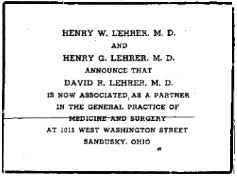
In 1916 Dr.  Henry William Lehrer opened his medical practice at 1015 West Washington Street in Sandusky, Ohio. He practiced medicine at that location until his retirement in 1977. During his long career, Dr. Lehrer served as chief of medical staff at both the former Providence and Good Samaritan Hospitals. He also served on the Advisory Board of BGSU Firelands College. The article below appeared in the February 4, 1974 issue of the Sandusky Register, when Dr. Lehrer was honored, along with several other area physicians.


Dr. Henry G. Lehrer joined his father’s medical practice in 1946, and another son, Dr. David R. Lehrer, came on board in 1948.


The senior Dr. Lehrer died in 1980. Eventually, Dr. David R. Lehrer left the Sandusky area. When Dr. Henry George Lehrer retired in 1983, it was the first time in sixty-seven years that there was not a Dr. Lehrer in the medical office at 1015 West Washington Street.

According to the Ohio Historic Inventory for Erie County, the man who was constructing the original building became sick with cholera and died in 1849. Later the building was a boarding house, a millinery shop, and a doctor’s office. In 1906. Dr. G.H. Boehmer had his medical office at 1215 Washington Street, the former address of the Lehrer Clinic. In 1901, this ad appeared in the January 15, 1901 issue of the Sandusky Star.


In the 1990s, Doctors Jay and Jerri Nielsen (known for her experience as a cancer patient in Antarctica) had their offices at 1015 West Washington Street, followed by an After-Hours Medical Center. Though this location no longer serves as a medical office, hundreds of Sandusky area patients were treated at the former Lehrer Clinic throughout many decades of the twentieth century.

Tuesday, January 22, 2013

Dr. Owen A. Wagner, Optometrist and Optician


Dr. Owen A. Wagner was an 1896 graduate of Northern Illinois College at Chicago, and he graduated from the Needles Institute of Optometry at Kansas City, Missouri in 1902. After practicing for a time as an optometrist in Chicago, Dr. Wagner came to Sandusky, Ohio in 1918. From 1918 until shortly before his death in 1949, Dr. Wagner had his office and his living quarters both at the same location, 114-116 Columbus Avenue in downtown Sandusky.


The signs along the windows in Dr. Wagner’s office stated that he offered "thorough scientific examinations."


Dr. Wagner passed away at Providence Hospital on May 22, 1949, at the age of 93. His obituary, found in the 1949 Obituary Notebook, stated that he was a familiar Sanduskian for many years, and he had a pet parrot which attracted wide attention. Funeral services for Dr. Owen A. Wagner were held at the Charles J. Andres Funeral Home, with Rev. C. L. Alspach officiating. Burial was at Oakland Cemetery.

Saturday, December 05, 2015

Dorothy Keefe, Sandusky’s “Globe Trotting” Librarian


Miss Dorothy Keefe, the daughter of Mr. and Mrs. Maurice Keefe, began working at the Sandusky Library in 1915. She was a graduate of Sandusky High School, and attended college at Chautauqua, New York and Western Reserve college in Cleveland, Ohio. She was also an outstanding musician, having studied with Professor N.E. Fox. For several years she was in charge of the library’s outreach services to various sections of Erie County. In November of 1922, she was named Librarian of the Sandusky Library. An article which appeared in the February 18, 1928 issue of the Sandusky Star Journal featured the headline “Librarian is efficient in various lines.”


Miss Keefe often spoke to community groups. She was an active member of the Harlequins, a local theatrical organization. When a musical revue was presented in 1937, for the benefit of Providence Hospital, she performed a dance solo entitled “Sea Gardens”  and appeared in the number “Castilian Castanet Dance.”  

In 1938 Miss Keefe took a five month world cruise aboard a British freighter. She traveled to the innermost parts of China, India and Africa, and took a camel caravan across the African desert. Though at times the food was terrible, and she became sick after having been bitten by fleas, Dorothy told the local Rotary Club that “she wouldn’t take a thousand dollars for her experiences, nor would she go through the same experience again for ten times that amount.”  She became known as Sandusky’s “globe trotting librarian.” 

In the Spring of 1939, Dorothy Keefe announced that she would be resigning as chief Librarian of the Sandusky Library, in order to move to England. Miss Mary McCann took over as Librarian of the Sandusky Library in September, 1939, a post she held until 1976. Miss Keefe married Frank Gordon, an engineer for a British freighter line, in November of 1939. At the time of her brother’s death in 1961, Mrs. Frank Gordon was residing in New York. Dorothy Gordon passed away in Florida in 1980. 

Here is a picture of the staff of the Sandusky Library from the 1930s; Dorothy Keefe is the second person on the left:


Friday, April 09, 2021

Ivette Martin Miller, An Active Senior

In honor of National Library Week, we recognize a former library worker.


Mrs. Ivette Martin Miller, usually known as Betty, was a former employee of the Sandusky Library. For a time she was in charge of the circulating library at Viewpoint, where she was also a resident. An article in “The Elderlies” column by Karl Kurtz, in the August 14, 1976 issue of the Sandusky Register provides more information about Betty’s background and her determination. Betty started working in Sandusky in 1913, around 17 years old, at her uncle Fred Martin’s ice cream parlor in the old West House building. Kurtz wrote that he and his friends would try to confuse Betty when they ordered sodas or ice cream sundaes, but she always got their orders correct. When Fred Martin moved his ice cream parlor, along with a restaurant, to the Cooke Building, Betty became the manager of the bakery department. 


Later she worked for the B& O and New York Central Railroads, in the ticket office. In 1922, Betty married Edwin Miller, who passed away in 1952. By 1970 Betty had moved to the Viewpoint Apartments, where she was a neighbor to Karl Kurtz. Around 1974, Betty fell and broke her right shoulder. In spite of several operations, and complications, her arm remained in a sling for quite some time. Karl said that Betty should be given a medal for “cheerfulness in time of anxiety, suffering, unselfishness, and endurance in face of much tribulation and trial, while retaining steadfast faith in a higher power.” Throughout her health problems, Betty always tried to cheer up others, and kept a positive attitude. If you would like to read this article in its entirety, along with dozens of other human interest stories, you can see a three-volume compilation of Karl Kurtz’s “The Elderlies” columns at the Sandusky Library Archives Research Center. 

Below is a picture of Betty when she was a volunteer with the Women’s Auxiliary at Sandusky’s former Providence Hospital. Betty is in the front, on the left side. In this picture the ladies were modeling hats, some of which were made from pieces of hospital equipment.

Monday, November 25, 2019

Deputy Sheriff A.A. “Pete” Killian


From about 1936 to 1948, Alfred A. “Pete” Killian worked as a Deputy Sheriff for the Erie County Sheriff’s Department. Pete Killian is the man standing on the left in the picture above. Wanted posters can be seen on the walls of the office. When Pete worked for the Sheriff’s Department, it was located inside the Erie County Jail on West Adams Street, now a part of the Sandusky Library.


Deputy Killian took special training in fingerprinting and identification at the Institute of Applied Science and at the University of Oklahoma. In 1937 he was elected to be a trustee of the Ohio State Association of Identification. Throughout his law enforcement career, Deputy Killian spoke about the science of fingerprinting to several local civic organizations. When he spoke to the Exchange Club in 1946, he pointed out that in collecting millions of fingerprints over fifty years, no two were ever found to be identical.  An article which appeared in the February 24, 1938 issue of the Sandusky Star Journal reported that Deputy Killian had 2,500 fingerprints that had been collected over a ten year period.


A.A. “Pete” Killian died at Providence Hospital in Sandusky on December 7, 1962, at the age of 71. He was survived by his wife, nieces and nephews. We do not know the details of why Deputy Killian is pictured behind "bars" (as a joke by/for friends?), but this photograph is housed in the historical photograph collections of the Sandusky Library Archives Research Center.


Sunday, October 20, 2019

Buffalo Bill’s Wild West Show Visited Sandusky


The September 15, 1885 Sandusky Daily Register carried an advertisement for Buffalo Bill’s Wild West Show, to be held at the Sandusky Fair Grounds (in the area now known as Cable Park) for “positively only one performance,”  on Thursday, September 17 at 2:30 p.m. Admission was fifty cents for adults, and twenty five cents for children. Streetcars ran directly to the fair grounds, and railroads brought excursion groups to the show.


A grand parade was held at 10 a.m. on the day of the performance. The show advertised the appearance of Sitting Bull, White Eagle, and fifty-two braves, along with Miss Annie Oakley, Frisking Elk, and the phenomenal boy-shot Johnny Baker. The show claimed to have the largest herd of buffalo ever exhibited. 

Buffalo Bill was to shoot at clay pigeons while on foot, but he would shoot at glass balls while riding horseback at full speed. The ad continued to state that the ten cowboys who rode bucking horses were wilder than the horses themselves.  Equestrian acts, lassoing, and steer riders rounded out the program. Proprietors Cody and Salisbury promised to “fulfill every promise.”

Charles E. Frohman, in his Sandusky Potpourri, recounted Sandusky’s only buffalo chase.  After Buffalo Bill’s September 17th show closed, a buffalo escaped near the railroad depot at North Depot and Mcdonough Streets. The buffalo ran out Hayes Avenue, as a dozen Native Americans pursued it on horseback. It ran through the yard of C. C. Keech’s residence, and kept going through neighboring fields, destroying corn stalks along the way. After an hour’s pursuit, the buffalo was caught and taken back to the depot.


(About twenty years later, the C. C. Keech home later became part of Sandusky’s Providence Hospital, now the South Campus of Firelands Regional Medical Center.)
  
While the chase was in progress, two cows belonging to Patrick Gagen were frightened, and ran away. Dairy farmer Louis Benckart and his sons found the two cows, and refused to give them back, stating that the cows damaged their fields. Mr. Gagen took legal action to recover the cows.

Tuesday, December 06, 2011

Captain George A. Brown

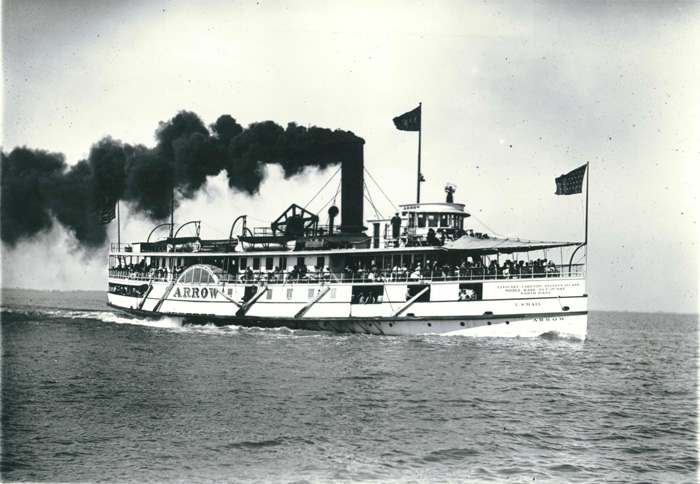
George Arthur Brown was born in Canada on December 6, 1841 to Joseph and Ann (Arbor) Brown. He began his long career with Great Lakes vessels as a deck hand when he was age sixteen. At age twenty one, he was made mate on a ship that operated out of Detroit. In the early 1860’s, Mr. Brown was appointed captain of the J.O. Moss, a ship owned and operated by the Gilcher & Shuck Lumber Company. Captain Brown was connected with several ships throughout his lengthy career. For a time he owned and operated the Champion, a ship that carried lumber. For thirty two years, Captain Brown was on the route between Sandusky and the Lake Erie Islands. He was captain of the steamers Jay Cooke, the City of Sandusky, and the Arrow.


An article in the December 22, 1910 issue of the Sandusky Register stated that Captain Brown “was known by practically every islander and many people from different parts of the United States, who acquaintance he made during the summer seasons…He was a personal friend of Grover Cleveland and many other notables. During all his experience as a lake captain he never met with a serious mishap.” After a lengthy illness, Capt. George A. Brown passed away at Providence Hospital, on December 21, 1910. He was survived by his wife, a son, daughter, and several siblings. The funeral for Captain George A. Brown was held on the day after Christmas in 1910 at the Masonic Temple. Burial was at Oakland Cemetery. Captain Brown was involved in many aspects of life on the Great Lakes. He transported mail, goods, as well as hundreds of individuals to a variety of locations in the Lake Erie Islands.

Saturday, August 18, 2018

Sandusky Has Loved Parades

With Sandusky's Bicentennial Parade soon to become part of history, it's a good time to share the stories of other parades in our history.


Pictured above is a scene from downtown Sandusky when Company B of the Sixth Ohio Regiment returned from the Spanish American War in May of 1899. Here is another view of the parade:


Parades have been held in Sandusky since the early days of the city. According to History of Erie County, edited by Lewis Cass Aldrich, (D. Mason and Co., 1889), Washington Square was originally appropriated as a “public ground, parade and walk.” In the 1840s, members of the local militia drilled on Washington Square, accompanied by fife and drums. On Saint Patrick’s Day in 1844, a joint parade was sponsored by the Sons of the Emerald Isle and Washington Total Abstinence Society, "in celebration of the principles of temperance."

The Sandusky Library Archives Research Center has pictures of several parades in Sandusky's history. On April 30, 1938, thousands of people celebrated the 150th anniversary of the passage of the Northwest Ordinance of 1787, which established the territory that included the future state of Ohio.  In the picture below, parade participants are seen proceeding north on Columbus Avenue.

      
At that time a Walgreen drugstore was located in the Cooke Block at the northeast corner of Columbus Avenue and East Market Street, and the S.S. Kresge store was on the southeast corner. 

A parade held in conjunction with the Buckeye League Band and Orchestra Festival took place in Sandusky on May 6, 1938. A band marched down Jackson Street; the Hotel Rieger is to the east and the Plaza Theater to the west.


A double feature was playing at the Plaza that day: I Was a Spy and Accidents Will Happen, starring future U.S. President Ronald Reagan. In 1938, our grandparents would probably never have guessed that Reagan would one day be the President.


Many local residents will recall when Gray Drugs was a busy store in downtown Sandusky, where the parking garage is now located. The Armed Forces Day parade was held on May 16, 1959.


Some of you may have attended this parade, which honored Jackie Mayer, Miss America of 1963.

   
Photographer Thomas Root took an aerial view of the Miss America Homecoming Parade held in November 1962. Providence Hospital was under construction at this time, seen on the right side of the picture above. 

Visit the Sandusky Library Archives Research Center to learn more about the history of Sandusky and Erie County. You may also browse through our historical photograph collection online.