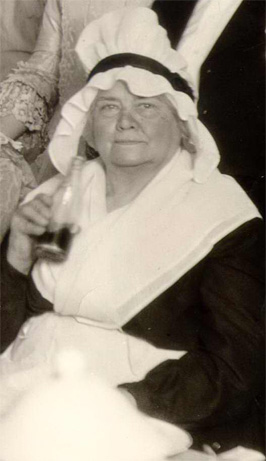
Helen Gallup was the daughter of Frank Gallup and the former Fannie Walker, born in Sandusky, Ohio in 1892. Both Helen’s father Frank and her paternal grandfather Mozart Gallup were associated with the Sandusky Tool Company. Above is a close-up from her third grade class picture at Monroe School about 1900. During her later years of high school, Helen attended Rogers Hall School for Girls in Lowell, Massachusetts, graduating in 1911.

In 1917, Helen Gallup married Joseph Gilpin Pyle, Jr., an attorney. The marriage took place at Grace Church in Sandusky.

A copy of the wedding invitation is in a collection of historic invitations from Sandusky area events in the Sandusky Library Archives Research Center.

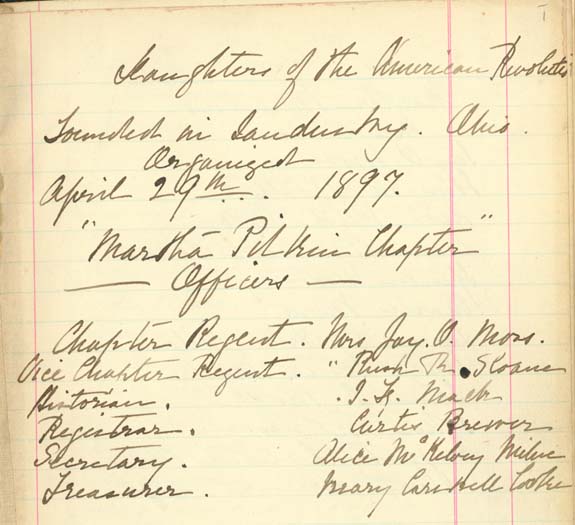
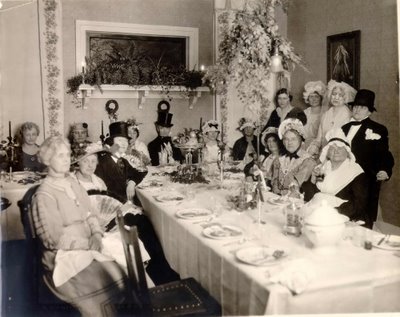
Mrs. Helen Gallup Pyle was very active in the Martha Pitkin Chapter of the Daughters of the American Revolution. An article from the February 8, 1922 issue of the Sandusky Star Journal reported that both Mr. and Mrs. Pyle took part in a group of period dances at the D.A.R. Ball held at the Odd Fellows Hall in Sandusky. Helen served as both a teacher and a dancer for the special event.
By 1927 Mr. and Mrs. Joseph G. Pyle, Jr. had moved to Pasadena, California with their two children, Joseph G. Pyle, III and Hermoine. Both of the Pyle children would later serve in the U.S. Military during World War II. Corporal Joseph G. Pyle, III was in an Infantry unit in the South Pacific in 1944, and Hermoine Pyle was with the Women’s Army Corps branch of the U.S. Army.
A brief article in Sandusky Register of July 14, 1934 stated that Mr. and Mrs. Joseph G. Pyle, Jr. had divorced. Mr. Pyle passed away in 1940. Mrs. Helen Gallup Pyle died in York, Pennsylvania in 1965, and her remains were returned to Sandusky for burial in the Gallup family lot at Oakland Cemetery.




 One of the earliest groups to sponsor concerts at Sandusky’s Carnegie Hall was the Tuesday Musical Club. The composer Beethoven was featured on the January 21, 1902 concert. It appears that the entertainment was provided by local musicians. The string quartet was composed of Miss Heiter, Mr. Dempsey, Mr. Schnaitter, and Mr. Anderson. Mary Lockwood and Mr. Anderson had solo numbers, and the final number was “Symphony, C. Minor” which was performed by Mrs. Williams, Mrs. Feick, Miss Stoll, and Mrs. Sloane. Anna G. Lockwood was the President of the Tuesday Musical Club during the 1901-1902 season. Miss Lockwood (Shown below in her 1888 Sandusky High School graduation photo) would go on to teach piano at the Institute of Musical Art, later known as The Juilliard School in New York City.
 Besides musical events, Carnegie Hall was used for political, social, and other cultural activities. In December, 1903, Professor Edwin Earle Sparks gave a lecture about Alexander Hamilton, and also presented a short study of the U.S. Constitution at Carnegie Hall. In January 1905, Hewson Peeke and F. G Strickland participated in a lively debate at Carnegie Hall. Hewson Peeke’s premise was: “Resolved that the Prohibition party presents a better solution of the labor problem than the Socialist party.” Mr. Strickland was a member of the Socialist Party. The January 21, 1905 Sandusky Star Journal wrote that about two-thirds of the crowd in attendance were in support of Mr. Strickland.
 In 1905, following her divorce from I. C. Brewer, Annette Fitch Brewer fled Sandusky with her young son, I. C. Brewer, Jr. They went to Canada and the western United States using aliases to avoid being found by Mr. Brewer. Annette wrote a book entitled