Showing posts sorted by date for query market street. Sort by relevance Show all posts

Tuesday, July 30, 2024

Sandusky Downtown Street Fair 1960


In 1960, the downtown merchants of Sandusky hosted a street fair, which was held on July 28, 29 and 30. A committee of thirteen men planned the details for the event.


Four blocks of the downtown area were closed to auto traffic from 9:30 a.m. to 9 p.m. each day. Merchants were encouraged to dress in old fashioned clothing, and the stores offered sale prices throughout the 3-day event. The W.S. Frankel Company provided 10,000 balloons for the children. Mr. William Barratt from Joseph’s clothing store arranged for special insurance coverage and early truck deliveries. Nicholas Carter from Kresge’s was in charge of giveaway promotional items. Entertainment was provided during each day of the street fair.

Cleveland television personality and performer at Cedar Point Jungle Larry appeared in person on Friday during the Street Fair.

On Friday night, Marilee and Joe Santoro, from the Arthur Murray Dance Studios, gave a dancing exhibition at the intersection of Columbus Avenue and Market Street.

Saturday’s entertainment included a performance by the Perkins High School Dance Band, strolling clowns, and a square dance in the street, called by Jerome Gravenhorst.

An article in the July 30, 1960 issue of the Sandusky Register reported that an estimated 10,000 people attended the Street Fair on Friday night, and several merchants stated that “the crowds were larger Thursday and Friday then for any event they could recall in the past.”

Sandusky held several street fairs through the years. Your parents or grandparents could probably tell you stories about their experiences in downtown Sandusky at the Street Fairs.

Friday, March 08, 2024

The Only Legal Execution in Sandusky


On a day in May 1840, the peaceful life in Sandusky was shattered by an unprovoked, unmotivated murder in the heart of downtown. Four months later, the murderer paid for his crime in a field on the east side of the city. 

John Ritter, a veteran of the War of 1812, operated a grocery store and saloon in an alley that ran east of the Lucas Beecher house, bisecting the block west of Columbus Avenue from Washington Row to Market Street. He had a large family, and was well-liked in the neighborhood. Fewer than two thousand people lived in Sandusky at this time.

Next to Ritter's shop was a tailor shop. The owner of the shop had an assistant with long experience in tailoring, but who had been in Sandusky less than a few weeks. 

Although the alley where Ritter's shop was no longer appears to exist in this 1875 photo, it was on this block that the murder occurred in 1840

John Evans never stayed in one place for very long. Born in Newfoundland in 1811, his childhood was marked by frequent changes of address and the loss of both parents before he reached his teens. He spent the remainder of his youth in bound servitude, first in farming -- where he lost a leg -- then as a tailor. It was as a tailor that he spent the remainder of his working life, when he worked at all. From his youth, he lived an itinerant life, traveling from New England to the South, up and down the Mississippi, and eventually to Ohio. Finally, in late April 1840, he arrived in Sandusky to try his luck here. Being addicted to alcohol, and with a violent temper, he needed some luck, and some self-control, but he lost at both.

On May 5, 1840, John Evans lost control of his life and ended the life of John Ritter. By Evans' own account:

Having been in the place only eight or ten days, I got into a "spree," spending my money freely, offered my bundle of clothing for twenty-five cents, attempted to burn, and finally did burn it, when my employer becoming alarmed with my threats, called in an officer to arrest me.

Ritter went into the alley to see what was the commotion, and was confronted by Evans, who stabbed him in the heart "with a Spanish knife" (possibly a folding-blade "Navaja" style knife). Other reports claim that Evans had demanded liquor from Ritter, who refused to serve him. Evans was quickly apprehended and placed on trial for the murder.

Evans was convicted by a jury on July 5, and on July 12 was sentenced by the court to be executed by hanging on September 30. Before the date of his execution, he composed his "confession," describing the tragic circumstances of his life and his plea for forgiveness from Mrs. Ritter. This confession was published as a pamphlet and is now in the collections of the Sandusky Library Archives Research Center. (The first page is above. You can read the full text of the confession in our online archives catalog.)

The execution of John Evans was probably conducted in the unoccupied block to the left of the railroad tracks.

On the day of the execution, sometime between 9:00 AM and 4:00 PM, Evans was brought to an open plot of land south of Jefferson Street and east of the railroad tracks on Warren Street. (Today, this is the block within Jefferson, Perry, Madison, and Warren Streets. Some reports have said that the execution was actually at the nearby Huron Park.) He was then hanged in front of a crowd of onlookers. A Sandusky Register article from 1885 claimed that Evans "was buried near the railroad and probably soon carried off by the body snatchers."

Thursday, November 02, 2023

The Forgotten Sandusky City Greenhouse

Sandusky is proud of its parks system, and particularly the beautiful landscaping and gardens in Washington Park and other locations. The plants for the parks are grown year-round in the Sandusky City Greenhouse at the corner of Franklin and E. Monroe Streets.
 
The first greenhouse at Monroe & Franklin, built 1908

Some Sanduskians might know that this greenhouse has been operating since the first building on that site was completed in 1908. You might even know that a new greenhouse was built there in 1975. Many also "know" that the 1908 greenhouse was the first city greenhouse and represented the start of the horticulture program to support the city's parks. The city's website says, "The City of Sandusky has operated a greenhouse to grow plants and beautify our city since 1908." But that's not quite correct.

Recently a researcher came to the library and asked if we could help confirm or disprove a family story that said his ancestor (a florist by profession) managed the city greenhouse on Shelby Street in the 1890s. Our first reaction was that it couldn't be true -- the city said that the first greenhouse was built on Franklin Street in 1908. So we needed to investigate. . . 

Our first step was finding the ancestor in the historical record. Gabriel Birkenmeier's grave is listed on the Find-A-Grave website; he was born in 1849, and died in Sandusky in 1896. Searching the newspaper, we found articles mentioning Mr. Birkenmeier's work as city parks superintendent, including a report of his illness.


Next we needed to find the greenhouse on Shelby Street. An 1890 article solved that question.


Where exactly was the west battery ground? On Shelby Street, between Tiffin Avenue and Market Street, as seen on this image taken from a 1905 Sanborn Insurance Map. If you look closely, you can see, under the pasted map addition, the faint outline of the original Shelby Street greenhouse, labeled "Municipal green ho." on the map (at the intersection with Lincoln Street). 


This was the actual first city greenhouse, serving the city parks until the new greenhouse was built in 1908.


Sometimes historical "facts" aren't always correct. If not for our researcher and his family lore, we might have continued to forget a piece of Sandusky's history.

Monday, July 24, 2023

Nearly All of the Loeffler Family Died in the 1849 Cholera

St. Joseph's Cemetery, Sandusky

According to the book, Sandusky Then and Now, in the course of a few days, John Loeffler, his wife Catherine, and four children all died from cholera in the summer of 1849. The only member of the family to survive was the youngest child, Johannes/John Loeffler, Local residents took the young child in, and the younger John Loeffler lived in Sandusky until his death in 1928 at age 82. He never married, and he worked as a gardener, tending to gardens and lawns all over Sandusky.

The elder John Loeffler came from Rentheim, Baden, Germany to Sandusky in 1835. He married Catherine that same year. Eventually, he ran a tailoring business, in conjunction with a tavern and grocery store at the corner of Fulton and Market Streets. John Loeffler was the first in the family to die from cholera, on July 24, 1849. On July 26, Catherine, Frank and George died. The last child to die was Conrad, who passed away on July 28, 1849.

John Loeffler, the young child who survived the deadly epidemic, made a career as a caretaker of lawns and gardens, and was buried at St. Mary’s Cemetery in Sandusky in 1928.

Though no stones have been located, St. Joseph’s Cemetery records list all six members of the Loeffler family as having been buried in Section B at St. Joseph’s Cemetery. A total of 357 persons died from cholera in 1849, and smaller epidemics took place in 1852 and 1854. While many have tombstones at Oakland Cemetery and St. Joseph’s Cemetery, most victims were laid to rest at the Cholera Cemetery on Harrison Street. An historical marker was placed at the Cholera Cemetery in 1966.

You can read more about the cholera epidemic in Sandusky in Hewson Peeke’s book, A Standard History of Erie County, Ohio (Lewis Pub. Co., 1916.)

Monday, July 10, 2023

Enrico and Olimpia Ambrusini, Victims of the 1918 Influenza Epidemic


Enrico and Olimpia Ambrusini both died from influenza in October of 1918, when the disease spread across the United States and many other parts of the world. Their young son Tulio had died in 1916, in a tragic drowning incident. In 1918, four Ambrusini children were left as orphans: Theresa, Erma, Eda and Louis.

In 1907 Olimpia Filipinni and Enrico Ambrusini, both natives of Italy, were married at Sts. Peter and Paul Church in Sandusky, on the very same day that Olimpia’s sister Filomena Filipinni married Lazzaro Uguccoini. Olimpia and Filomena were the daughters of Enrico Filippini and his wife Maria.

By the time of the 1910 United States Census, three related families were all living on Market Street. Enrico Flippini and his family were at 426 Market Street. Filomena Uguccioni and her husband Lazzaro Uguccioni, and their daughter Rosa lived at 430 Market Street. Enrico (here listed as Federico) and his wife Olimpia resided at 432 Market Street. (These house numbers changed in 1915, when the city of Sandusky re-numbered the city streets.)

Sadly, Enrico Ambrusini died at the emergency hospital on Adams Street on October 19, 1918. Olimpia Ambrusini died on October 20, 1918, leaving behind four young children.

An article on the front page of the Sandusky Register of October 21, 1918 told of the rapidly rising numbers of cases of influenza in Sandusky at that time:


Theresa Ambrusini was adopted by the Battisti family in Sandusky. She lived a long life and died in Louisville, Kentucky at the age of 91. Her married name was Theresa Moremen. Erma Ambrusini marred Zeno Adante. She lived most of her life in Michigan, but passed away in California in 1997, at the age of 87. Louis Ambrusini, later known as Louis Ambrosine, lived in the Dearborn, Michigan area. He repaired and sold juke boxes, and he retired in Florida. A reasonable search did not find information about Eda/Ida Ambrusini.

The 1918 influenza epidemic brought tragedy to many. The Ambrusini family hoped to find a better life in the United States. They were active in the local Catholic Church, and had close relationships with members of their large extended family. Enrico and Olimpia Ambrusini were buried at St. Joseph’s Cemetery in Sandusky, Ohio.

Note: The spellings of both first and last names of members of the Filippini and Ambrusini families vary widely, depending on the record.

Saturday, July 01, 2023

Sandusky Business College and Its Students


The Sandusky Business College was founded in 1865 as the Buckeye and Great Western Business College and educated students until its closing in 1949. First located in Union Hall (part of what became the Cooke Block) on Columbus Avenue, in the 1890s, the school moved to the Mahala Block on East Washington Row. After the big 1909 fire that destroyed the Mahala Block, the college moved to the Feick building on East Market Street. 

Below is the Sandusky Business College men’s basketball team from the 1914-1915 academic year:

This post card showed the confidence that the Cleveland based Bourne-Fuller Company had in eight former students from the Sandusky Business College:

The Protectograph, an early business machine that allowed for forgery-proof check writing, was used by students at the college in the first half of the twentieth century. This machine is now in the historical collections of the Follett House Museum.

Beginning in 1923, the Sandusky Business College was in operation at 403 East Adams Street, at the former residence of Rush Sloane. It was its final home, because declining enrollment forced the school to close in 1949.  

Friday, May 05, 2023

Sandusky Recreation Center Opened in 1928


The Sandusky Recreation Center bowling alley opened on West Market Street in 1928. J.C. Feick was the builder for the new building, which was in the 400 block of West Market Street, next to the Ogontz Garage. An advertisement announced that the facility was open for public inspection on November 10 and 11, 1928.


Charles A. Bogert was the owner of the Sandusky Recreation Center. He also operated a gun store in Sandusky. Mr. Bogert was skilled in bowling and trapshooting, and he was known as a good football and basketball player in his high school days. Through the years, there were several different managers of the Sandusky Recreation Center. When it opened, Herman Martens managed the first floor of the Rec Center, and Frank Hegner was in charge of activities on the second floor. The twenty bowling alleys were built by Brunswick, Balke and Collender. In a modern innovation, soft drinks were kept chilled in a Frigidaire, instead of in an ice chest. There was a total of 360 lockers for bowlers, and each floor had a dressing room for the pin setters.

With the increasing popularity of bowling in the mid-twentieth century, in 1941, an ad from Holzaepfel Brothers let bowlers know that they could purchase their uniforms, bowling balls, and bowling shoes from their store.


The Sandusky Recreation Center was still popular in 1951. Their advertisement in the August 3, 1951 issue of the Sandusky Register Star News announced that bowling leagues were being organized.


Charles A. Bogert died in 1945. The Sandusky Recreation Center continued into the early 1950s. In 1967, Goodwill Industries acquired the property. Eventually Goodwill also purchased the property on the corner of West Market and Decatur Streets, where Ogontz Garage was in business for many years. When you drive down West Market Street, the building which once was known as the Sandusky Recreation Center is still visible.

Friday, January 27, 2023

A Home to Many Businesses on Market Street


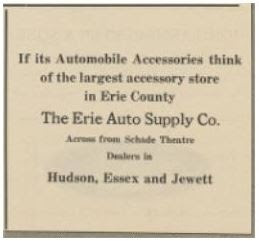
From the early 1920s through the mid 1930s, The Erie Auto Supply Co. was located at 208 West Market Street in Sandusky. The company sold wholesale and retail automobile parts, and serviced vehicles in the space behind the store. Hudson, Essex and Jewett were some of the brands carried by Erie Auto Supply.


In 1936, Erie Auto Supply moved to 212 Hancock Street. From 1942 until the mid 1960s, Weber’s Men’s Wear was in business at 208 West Market Street.

Weber’s was one door away from City Hall. Other stores visible on Market Street in this 1950s era picture above were Gray’s Drugstore, Herman’s Jewelry, and Third National Bank.

Through the years, several different businesses operated at 208 West Market Street, including Sears, Spiegel Inc., Sonrise Ceramics, Revelations, and Bloomquist TV.


Today the Crowbar is now in business where Erie Auto Supply Company was once located.

Monday, January 09, 2023

Do You Remember Bazley Meats?


In the picture above, Bazley Meats can be seen in the 200 block of Columbus Avenue during a Grape Festival Parade held in 1940. The Bazley family had a chain of meat markets throughout states in the Midwest for several years.  From 1928 to 1930, Bazley Meats was in Sandusky at 148 Columbus Avenue.  By November of 1930, the business had moved to 216 Columbus Avenue, where later Woolworth’s had a store in the 1950s and 1960s. An advertisement in the Sandusky Star Journal of November 21, 1930, stated that the Bazley Cash Market was modern and sanitary, and pledged to “give you better quality meats at lower prices.”

In today's dollars, pork loin was $2.49/lb and ground beef $1.62

In 1936, an article in the December 23 issue of the Sandusky Star Journal, reported on a pig named Oscar that was given free run of the market for a day. The manager of Bazley’s Meats, Leo Hall, reported that Oscar “would go the way of all porkers” and was soon to be at the table of an employee.

In February, 1949, a newspaper article reported that soon Bazley Meats would be moving to a new location at 182 East Market Street.

By April 26, 1972, Family Meats had taken over the location at 182 E. Market Street, where Bazley Meats had been in operation since 1949.  You can see Bazley Meats at its East Market Street location in the picture below, taken by Helen Hansen in 1963.

Locations of specific businesses and homes in Sandusky throughout several decades can be found in the historical city directories housed in the Reference Services area of the Sandusky Library. Consult the street directory, where addresses can be looked up by house number in an alphabetical listing of streets in Sandusky, Ohio.

Wednesday, January 04, 2023

George William Doerzbach, General Contractor


G. William Doerzbach is pictured above with a youngster and dog in an undated picture. Mr. Doerzbach was born in Sandusky in 1852 to Christopher and Louisa Doerzbach, both natives of Germany. Hewson Peeke wrote in A Standard History of Erie County (Lewis Publishing, 1916), that “G. William Doerzbach is a man who has largely been the architect of his own fortune.” As a youngster, he worked for the Western Union Telegraph Company. His first trade was cabinet maker, and then he became a carpenter. Eventually he studied in Philadelphia under a leading architect. When he returned to Sandusky, he worked as a general contractor. 

In 1894, G.W. Doerzbach built a bridge crossing Mills Creek. An article in the December 24, 1894 issue of the Sandusky Register reported about the new bridge.

After working independently for several years, he formed a partnership with his brother Fred C. Doerzbach in 1900. Together G.W. Doerzbach and Brother built many important buildings in Sandusky and beyond. The Sandusky Register of December 31, 1922 describes several of their projects:

The Hotel Rieger was built by the Doerzbach brothers in 1911.

Right across the street from Hotel Rieger, G.W. Doerzbach and Brother built the Sandusky Star Journal building (now occupied by the Sandusky Register) from 1920 to 1921:

Now home to Bailey Legal Group, this Market Street building was originally built by the Doerzbachs as Third National Exchange Bank:

Mr. Doerzbach never married. His office and home were located at the corner of Monroe and Camps Streets.

Image courtesy Google Maps

George William Doerzbach died in 1932, and his brother and business partner, Fred C. Doerzbach died in 1934. Both were buried in Sandusky’s Oakland Cemetery. Though the Doerzbach brothers have been gone for decades, many buildings in Sandusky still stand as a testament to their excellent workmanship as general contractors.

Saturday, November 26, 2022

The Phil T. Beer Cafe


A mirror from the Phil T. Beer Café has a saying at the top, “Look at yourself, but think of us.” Phil Beer (a great name for a tavern owner) operated the tavern from about 1910 to 1919, at 301 East Market Street. Grace Episcopal Church now operates a thrift shop at this location. In an advertisement in the Sandusky Register on June 28, 1912, readers were informed that they could “while away an idle hour” or play pool, or eat a meal at Phil’s Café.

At the end of May in 1919, the state of Ohio became a “dry” state, several months before the 18th Amendment became a law on October 28, 1919, prohibiting the manufacture, sale or transportation of intoxicating liquors throughout the United States. 

The article below from the May 24, 1919 issue of the Sandusky Star Journal reported on the mock funeral for “John Barleycorn.”


A group of men were to meet at midnight, and pay their respects to old man “Booze” who died from an “overdose of votes.” There was a procession that was to start at Washington Park, and then go to Water Street, past Dan Nolan’s, Baldwin’s, Ted Lauber’s Mulharen’s, the Pabst and the old West House. Next they would shed a tear at the old Annex Cafe, pass by Werner & Wagner, and play slow music as they passed by Phil Beer’s Cafe. It was expected that there would singing and speeches, concluding with the song “We’ll be dry for a long, long time.”

Later in 1919, Phil Beer ran a cigar shop at the Rieger Hotel. 

Mr. Beer died in September, 1959, and was buried at Oakland Cemetery.


You can read more about the residents of
Sandusky and Erie County at the Sandusky Library Archives Research Center, which houses microfilmed copies of decades of local newspapers. A ClevNet database, Newspaper Archive, provides online access to many historical newspapers as well.